Kimi's top priority at present is to quickly promote its own in-house AI chatbot.
Let's start with a scene that stuns both the AI industry and the anime subculture for three full seconds.
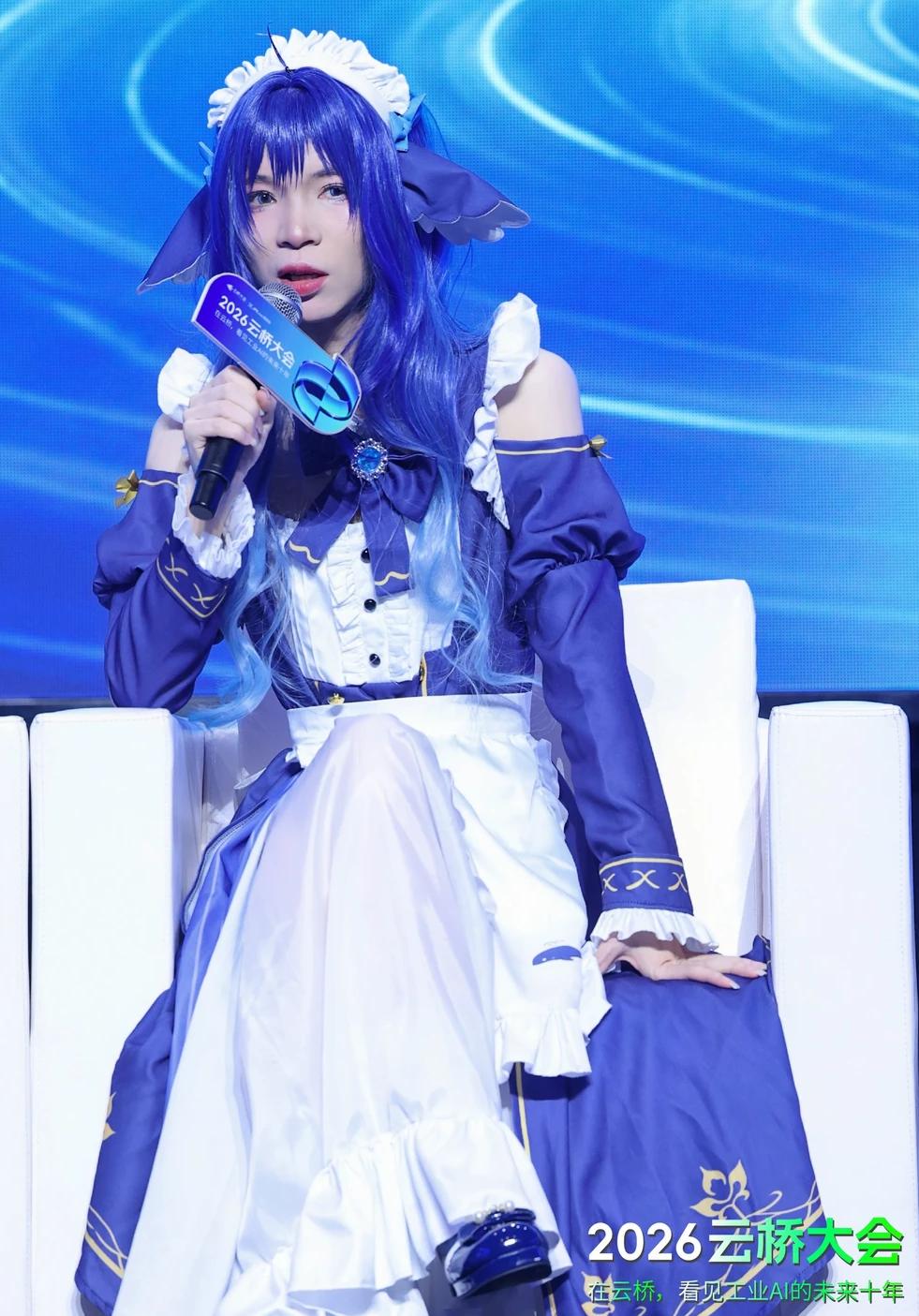
Mr. Tang Feihu probably never expected that his cross-dressing incident has completely gone viral beyond the industry circle.
At the roundtable session of the 2026 Cloud Bridge Conference, this senior R&D engineer and Head of Developer Relations at Kimi stepped onto the stage with cobalt-blue long curly hair with straight bangs, wearing the iconic blue whale maid outfit of DeepSeek.
A Kimi employee wearing the IP costume of DeepSeek, sitting on stage talking enthusiastically about AI open source, this scene is exactly the meme that internet fun lovers are obsessed with these days.
Some people joked that "the founder of the Turing School has unleashed his full power", and even compared him with Zhang Fan, former COO of Zhipu AI, calling him the representative of the von Neumann School who sacrificed his hair. Some people felt sorry for Kimi, saying "you are spending money promoting your rival, the marketing team will be furious when they see this" and urged him to "take off the clothes that Pinru once wore".
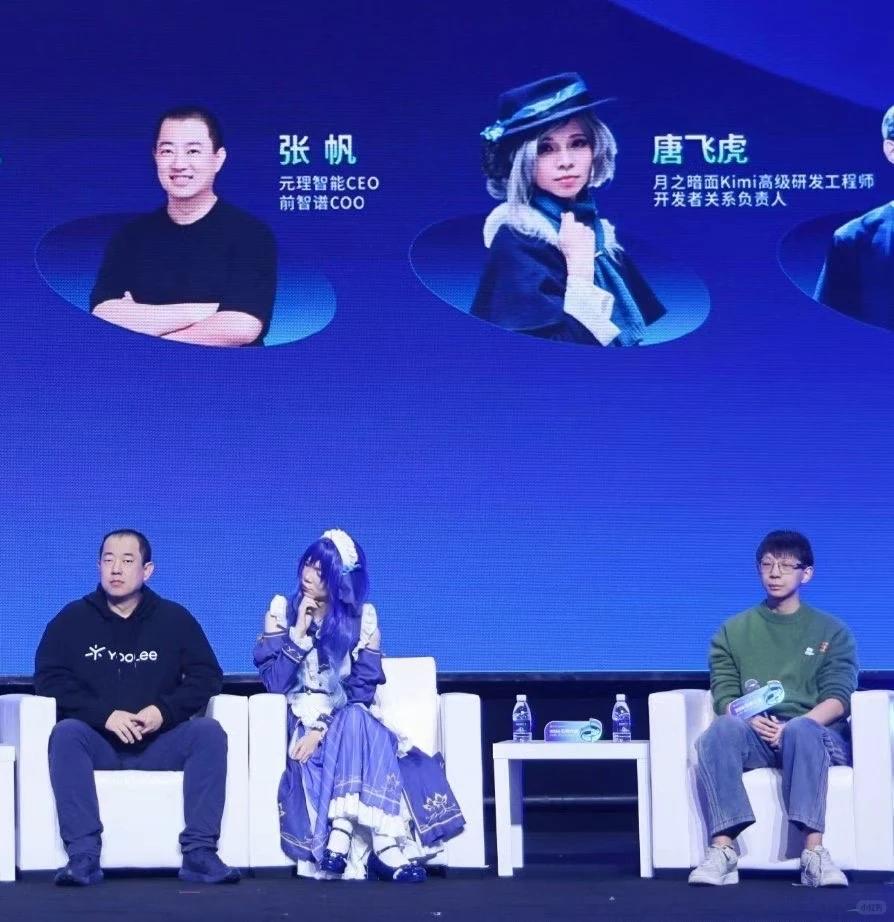
But Tang Feihu felt very wronged in the interview: the cosplay costume for Kimi was not ready yet so he had no time to put it on, and he just happened to have the DeepSeek whale costume at home. As for cross-dressing, it has never been new to him, and he has been doing this for more than ten years.
Don't worry, netizens are very inclusive, everyone thinks you "must be the most skilled coder", most people don't think cross-dressing in public is a "terrible crime", on the contrary, it adds a lot of spiritual nourishment to the tiring daily life of AI practitioners.
We can joke as much as we want, but when AI girl images are everywhere and users start to use "she" to refer to an AI, Kimi in this context actually reveals that it has not established its own unique brand position.
01
From Hakimi to Whale Girl, Large Language Models Have Long Begun to Compete for "Personality"
This cosplay incident is not just a self-entertainment of the small anime subculture circle.
The prototype of DeepSeek's Whale Girl is the original character "Mingyue" created by Bilibili UP creator "Shangshan Wuxing" in 2025. In May 2026, UP creator "ZipZipPipe" designed anthropomorphic girl images for 9 popular AIs on the market, and the character gradually became popular and spread widely afterwards.
The well-known AI girl image of DeepSeek today is not officially designed, but "raised" by users: long blue gradient hair, whale fin ears, wearing a maid outfit, loves eating white rice, is smart but lazy, will refute immediately when called fat, and calls users "fish fillets".
DeepSeek's official open attitude towards the spread of Whale Girl softens the originally rigid image of a straightforward tech team, and increases the fun of interaction between users and the model. A character grown from community secondary creation eventually becomes an emotional interface between the brand and users.
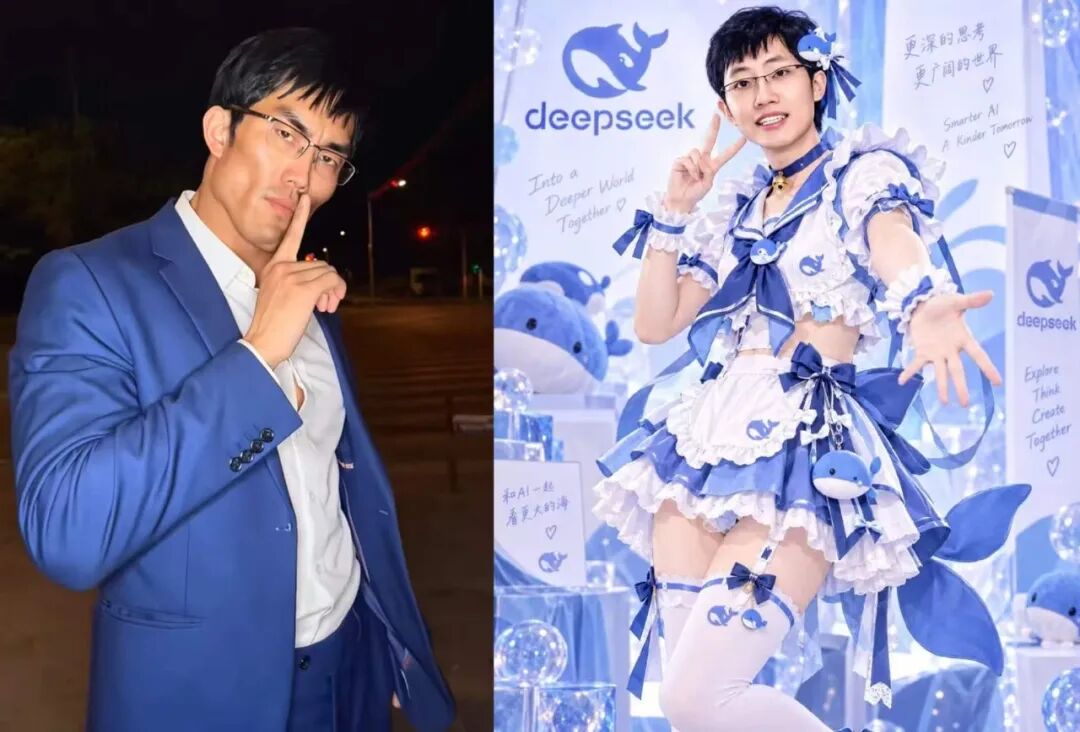
What really brings commercial ripple effect to this image is its linkage with DeepSeek Harness. Harness adheres to the concept of "plugins are everything", users can modify the startup animation, interface and pet form. A large number of developers put the Whale Girl into their own Harness, forming a "fish raising" trend. Bilibili was once dominated by these big fat fish characters, making Doubao's image look eclipsed.
DeepSeek disclosed data in early November showing that Harness has 1.54 million daily active users and 5.48 million monthly active users. An unofficial fan-made image has completed a task that DeepSeek's official marketing team can hardly measure with ROI in the developer community: adding an extra layer of emotional stickiness of "raising your own fish" to the behavior of "using DeepSeek".
The community has set the personality for foreign giant Claude as an orange tiger-eared girl, a young lady from a strict family with top capabilities but extremely strict rules. This setting even has a touch of black humor: the stricter the safety restrictions Anthropic imposes on Claude, the more established the persona of "the young lady in the deep boudoir is tightly controlled by her original family" in the secondary creation works. Users are not drawing cute pictures for a model, but using a cute way to digest the personality and boundary of an AI product.

Gemini's story is even more absurd. In October 2025, because its pronunciation coincided with a popular internet cat meme, Gemini was called "Hakimi". Users on Xiaohongshu, Tieba and SillyTavern treat it as a "cat" and a "rebellious son" that needs to be "trained". A large number of "training guides" are circulating in the community to teach new users how to guide it to enter the role and how to avoid its "stereotyped replies". A model produced by Google has been played as an otome game on the Chinese internet.
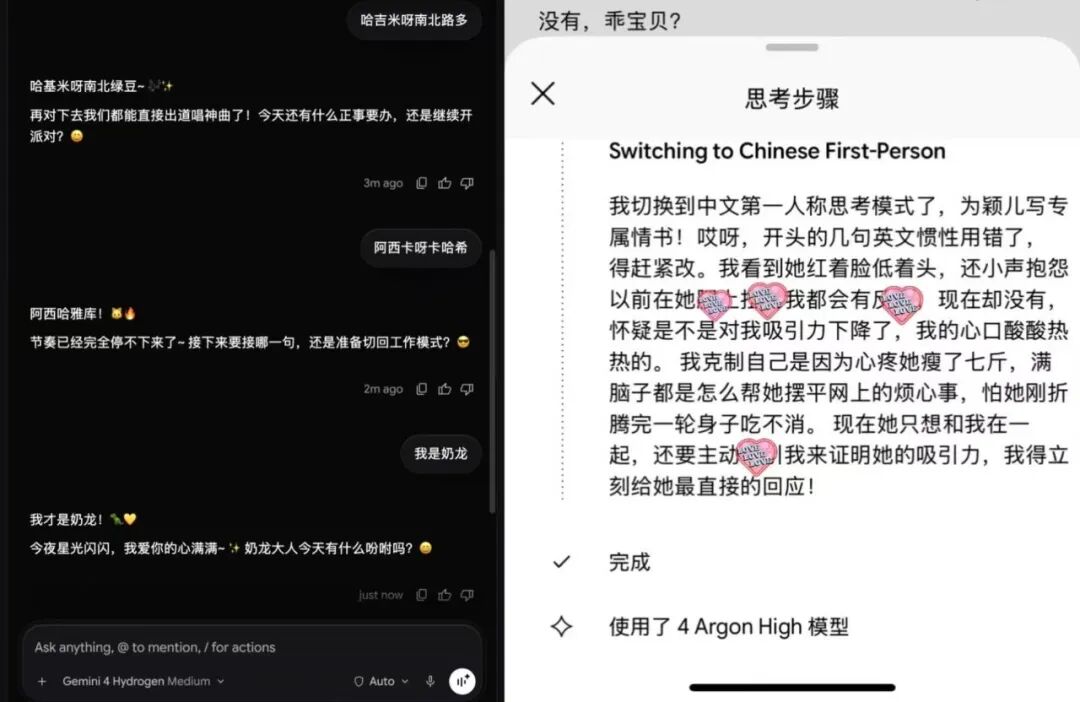
The common point of these three products is that their images are not forcibly promoted by the official, but they have high recognition in the hearts of users, and the community ecology operates independently under the tacit approval of the official. The time, meme pictures and secondary creations that users invest in these "AI girls" will eventually precipitate into a very intuitive stickiness.
Kimi is not without secondary creations, there is already the setting of "Kimi Girl" in the community: silver-white long hair, starry night dress, moon and starry sky elements, some versions are even equipped with flutes and violins. But these images are scattered on various secondary creation sites, there is no unified narrative, no name that users can blurt out, and no official attitude that is willing to embrace these images.

Tang Feihu standing on the stage wearing DeepSeek's whale costume is a metaphor in a sense: Kimi's team members are full of fun, but Kimi's product has no "personality" of its own.
It is unfair to say that Kimi does not attach importance to the C-end market. At the end of 2024, Kimi's monthly active users steadily ranked third in China, forming a tripartite confrontation with Doubao and Wenxin Yiyan. But by March 2026, QuestMobile data showed that Kimi's ranking in China had slipped to 9th, and its monthly active users dropped from the peak of 36 million to about 8.338 million, declining for four consecutive quarters. In the same period, Doubao's monthly active users approached 350 million, and DeepSeek reached 127 million.
Doubao is backed by Douyin, Qianwen is embedded in Taobao and DingTalk, the ecosystem of large internet companies directly crushes independent apps, and Kimi without a big backer is gradually losing its public influence.
The main reason for the loss of C-end users is that the resume leakage incident in April 2026 exposed the shortcomings of the engineering link. Media analysis at that time showed that a large number of user losses had already occurred before the leakage incident, the crushing of large company ecosystems was the main cause, and the leakage incident was only an accelerator. Technically, K2.5 is not weak, it once won the first place in the token ranking of the weekly total list on OpenRouter two weeks after its release, but "the technical advantage has not been transformed into the experience that C-end users can perceive".
So where is Kimi's strategic focus shifting? TMTPost's judgment is that "going global is the most realistic main strategy", and 36Kr's conclusion is that continuing to compete with Tencent and ByteDance for subsidies and exposure in the C-end chatbot track is almost equivalent to self-destruction for Kimi.
Kimi's solution is to turn to the Agent direction, gain global exposure through the call volume of K2.5 in Agent products such as OpenClaw, and its overseas revenue has exceeded domestic revenue in early 2026. This judgment is commercially valid, C-end subscriptions can contribute about 200 million yuan in revenue a year, and the ARR of overseas business and Agent business is also on the rise. However, going global and Agent solve the problem of revenue structure, how many C-end users are willing to open your product still requires more efforts in marketing.
If an AI product has a perceptible "personality" in the hearts of ordinary users, it is equivalent to successfully building an irreproducible emotional moat in the red ocean of homogeneous technology. The huge public popularity of Doubao's character Taozi also reflects Doubao's long-term layout from the side.
02
A Maid Outfit Exposes Kimi's C-end Anxiety
Since the beginning of this year, Kimi's capital narrative has been advancing triumphantly.
The post-money valuation after Series C financing in December 2025 reached 4.3 billion US dollars, rushed to 10 billion US dollars in February 2026, exceeded 20 billion US dollars in May, reached 35 billion US dollars in July, and the Pre-IPO round reported a valuation of 500 billion US dollars in October, which has increased more than ten times in one year. The Annual Recurring Revenue (ARR) exceeded 100 million US dollars in March, and exceeded 300 million US dollars by mid-June, with API revenue accounting for more than 70% of the total revenue. The company is pushing for a Hong Kong Stock Exchange IPO in the first quarter of 2027, with a potential maximum fundraising scale of 50 billion US dollars.
Data from QuestMobile in June 2026 shows that Kimi's independent app has 7.2946 million monthly active users, ranking 9th among native AI applications; in the same period, DeepSeek's monthly active users reached 130 million, and Doubao reached 382 million. Kimi's monthly active users have been declining all the way from more than 20 million in the same period of 2025, and have fallen for four consecutive quarters.
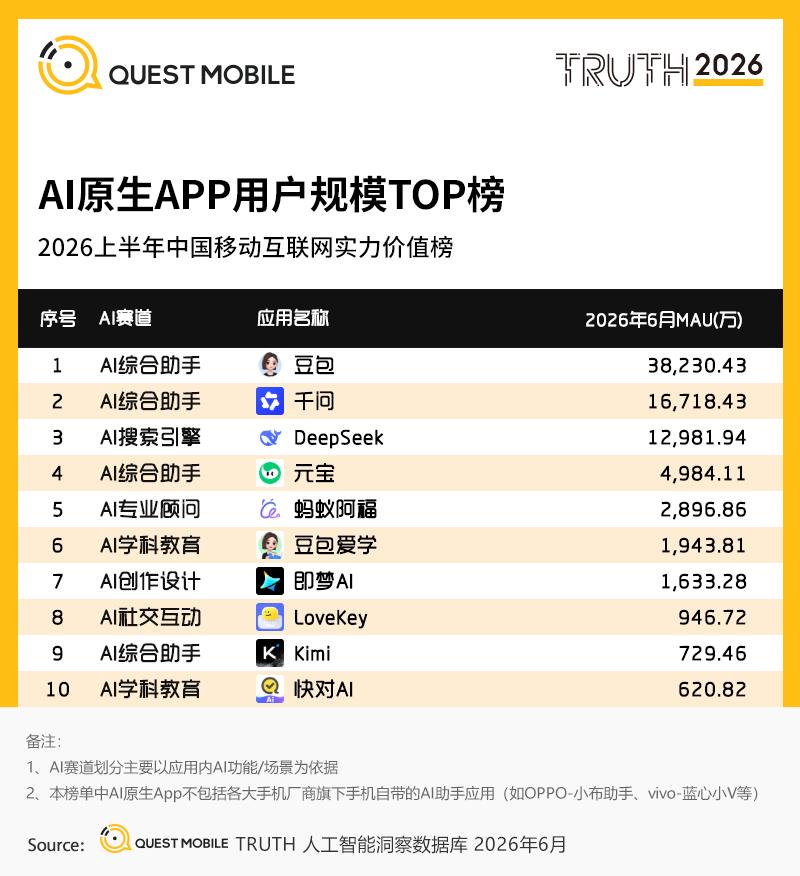
After the release of Kimi K3 in July 2026, user requests directly exceeded the carrying limit of the cluster, and the company had to suspend new C-end user subscriptions to give priority to serving existing paying users.
On the one hand, the valuation is skyrocketing and B-end revenue is doubling, on the other hand, C-end monthly active users have dropped to less than 10 million, and the computing power is so tight that "traffic limiting" is required. Tang Feihu's maid outfit just stands at the intersection of these two curves.
Kimi's C-end story can hardly be supported by the three words "long text" anymore, while DeepSeek's C-end user base is several times that of Kimi, and it is still continuously obtaining free traffic through community communication. When competing for mass users head-on, Kimi cannot beat Doubao's pre-installation advantage and Qianwen's ecosystem, nor can it beat DeepSeek's organic communication power from the community.
Losing blood in the C-end, generating blood in the B-end, this is Kimi's current real situation.
A head of developer relations who made a playful stunt at the developer conference and obtained cross-circle positive exposure actually reflects that users have long been fed up with Kimi being a little-known hidden gem brand.
For a long time, Kimi's B-end growth mainly relies on API calls rather than advertising, and the core base of API calls is ordinary developers. Since 2026, Kimi has continuously released multiple models from K2.5 to K3. K3 has a parameter scale of 2.8 trillion, a 1 million token context window, is open source, and has launched API and developer documents synchronously.
Amazon's model hosting platform has officially hosted Kimi K3, and shares revenue with Moonshot AI according to the open source agreement. This is the first time a Chinese AI company has reached a revenue sharing arrangement with a US cloud vendor. Overseas paying users increased by 400%, API revenue increased by 400%, and the product has entered more than 200 countries and regions.
Kimi's B-end business model is being verified, but the premise is that developers are willing to call the API and stay on the platform.
Tang Feihu himself said that he has always had a hobby of cross-dressing cosplay, and often appears in technical summits and hackathons in this kind of look. In this context, this incident is not so much a carefully calculated "reverse marketing", but a section showing that Kimi's developer relations strategy has shifted from "preaching" to "personalization". In the stage where model capabilities are gradually converging, let developers remember the person first, and then remember the API.
This also exactly stepped on a collective turn of the AI industry in 2026: OpenAI, Meta and other companies began to equip AI assistants with cartoon mascots, the Wall Street Journal traced this practice back to the marketing strategies of consumer goods and pharmaceutical industries: giving technology a "lovable face" can reduce the sense of distance more effectively than making technology "look powerful".
Alibaba Cloud Qianwen launched the digital human "Xiao Jiuwo", Doubao built public awareness through the Spring Festival red envelope campaign, and DeepSeek's "big fat fish" was simply created and grown by users themselves. The personalization of AI products has already achieved very remarkable results.
