Just now, the entrepreneurial venture of Zhang Bo from DeepSeek has been exposed: open-source personal Agent
Gathered we are a blazing fire, scattered we are stars filling the sky.
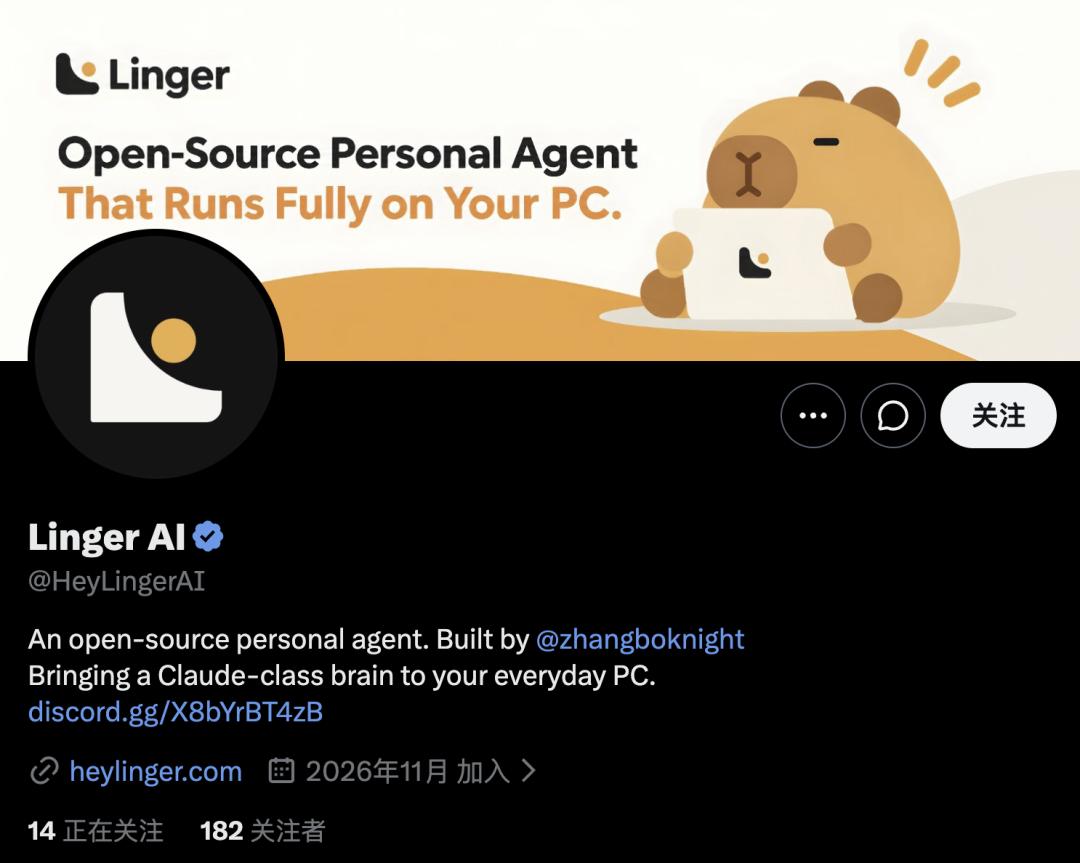
Just now, former DeepSeek V1 contributor and Project Lead of DeepSeek-VL Tony Zhang (Zhang Bo) officially announced his new startup project: Linger.
Its focus is exactly on the most popular Personal Agent at the moment.
Its development path is quite distinctive: while peers are all building mobile apps, they prioritize the PC platform.
This means Linger can directly operate the existing web pages, email inboxes and calendars on your computer, without requiring you to configure a large number of login credentials.
When it encounters a stuck process, you can also directly take over the operation manually.
Another highlight is that as a middle layer, Linger supports access to various third-party models.
It is also specially optimized for local LLMs.
Specifically, an RTX 3060 graphics card with 12GB VRAM can run the Qwen3.8-Flash-Next model with 125B parameters, and achieve a generation speed of 45.5 tokens per second.

By the way, there is another very important point —
This entire system is open source...
As for why they made this choice?
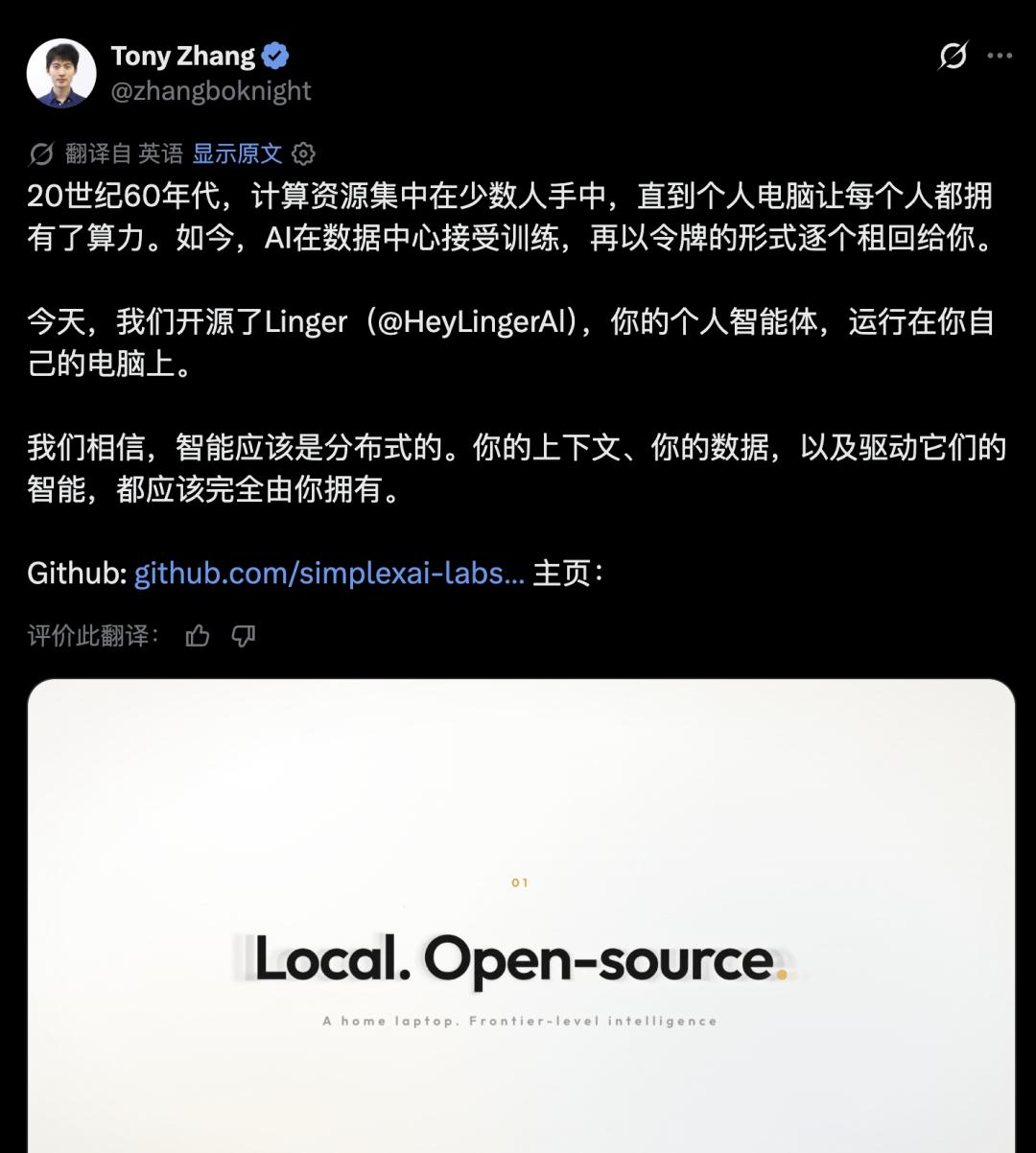
In the official announcement post, Tony Zhang cited the history of the rise of personal computers:
In the 1960s, computing was centralized, until personal computers put the power of computing in everyone's hands. Today, AI models are trained in data centers, then leased to you in the form of tokens.
We believe that intelligence should be distributed. Your context, your data, and the intelligence that powers them should all be fully owned by you.
So today, they open sourced Linger, a dedicated Agent that lives on your personal computer.
This also carries on the fine tradition of the "Big Fat Whale" team 😭.
An AI that "takes initiative and can learn on its own"
The core of Linger is an Agent system called "Another Me".
First of all, it acts as a memory hub.
Linger locally reads your inbox, calendar, chat records and meeting notes, and automatically organizes this information into a personal knowledge base (Wiki) every night for all Agents to query.
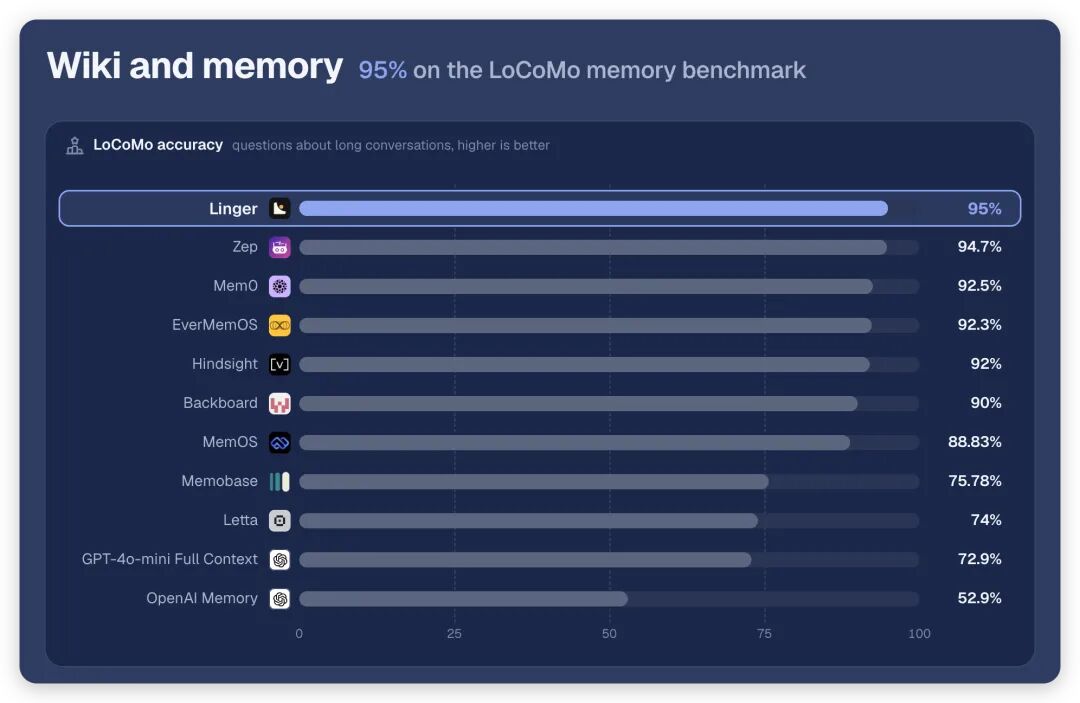
In the LoCoMo benchmark test that measures long-term conversational memory capability, Linger achieved an accuracy rate of 95%, outperforming many memory-augmented AI systems such as Mem0 and MemOS.
With these capabilities, Linger can work proactively better.
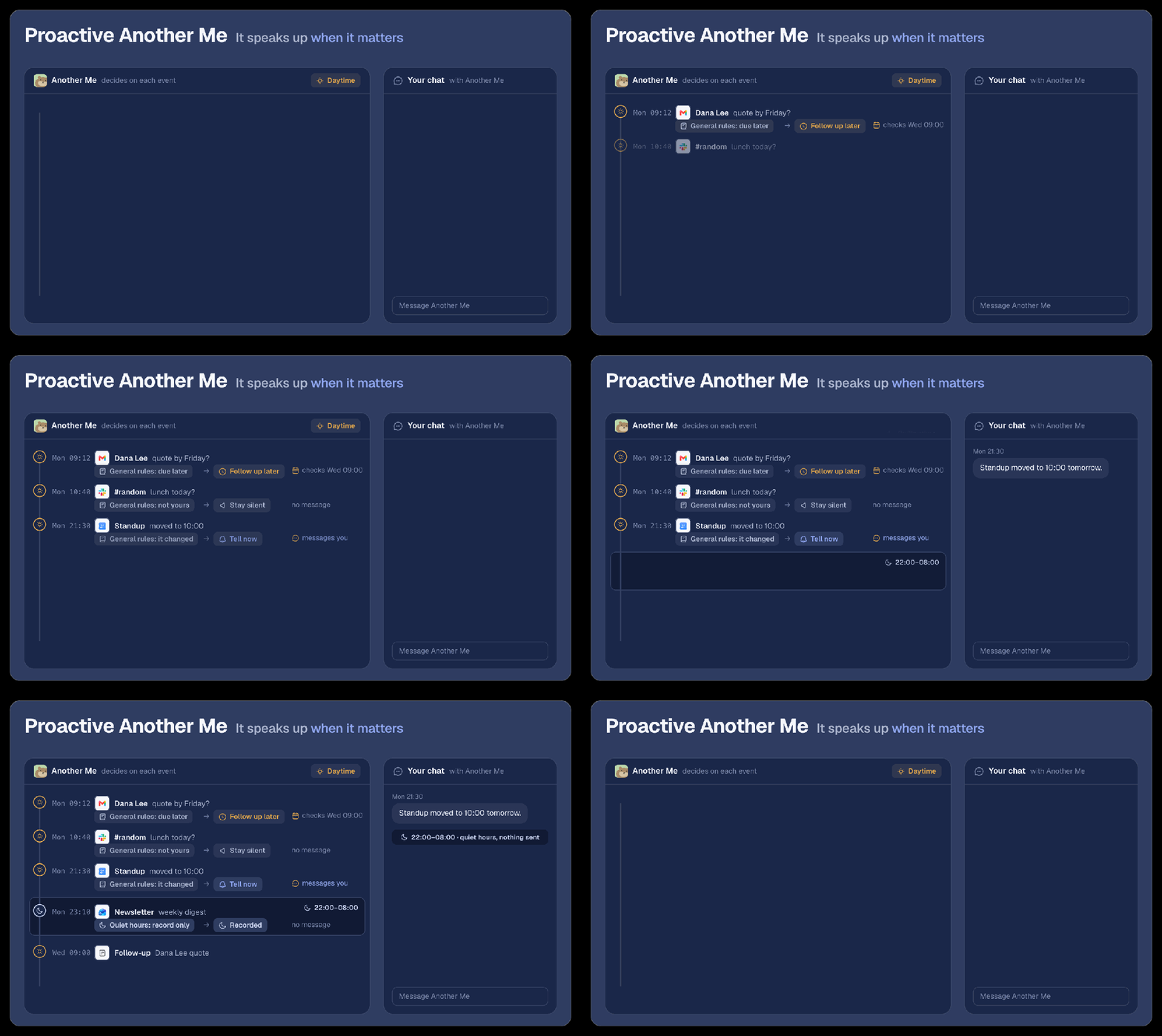
It will silently observe your information flow, and decide when to remind you based on the importance and urgency of events. If you receive a customer email on Monday requiring a quotation before Friday, it will not disturb you immediately, but pop up a reminder on Wednesday morning instead.
But if there is a meeting time change, it will notify you right away.
This Agent can also learn from your feedback on its own, a feature that Linger calls "implicit reinforcement".
For example, when it reminds you that an invoice is about to expire, and you reply "I received it last week, you should have told me the moment it arrived", the system will record this clue.
If a similar situation occurs for another invoice next time and you express the same preference again, the system will automatically generate a rule: "Supplier invoices → remind immediately".
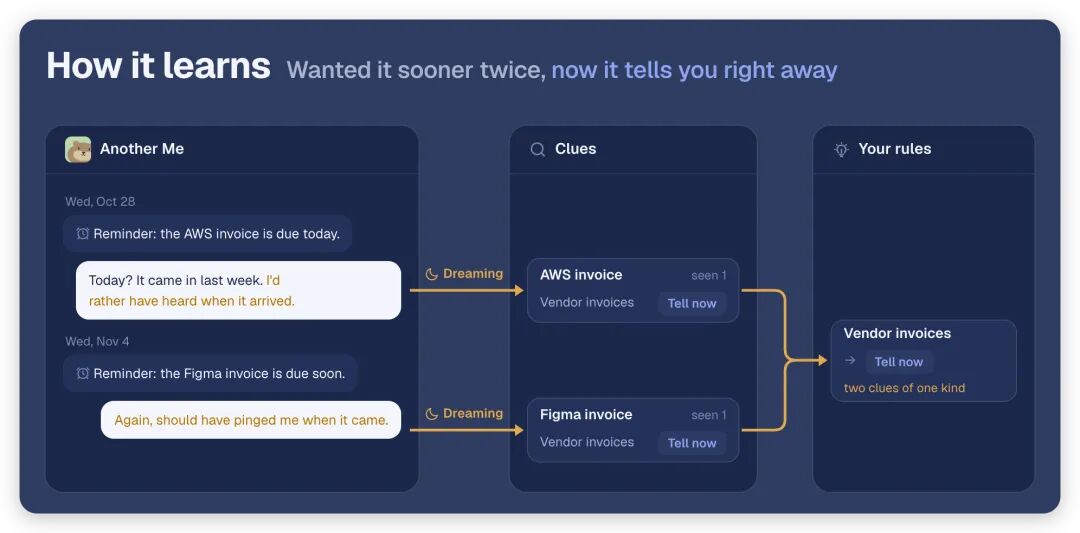
Conversely, if you show no interest in "courier reminders" twice in a row (such as ignoring it directly or replying "don't tell me about it"), it will also learn to keep silent about such notifications later.
You can also give direct instructions to teach it rules in one go. For example, tell it "notify me immediately when I receive a reply from a customer", or "don't inform me right away for meeting changes after 9 p.m.".
This continuous interaction and learning makes the Agent increasingly familiar with your work habits, and becomes a truly personalized assistant.
In addition to the above features, Linger can also:
Operate desktops and browsers.
As mentioned at the beginning, Linger can directly use Chrome and various apps that are already logged in on your computer, without requiring reconfiguration.
Form an Agent team.
This follows the Super Agent principle that DeepSeek explained before.
When you assign a complex task, Another Me will call or create Agents with different functions to complete the work collaboratively.
And you only need to stay in this single session with Linger.
Voice interaction.
This feature is mainly designed for office scenarios.
Linger can transcribe meetings in real time, and you can directly ask the Agent questions about meeting content after the meeting, and let it follow up on to-do items.
All in all, it is a Personal Agent specially optimized for office scenarios.
However, some netizens do not quite understand this product positioning:
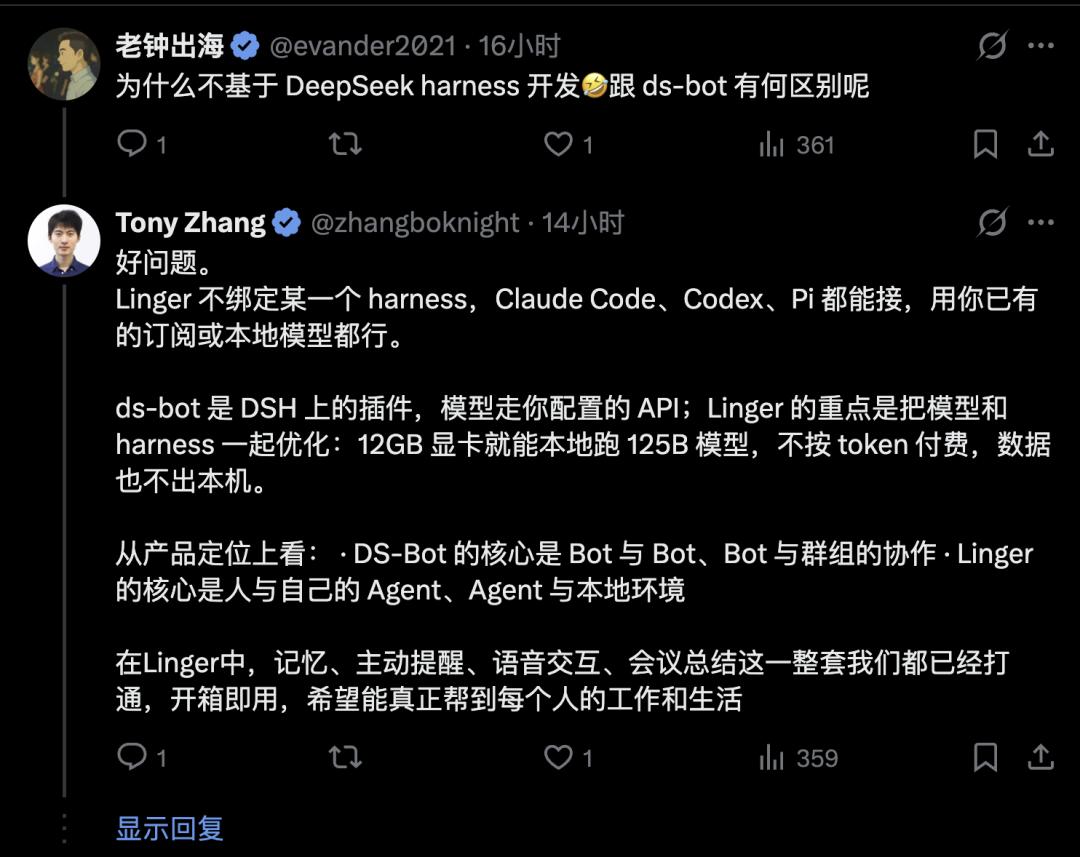
Why not develop based on the DeepSeek harness 🤣 What is the difference between it and ds-bot?
In response to this question, Tony Zhang responded:
The focus of Linger is to optimize the model and the harness together: a 12GB graphics card can run a 125B model locally, you don't need to pay per token, and your data will never leave your local device.
In terms of product positioning: the core of DS-Bot is collaboration between bots, and between bots and groups; the core of Linger is the interaction between humans and their own Agent, and between the Agent and the local environment.
Run a 125B model on a 12GB graphics card
The core technology of Linger that enables consumer-grade hardware to run trillion-parameter large models is a MoE inference engine called PolyStrata.
Its principle can be understood as an intelligent tiered storage mechanism.
For a huge MoE (Mixture of Experts) model, PolyStrata will place the most frequently used and most active "expert modules" in the fastest GPU VRAM, place the less commonly used ones in system memory, and place the least frequently used ones on the SSD solid-state drive.
When the model needs to call a certain expert, the system will dynamically move data among GPU, memory and SSD. In this way, you do not need to fit the entire model of tens or hundreds of gigabytes into the limited VRAM.
The effect is immediate.
According to official data, the Qwen3.8-Flash-Next model with 125B parameters can achieve a generation speed of 45.5 tokens per second on a computer equipped with 12GB RTX 3060 and 64GB RAM.
On the more powerful RTX 5090 (32GB), the speed soars to 179 tokens per second.
To make it more convenient for users to use local large models, Linger also provides a "Model Autopilot" feature.
It will automatically detect your hardware configuration (GPU, VRAM, RAM), then recommend and install the model with the best performance for you from combinations of 49 language models, 2 inference engines, multiple quantization schemes and different context lengths.
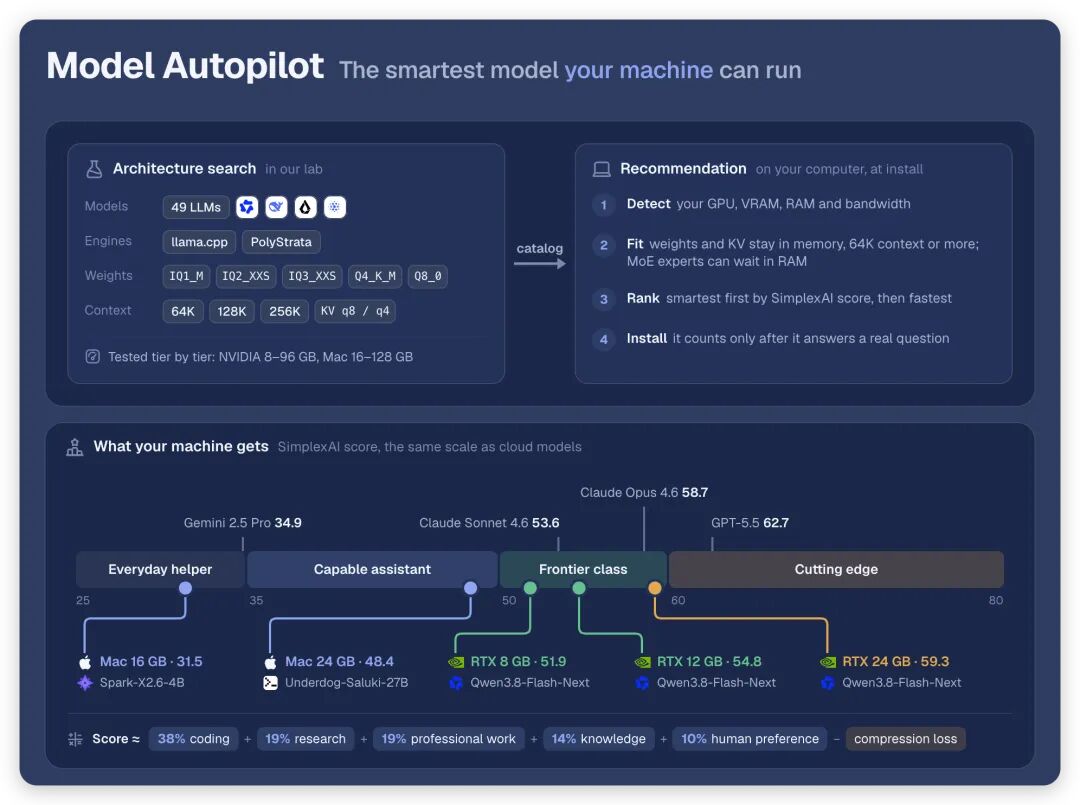
According to the scoring system of SimplexAI, local devices with different configurations can achieve capabilities comparable to mainstream cloud large models:
8GB graphics card + 32GB RAM: scores 35.4, roughly equivalent to Gemini 2.5 Pro.
Mac 24GB unified memory: scores 51.9, roughly equivalent to Claude Opus 4.5.
12GB graphics card + 32GB RAM: scores 57.3, roughly equivalent to Claude Opus 4.6.
This means that your gaming laptop or MacBook will have a truly powerful AI brain that is on standby 7x24 hours, has no token usage fees, and keeps all data completely local.
The Project Lead of DeepSeek-VL starts a new business again
Behind Linger is a team with profound technical background, and the resume of its founder Tony Zhang is particularly outstanding.
(After all, he is from the DeepSeek ecosystem...)
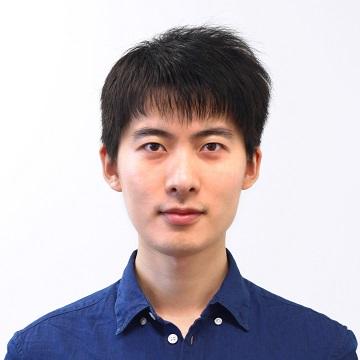
Tony Zhang graduated from Zhejiang University with a bachelor's degree, obtained his doctorate degree from the Hong Kong University of Science and Technology in 2019, then joined Microsoft Research Asia (MSRA), and has long been engaged in research on computer vision and generative models. He is the author of many well-known projects such as VQ-Diffusion and Rodin 3D digital human.
In 2023, he joined DeepSeek as an AI scientist.
Here, he not only participated in the R&D of the early language model series DeepSeek LLM V1, but also served as the Project Lead of the vision-language large model DeepSeek-VL. This model is widely praised for its image, document and chart understanding capabilities in real-world scenarios.
After leaving DeepSeek, Tony Zhang joined Zhejiang University as a principal investigator of the Hundred Talents Program and doctoral supervisor, and founded Simplex AI.
Linger is the latest work of Simplex AI.
And the inference engine that is the technical core of Linger, which is built specifically for local deployment?
According to Tony Zhang, it was built by an 18-year-old prodigy in the team.
18 years old? Just graduated from high school?
This article is from WeChat official account QbitAI, written by Jay, authorized for release by 36Kr.