As Chinese developers expand their business overseas, how does SUNMAX open up new space for offline business
In Bangkok, it is not difficult to find a SPA shop, where a row of notes are pasted on the cashier desk, recording customers' appointment information.
The front desk staff of this store may keep checking messages on LINE, WhatsApp and Google Maps, and also take calls from customers midway. After 4 p.m., customers come into the store one after another, and the front desk needs to find the corresponding information from the notes, confirm the service items, and then arrange technicians to receive them.
In addition, Thai SPA also has a mode where multiple technicians serve one customer, such as four-hand, six-hand, and eight-hand services. How many technicians are needed for one order, how is the commission distributed? How to schedule shifts for technicians? How to settle tips and taxes? The daily work of the front desk is extremely complicated.
Last year, the team led by Luo Xin, the head of Nake, investigated such a store in Thailand and found that there was already a cash register management system in the store, but the front desk rarely used it. The reason is very simple: "Because it is not easy to use." For front desk employees who need to receive customers non-stop, handwriting is actually faster.
This scene is the epitome of a large number of overseas offline small and medium-sized merchants. They have real operational pain points, but lack easy-to-use digital systems that fit local habits.
Recently, Nake, together with GPOS, a local partner in Thailand, told 36Kr Global about the practice of promoting SPA solutions in Thailand, and also revealed the complete path of SUNMAX, a brand under Sunmi, to help domestic developers expand overseas markets.
01 Go deep into a niche industry, how big is the opportunity for going global?
According to Luo Xin, there are more than 30,000 SPA stores in Thailand, but about 90% still rely on handwritten appointment information. Some stores have purchased digital systems but rarely actually use them. For domestic developers deeply engaged in the service industry, this is a huge market window.
Nake, based in Yichang, Hubei, has 14 years of experience in SaaS software development and has served more than 1 million physical merchants in total. The team chose the Thai SPA industry as the first stop for going global.
However, software going global is not equal to simply translating the domestic version. Therefore, from March to September 2026, the Nake team went to Thailand 5 times to conduct in-depth research on the SPA industry format and user habits in Thailand, and fully understood the local rules such as multi-technician commission, tip and tax settlement, and technician shift scheduling. The team spent about 1.5 months completing the localization transformation, and then GPOS, a local Thai service provider, was responsible for market promotion, and undertook on-site deployment and after-sales service.
The solution for the Thai SPA industry is very representative, but it is only a very small entry point for overseas offline digitalization. The opportunities for going global are not limited to one country or one industry. Sunmi disclosed that the SUNMAX platform has helped software developers in catering, retail and other industries connect with overseas local service providers, serving nearly 40,000 merchants in more than a dozen countries and regions. The business has also extended to niche scenarios such as SPA, bars and beauty industry.
For developers with profound industry experience but lack of overseas localization capabilities, the gap between market demand and service supply means new cooperation opportunities.
Of course, developers are more concerned about what benefits these opportunities can bring in the end. After the product enters overseas markets, where do customers come from? To sustain the business for a long time, work beyond R&D is also indispensable.
02 How can industry experience become a long-term business?
GPOS is one of Sunmi's ecological partners. The CEO of GPOS mentioned that the European POS software that the team cooperated with in the past could not fully meet the needs of Thai merchants. Local service providers hold merchant resources but lack suitable products; Chinese developers are familiar with the industry and have R&D capabilities, but lack local channels when entering overseas markets.
SUNMAX just provides a collaboration platform for both sides, forming a tripartite cooperation model where domestic developers rely on the platform and connect with local service providers:
- SUNMAX provides common technical capabilities, and developers can call existing globalization capabilities, such as accessing local payment services, or adapting to multi-currency businesses; it provides corresponding hardware peripheral interfaces. The platform also provides technical support related to tax and data compliance to reduce redundant construction.
- Developers are responsible for industry solutions, the team develops products according to the actual needs of overseas merchants, and continuously improves functions and user experience.
- Local service providers are responsible for marketing and services, the team promotes products to Thai merchants, continues to undertake after-sales service after deployment, and provides a clear service entrance for stores.
Luo Xin described the tripartite cooperation as "no overstepping, no absence". When all parties give full play to their strengths, developers can focus on industry products, and local service providers also have solutions that can be delivered to customers.
For developers, the benefits of this model are reflected in two levels:
- Obtain orders through existing channels to reduce overseas delivery costs. The accumulated merchant relationships of local service providers help products enter the market faster. Developers can obtain license authorization revenue and participate in the sharing of relevant payment business. The platform undertakes a large number of general technical work, so the development team can focus on polishing industry solutions.
- Reuse mature solutions to expand sustainable revenue. After an industry solution is verified, it can quickly enter other countries after completing necessary adaptation, and new customers will bring new license sales revenue. As the number of merchants gradually increases, version upgrades and continuous maintenance also have the opportunity to generate subscription revenue. SUNMAX is also exploring more diversified revenue sharing models to expand space for subsequent cooperation.
This business model has also extended beyond Thailand. Yue Yan, CTO of Sunmi and President of SUNMAX Division, also introduced the South African FlashPOS project. Payment companies can also become cooperation entrances for software developers to approach local merchants, so industry experience has the opportunity to continuously generate revenue in different markets.
As the business expands, products need to serve more stores, and customers will also put forward new demands. After the R&D speed is improved, how to deliver stably and how to serve more merchants at an affordable cost will become the next question that developers need to answer.
03 Why invest in Magic AI at this moment?
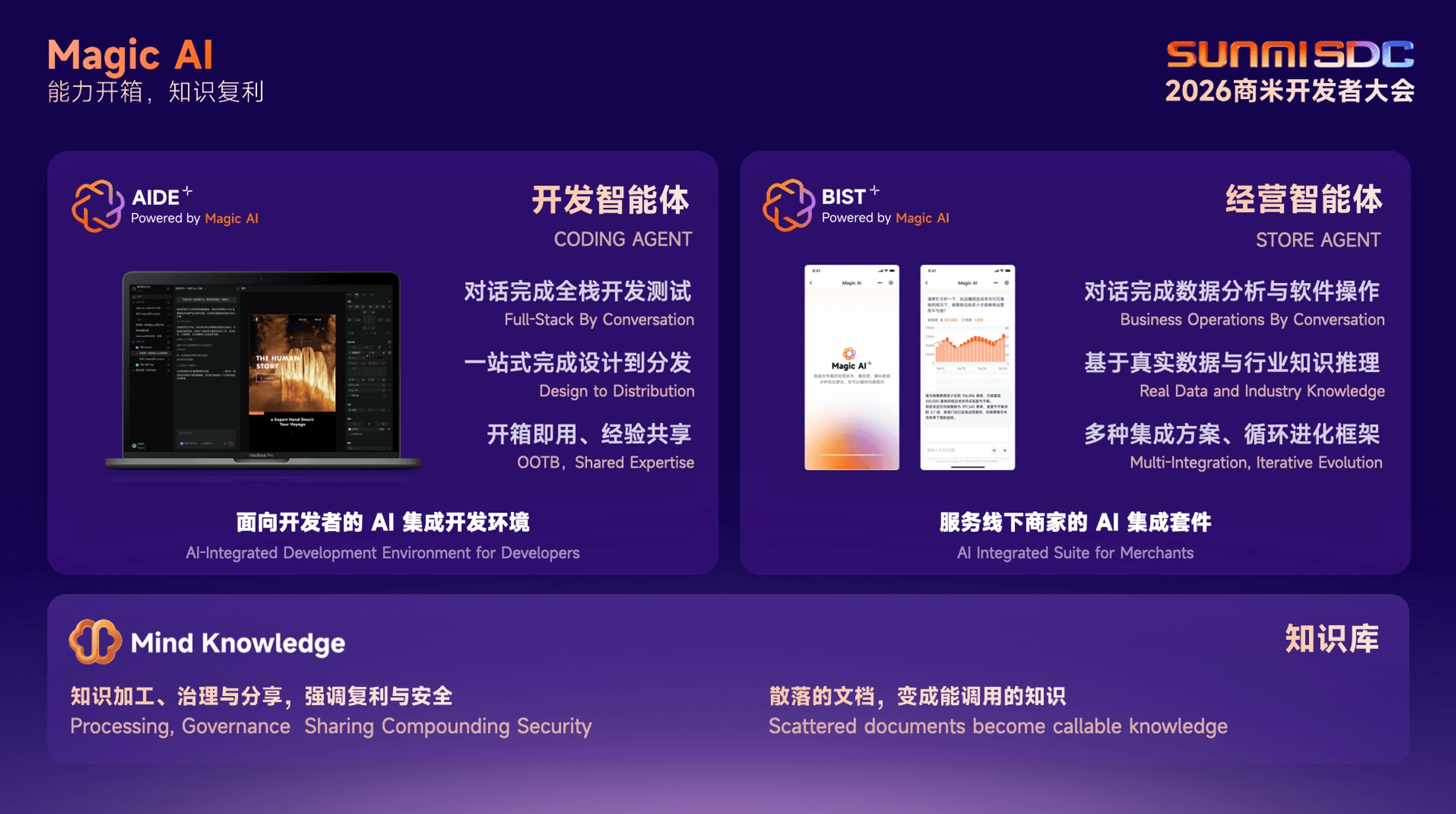
Recently, SUNMAX officially released the agent platform Magic AI. Based on Magic AI, the development agent AIDE undertakes development work, the operation agent BIST serves merchant operations, Mind Knowledge acts as the enterprise knowledge hub, and Max Program provides distribution support.
Why did Sunmi choose to invest in AI at this time?
Although AI programming tools are already quite popular now, Yue Yan still observed: "The coding speed has become faster, but end-to-end delivery has not improved as much as the coding speed." Code can be generated quickly, but to deliver software stably to overseas merchants still requires complete engineering capabilities. At the same time, customized demands are increasing, and it is difficult to balance efficiency and cost by relying on manpower to deal with each project one by one.
Therefore, Magic AI extends the improvement focus to the entire delivery process. Developers can sort out requirements through natural language to form PRD, and then promote design and development in the same environment. After problems are found in testing, AI assists in locating and fixing them, and manual review is carried out after the retest passes. The solution can also be copied and distributed through the platform, and adapted in combination with the target market; after entering the store, BIST continues to provide operation analysis and product usage support.
Yue Yan recalled that in the past year, the SUNMAX team shifted its work focus to the construction of AI basic capabilities, and Magic AI is the result of this investment. In his judgment, models and agents will become more and more accessible, and software enterprises need to pay more attention to their own industry accumulation.
"The Context formed by industry, market and customer knowledge is the core," Yue Yan said. Whoever better understands the real needs of stores is more likely to come up with effective solutions.
This judgment further points to the upgrade of the FDE Frontline Deployment Engineer model. Yue Yan summarized the change as "FDE delivers value": the development team goes deep into the customer site and completes the implementation around specific business problems. AI is expected to reduce the cost of customized delivery, and some niche demands that were difficult to balance input and output in the past may also become businesses that can be undertaken.
In Yue Yan's view, for developers, integrating AI at this moment is to complete the capability transformation in advance. Precipitate industry experience into reusable knowledge, and optimize the delivery process at the same time. SUNMAX hopes to provide these common capabilities to support partners to undertake more niche merchant demands.
04 What makes Magic AI different and what can partners get from it?
The capabilities of general models are becoming increasingly mature, and Magic AI focuses on the needs of offline physical businesses, forming differences in three aspects.
First, one-stop for the whole process. Magic AI intervenes from requirement sorting, and supports product design and development. After the code is generated, it can continue to participate in testing, assist the team to complete the release, and provide support for subsequent operation and maintenance. Developers do not need to connect all links alone, which helps reduce repeated communication.
Second, deeply rooted in offline business scenarios. Magic AI is deeply integrated with Sunmi devices, and combined with the platform's existing business capabilities, supports access to services such as payment and food delivery. When entering different markets, developers can also use adaptation capabilities related to tax and business compliance. With the support of the platform for common work, the team can focus more on store demands.
Third, knowledge-driven business. The Mind enterprise knowledge hub can help developers organize industry experience for AI to use in R&D and services, and the professional knowledge accumulated by developers in the past can be continuously reused.
These designs all serve one goal: to shorten the distance from demand to delivery, and give full play to the professional strengths of industry developers.
In addition, for merchants, SUNMAX has also launched the operation agent BIST. Store owners can inquire about the store's operation status, and then arrange follow-up work according to the analysis. According to Yue Yan, in the middle of this year, the SUNMAX team spent three months selecting 1000 merchants to carry out in-depth usage tests, and operation data query is one of the main demands.
How far can developers with industry expertise go?
After AI reduces part of the development cost, teams with industry accumulation actually have more opportunities to serve overseas small and medium-sized merchants that were difficult to reach in the past. SUNMAX is a bridge that helps Chinese developers and software vendors open up the global expansion path by connecting global local service providers; Magic AI further shortens the delivery chain, allowing developers to try to undertake niche demands with a smaller team.
For Chinese software teams, at the moment, what is worth striving for is a sustainable business. When products are widely used overseas, revenue is more likely to grow sustainably in the long run. At the same time, there is more room for replication overseas, and the experience left by each overseas delivery continues to accumulate, making it more confident to enter new markets next time.
Whether the industry expertise of developers can be fully utilized will also become the key to the continuous growth of the SUNMAX ecosystem.
Recent Events
Registration for the second phase event of "The Diverse Landscape of Japanese Industry" is open
The second phase event of "The Diverse Landscape of Japanese Industry" will come to Shenzhen again on December 3. Government representatives from Aichi, Ibaraki and Kanagawa gather in Shenzhen with Chinese enterprises to share Japanese market opportunities and implementation practices. Aichi Prefecture is one of the most representative manufacturing clusters in Japan; Ibaraki Prefecture gathers a large number of national scientific research institutions, universities and technology enterprises; Kanagawa Prefecture is one of the regions in Japan with a high degree of internationalization and a solid foundation for the technology industry. If you are planning to enter the Japanese market, hope to find partners, set up local teams, carry out R&D verification or expand customers, you are welcome to scan the QR code below orclick "here", sign up for this event!

English Services
Service | KrASIA releases a brand-new English media service for Chinese enterprises going global
In the current complex pattern of the global economy, English reporting is not only an important means to convey value propositions to overseas customers and consumers, but also the cognitive precipitation of enterprises in the world. English media KrASIA (kr-asia.com) is committed to introducing Chinese business and culture to the world. About 60% of the readers of the English website are business people in core Southeast Asian countries. KrASIA through excellent search engine optimization, professional English content and reliable social media matrix, as well as external inclusion platforms such as Bloomberg Terminal and Dow Jones Factiva, the world's top information and data platforms, helps Chinese companies enhance their global brands. If your company has relevant demands for English communication, or hopes to cooperate with KrASIA to provide global expansion services, you are welcome to scan the QR code below or click "here" to fill in the form, to get the KrASIA media service price list and the contact information of the staff.

Japanese Services
Service | 36Kr Japan combines "Chinese efficiency" with "Japanese expression"
Japan is a relatively prudent commercial society for foreign brands. As a strategic partner of Nikkei, the authoritative media group, 36Kr Japan (https://36kr.jp) provides another path for Chinese enterprises to enter the Japanese market: relying on a vertical media platform that has been recognized by the local Japanese market and always adheres to localized operation, through the content matrix of mainstream Japanese channels such as Yahoo! News and SmartNews and a local business community network of more than 8000 people, translate the technical language and business logic of Chinese enterprises into expressions that the Japanese business society can truly understand and accept, helping Chinese brands to truly gain a firm foothold in the local area. If you are considering entering the Japanese market