When Intelligence Goes into Mass Production: Six Trends of Large Models Seen from Anthropic's Listing
Tonight (November 19), Anthropic, a company founded less than six years ago, will list on the Nasdaq under the stock ticker ANT. Its development speed and scale are undoubtedly a miracle in the history of technology and business, offering a glimpse of the tremendous impact AI will exert on the future economy and society.
At the final offering price of $83 per share, its fully diluted valuation stands at around $1.5 trillion. Based on current market expectations, its market capitalization may exceed $2 trillion after listing. Seven upstream enterprises including Google, NVIDIA, AMD, Broadcom, Micron, Microsoft and TSMC have also subscribed for a total of $26 billion simultaneously. Its issuance size surpasses SpaceX's $75 billion base issuance in June this year, making it one of the largest IPOs in US stock market history.
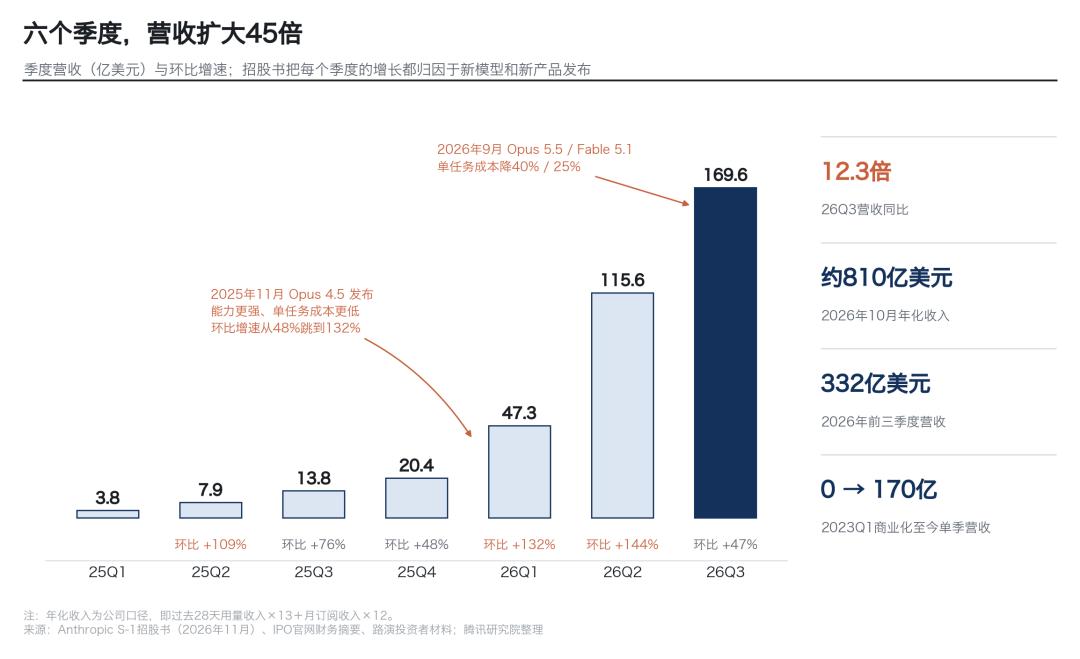
What is more noteworthy than its valuation is its growth curve. This continuous 10x growth far outpaces the high-speed growth seen in the mobile internet era, demonstrating the astonishing AI acceleration to the world.
In Q1 2023, Claude began commercialization, with revenue starting from zero. Its full-year revenue reached $41 million in 2023, $386 million in 2024, and $4.585 billion in 2025. By Q3 2026, its single-quarter revenue hit $16.96 billion, 12.3 times that of the same period last year. Its annualized revenue in October this year has reached approximately $81 billion, and projections suggest it could hit $100-120 billion by the end of the year.
The second page of the roadshow investor materials carries this line: For the first time in human history, intelligence has become something humans can build. Cognitive capabilities including reasoning, analysis, synthesis, decision-making and creation can be mass-produced and accessed on demand. I have read this line many times. It does not merely describe a single company, but marks an industry turning point: for the first time, intelligence starts to exist independently of human beings, and becomes an industrial product that can be mass produced, priced and scheduled.
Especially the chart below demonstrates Anthropic's ambition. The returns it expects go far beyond current revenue streams from programming, analysis and office work, extending to fields including drug discovery, materials science, advanced manufacturing and robotics, the $2 trillion life sciences sector, and even the global $40 trillion knowledge work market in the future. This reminds us of a previously controversial industry rumor: "In the future, there may only be Anthropic left in the world".
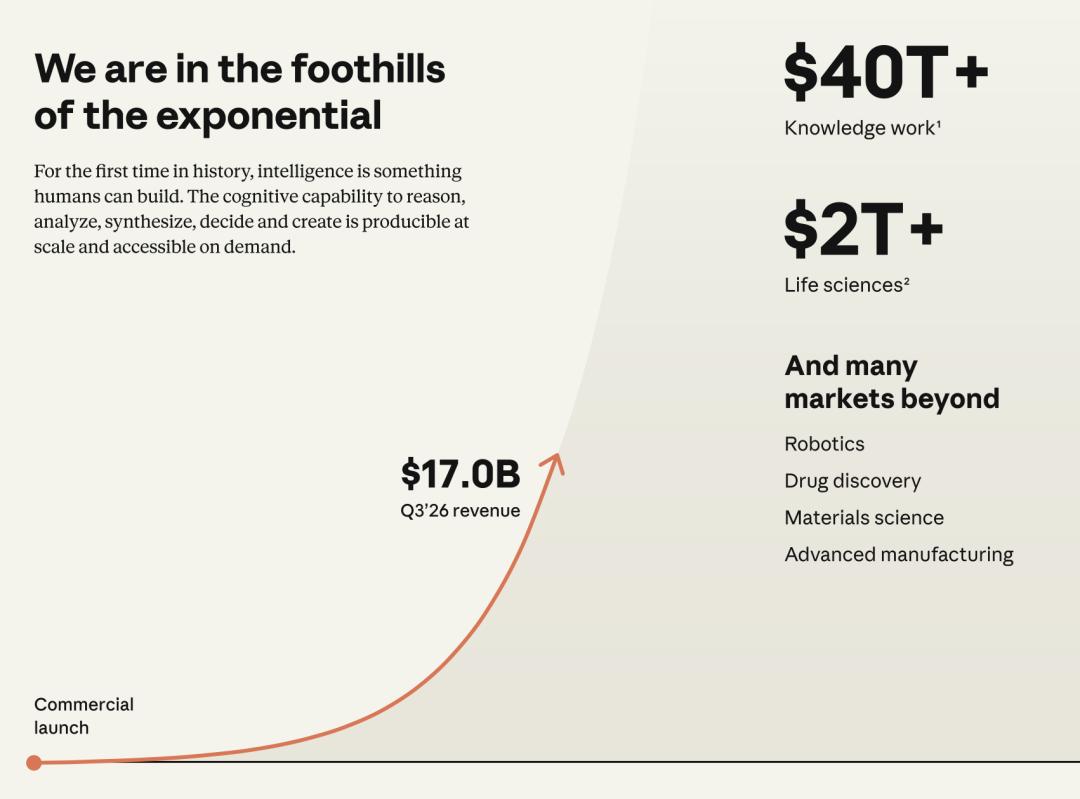
Source: Anthropic roadshow investor materials
Over the past week, we reviewed over 400 pages of Anthropic's prospectus, 15 pages of roadshow investor materials, the 41-minute roadshow video, and the open letter jointly signed by its seven founders. How revenue is generated, where computing power is spent, how models are iterated, how the organization operates, and how risks are priced, all have been fully disclosed by a cutting-edge model company for the first time. We can see six ongoing changes in the large model industry.
Trend 1: The Scaling Law remains valid, but the main R&D engine has been replaced by AI itself
Among Anthropic's founding team are the key authors of the 2020 paper Scaling Laws for Neural Language Models. The founders' letter notes that many people did not believe at the time that machine intelligence would rely so heavily on scale, but predictions based on the Scaling Law have been proven correct time and time again. The judgment in the prospectus is also clear: AI capabilities will continue to improve, demand will continue to outstrip supply in the foreseeable future, and supply is mainly constrained by computing power.
However, after reading the full prospectus, I believe what deserves more attention is not the Scaling Law itself, but three changes in R&D methods.
First, post-training has become the link with the largest investment. The prospectus states that post-training has evolved from a final finishing step to one of the company's largest areas of research investment, as the market is shifting from conversational assistants to autonomous agents. Training methods have also changed, using complete, real-world tasks with complexity close to that of professional work. Anthropic believes that the breadth and authenticity of this task portfolio is one of its most enduring scientific advantages, which is very difficult to observe from outside and thus very hard to replicate.
Second, model architecture and inference infrastructure are designed together. AI researchers and inference engineers share planning cycles, reporting lines and performance targets, and inference costs are factored into architecture decisions from day one. This explains why every generation of Claude can achieve stronger capabilities while being more cost-efficient at the same time.
Third, and most importantly, AI has started building AI, which is the widely discussed RSI (Recursive Self-Improvement) at present. Each generation of Claude participates in building the next generation, including running experiments, generating and processing training data, automating evaluation and security audits, writing and reviewing code.
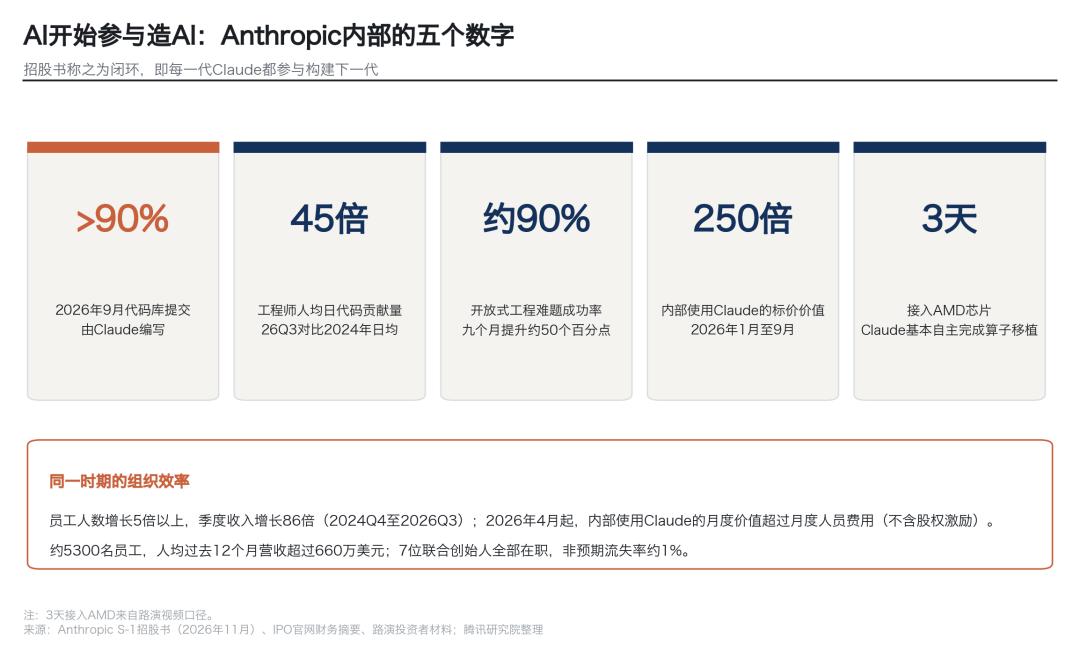
Several figures speak volumes. In September 2026, over 90% of the commits in Anthropic's codebase were written by Claude; the amount of code contributed per engineer per day in Q3 was more than 45 times the average daily level in 2024. On open-ended engineering problems with no clear specifications that previously relied heavily on the judgment of senior engineers, according to the company's internal benchmark tests, Claude's success rate increased by about 50 percentage points in nine months to reach around 90%. When integrating AMD chips this year, Claude completed the adaptation in basically three days with almost no human intervention, porting or writing almost all operators, a task that previously required dozens of engineers several months to finish.
Calculated at list prices, the value of Claude used internally at Anthropic has increased more than 250 times from January to September this year. In April this year, this monthly value exceeded the company's monthly personnel expenses (excluding equity incentives) for the first time.
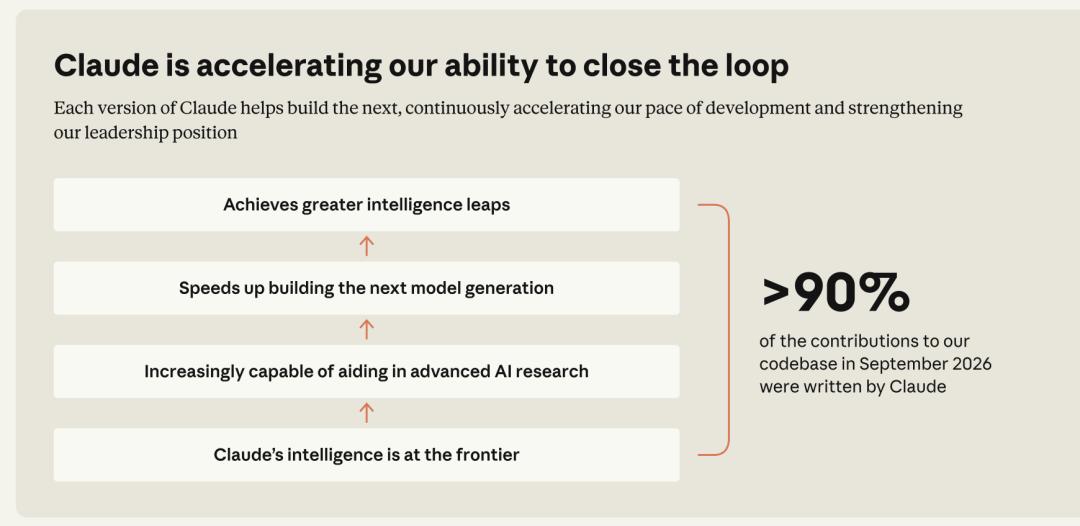
Source: Anthropic roadshow investor materials
There is also an easily overlooked trade-off. The prospectus explicitly states that despite the commercial appeal of video and image generation models, the company is not currently focusing on this area, and the corresponding computing power has been redirected to programming, agent and security research. There are three reasons for this: programming has huge economic impact; security issues will emerge first in this field; and programming outputs are largely verifiable.
The key to winning large model competition is shifting to the rotation speed of the R&D cycle. The company whose model can do its own internal work well first will develop the next generation of models faster. Verifiable fields will be conquered first, and will in turn feed back to R&D first.
Of course, this cycle also has its other side. The prospectus specifically mentions that using AI to accelerate AI will bring considerable security risks, and the company's Responsible Scaling Policy has included monitoring and mitigation plans when approaching recursive self-improvement. The founders' letter puts it more directly: the company may take the initiative to slow down the pace when necessary.
Trend 2: Products are evolving from dialog boxes to virtual collaborators, delivering work results rather than just answers
The founders' letter includes a judgment on product generations: AI chatbots became usable around 2022, AI programming agents around 2025, and agents for general knowledge work and scientific discovery gradually became available in 2026. The letter also notes that Anthropic will spend less effort consolidating existing products and more effort defining new products, as new-generation models always unlock product categories that were not feasible just a few months ago.
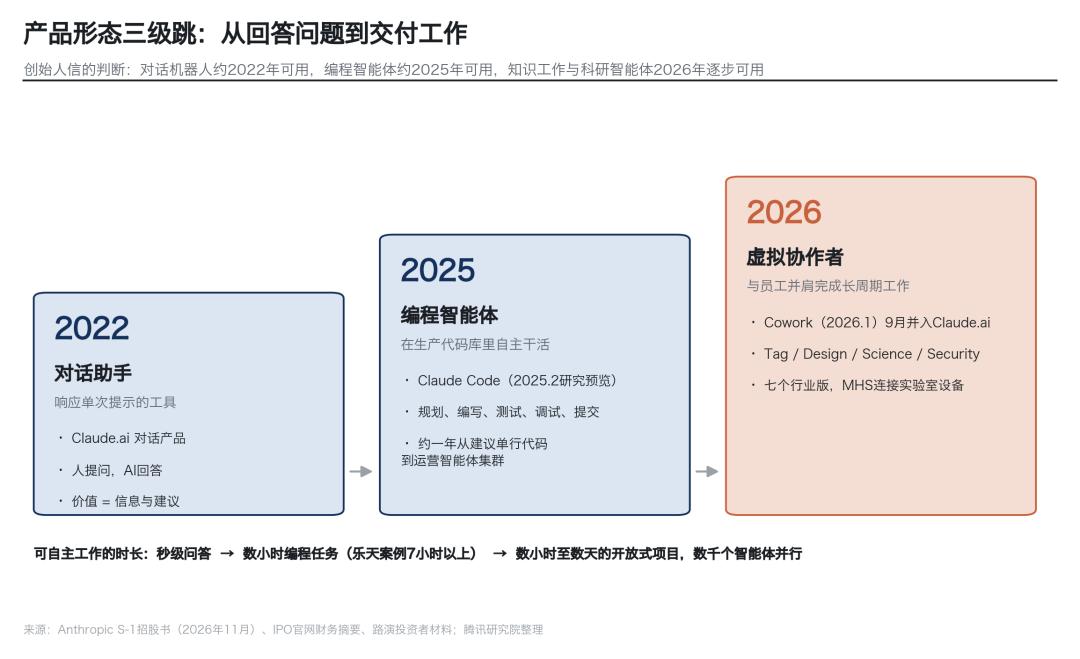
The prospectus names this generation of products virtual collaborators: entities with organization-granted permissions, system connections and context, that can use internal tools, execute multi-step workflows requiring continuous reasoning, and work side by side with employees.
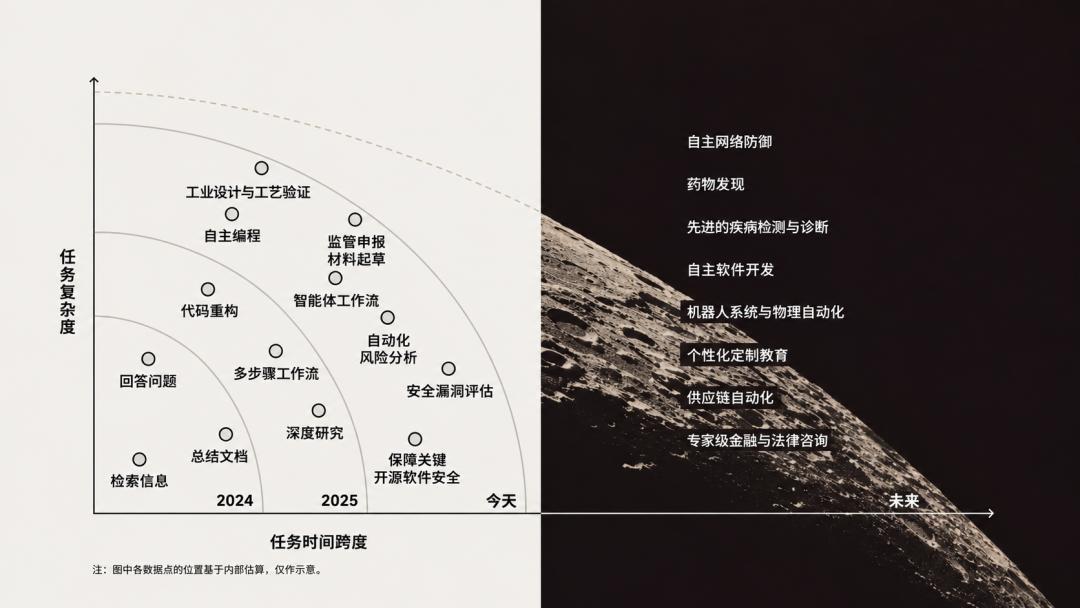
Source: Anthropic roadshow investor materials
Programming is the first category that has crossed the threshold. Claude Code was released in research preview form in February 2025. In roughly one year, Claude has evolved from suggesting single lines of code to running clusters of agents that work autonomously in production codebases. The prospectus draws a parallel between the impact of Claude Code and the first widely adopted conversational AI assistants. Its use cases are often unexpected: for example, NASA engineers used it to plan and write navigation instructions for the Mars Perseverance rover, completing the first AI-planned drive on Mars.
Cybersecurity may be the second category. On the vulnerability exploitation benchmark developed by researchers from Carnegie Mellon University, Claude's score rose from 40% to 78%, and then to 91% in roughly four months.
Knowledge work is the third. There is a line in the prospectus that left a deep impression on me: All digital work is ultimately an expression of code. Based on this judgment, Anthropic transplanted the agent architecture of Claude Code to knowledge workers, building Cowork, which can autonomously read files, operate applications and execute multi-step workflows on the user's desktop, with underlying code hidden. Cowork was released as a research preview in January 2026, and by the end of September, its adoption rate had exceeded that of Claude Code at the same point in time. In September, Cowork began to merge with Claude.ai, allowing users to transition directly from a simple question to a complex multi-step task in the same conversation.
Conversations and agents are merging into the same product.
Customer cases also confirm this. Rakuten used Claude Code to achieve over 7 hours of autonomous programming, cutting new feature launch time from 24 working days to 5; Salesforce completed an API migration that originally required 231 days in 13 days; all 30,000 employees at Bristol Myers Squibb have access to Claude, and the response time for an epidemiological question has been shortened from one or two months to four or five minutes.
As product forms change, the technology stack needs to change accordingly. There is a plain line in the prospectus: A model by itself does not constitute an agent. Agents need to be able to recover from crashes, operate systems with scoped, auditable credentials, and scale under variable loads, all of which require a runtime framework. Anthropic opened the same runtime framework that powers Claude Code as the Agent SDK, and launched the hosted version Managed Agents; together with the Agent Skills package, the MCP protocol that connects enterprise data and tools, and the MHS model hardware standard that allows agents to operate laboratory and manufacturing equipment, they form the middle platform layer.
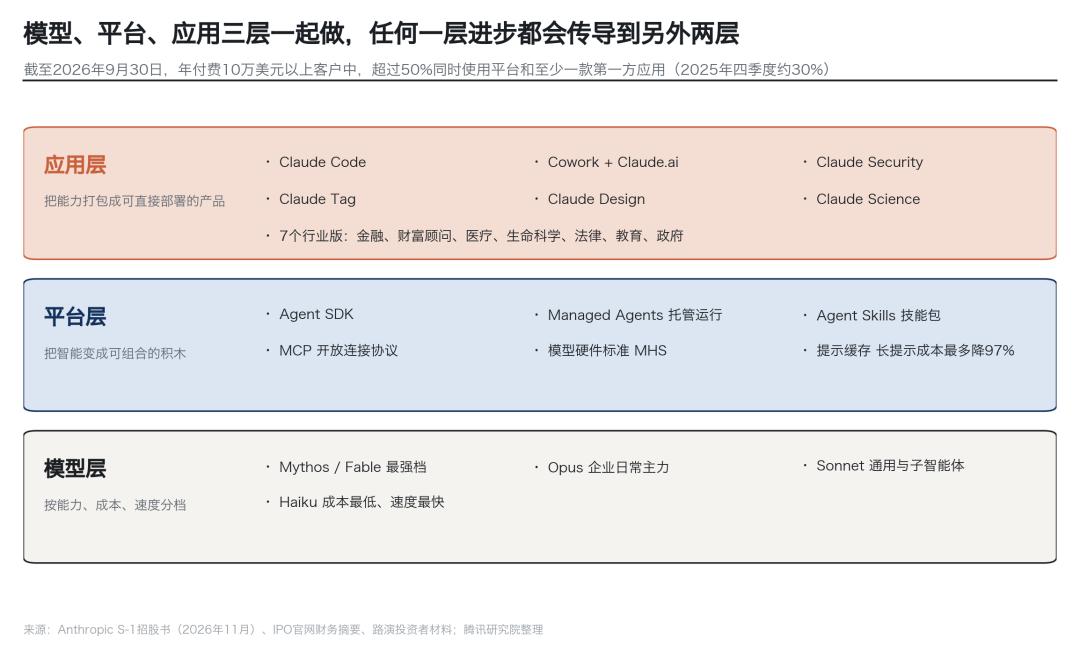
The benefits of building the three layers of model, platform and application together are already visible in customer data. As of the end of September this year, among customers paying more than $100,000 annually, more than half are using both the platform and at least one first-party application, compared with around 30% in Q4 last year.
The product unit of large models is evolving from a single answer to a delivered outcome. The focus of competition will shift from model benchmark scores to engineering capabilities such as runtime frameworks, context management, permission systems and tool connections, which are commonly referred to as Harness. Another practice worth learning from is that Anthropic designs products around the capabilities the model will have, rather than around its current capabilities. This is exactly how Claude Code was developed, so once the capabilities are ready, the product can quickly scale up.
Trend 3: Pay by intelligence, models have shelf lives like fresh produce
Anthropic calls its main revenue model pay-by-intelligence, i.e. usage-based billing, measured in tokens and priced based on the selected model. In the first three quarters of 2026, usage-based billing accounted for 79% of revenue, and subscriptions accounted for 21%; revenue generated through the three major cloud platform marketplaces accounted for 44%; revenue outside the US accounted for 29%.
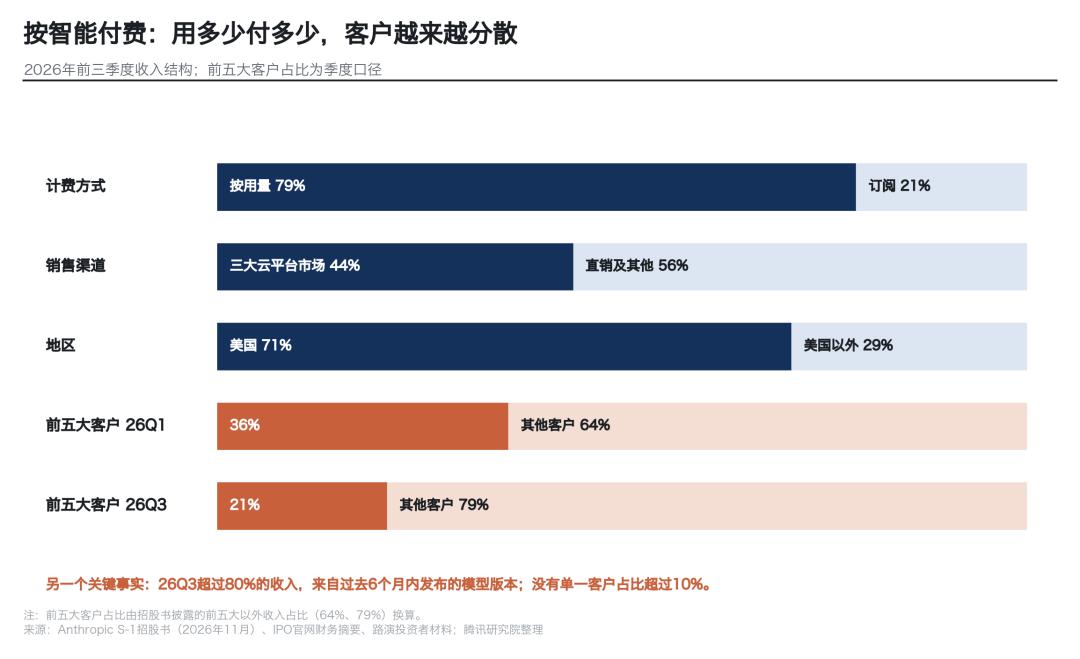
Three details particularly illustrate the characteristics of this model.
First, price cuts are for volume expansion, not price wars. In November 2025, Anthropic released Opus 4.5, with stronger capabilities, lower prices and lower cost per task. After that, the company's sequential revenue growth rate jumped from 48% in Q4 last year to 132% in Q1 this year. Opus 5.5 released in September this year reduced customers' cost for completing the same task by about 40%; Fable 5.1 reduced costs by about 25% compared with the previous generation, with savings of up to 45% for complex programming and highly agentized tasks. According to the caliber disclosed in the roadshow, the company lost about $6 billion in Q3 due to price cuts and contract discounts, but this was fully offset by usage growth. The management stated that this price cut is neutral to profit margins, as the new models themselves require less computing power.
In other words, behind the drop in token unit price is efficiency dividend: computing power efficiency is improved first, then prices can be lowered, and price cuts in turn further unleash demand.
Second, models have shelf lives. The prospectus discloses that over 80% of revenue in Q3 came from model versions released within the past 6 months. In the first three quarters of this year, the company launched a total of 250 new model versions, platform features and applications. In this industry, models are not software that is developed once and sold for a long time, but more like fresh produce that requires constant new releases. Whoever stops moving forward