Top-tier institutions are indeed pulling back, but the development path for embodied intelligence remains very broad.
Recent market sentiment is rather sluggish, especially in the once red-hot embodied intelligence track, where some people believe the sector is "cooling down" or "going cold". Let's take a look at the data to find out what is actually happening —
Data from IT Juzi shows that in February 2026, HSG participated in 6 financing deals in the embodied intelligence sector; by October, this figure had dropped to 1. GL Ventures has also slowed down its pace: it participated in 7 deals in April, and did not appear in the financing list in October.
Top-tier investment institutions have indeed made fewer moves, and the financing pace for full humanoid robot products has indeed slowed down. However, it would be a narrow perspective to conclude that embodied intelligence no longer attracts capital attention based on this fact.
According to data from IT Juzi, in the first 10 months of 2026, 668 financing deals were closed in the embodied intelligence sector, compared with 287 deals in the same period of 2025, representing a year-on-year increase of about 133%. Projects are still securing funding, but the heat is not evenly distributed across every institution and every sub-sector.
Humanoid robot is one form of embodied intelligence, not the entirety of this track. When investors discuss whether robots can enter factories, households or other real scenarios, they should not only look at the appearance of the robot, but also the software and technologies that enable it to perceive the environment, understand tasks and complete operations. This path is wider than developing a single humanoid robot, and it also takes a longer time to traverse.
Top-tier institutions have slowed down, this is no illusion
First, let's look at the investment records of 10 active investment institutions. From the second half of 2026 up to November 15, the average monthly number of participations of these 10 institutions in the embodied intelligence sector is lower than that in the first half of the year.
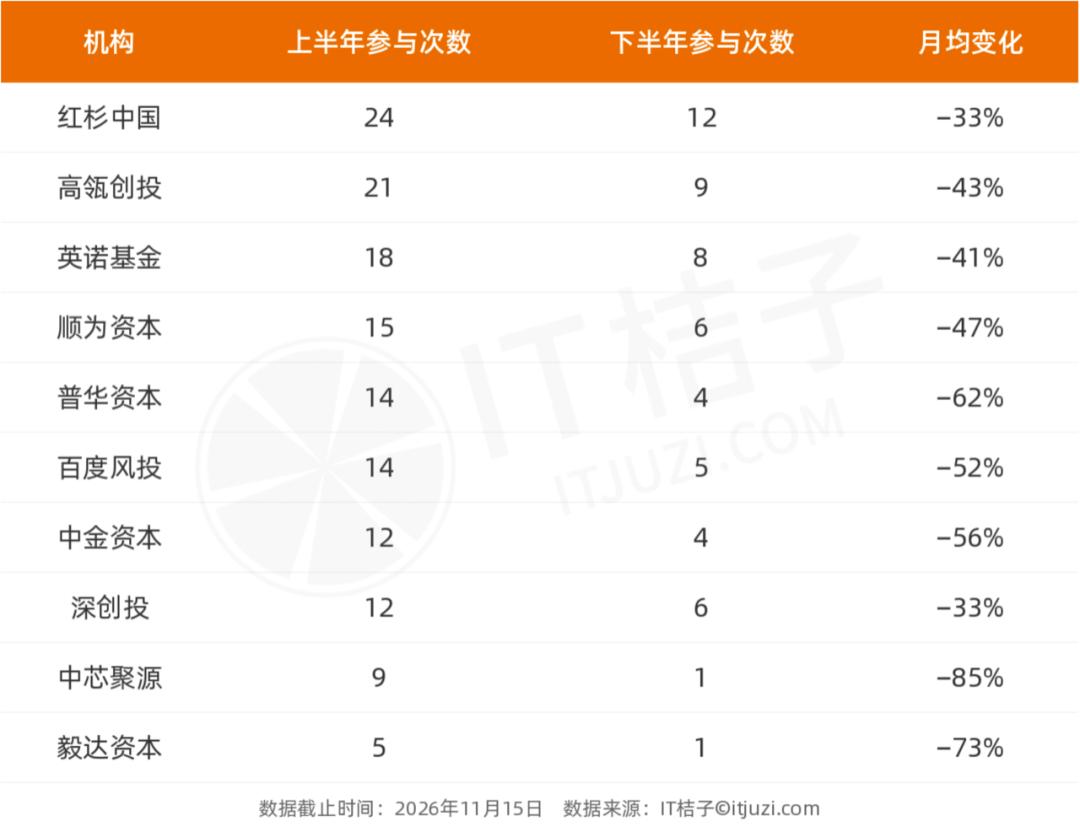
The first half of the year is calculated as 6 months, and the second half as approximately 4.5 months. HSG's monthly participation dropped from 4 deals to about 2.7 deals, and GL Ventures' monthly participation dropped from 3.5 deals to 2 deals. It is not a case where a single institution took a break occasionally: the investment frequency of all 10 institutions has declined.
However, "making fewer investments" and "withdrawing from the track" are two completely different things. The statistics here count the number of new financing deals that institutions participated in, not how much of their existing positions they have sold; these 10 institutions cannot represent all investors. At least from this set of samples, top-tier institutions are slowing down the pace of investment in new projects, rather than data proving that they have left the market.
If we take a broader view, the situation is different. A total of 365 financing deals were closed in the embodied intelligence sector in the first half of the year, and 333 deals were closed in the second half up to November 15. Converted to monthly average, the figure rose from about 60.8 deals to 74.0 deals instead.
The slowdown of several top-tier institutions does not mean that all investment activities in the market have slowed down.
Financing is still ongoing, instead of rising nonstop
In the first 10 months of 2026, the 668 financing deals in the embodied intelligence sector have exceeded the total 403 deals of 2025. From this perspective, the claim that capital is "fully withdrawing" does not conform to the data.
However, active financing does not mean that each month is hotter than the previous one. 87 financing deals were closed in August, which was the single-month peak from the start of 2026 up to October; the figures dropped to 72 deals and 69 deals in September and October respectively. Investment sentiment fluctuates, and the two-month decline cannot be directly interpreted as the contraction of the entire track, nor can the past growth be taken as an inevitable trend that will continue in the future.
Fewer financing deals for humanoid robots does not mean the entire robot body sector is cold
Compared with the total volume of the whole track, a more obvious change has taken place in the humanoid robot segment.
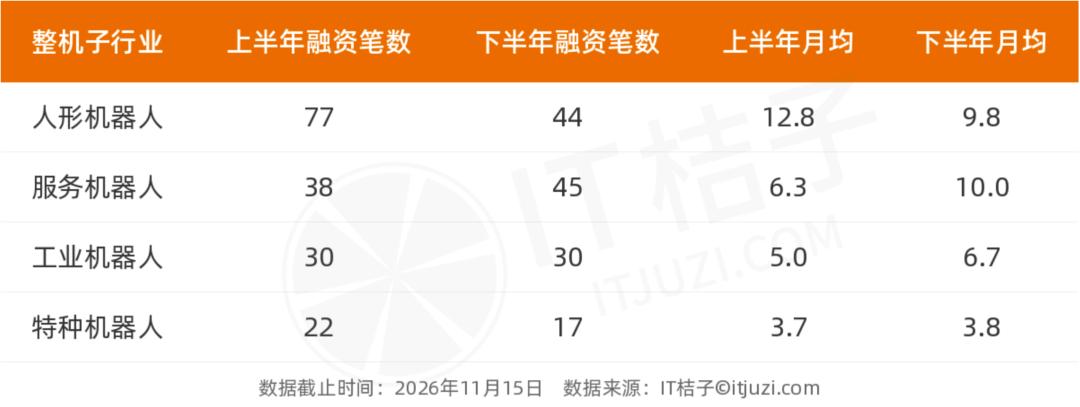
Calculated according to the duration of different stages, the average monthly number of financing deals for humanoid robots has decreased by about 24%. This is not a comparison that only takes the peak in March and a certain trough: when we compare the two stages as a whole, the slowdown is also observable.
However, the entire robot body sector has not cooled down accordingly. The average monthly number of financing deals for service robots increased from about 6.3 to 10, and that for industrial robots also saw growth. Taken together, the average monthly number of financing deals for the four types of robot bodies in the table rose from about 27.8 to 30.2.
This indicates that investing in robots does not necessarily mean only investing in human-shaped robots. Service robots and industrial robots are also directions for embodied intelligence to enter real scenarios. A few fewer financing deals for humanoid robots do not mean that other forms of robots have lost opportunities.
Embodied intelligence is far more than manufacturing robot bodies, opportunities are extending outward
To make a robot truly complete a task, a movable body alone is not enough. It needs to recognize the surrounding environment, understand what to do, and then turn judgments into actions. Around these demands, software and AI-related projects are also part of the financing market.
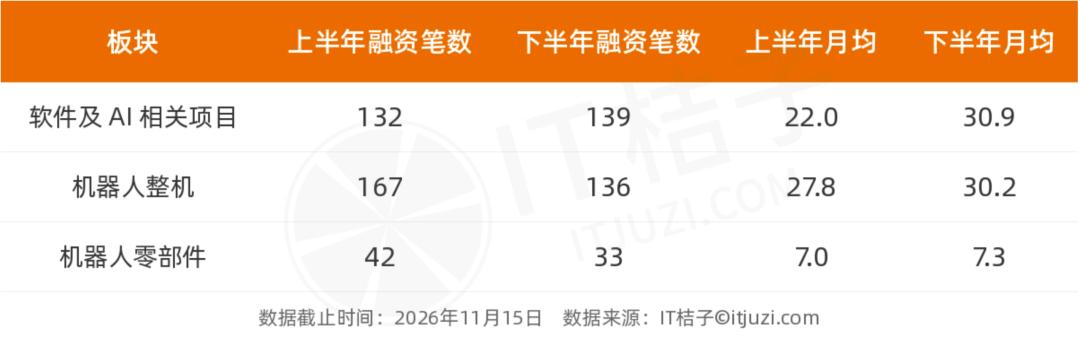
Classified by the sub-sectors in the database, the average monthly number of financing deals for software and AI-related projects has increased by about 40%, faster than that of robot bodies and components. These projects cover robot software, AI technology layer and AI infrastructure layer, indicating that the financing opportunities in this sample are not only concentrated on the humanoid robot body.
Of course, a larger number of deals does not mean more capital raised, nor can we conclude that capital has fully shifted from robot bodies to software. Some companies' businesses involve both software and hardware, and the database classification is not exactly the same as the actual product boundary.
But this change reminds us: when observing the embodied intelligence sector, we should not only focus on the humanoid robot on the stage. Different forms of robots, software and underlying technologies may all be integral parts of the continued development of this industry.
Top-tier institutions have slowed down, but the track is not narrowing
Putting all these data together, the conclusion is not complicated: some top-tier institutions have slowed down their investment pace, and there are fewer financing deals for humanoid robots; at the same time, the overall financing activities in the embodied intelligence sector remain active, and investments are still being made in other robot forms as well as software and AI-related projects.
The road for embodied intelligence is still very wide, because it does not only involve one type of robot or one single link; the road is also very long, because to turn technologies into different real scenarios, we still need to continuously solve problems in perception, understanding, execution and other aspects. The number of financing deals cannot prove when these problems will be solved, but it shows that current exploration is not stuck on a single hot spot.
This article is from the WeChat Official Account "IT Juzi" (ID: itjuzi521), written by Judy, published with authorization from 36Kr.