Collective Reflection Among European and American Gaming Practitioners Amid the GTA6 Frenzy
Thirteen years later, the "GTA Flu" has made a comeback.
Right after midnight New Zealand time on November 19, in a quiet living room in Wellington, the capital, 50-year-old director of photography Adam Simmons turned on his screen on time, becoming one of the first batch of players in the world to take over Vice City. He moved from Oregon, the United States, just five months ago, and joked that it was more or less to get his hands on *GTA 6* earlier than his friends. The official Tourism New Zealand also jumped on the trend on Instagram: "One of the great perks of being the first to see the sunrise? You also get to play *GTA 6* the earliest!"
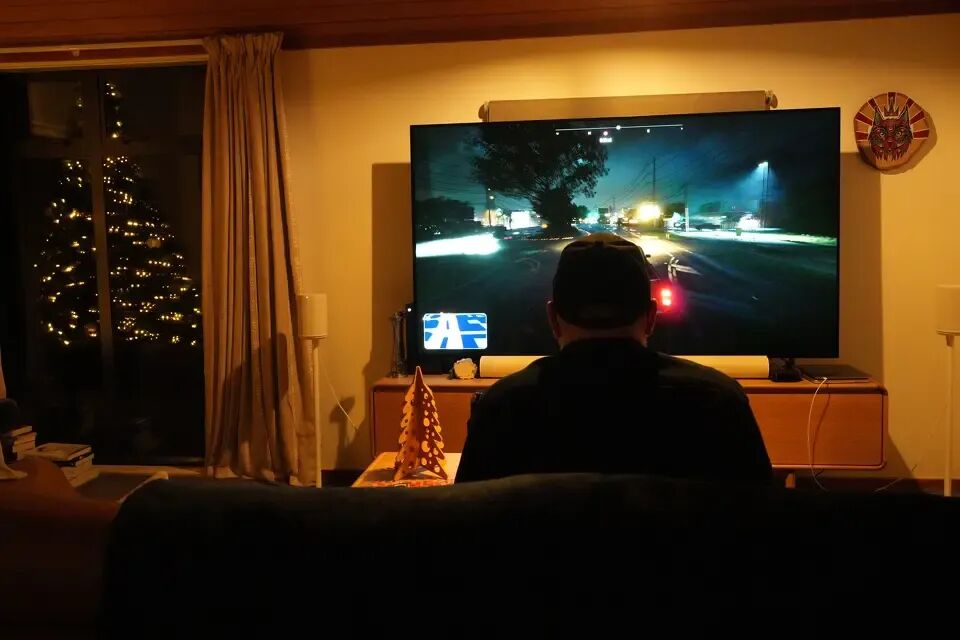
Adam Simmons plays 'Grand Theft Auto VI' at his home in Wellington, New Zealand, Thursday, Nov. 19, 2026.(Photo: Charlotte Graham-McLay|AP)
Many people have temporarily stepped away from the real world for GTA. A Reddit user rented a hotel room for a week, saying, "My wife thinks I'm either crazy or having an affair." A family-owned perfume shop in Tasmania announced it would close for a week, because the 20-year-old son of the owner convinced her to take time off to play games together. Global streamers have also entered a state of preparedness. Well-known Australian streamer DarkViperAU adjusted his schedule in advance, pushing his wake-up time to 3:30 PM — he had already spent 13,000 hours in *GTA 5* before, which is equivalent to the entire lifespan of a hamster (541 days).
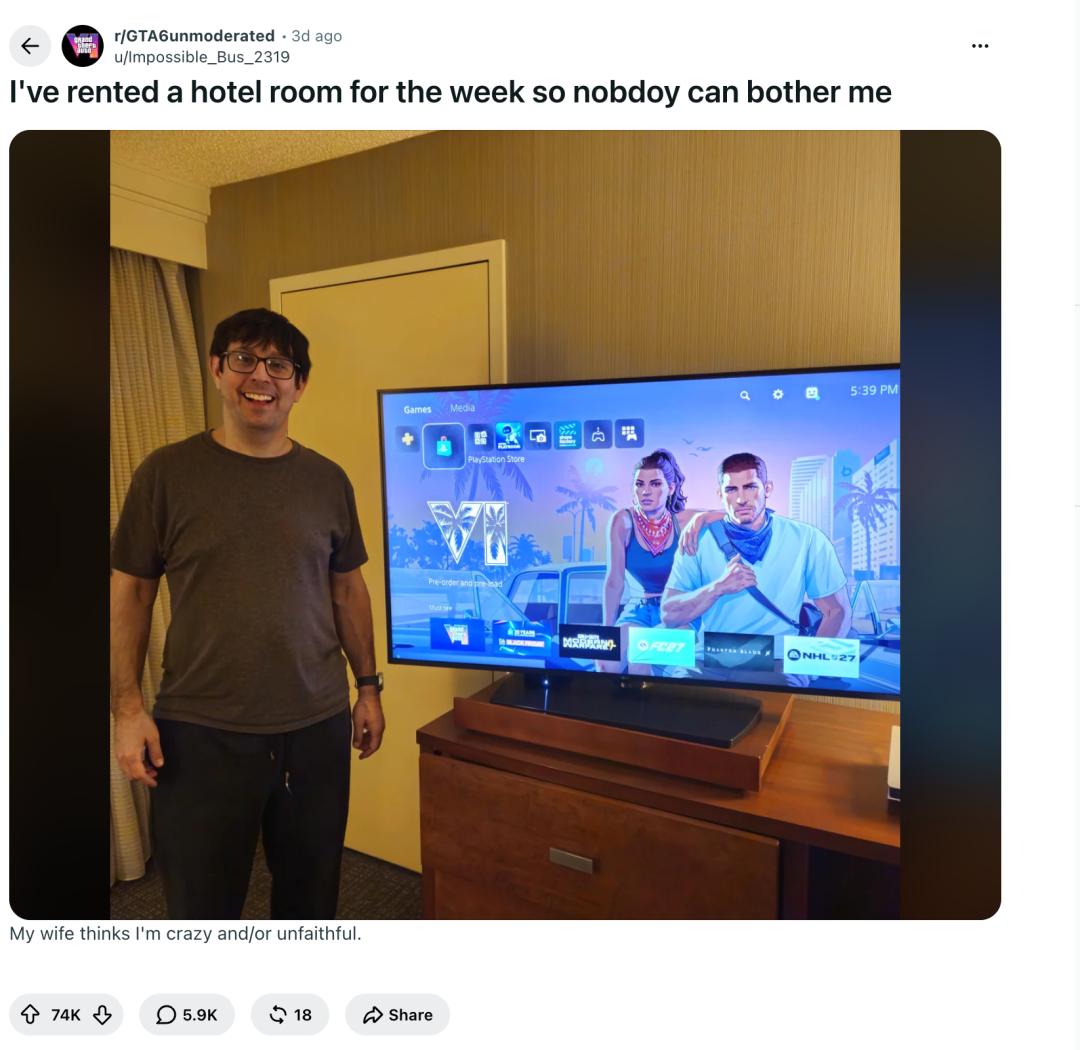
A Reddit user posted a photo of himself with his TV, with 5.9k comments below
Those who haven't got access to the game yet are busy "saying goodbye" on social media, claiming it's their "last day surfing the Internet", "last time driving in LA", "last social interaction"... Some even set off fireworks to celebrate that the long-circulated meme — "We would have already (passed away) before *GTA 6* came out..." — has finally come to an end.
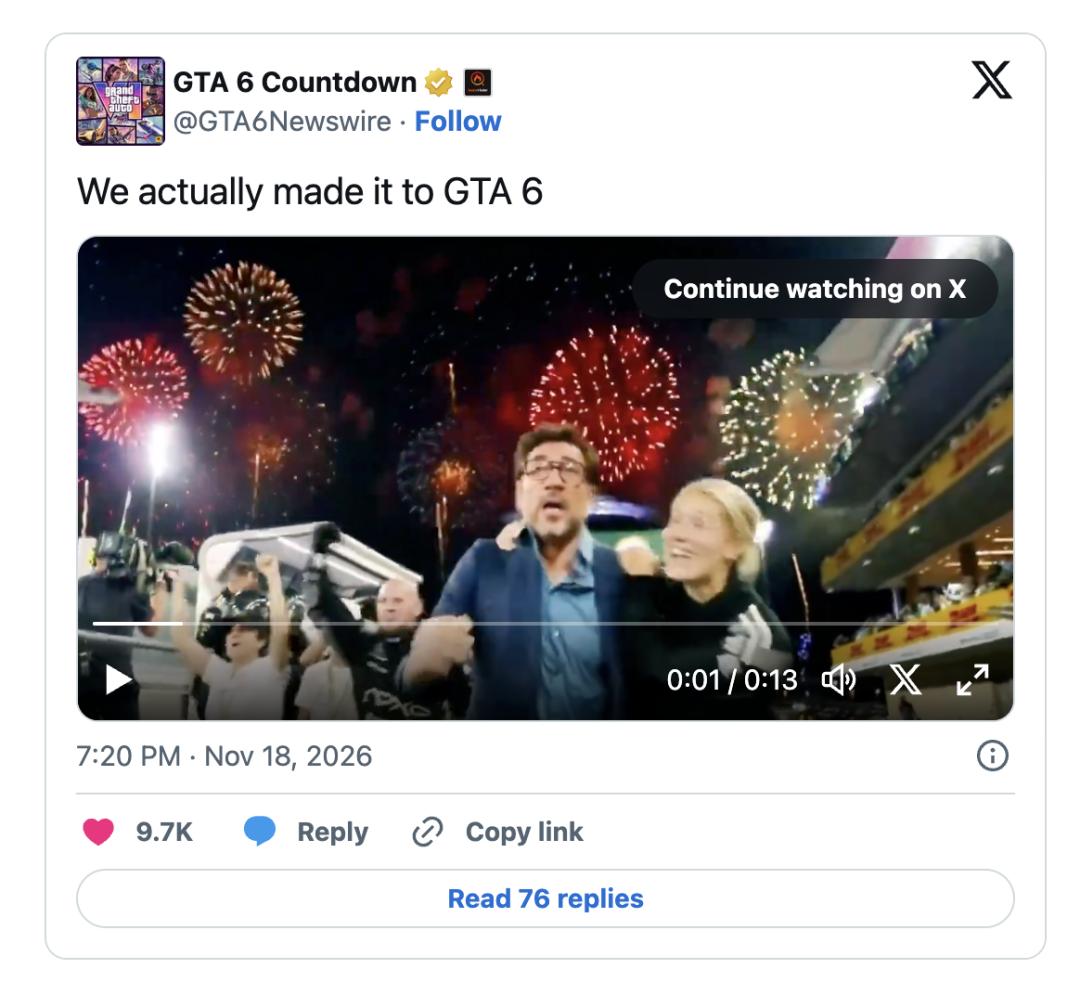
The first batch of media scores are surprisingly high. As of press time, the Metacritic media average score of *GTA 6* once reached 99 points, tying with *The Legend of Zelda: Ocarina of Time* for the highest in history, and IGN gave it a full 10 points. Players are full of praise for the picture details, driving feel and world immersion. During the preload phase, the game file of over 200GB has put pressure on the network in some regions; Comcast in the United States even said that this preload traffic has set the record for the largest single traffic event in its network history.
Even if you are not a player, it is difficult to avoid this "pandemic". A few weeks ago, Miami was dressed up as Vice City: a "Welcome to Vice City" banner was hung on the roof of the Kaseya Center Arena, a Y Hotel appeared on Collins Avenue, a pink "Vice Beach" sign was erected on the beach, and even the fictional brands in the game were moved into the city center. From New York, Los Angeles, to Paris, Tokyo, Hong Kong, Melbourne; at the La Liga El Clasico scene, or when you turn on the TV to watch *South Park* (yes, it even inserted a segment of actual game footage into the latest episode), no corner can escape its "influence".

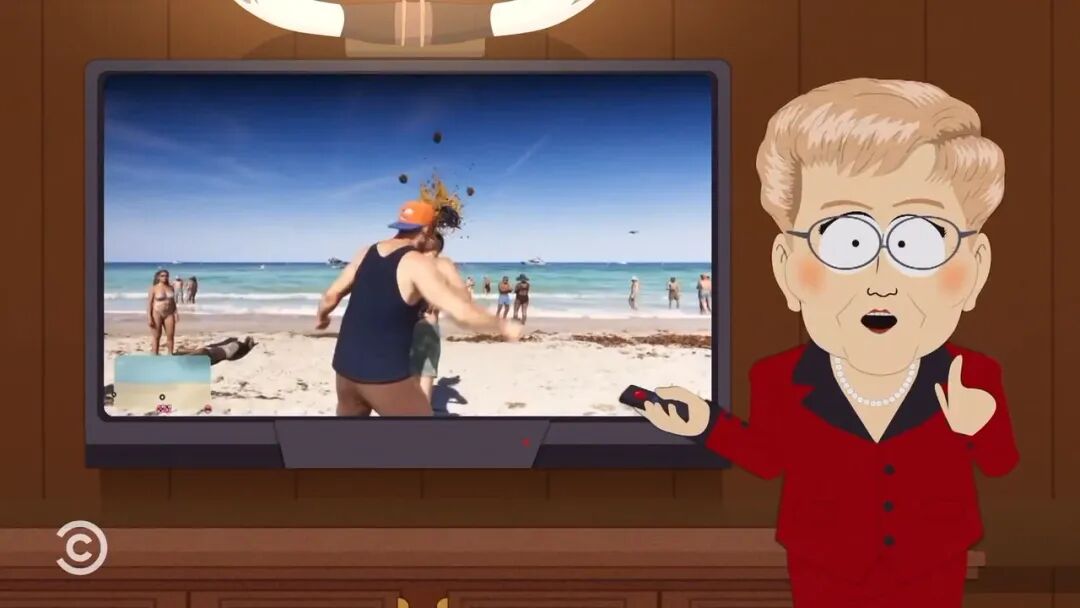
*South Park* Season 29 Episode 4 *Guinea Pig on a Stick* features about 20 seconds of actual gameplay footage of *GTA 6*: the protagonist Jason provokes a dog-walking passerby on the beach in Vice City, then picks up the bag of dog feces from the passerby and slaps it on his face.
Behind this global feast is Rockstar's almost cost-free expansion and investment. In the past few years, when the industry has generally contracted, Take-Two spent about 32 million US dollars to buy a 52,000-square-foot office building in the expensive Culver City, Los Angeles, and expanded its business to 12 offices in India, the United Kingdom, the United States, Australia and other places, with the number of employees increasing from 2,441 at the time of *Red Dead Redemption 2* to 4,711 now. In less than eight years, the overall scale of Rockstar has almost doubled.

Based on Take-Two's financial reports, judgments from third-party analysts and industry experience, we estimate that the median R&D cost of *GTA 6* is about 1.45 billion US dollars, the global marketing investment is about 500 million US dollars, and the median total investment is close to 1.95 billion US dollars. This is not the officially announced budget by the publisher, but even if the actual figure varies, it is enough to make it the most expensive game in history, equivalent to about 6 times that of *Cyberpunk 2077* (316 million US dollars), or nearly 10 times that of *Elden Ring* (200 million US dollars).
However, for the entire AAA industry, this is an unattainable success. Since 2022, more than 58,000 people in the global game industry have lost their jobs, the vast majority from North America and Western Europe; some AAA blockbusters have invested hundreds of millions of dollars in R&D, but in the end only got tens of millions of dollars in revenue. Layoffs, studio closures and project cancellations have become the norm, and practitioners can only self-mock: joining a project is like joining a film crew, and the team may be disbanded at any time... What many people thought was a "short post-pandemic contraction" has come to its fifth year, and there is still no end in sight.
Thus, two completely different emotions are quietly brewing over the European and American game industries: on the one hand, there is the carnival of players who have been waiting for a long-awaited masterpiece, on the other hand, there is the long-accumulated anxiety of practitioners, which has been heating up from late summer to early autumn, and finally converged at the release node of *GTA 6*.
Reflection first broke out from within the game industry. In mid-September, game magazine *Edge* released the cover feature "Crash 2.0" (the second game industry crash) of its November issue online in advance. Editor Alex Spencer interviewed nine industry insiders, asking whether the game industry is experiencing a second crash since the 1980s.
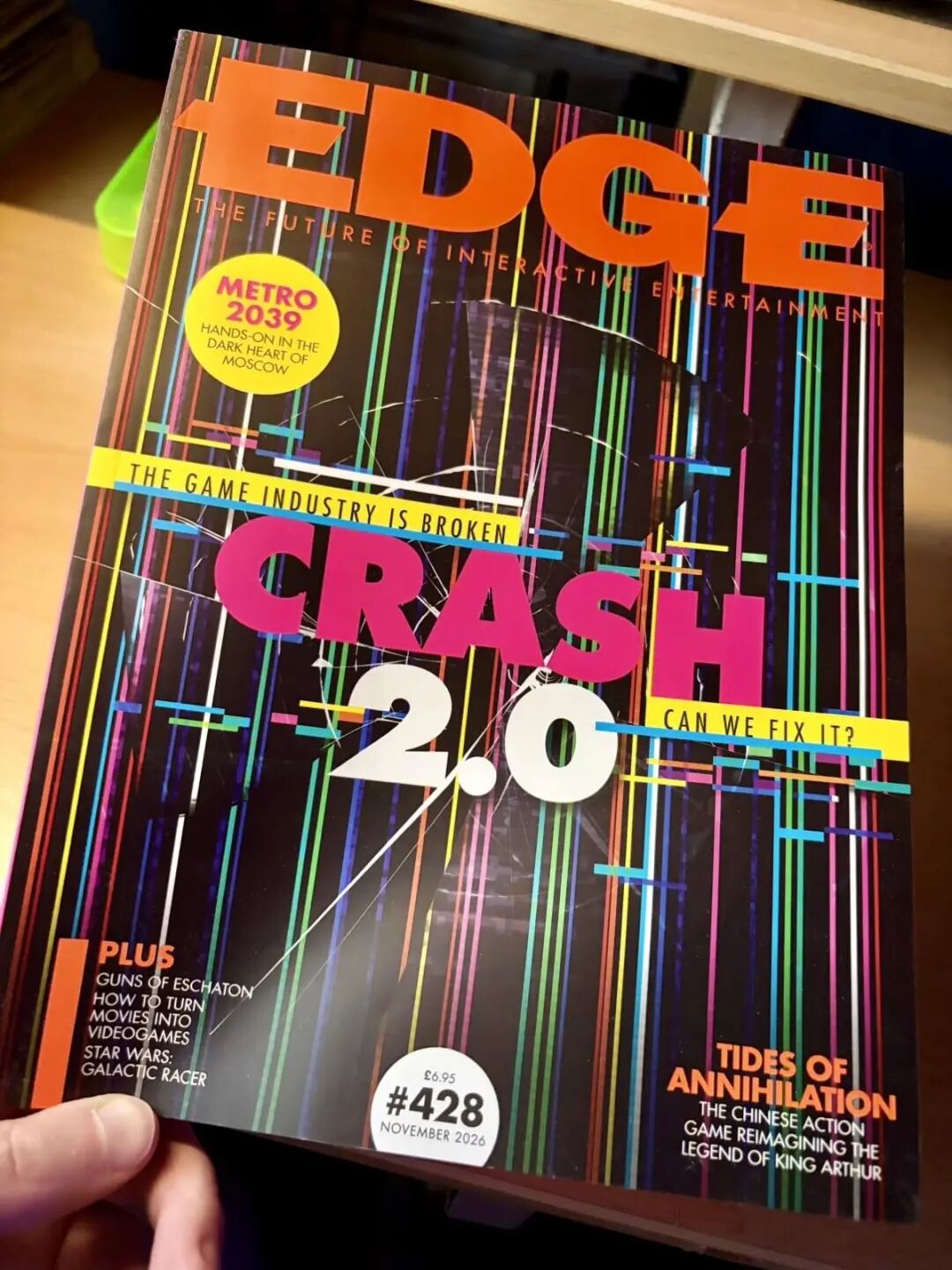
Source: *Edge* Issue 428, November 2026, the title of the cover feature "The game industry is broken – can we fix it?"
The opening wording is quite strict: "Something in the game industry has rotted. Creators gritted their teeth and held on to the slogan 'make it to 2025', only to wait for a colder reality... How on earth can we carve out a brighter future — or, what exactly should we pay for this path." Among them, Amir Satvat, a game industry employment researcher, proposed that this crash is not global, but mainly concentrated in the traditional AAA development centers in North America and Western Europe.
Before the feature magazine was released, the discussion had spread to a wider public opinion field. A few days later, Swiss media Galaxus published an article following the statement of "the second crash"; on October 21, tech magazine *WIRED* published an article titled "Gaming Can’t Afford More Games the Size of Grand Theft Auto VI", linking layoffs, budget inflation and convergence of game experience, and bluntly stated that the industry can no longer take super-large projects like *GTA 6* as a general development goal. On November 16, *The Washington Post* even published a commentary titled "*GTA 6* may be the last great heist of the game industry".
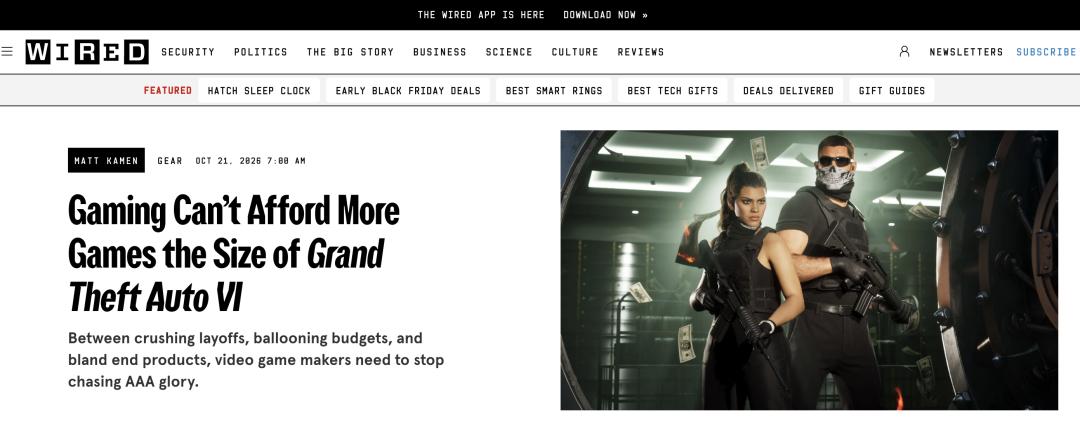
WIRED article: *Gaming Can’t Afford More Games the Size of Grand Theft Auto VI*
Interestingly, when the discussion in European and American gaming circles about "whether the traditional AAA model has come to an end" was in full swing, on November 17, The Game Awards (TGA), an important annual vane of global console games, announced this year's nomination list. *Phantom Blade Zero* from the Chinese team won five nominations, and will compete for Game of the Year with *GTA 6*, *Resident Evil: Requiem*, *The Legend of Zelda: Ocarina of Time (Remastered)*, *007: First Light* and *Control: Resonant*.
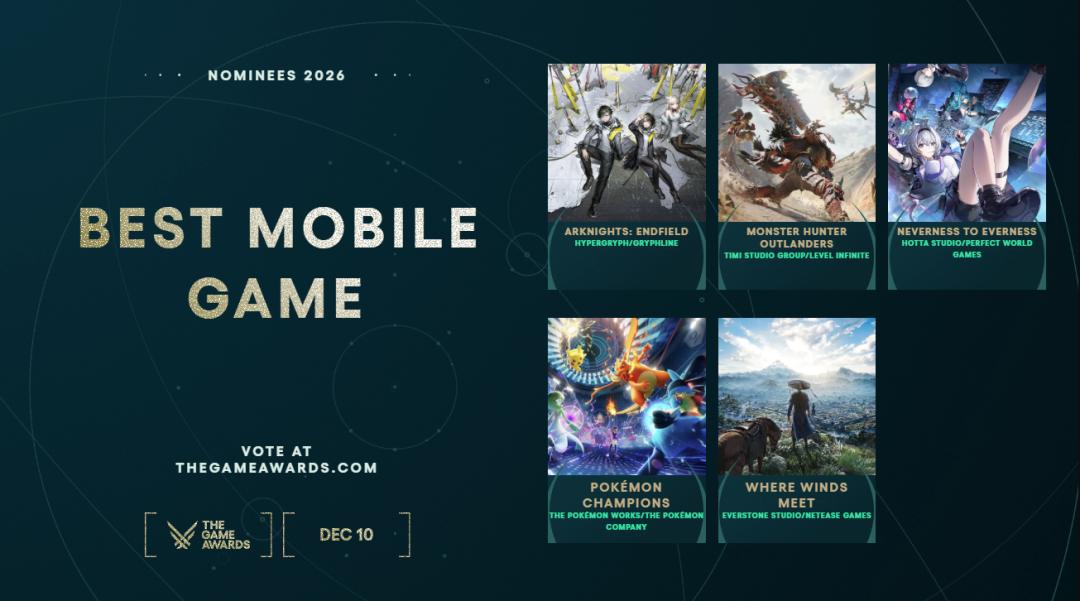
The last Chinese work nominated for TGA Game of the Year was *Black Myth: Wukong* in 2024, which received a total of four nominations that year. Neither of the two development teams had previous mature AAA console development experience: one started from PC online games, and the other accumulated experience from mobile games. When they first challenged the high-spec standalone game market, they broke into the global AAA console final circle long dominated by European and American manufacturers for two consecutive times.
This subtle change makes it necessary for China's game industry to re-examine its position in the global game industry. We should not just be bystanders of this discussion, but also participate in the discussion about the future of the industry:
Why has a production system that was once regarded as the highest standard of the global game industry now encountered such strong doubts in its birthplace? What deep-seated dilemmas of the traditional AAA model does this round of reflection reveal? Can the technical capabilities, R&D experience, long-term operation system and global distribution capabilities accumulated by China's game industry over the past ten years support another path for high-quality games to go to the world?
Where will the global game industry go after *GTA 6*?
Becoming More "Boring" Is the Real Crisis of Traditional AAA Games
In August this year, *The Guardian* raised a very blunt question: "*GTA 6* costs four times as much as *GTA 5*, but will it be four times better than its predecessor? Will it be four times more fun?"
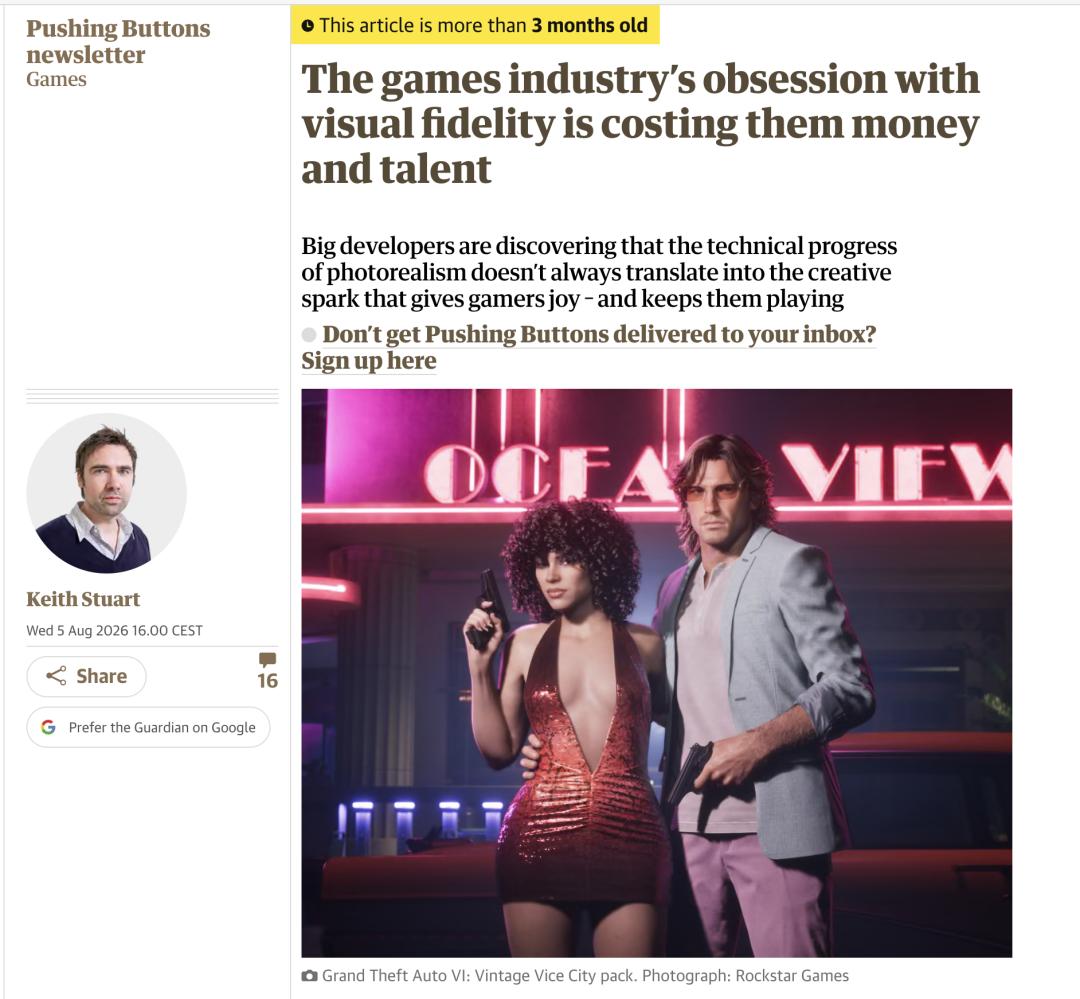
This is of course a relatively rough analogy that cannot be directly used to convert the value of games. But it hits an important emotional change: people no longer believe that the more expensive, the better, and the discussion is being pulled back to the essence of games — the investment is getting higher and higher, but is the game fun?
In *Edge*'s feature interview, Bruce Straley said he no longer wants to develop traditional AAA games, for a very direct reason: "I think the verbs and experiences we offer in AAA games... are a little boring." He took the unreleased *God of War: Laufey* as an example, every frame of the picture is amazing, and the production level is admirable, but the actual gameplay is not interesting at all.
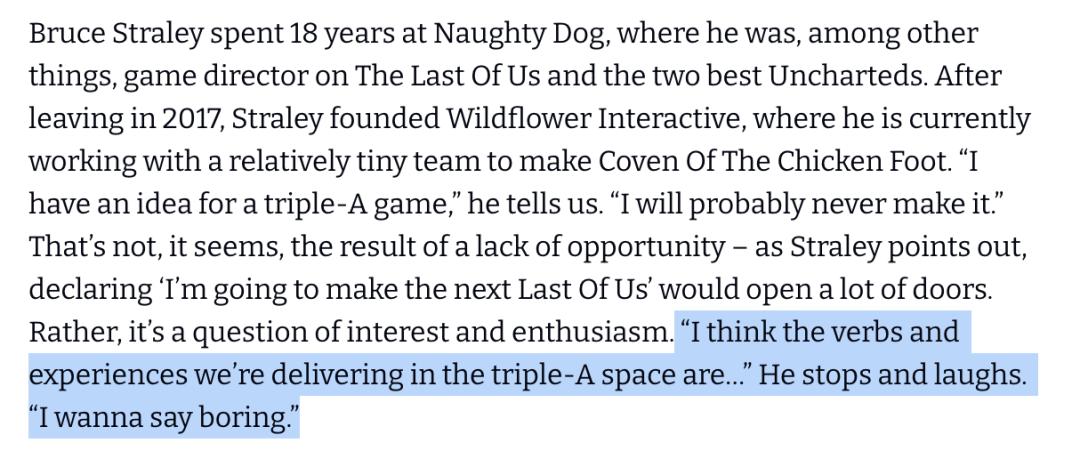
Screenshot of the original *Edge Magazine* article. The keyword "verbs" in the text can be understood as the actual actions performed by players in the game, such as exploring, climbing, shooting, sneaking, dodging, collecting, building, talking, trading and so on. That is, what players are actually "playing" in the game.
It is quite meaningful that Straley worked at Naughty Dog for 18 years and served as the game director of *The Last of Us* and two of the most outstanding *Uncharted* works (2 and 4) — the cinematic narrative and action design he helped shape were once important templates for modern AAA games. Now he thinks that this design method, which has been continuously referenced and strengthened by the industry under the demonstration effect of commercial success, is becoming