Is NVIDIA a company where "even a fool can be the CEO"?
Operators do not have to be great men, nor can they always be great men.
Who will become the new CEO of NVIDIA?
Will it be Colette Kress, the CFO who took over as CEO on an interim basis? Or René Haas, who has a technical background? Or Ian Buck, the inventor of CUDA? If they take office, will they be outstanding successors like Tim Cook and Satya Nadella, or a bad CEO?
I am afraid that even these candidates themselves cannot answer these questions, and the answers may not be obtained until they have been in office for several years.
And what we can answer now is: For NVIDIA, does the requirement for CEO's ability really need to be that high?
Warren Buffett once said: "If you have a good enough business, even your silly nephew can run it." Not to mention a silly nephew, he also said "A ham sandwich as CEO can also run Coca-Cola well."
As long as Coca-Cola's classic taste remains the same, its distribution channels are intact, and consumers' habits remain unchanged, even if a sandwich sits in the office, consumers will still buy Coca-Cola.
This is the power of the business model. A good business requires a brilliant business leader to build, but after it is built, it does not rely on a sufficiently brilliant leader to operate.
Is NVIDIA such a company now?
If so, who becomes CEO will at least not be a fatal problem.
01 The power that even AMD can hardly shake
Without Jensen Huang, there would be no NVIDIA. But after the enterprise matures, it will not rely on the founder forever.
Programmers have created AI agents, making themselves no longer "necessary". For Jensen Huang, the software ecosystem he created also makes himself no longer "necessary" for NVIDIA.
This is CUDA.
CUDA is a software system launched by NVIDIA. It is not a single piece of software, but a complete system extending from the underlying chip architecture to the top-level algorithm library. From GPU hardware to the outermost application software, everything is wrapped in the CUDA ecosystem.
Since 2006, CUDA has been promoted to the industry by NVIDIA. Over the past 20 years, NVIDIA has built an extremely huge CUDA ecosystem.
Today, more than 7.5 million developers around the world are using CUDA and other NVIDIA software, more than 6,000 professional software rely on NVIDIA's computing platform, and more than 78% of the world's TOP500 supercomputers on the list are supported by NVIDIA. When new players enter the market in the future, their first choice will still be CUDA.


Caption: NVIDIA 2026 Annual Report
Jeff Bezos once put forward his understanding of the corporate moat, the flywheel effect. It means that after the system reaches a certain critical point, it will be pushed forward continuously by endogenous force like a flywheel.
NVIDIA's CUDA is such a flywheel, and it can even be said to be the strongest flywheel.
The flywheel of "developers attract customers — customers purchase hardware — the ecosystem attracts more developers" has been running continuously for 20 years, forming a huge and irreplaceable CUDA ecosystem. Jensen Huang is the "initial force" that pushes the flywheel, but after the flywheel has been running until now, it can operate independently.
Nowadays, if you want to replace NVIDIA's products, you cannot simply replace NVIDIA's chips with AMD's, but the entire system needs to be migrated. Replacing NVIDIA's hardware will not only lose NVIDIA's complete ecosystem, but also face extremely high conversion costs.
Do all engineers have to re-learn AMD's language? Do all enterprises have to shift their technology stack to AMD? Do long-established customer relationships and procurement contracts have to be renegotiated? Do all software have to be migrated to AMD's platform?
Even if AMD launches a stronger and cheaper AI computing card, this is still a difficult choice.
AMD has understood this truth long ago. In the process of challenging Intel, the ecological moat has shown its power.
It is a well-known fact that the gap between AMD and Intel used to be huge, but relying on excellent management and outstanding technical capabilities, AMD has gradually narrowed this gap, and even surpassed Intel in indicators such as process node and energy efficiency.
On Intel's side, although their management is not the "ham sandwich" mentioned by Buffett, they did make many mistakes. They even refused to produce chips for Apple's mobile phones. If today's iPhones used Intel processors, it is unimaginable how high Intel's market value would be.
But so what?
Intel's software ecosystem still gives them the strength to fight back when facing the powerful AMD. Software in some niche fields has long been adapted to Intel's chips, and there are still a huge number of users of Intel platforms in the market, so the cost of migrating to AMD is very high.
Intel's poor performance today is dragged down by its wafer business. If we only look at CPUs, at present, Intel's share in the X86 market is still about 70%, and consumer-grade chips still have a profit margin of about 30%, which is even higher on the enterprise side.
This is the power of the ecological moat. AMD's CEO is already strong enough, but objective laws cannot be reversed by human power.
Intel used this power to fend off AMD, which has faster technological progress, so NVIDIA can of course do the same.
02 Connections matter, but chips bring connections
Of course, no matter how powerful CUDA is, it cannot replace Jensen Huang toasting at banquets.
What is Jensen Huang's main job? According to public reports, it is most likely business banquets. Jensen Huang meets thousands of customers a year, and under such a schedule, the time left for him to do other work is probably very tight.
There is no way, NVIDIA is a company where "relationships" account for a very large proportion.
On the one hand, it needs to maintain a good relationship with TSMC to ensure sufficient supply of chips. On the other hand, it needs to maintain good relationships with customers to prevent them from turning to competitors. Due to the huge strategic value of AI, NVIDIA also needs to handle government relations all over the world.
Jensen Huang himself has indeed demonstrated strong sales capabilities.
In 1996, there was a huge problem with the chips NVIDIA developed for Sega. Jensen Huang flew to Japan alone to negotiate with Sega on this matter. Perhaps because of his negotiation skills, or his personal charm, he managed to convince Sega to convert the payment for the chips into an investment in NVIDIA for the huge mistake that should have led to penalty compensation, and saved the company from the predicament of capital breakdown.
In 2016, when deep learning was just emerging, Jensen Huang personally carried DGX-1, the world's first supercomputer dedicated to deep learning, into OpenAI's office to promote his own supercomputer.
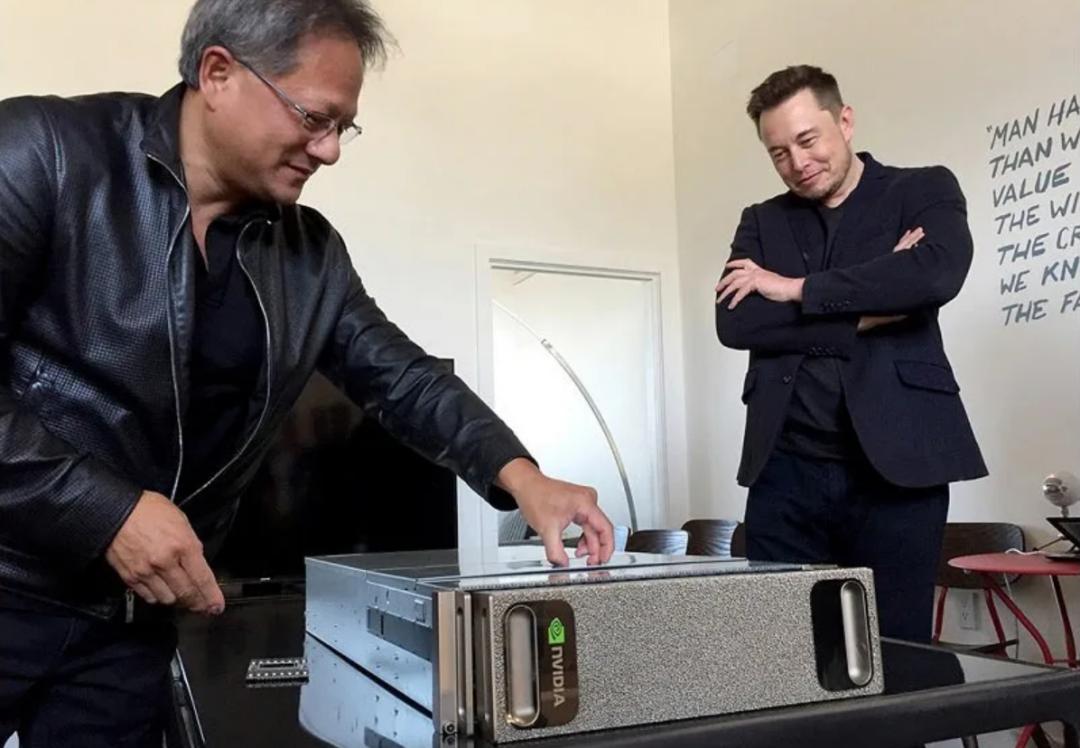
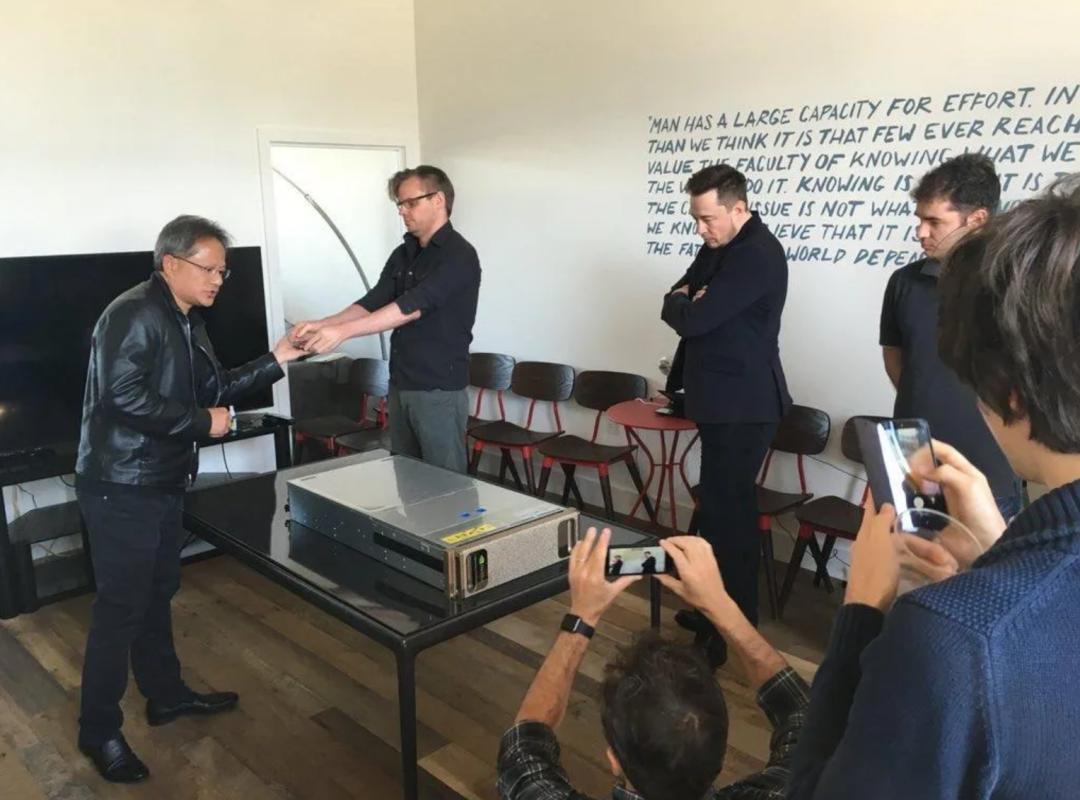
Caption: Jensen Huang went to OpenAI to personally deliver the first DGX-1
In the early stage of NVIDIA's establishment and the initial stage of deep learning development, Jensen Huang's personal credibility, strategic vision and negotiation ability did play a decisive role. He traveled around the world in a leather jacket, and used his own ability to bring in customers.
In the mature period of NVIDIA, Jensen Huang's personal charm, personal brand and social network also act as a lubricant for NVIDIA to maintain supply chain, customer and government relations. Some difficult things may become smoother with Jensen Huang's presence.
In the past two years, Jensen Huang is probably the person with the highest social value in the world, maybe not even one of them.
But the question of "which came first, the chicken or the egg" also exists in the case of NVIDIA and Jensen Huang.
Do people buy NVIDIA's graphics cards because of Jensen Huang's social skills? Or is it NVIDIA's graphics cards that give Jensen Huang such social skills?
At least many people socialize with Jensen Huang just for the chips.
In 2024, Oracle Chairman Larry Ellison invited Jensen Huang to a Japanese restaurant for dinner. At the dinner table, he and Elon Musk begged Jensen Huang to provide more GPUs.
"Please take our money, please take all our money, this meal is on me. Take more of our money, you don't take enough now, we need you to take more of our money, please." Ellison recalled at the meeting.
The person who asked Jensen Huang to deliver the goods to his door eight years ago now takes the initiative to invite him to dinner, and even takes the initiative to raise the price to buy the scarce GPUs.
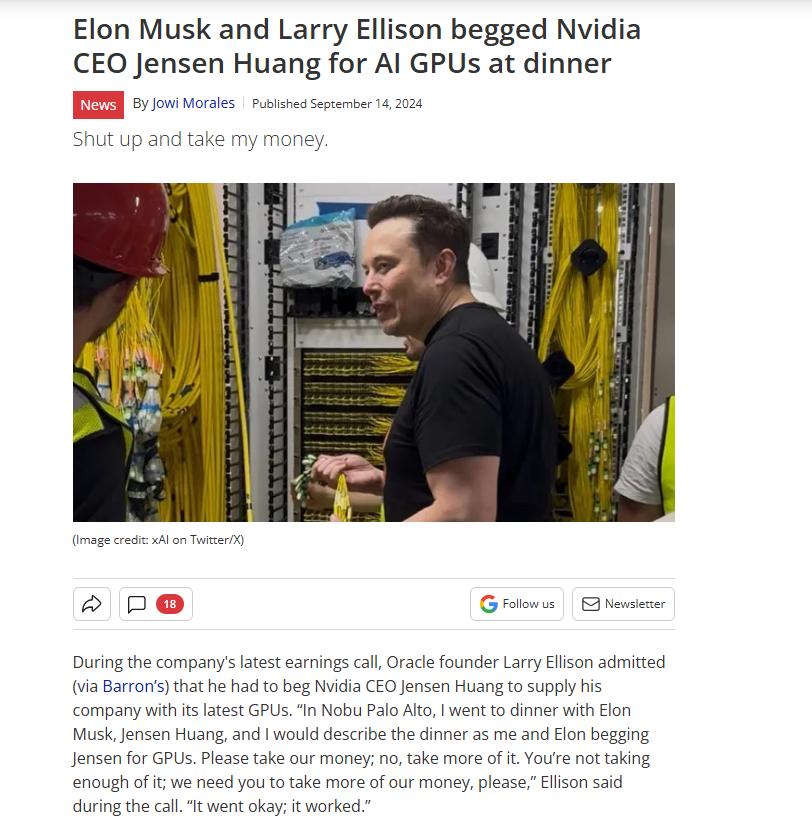
Caption: Oracle's 2024 Annual Financial Analyst Meeting
Even the former director of Megaspeed, the Singaporean computing power provider who is the protagonist of this incident, has purchased hardware worth more than 4.6 billion US dollars from NVIDIA during the time he knew Jensen Huang.
A business that requires the CEO to accompany drinking and run relationships every day to sell may face the situation that "the tea cools down as soon as the person leaves" when the CEO changes, but NVIDIA's GPU is a business that even Musk has to beg to pay for.
Will anyone replace all the servers in their data center with products from other companies just because the CEO is no longer Jensen Huang today?
Will the new CEO lose that social magic just because he is a different person?
03 "Cook" does not have to be a genius
Without Steve Jobs, it would be very difficult to find another person to make an excellent product like the iPhone.
But after "Steve Jobs" built a solid moat for the company, Steve Jobs' most important value has been realized. He cannot guarantee that his successor is a genius like him, but he can guarantee that even if the successor is not a genius, Apple can still remain great.
After Steve Jobs left, Tim Cook did not create another iPhone moment. He has no revolutionary products of his own, and he even created many failed products like luxury watches, and many products with mediocre sales like VR headsets.
He is not a genius in the sense that the public understands. He just continued to strengthen and expand Apple's products, supply chain and ecosystem on the basis left by Steve Jobs.
But over the past 15 years, Tim Cook has pushed Apple's market value from 350 billion US dollars to 4.6 trillion US dollars. Duan Yongping even believes that Tim Cook is a better CEO than Steve Jobs.
Without Steve Jobs, Tim Cook could not have created Apple. But after Steve Jobs left, Tim Cook could increase Apple's market value tenfold.
Once a great business model is built, it will no longer rely on great operators to exist. Operators do not have to be great men, nor can they always be great men.
Just as Buffett said, choose a company that even an idiot can run well, because sooner or later every company will be run by an idiot.
This article is from the WeChat Official Account "Lüe Da Can Kao" (ID: hyzibenlun), written by Lin Jiu, edited by Yang Zhichao, published with authorization from 36Kr.