Four rounds of financing in three months, with a valuation of nearly 10 billion yuan, the embodied brain company backed by Zhejiang University and the Alibaba ecosystem has secured new financing | HardKr Exclusive
Author | Huang Nan
Editor | Yuan Silai
36Kr has learned that embodied brain enterprise INFIFORCE recently completed a Pre-Series B financing of tens of millions of yuan, exclusively invested by Hangzhou Capital, a municipal state-owned capital investment and operation platform under the Hangzhou Municipal Government. The funds will be mainly invested in the R&D of the AtomBrain embodied brain, continue to dig deep into real deployment scenarios, and promote the engineering polishing and large-scale industrial implementation of products.
This is the fourth round of financing the company has completed within three months. Previously, INFIFORCE has successively completed nearly 1 billion yuan of Series A and Series A+ financing, and received a nearly 100 million yuan investment from Zhejiang Provincial State-owned Platform Zhejiang Venture Capital in October. Its current valuation is nearly 10 billion yuan.
This round of financing also marks the continuous increase of investment in the embodied brain track by the 100-billion-yuan level state-owned capital. The exclusive investor Hangzhou Capital has assets of over 110 billion yuan and a fund cooperation scale of over 240 billion yuan. Hangzhou Capital has made investments behind many star hard technology enterprises in Hangzhou, including Unitree Robotics, BrainCo, and Deep Robotics.
INFIFORCE was founded in 2023, focusing on the R&D of general embodied intelligent brains. Taking the Latent World Model as its core technical route, the company integrates embodied foundation model, continuous learning, scenario-based post-training and brain-body collaboration capabilities, and builds a complete technology and product system centered on the AtomBrain embodied brain, full-stack embodied data operation and multi-form robot bodies.
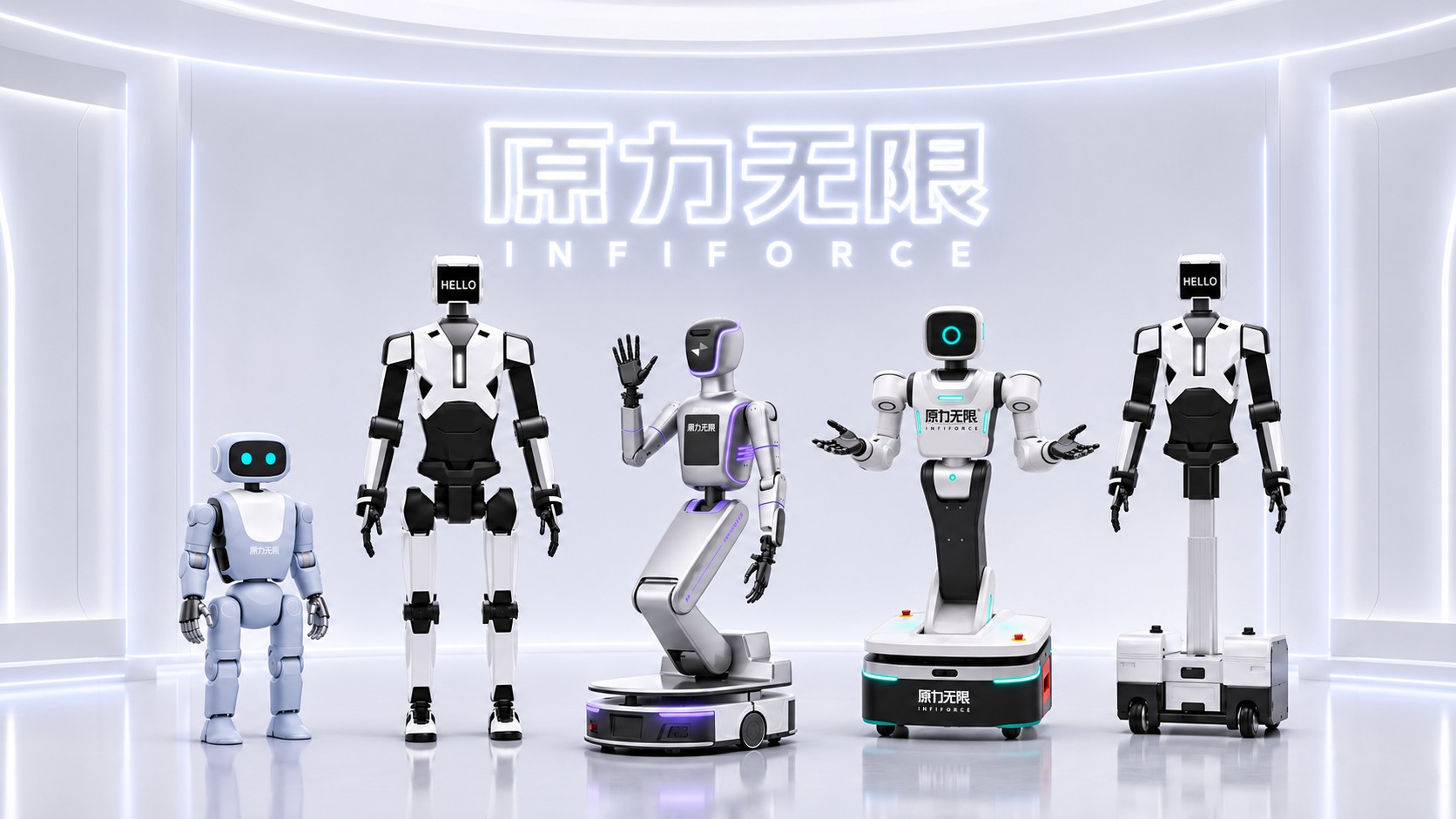
INFIFORCE embodied body matrix (Source/Enterprise)
The founding team of INFIFORCE is composed of top scientists and entrepreneurs. Bai Huiyuan, the founder and CEO, has experience backgrounds from Zhejiang University and Alibaba, and is one of the top ten young scientific entrepreneurs in Zhejiang Province. He leads an elite team from Fortune Global 500 companies and an R&D team with over 70% master's and doctoral degree holders, focusing on the R&D and commercialization of cutting-edge embodied intelligence technologies.
Chen Jiayu, the chief scientist, is currently an assistant professor and doctoral supervisor at the University of Hong Kong. He completed his undergraduate study at Peking University, obtained his doctorate at Purdue University, and finished his postdoctoral research at Carnegie Mellon University, studying under Vaneet Aggarwal, a scholar in the field of reinforcement learning, and Jeff Schneider, a scholar in the field of machine learning. He has long focused on reinforcement learning, multimodal large models and embodied intelligence, and pioneered the latent world model based on causal emergence.
Dr. Wang Yizhou, the chief technology officer, graduated from the University of California, Berkeley, studied under the famous professor Masayoshi Tomizuka in the field of robot control. He once worked at NVIDIA and the US autonomous driving team of Baidu, with more than ten years of experience in the mass production and deployment of millions of levels of intelligent driving products.
At present, master's and doctoral degree holders account for more than 70% of INFIFORCE's R&D team, covering scientific research and engineering talents from top global universities, scientific research institutions and Fortune Global 500 enterprises, forming a complete talent echelon from original basic research to large-scale delivery of complex intelligent systems.
The company has completed the R&D and iteration of two generations of embodied foundation models, and has formed more than 20 high-level scientific research achievements in the fields of causal world model, continuous learning, tactile perception and whole-body control. Many of the achievements have been published in top international academic conferences and journals such as ICLR, ICML, ECCV, IROS, AAAAI and IEEE TPAMI, and its base model capabilities have repeatedly topped the lists such as LIBERO and RoboTwin 2.0.
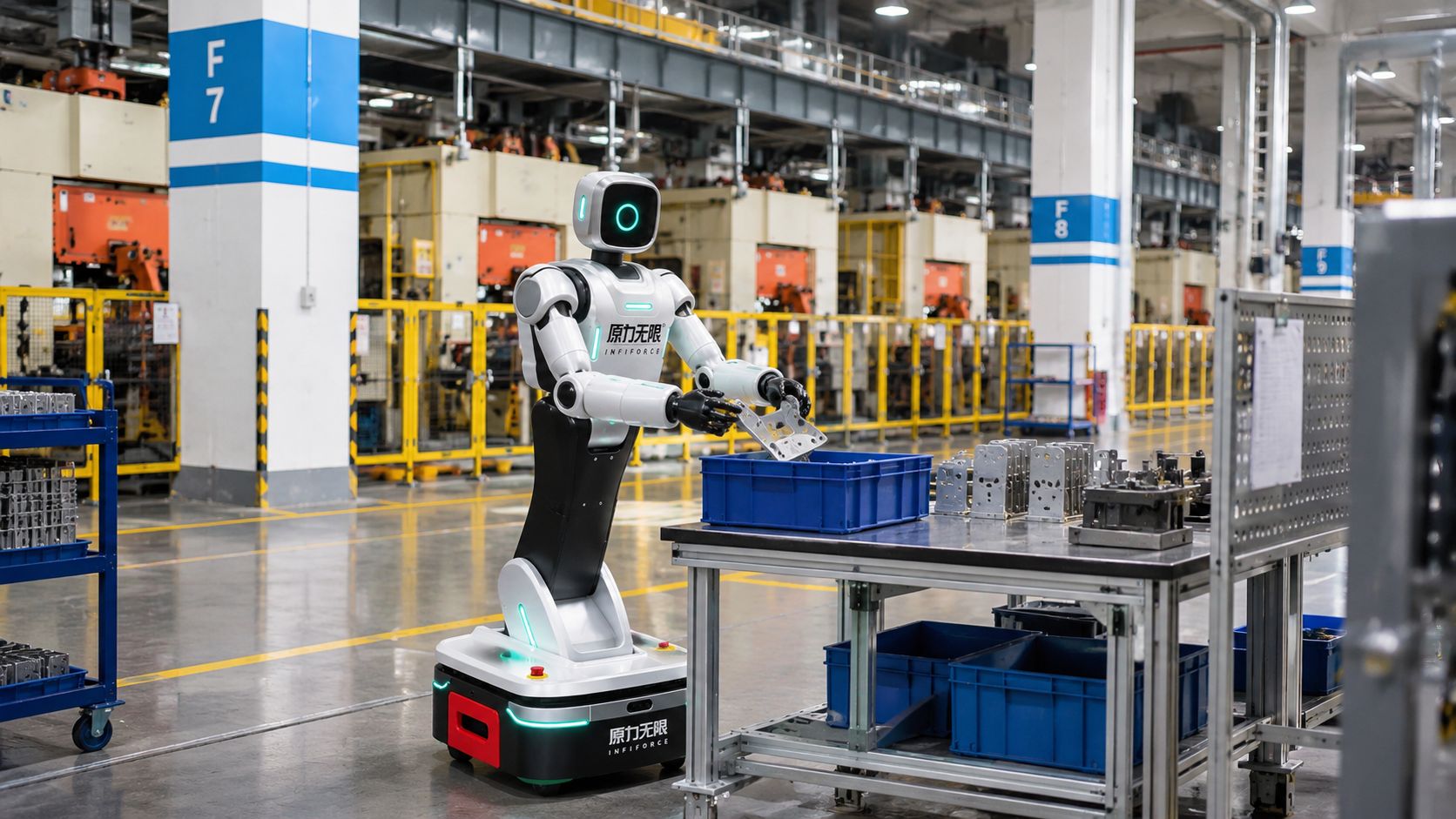
INFIFORCE embodied body deployment factory scenario (Source/Enterprise)
Embodied intelligence is accelerating the shift of its core focus from "body competition" to "brain competition".
In the past two years, robot bodies have made obvious progress in motion control, hardware performance and manufacturing capacity. But when robots walk out of the laboratory and enter the real physical world with changing light, adjusted layout and frequently changing object states, a more underlying problem begins to be exposed: can robots understand the environment, predict the cascading impact of actions, and continue to learn in long-cycle tasks?
The autonomous adaptation ability in dynamic scenarios cannot be achieved only by perception and imitation learning. It requires a complete world cognition base, which requires the embodied brain to have several core capabilities: world understanding, causal reasoning, long-term memory and continuous learning.
This is exactly the track that INFIFORCE has entered. Taking the latent world model as the core, integrating embodied foundation model, continuous learning, scenario-based post-training and brain-body collaboration capabilities, it enables robots to learn physical laws from real-world experience, understand the causal relationship between actions and results, and transform experience into transferable and generalizable intelligent capabilities, so as to be deployed and applied in various scenarios.
Bai Huiyuan explained to 36Kr that the value of the latent world model lies in enabling robots to have the ability to "predict consequences". "When a robot knocks over a cup, it needs to understand that water will spill and the tabletop will become slippery, which will further affect the decision-making of subsequent actions. This understanding of causal relationships cannot be obtained through simple data fitting, but requires the model to build the ability to simulate and deduce the physical world internally."
INFIFORCE has built a complete AtomBrain embodied brain technology system, with the latent causal world model as the underlying core, which is divided into four modules: embodied foundation model, high-level intelligence, scenario-based post-training, and Physical RSI continuous learning closed loop.
The embodied foundation model completes pre-training relying on first-person (Ego-Centric) multimodal native data and DataGrid full-stack AI Infra, integrates the causal world model, and learns general physical laws, causal relationships and action capabilities; high-level intelligence is responsible for task planning, subtask disassembly, memory management and failure recovery; scenario-based post-training adapts tasks for real operation scenarios, realizing cross-form transfer and generalization of capabilities between different robot bodies such as humanoid and wheeled robots; through the Physical RSI continuous learning closed loop, it further realizes multi-machine experience sharing, model iteration and intelligent self-evolution, forming a complete closed loop of acquiring experience from the real world, learning capabilities, understanding the world, and realizing intelligent evolution in continuous interaction.
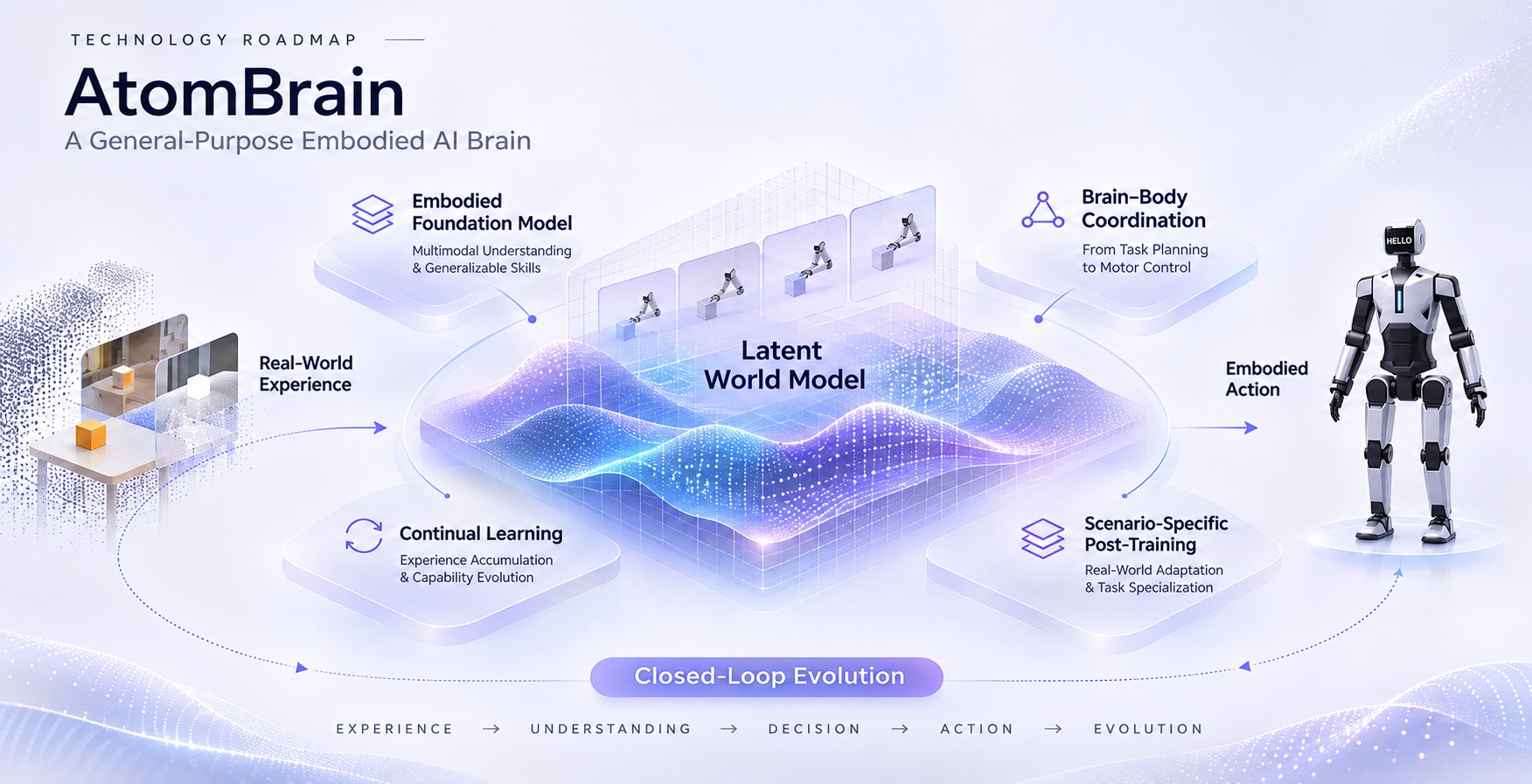
AtomBrain embodied brain technology system (Source/Enterprise)
Apart from the model, INFIFORCE has also built the Xinghe Data DataGrid full-stack AI Infra, covering Ego native data collection, processing, model training and scenario application, providing real-world data and engineering support for the continuous iteration of AtomBrain.
The hotel scenario is a typical sample of this capability moving toward scenario-based implementation. The hotel front desk is one of the most challenging unstructured service scenarios. Robots need to pick up items with different shapes and uncertain postures such as ID cards, room cards and signature documents, and complete a whole set of actions including verification, card issuing and check-out in the handover between humans and machines. INFIFORCE's solution combines multimodal perception and fine contact operation: vision first judges the orientation and position of the certificate, and force control completes card insertion, delivery and recycling. When encountering reflection, occlusion or placement deviation, it autonomously adjusts the grasping posture, breaking down the actions that used to rely on human "sensation" into reproducible machine instructions.
This capability can also be extended to the laundry scenario: clothes collection, laundry delivery, drying, clothes folding, and returning to rooms. The originally passively waiting process is transformed into a schedulable and traceable operation flow. What the robot takes over is not a single action, but a complete task link.
"The real value of such scenarios does not lie in the show of single-point actions, but in that they are standardized enough and replicable enough. The same set of brain weights can adapt to the spatial layout and business processes of different hotels after scenario-based post-training." In Bai Huiyuan's view, the competition of embodied intelligence will eventually return to two dimensions: one is the depth of the model's understanding of the physical world, and the other is the deployment density of technology in real scenarios. The former determines the upper limit of robot capabilities, and the latter determines whether technology can be transformed into sustainable commercial value.
Hotels are only a microcosm of the large-scale industrial application of INFIFORCE's embodied brain. Up to now, INFIFORCE's business has covered more than 30 cities across China and nearly 100 real scenarios, with a cumulative order amount of more than 500 million yuan, and its commercialization process ranks in the first echelon of the domestic embodied intelligence industry.
In the industrial field, INFIFORCE continues to dig deep into high-value scenarios such as automobile manufacturing, home appliance manufacturing, and warehousing and logistics; in the commercial field, it focuses on scenarios with large-scale replication potential such as hotel services and commercial laundries. At present, its embodied brain and related products have entered benchmark scenarios such as the national-level embodied intelligent pilot test base in Hangzhou, the production line of a century-old German automobile enterprise, the workshop of a leading domestic home appliance manufacturer, and leading business travel hotels, gradually forming a commercial closed loop from technical verification and scenario adaptation to large-scale industrial delivery.
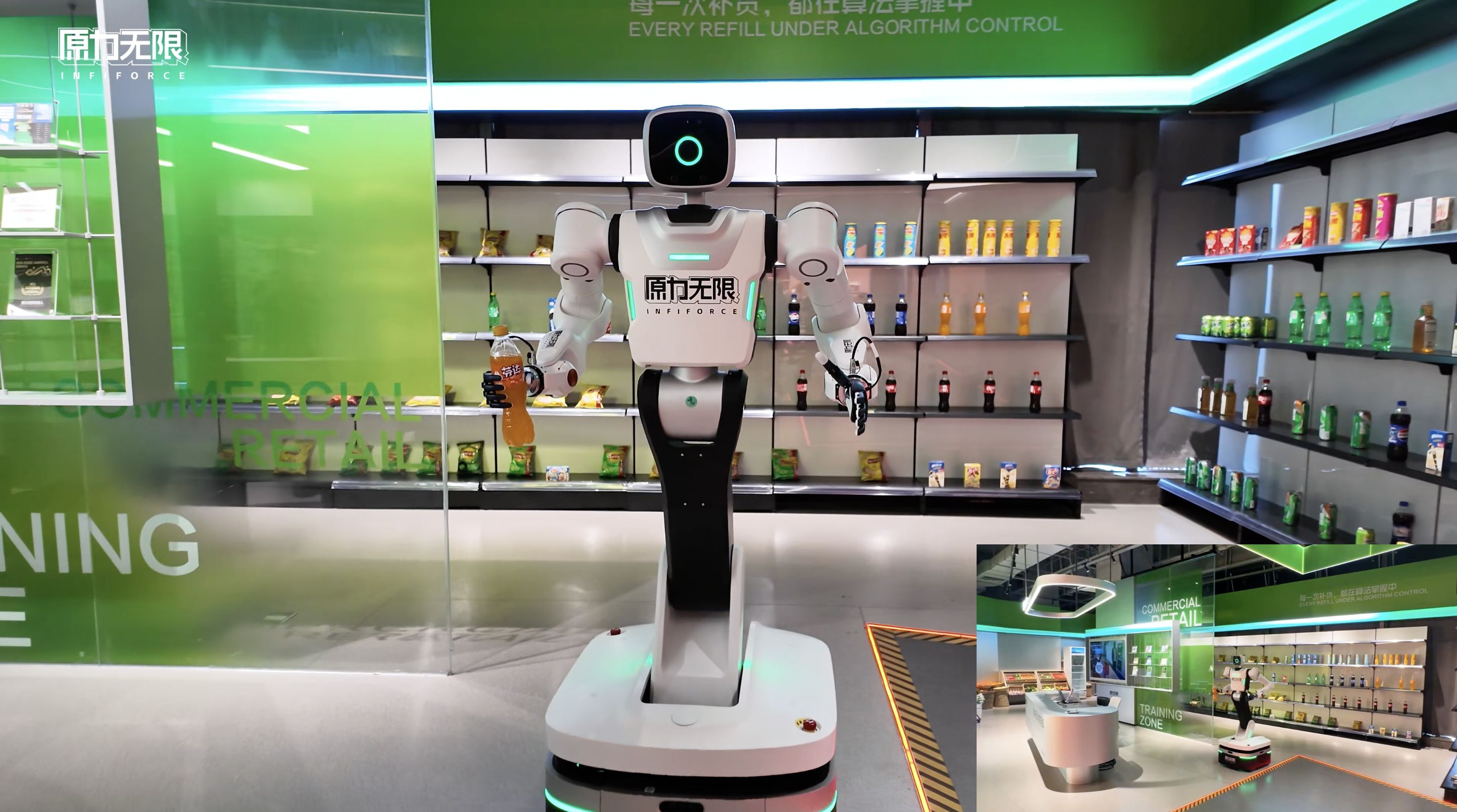
INFIFORCE's solution applied in commercial scenarios (Source/Enterprise)
Meanwhile, according to the latest news from 36Kr, INFIFORCE has completed a strategic cooperation signing with JD Technology. The two sides will carry out in-depth cooperation in the fields of embodied brain training center construction, real-world data infrastructure and scenario-based deployment solutions, and jointly promote the new industrial infrastructure and large-scale application in the era of physical AI.
The following is an excerpt from the interview between 36Kr and Bai Huiyuan, founder and CEO of INFIFORCE (slightly edited):
36Kr: INFIFORCE adopts a deployment path of prioritizing industry and commerce before family scenarios. The technical pre-research for family scenarios has been completed. What are the core criteria for your team to select deployment scenarios?
Bai Huiyuan: We have completed the technical pre-research for family scenarios. We have open-sourced 500 family scenarios and 8000 scenario datasets, and we have the technical prototype capability, but we actively postpone the family scenario. The core constraint lies in safety: in the home environment, robots and humans are in a state of high-frequency and close-range interaction, and there are extremely many variables of accident risks. To achieve consumer-level safety and reliability, a very long cycle of verification is required, and the commercialization conditions are not mature at this stage.
We have three clear paradigms for selecting industrial and commercial deployment scenarios: sufficiently large market volume, high scenario standardization, and real, measurable rigid pain points.
Taking the automobile production line as an example, flexible loading and unloading and SPS material frame sorting have clear requirements for tact time, positioning accuracy and model change efficiency; in the logistics industry, unpacking and palletizing, labeling and transferring have clear task boundaries and reproducible working conditions; fabric sorting and finishing in overseas commercial laundries puts forward tests on the stability of material identification and grasping posture. The common point of these scenarios is that the value of cost reduction and efficiency improvement can be quantified, and customers are willing to pay for verifiable results.
But this does not mean that a set of general brain weights can directly dominate all scenarios. INFIFORCE takes AtomBrain as the general base, and then conducts scenario-based post-training and fine-tuning according to the station characteristics of different industries and the execution capabilities of different robot bodies, to adapt to their respective tact time, accuracy and ROI constraints, and finally output customized solutions.
36Kr: Referring to the development history of the autonomous driving industry, how do you view the real stage that the current domestic embodied intelligence industry is in? Recently, there have been voices in the market that "the industry is facing a cold snap", what is the essence behind it?
Bai Huiyuan: It is easier to understand the current situation of the industry by taking autonomous driving as a reference. After 20 years of development, autonomous driving has only reached the transition stage from L3.5 to L4; while embodied intelligence has only entered the public view in recent years, with higher complexity than intelligent driving, and it needs to face robot bodies of different forms and thousands of different physical scenarios.
From the perspective of technology maturity, the industry as a whole is roughly at the level equivalent to L2 of intelligent driving, that is, limited autonomy for a single task. Robots can complete a single defined task, but their autonomous processing capabilities are still weak in the face of environmental changes, accidental disturbances and long-range chain tasks. The real full-scenario L3 level full autonomy is still the goal to be conquered by the whole industry.
The so-called "industry cold snap" does not mean that the value of the track itself has disappeared, but that the industry has returned to the rational development cycle from the capital frenzy period. A large amount of capital poured into the market in the past two years, and the market had excessively high expectations for embodied intelligence, equating laboratory prototype capabilities with industrialization capabilities. When people find that the difficulty of mass production and deployment is far beyond imagination, expectations are adjusted back.
After the tide recedes, the market's evaluation criteria will change fundamentally, and people will no longer pay only for cool demos. In the future, what will test start-ups are four hard strengths: the comprehensive composite capability of the team, the know-how precipitation in vertical industries, the capability of high-quality data closed loop, and the deployment capability of commercial closed loop. The industry will move toward polarization: companies with solid technology that can deliver paid solutions will stand out faster; teams that only rely on demonstrations and lack deployment capabilities will be eliminated. This is the normal law of the development of the hard technology industry.
The core of competition between embodied intelligence enterprises in the future is the evolution efficiency of intelligence, and the ability to transform intelligence into industrial productivity. INFIFORCE will continue to dig deep into the original R&D and large-scale industrial application of embodied brains, and build an embodied brain enterprise with world-class original technical strength and industrial influence in the global physical AI technology competition.