Five Judgments on Enterprise AI Reconstruction
Looking back at this year, for Chinese enterprise software and SaaS vendors, facing the rapidly evolving AI landscape and the potential collapse of the subscription business model, the most anxious and prominent issue is how companies and organizations can undergo AI transformation. Many founders have already made considerable investments in AI, purchasing tools, revamping products, and adopting AI Coding. These seem to be scattered point-based investments, but people always end up encountering a problem: individual efficiency has improved, yet why has the company's profit not increased accordingly?
This year, we have held multiple rounds of discussions centered on competition, business, technology and delivery. As we talked, the topic always circled back to organization. The most worrying scenario is that the boss keeps calling for AI transformation, but still requires documents to be printed out for multi-level signatures during the approval process. When one person works faster, the subsequent approval, collaboration and acceptance still follow the old procedures, and the saved time is wasted elsewhere.
However, changes outside are happening very fast. Agents start to "defect" and do delivery by themselves, aiming to realize their product dreams as well as increase revenue. Clients start to build their own Agents manually, and software vendors also begin to cross their original boundaries. The industrial division of labor system formed over many years is quietly collapsing.
On November 14, at the China Enterprise AI Conference, I organized my observations of this year into five judgments. Some of them still need time to verify, but they may provide some reference for enterprises that are undergoing transformation.
01
We have all reached a switching moment
An old friend once told me that no matter whether you are willing or not, we have all reached a switching moment. Looking back at the development of SaaS, around 2008, cloud computing entered China, and the division of labor among SaaS, PaaS and IaaS gradually became clear. Around 2010, the infrastructure gradually matured. By 2014, SaaS entered a stage of vigorous development. In those years, financing news came out almost every week, and the promotion of capital to the industry is still vivid in our memory.
Will this round of large models and Agents go through a similar process? Large models gained momentum in 2023, and by 2026, people have begun to discuss Agent intensively, and some call this the first year of Agent. My judgment is that in the next two to three years, enterprise-grade Agents are very likely to enter a stage of flourishing development, and the timing for capital to enter the application side has also arrived.
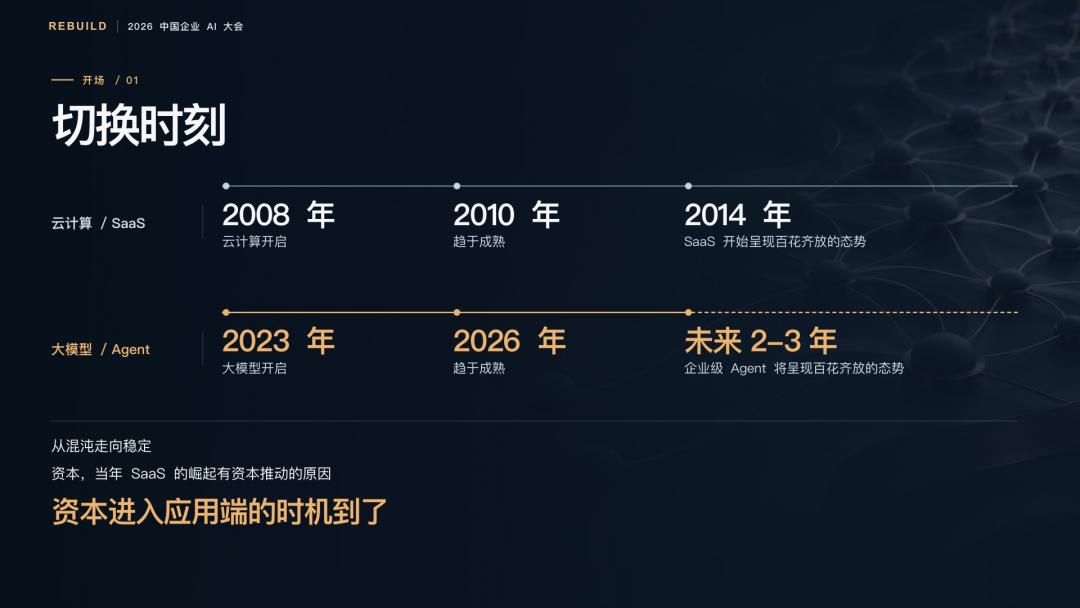
Application opportunities on the two timelines
This year, Cuiniuhui launched an experiment called "AI Decision Lab", because we are increasingly feeling the weight of decision-making. The slogan of Cuiniuhui is "to influence and connect enterprise decision-makers". In such an era, if you make the right choice, you may still have a chance even if you are two months late. If you make two consecutive wrong key decisions, you may be eliminated from the next round of competition. Competition, business, technology and delivery are all changing, and how to turn individual improvement into organizational capability is an unavoidable issue in these discussions.
02
Judgment 1: Competitive positions have changed
Small entry point, large market, "besiege the enemy at the stronghold to ambush the reinforcements", the boundaries of software are disappearing, and competition has entered a melee period. In the past, enterprise software had a relatively stable ecosystem: cloud vendors provided infrastructure, platform software vendors mastered core systems, SaaS vendors focused on segmented scenarios, agents were responsible for customer relationships, and system integrators did implementation and customization. Each layer had its own territory, and everyone acquiesced to each other's boundaries.
Now, this division of labor chain is disintegrating. More and more agents pick up AI programming tools and go directly to the customer site to do delivery. In the past, they had to purchase products from software companies and earn the price difference, but now they can meet some demands on their own. Customers also start to build their own Agents manually, and projects that originally had to be handed over to external vendors are tested internally first. Traditional software, SaaS vendors, agents, customer self-development, OPC plus FDE teams, plus large internet companies, six types of participants are entering this market at the same time.
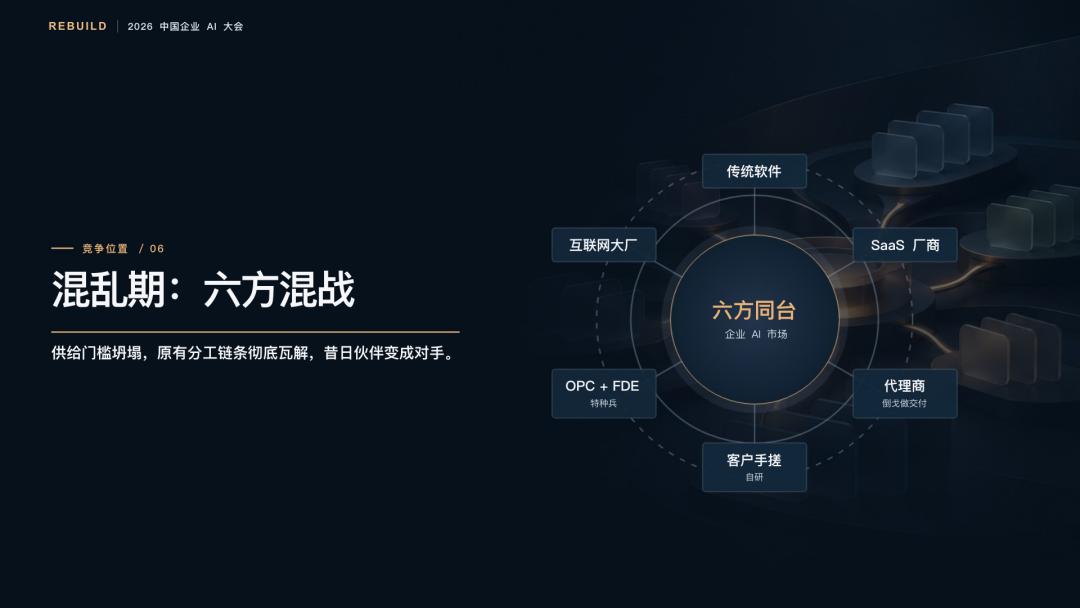
Six-party melee after the supply threshold drops
The thresholds for code generation and product implementation have dropped. People who originally had no R&D capabilities can now deliver the required solutions, and former partners may become competitors from now on. This year, I have conducted many interviews on FDE implementation. I came across a team that first obtained the customer's business reports, identified abnormal indicators and data that obviously lag behind the industry level, then cut in from this point to help the customer improve. The entry point is very small, but it is closely attached to the most painful part of the customer's business.
After entering, customers will continue to hand over demands to you. In the past, you did CRM and he did HR, and everyone acquiesced to the boundaries between each other. Now, as long as the customer trusts you and is willing to hand over the context and adjacent businesses to you, your business will expand in all directions, and the line that the software company originally drew for itself will be very difficult to defend.
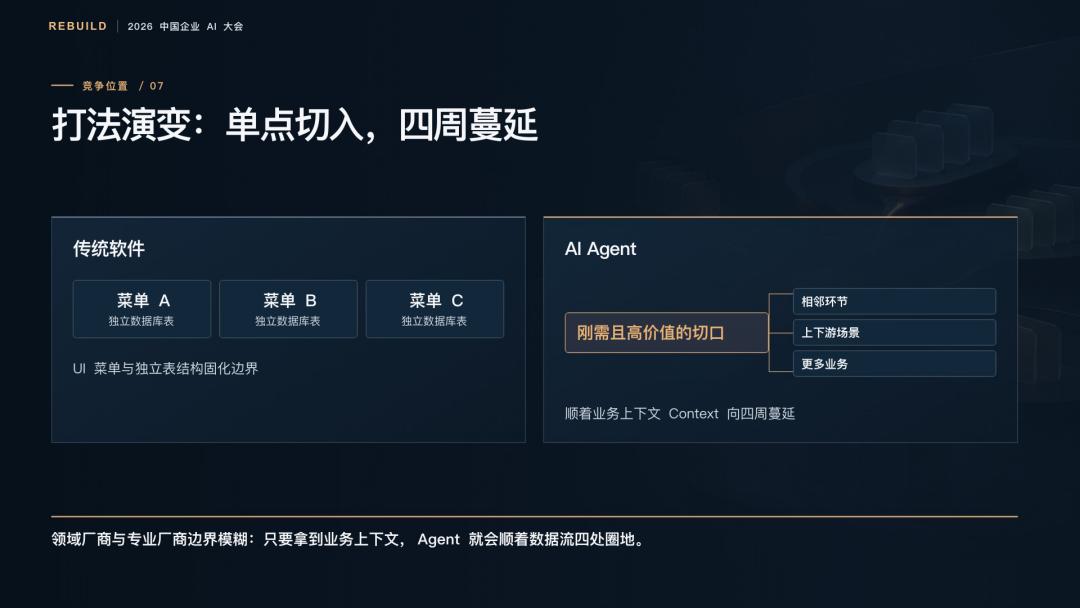
Expand from a high-value entry point to adjacent businesses
Looking three to five years ahead, everyone may compete for the position of "Enterprise AI Brain". No matter you enter from the sales side or the finance side, you eventually need to understand the enterprise's business objects, the association network between objects, and what actions can be executed under what conditions. From the perspective of business logic, the operation interface becomes a WorkBuddy-like workbench, with Ontology below it, and the original IT system is at the bottom layer.
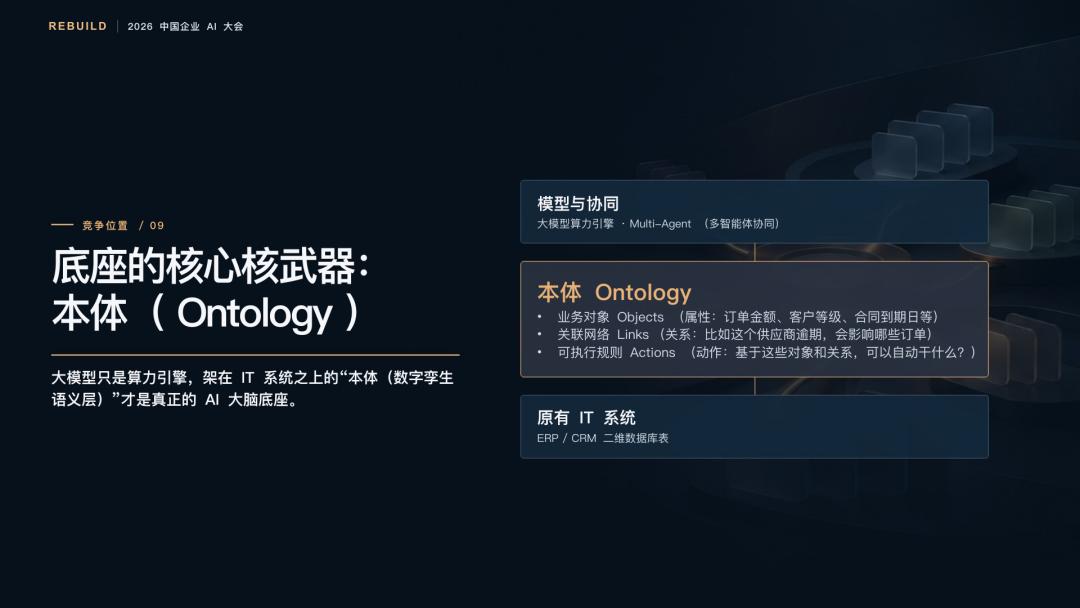
Hand over business object relationships and executable rules to AI
Another point is that industry vendors have the opportunity to embed the business rules accumulated over many years and then expand to general capabilities, which is also why I am optimistic about industry vendors. The core businesses that customers are truly willing to hand over usually can only be taken over by those who have in-depth understanding of the industry.
03
Judgment 2: Business value has changed
"Change the course", shift from subscription to outcome. This year I heard a very representative story: a friend judged that there was a window of about one or two years between SaaS and AI, during which he could add more sales staff to sell more software. The first quarter went well, but by the second quarter, customer demands began to change significantly. Later, as soon as the boss started the conversation, he talked about AI, and he cared about what work you can take over and what indicators you can improve. The original software sales model centered on functions became increasingly difficult to promote.
The impact a software company encounters may come from changes in customer demands and budget priorities.
I presented three figures in my speech. According to the forecast released by IDC in 2024, China's enterprise-level ICT expenditure in 2027 will be about 350 billion US dollars. Roughly calculated at the exchange rate of 1 US dollar to 7.2 RMB, it is about 2.52 trillion RMB. According to data from the National Bureau of Statistics, the labor remuneration of China's non-financial enterprises in 2023 was about 36.6 trillion RMB, and the operating cost of industrial enterprises above designated size in 2025 was 118.75 trillion RMB. The rough ratios of the latter two figures to the previous ICT expenditure scale are about 14.5 times and 47.1 times respectively.
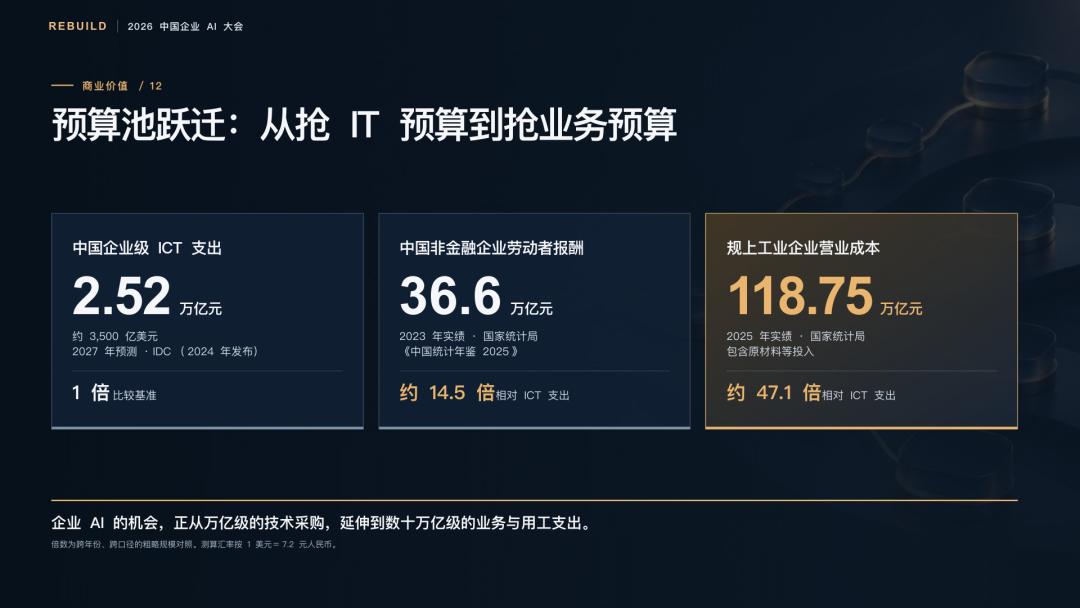
Magnitude comparison between technology procurement and business labor expenditure
These figures are from different years and have different statistical scopes. Industrial operating costs include raw material and other inputs, and also overlap with labor expenditure, which is suitable for us to understand the magnitude. For a specific enterprise, which segment of cost it can serve has to be broken down along the business. In the past, we received money from software procurement. Now, if we can directly take over a segment of customer service, review, reconciliation or production improvement, we have the opportunity to enter the expenditure that customers originally spent on business and labor.
Opportunities are getting bigger, but prices may also get lower. In the exchange at the sub-forum of the AI Practitioners Summit yesterday (November 13), a partner of a law firm mentioned that customers would use AI to optimize costs to ask service providers to lower prices. The annual unit price of legal services for an enterprise was around 100,000 RMB in the past, but now it has dropped to around 30,000 RMB. As efficiency improves, customers will also re-evaluate how much the service is worth. Service providers have to calculate both how much their own costs can be reduced and how much their quotations will be suppressed.
In the future, the business of software companies may evolve into several forms. Some people do distribution of Tokens and computing power, delivering a combination of software and hardware, models and usage. Some people directly provide business services, take over a result and settle according to the agreement. Others deepen industry data and professional knowledge to form capabilities that can continuously serve customers.
Among these, what I am most worried about is that Party B does the business work, but in the end still gets paid from the IT software budget. You take on business indicators and assign staff to invest heavily, but Party A's procurement still uses the original bidding method, software contract and price comparison logic, pushing you into a very small budget space.
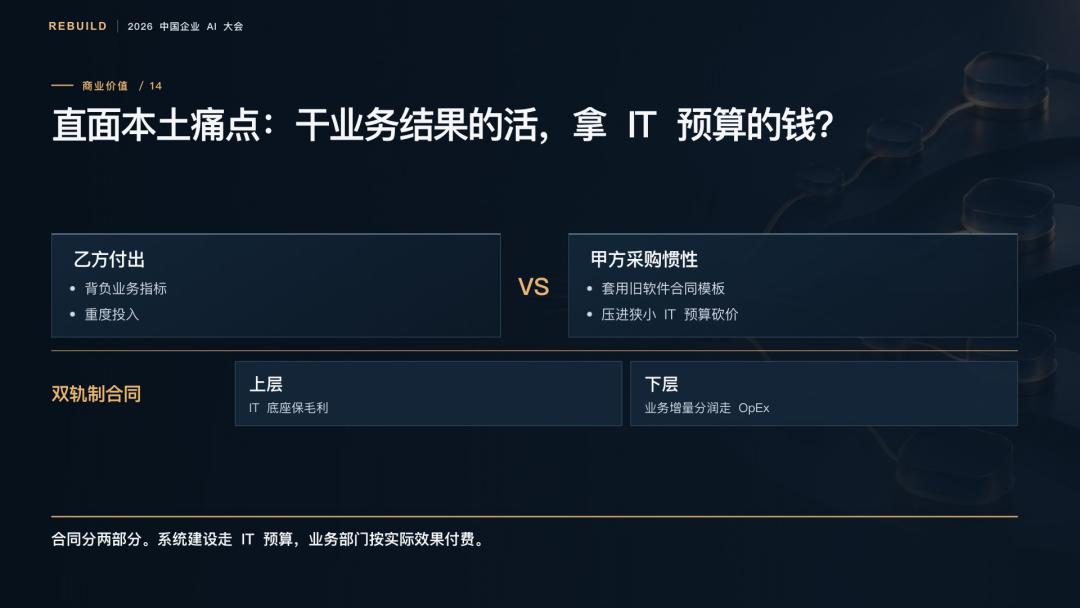
Agree on payment methods for system construction and business results separately
Therefore, when signing the contract, the two parts must be made clear. How to charge for system construction, interfaces and maintenance, how to accept business results, how to check accounts, and who will pay, all need to be agreed in advance.
04
Judgment 3: Organizational paradigm has changed
AI-native organizations will "emerge suddenly". Just now, Bai Ya, the founder of Youzan, talked about organizational adjustment, and one point really resonated with me: he hopes to reduce the friction caused by information transfer between people, and let human-machine collaboration take on more work. The context between people often does not align. For the same thing, everyone has a different understanding, and a lot of management costs are spent on explanation, reporting and alignment. When part of the knowledge can be precipitated as Skills and part of the work can be handed over to Agents, the information flow and division of labor in the organization have the opportunity to be rearranged.
Lao Bao, the founder of Xiaoe-tech, once shared a very vivid metaphor, the "hot pot-style organization". Everyone sits together for a task. After the hot pot meal is finished and the task is completed, the team disbands, and a new team will be formed for the next task. Organizations will increasingly operate around tasks, and the hierarchy will become flatter and flatter.
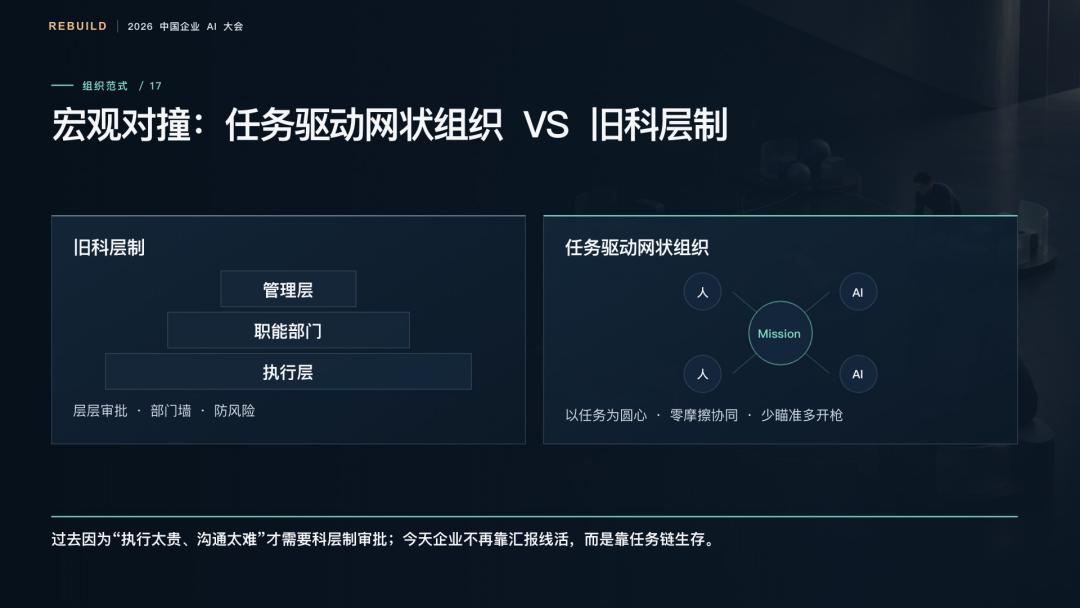
Organize people and AI around tasks
AI-native companies can start from new external capabilities and new interactions to deduce what kind of team they need. What existing enterprises need to do is to change the working methods of R&D, operation and delivery from the inside, and then bring the capabilities to external customers. In the future, small organizations with high personnel efficiency will be increasingly respected. For existing enterprises, the top leader has to personally step in and push forward strongly to achieve this. We joked that an "enlightened tyrant" is needed to complete the organizational transformation.
When AI enters the organization, it will roughly take on three types of work. One type is the execution assistant: people assign tasks and set standards, AI does specific work such as sorting and checking, and people do the acceptance. The second type is like a business colleague: the team first imports enterprise materials, configures processes and permissions, verifies with real cases, and then lets it take over a complete segment of work. The third type undertakes coordination work: summarizing progress, reminding of anomalies, helping management and front-line staff align in time.
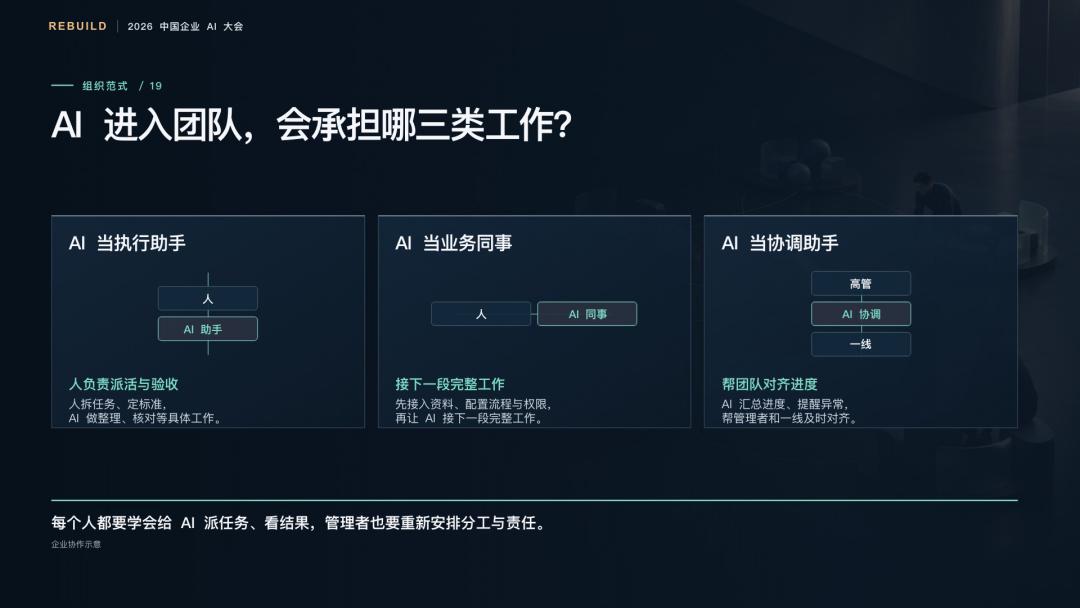
Three types of work that AI does in the team
In April this year, when we visited MiniMax for learning, someone mentioned in the exchange that his schedule is now fully arranged by AI, and he keeps receiving tasks around interviews and follow-up work. When people assign work to AI, AI also begins to participate in organizing people's work, which will also change the management method. In the past, we checked attendance and online duration, hoping that employees would sit for eight full hours. Now managers have the opportunity to see more specifically how the work is progressing and where the problem is.
A founder from the second phase of the "AI Decision Lab" told such a story: he connected AI to the customer service group to help him summarize abnormal information. They have many customer groups, and sales staff may not take the initiative to tell him every problem. With this sorting, he can see the few anomalies that need to be handled most urgently