IBM has developed an ultra-large quantum chip
Over the past few years, Microsoft has been heavily promoting its progress toward its ambitious goal of launching a fault-tolerant quantum computer in 2029, highlighting advances in areas ranging from error correction and quantum advantage to tighter integration of quantum and classical high-performance computing.
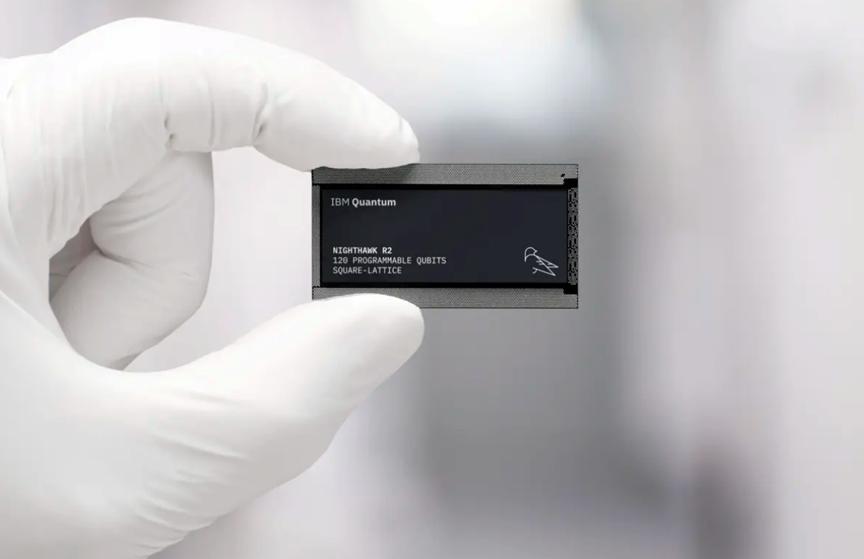
This month a year ago, IBM released Nighthawk (shown in the figure below), the successor to the Heron quantum processor, which contains 120 qubits and adopts a square lattice architecture. This topology is completely different from IBM's previous heavy-duty hexagonal technology, bringing higher qubit connectivity, crosstalk management and circuit depth performance. In September this year, IBM launched Nighthawk r2, another 120-qubit quantum processing unit (QPU) equipped with a brand-new reset system that boosts throughput to more than 100,000 circuits per second.
Meanwhile, research papers outlined three quantum advantage demonstrations running on IBM's Heron quantum chip, as well as the launch of a modular and scalable cryogenic cooling system, which is critical for IBM's fault-tolerant Starling system to be launched in 2029, and is another example of the company's modular approach to building quantum infrastructure.
In addition, achievements with partners were announced, including cooperation with AMD and Oak Ridge National Laboratory on error correction for quantum-classical computing, and collaboration with RIKEN of Japan and Cleveland Clinic on the application of hybrid quantum and classical computing in scientific research.
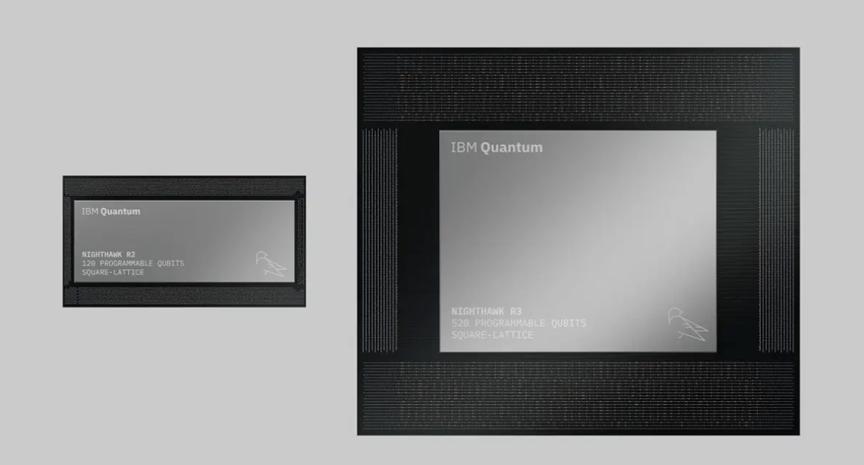
This week, at IBM's 2026 Quantum Developer Conference held in Chicago, the company outlined the speed and quality improvements of the Nighthawk r2 QPU, and plans to launch its next-generation quantum chip Nighthawk r3 in 2027. The company also plans to release a device that will use remote couplers (L-couplers) to connect two Nighthawk r3 processors into a single system.
IBM executives said that when discussing quantum workloads, speed is as important as scale and quality. They pointed out that a growing number of applications require circuits capable of performing thousands of operations on 100 or more qubits to generate millions or even billions of samples. Quantum systems need to achieve a leap in speed to ensure that such applications can run fast enough at an acceptable cost.
Oliver Dial, IBM Fellow and Senior Vice President of Quantum Systems, said that the design of Nighthawk r2 has made progress in this direction. Dial told reporters at a pre-event press conference that like the first-generation Nighthawk, the r2 also contains 120 qubits, but it is also equipped with on-chip qubit reset functionality.
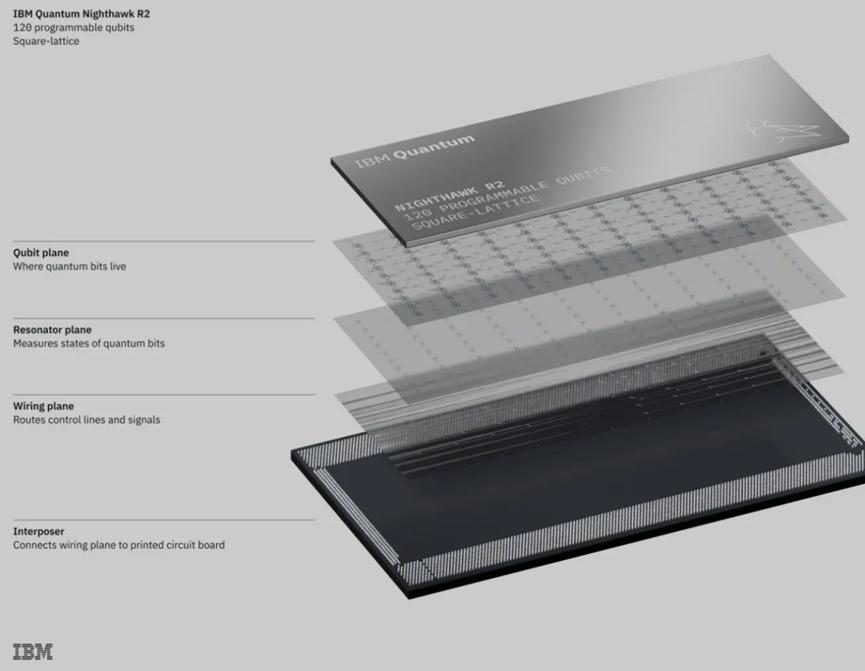
"This is an extra physical qubit we added on the chip for each programmable qubit, which allows us to quickly remove energy from the programmable qubit and bring it back to the ground state," he said. "This feature enables our users to run circuits on this chip faster than ever before. In fact, in the first three weeks after this device was launched, our users ran 8 billion circuits."
Since September, Nighthawk r2 has run more than 34 billion circuits, and IBM has run 7,500 gates on this chip, which is 19 times faster than Nighthawk r1 thanks to the reset feature.
Nighthawk r3 can scale to more than 520 qubits and support 10,000 quantum operations. While maintaining square lattice connectivity, it also includes 10 inter-chip L-coupler interconnects that can be used to build larger quantum systems. Connecting two Nighthawk r3 processors creates a 1,040-qubit system that can run larger and more complex calculations.
Nighthawk r3 will be manufactured at the Anderon 300mm quantum superconducting wafer fab in Albany, New York. (Figure below) Anderon is a subsidiary of IBM, and its business scale has expanded after the US Department of Commerce allocated 1 billion USD through the federal CHIPS Act in May this year. IBM itself has also invested 1 billion USD. It is also worth mentioning that GlobalFoundries has also received 375 million USD in funding from the Department of Commerce to develop a quantum wafer fab.
Dial said that L-couplers are the key to improving performance and scalability. IBM used four L-couplers to connect Nighthawk r1 processors, achieving a quantum state transfer fidelity of 99.3%, getting closer to the company's target of 99.9%.
"The cooling work currently underway in Poughkeepsie, New York (the location of IBM's quantum data center) is the first of its kind, placing two processors in two different refrigerators and using four L-couplers, but this time using Nighthawk R2 processors," Dial said. "We believe this progress shows that we have made significant progress on the path to building the Starling system."
Starling, expected to arrive in 2029, will be a fault-tolerant system with 200 logical qubits capable of performing 100 million quantum operations. IBM's key to the Starling project is the planned use of the dual-variable bicycle code, a quantum low-density parity-check (qLDPC) error correction code that reduces the number of physical qubits required to form a logical qubit and the amount of quantum information they store.
Starling's successor, Blue Jay, will be launched in 2033 or later.
"Many of the technologies we first applied in the Nighthawk project will also help us build Starling," he said. "Our solution to achieve large-scale fault tolerance is the only practical fault-tolerant method currently available. This is because it is based on a universal Pauli computational architecture that uses error correction codes that are more than 10 times more efficient than other solutions such as surface codes. It is built on a modular platform that allows us to build modules of the same size and complexity as we can currently build, and combine them to build this huge platform."
Dial added: "The modularity and efficiency of this design are the keys to its practicality. To make this architecture a reality, we need to demonstrate several key technologies. This includes device physics for improved connectivity (such as C-couplers), packaging for transmitting more signals, decoders, the ability to detect and correct computational errors, modular quantum processors with L-couplers (as previously mentioned in Nighthawk R3), modular cryogenic systems, and modular control electronics."
When asked about what other milestones Starling needs to reach, Dial pointed to "larger and better devices", "more wiring", the ability to demonstrate a modular cryogenic cooling system at three times the current scale, and the ability to run decoding in real time.
IBM is also continuing to promote the tighter integration of quantum systems with classical computers. The latest initiative launched by IBM during this week's event is to integrate classical high-performance computing (HPC) and quantum computing into a single management environment on the IBM Quantum platform, which will enable enterprises to integrate quantum workflows with various classical computing resources ranging from laptops to supercomputers, or with existing classical resources on the platform.
This coincides with the error correction co-design platform announced by IBM this month, which integrates IBM's Nighthawk r2 and Oak Ridge National Laboratory's Umbra supercomputer (powered by AMD Epyc data center chips and Instinct GPUs) into the same data center in Poughkeepsie, New York.
Jerry Chow, IBM Fellow and CTO of Quantum Supercomputing, said that this managed service "allows you to configure computing resources of different scales, from CPU-based computing to GPU-based computing, and deploy them in the same environment where quantum computers run. You can ensure the persistence of resources between running jobs, and easily pay for both classical and quantum resources in one place."
(Source: Compiled from nextplatform)
This article comes from the WeChat official account "Semiconductor Industry Observer", published with authorization from 36Kr.