Druckenmiller's latest view: shift to capital preservation mode, and AI investment is pivoting to application sectors.
On November 17, 2026 local time, Stanley Druckenmiller, founder of Duquesne Family Office and renowned investor, stated at the TomorrowX Summit in Austin that he has entered a capital preservation mode. The lack of clear judgment on the next 12 months has led this macro investor to choose to reduce risks and wait temporarily.
"What I am striving for now is not losing money, rather than making money," he said in an interview with Iliana Bouzali, an executive of Morgan Stanley.
At the same time, he is also adjusting the direction of seeking returns on AI investments: Infrastructure may still offer phased trading opportunities, but his focus is shifting to specific applications, and whether model companies can move from selling tokens to task delivery.
"Bright Company" has sorted out Druckenmiller's core views based on on-site information released on various platforms.
01
Investment conditions that prevailed at the start of this year are reversing
According to on-site records, Druckenmiller said that the assets he currently holds are almost completely different from those in January 2026. At the beginning of the year, the interest rate environment, low credit spreads, market technicals, economic growth and the AI boom collectively supported his judgment. Back then, he believed that the probability of a recession in the next 12 to 18 months was very low.
Today, the US economy itself remains strong, but other supporting conditions have changed. The Federal Reserve has stopped cutting interest rates, commodity prices have weakened, and credit spreads have widened. He also mentioned that the advance-decline line, the cumulative indicator of advancing and declining issues that measures market breadth, peaked on August 14.
Defensive stocks have started to outperform the broader market, which has also entered his observation scope. Combined with changes in commodity prices, he remains vigilant about the economic performance in the second half of 2027, believing that the performance then may be disappointing. Duquesne has established short positions in copper.
However, concerns about the economic outlook have not yet translated into large-scale short selling of stocks. Druckenmiller believes that technological innovation and market position structure may still bring about a rebound, making short selling equally risky. At present, his net stock exposure is close to neutral, with a small number of US dollar-related positions. The "neutrality" here means that the long and short risks are roughly balanced, and does not mean that all stocks have been sold off.
02
Profit and loss and trading status determine advance and retreat
In this interview, Druckenmiller gave a lot of explanations about his trading status. He said that Duquesne's returns tend to be concentrated in certain stages: it makes relatively large profits for three or four consecutive years, and then may experience a long period of sideways movement. Institutions do not need to maintain the same offensive intensity at every stage.
He also mentioned that young members of the team helped Duquesne seize this round of AI market rally. For an institution that relies on investment judgment to obtain returns, maintaining an understanding of new technologies is as important as judging when to reduce participation.
According to on-site notes, Druckenmiller said that Duquesne does not use traditional VaR or stress test indicators as its risk management method, but regards actual profit and loss as the core feedback. If the stock price movement no longer conforms to the expected correlation, he will reduce his positions.
He believes that there is a "state" in trading: sometimes he can clearly see opportunities and make effective judgments continuously; sometimes it is difficult to form a firm grasp. When performance improves and judgments go smoothly, he will increase his investment, otherwise he will scale back. At present, he describes himself as being in a "temporarily away from the market" state. This break may last for two days, or as long as six months.
03
AI labs may shift from selling tokens to selling tasks
In the AI field, the change Druckenmiller presented this time is that stock investment is starting to look for more practical application scenarios. Infrastructure may still present tactical trading opportunities in the future, but he no longer regards it as the main engine of performance in the next stage.
Healthcare and cybersecurity are the two directions he explicitly mentioned for attention. His thinking also extends to the model labs themselves: if these institutions have leading intelligent capabilities, they may develop businesses internally and directly sell the ability to complete tasks to customers.
This means that the business model of model companies may continue to move closer to customers' business outcomes. Charging by tokens measures the usage of the model; selling tasks requires service providers to take more responsibility for delivery. What customers need to judge will also include whether the task is completed, whether the cost is reduced, and whether the result is reliable.
This is the business analysis extended along with his statement this time. The growth of application demand still needs to be further translated into revenue, delivery costs and profits. For independent application companies, model labs may also become direct competitors. Having customer relationships, understanding industry demands, and integrating into actual work processes will affect how much value these companies can retain.
Therefore, Druckenmiller's shift to applications this time includes a re-judgment of profit ownership: as AI capabilities improve, investors need to continue to find which enterprises can translate technological progress into sustainable revenue.
04
Positions have shrunk in the third quarter, and internal allocation continues to adjust
The day before the summit, Duquesne disclosed its 13F position report as of September 30, 2026. The total value of the declared securities is about 4.471 billion US dollars, lower than the about 5.21 billion US dollars at the end of June, with a decrease of about 14%; the number of declared position entries decreased from 95 to 65. This change reflects the shrinkage of the disclosed portfolio size, but the market value change is also affected by trading and price fluctuations, which cannot be fully interpreted as capital withdrawal.
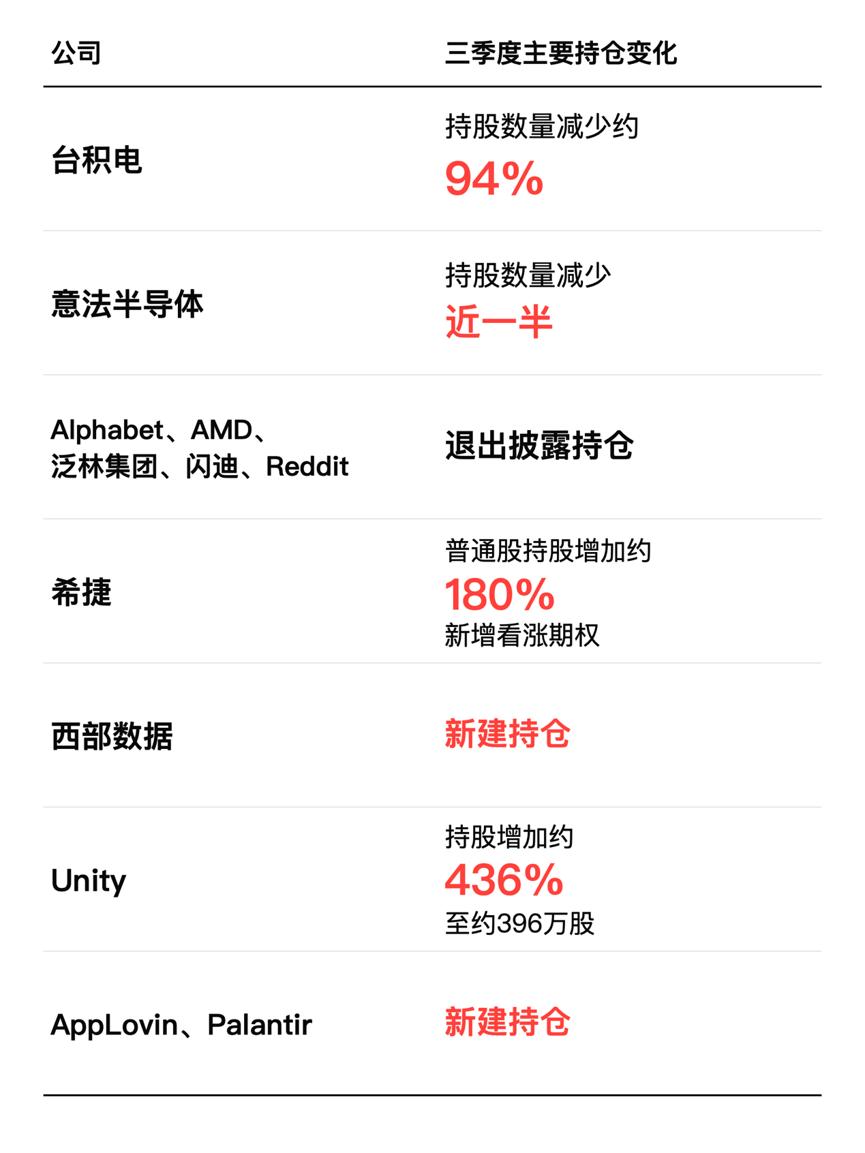
Source: 13F documents, sorted out by Bright Company
Among specific companies, semiconductors saw the most obvious position reduction. In the third quarter, Duquesne cut its shareholding in TSMC by about 94%, reduced its stake in STMicroelectronics by nearly half, and exited positions in Alphabet, AMD, Lam Research, SanDisk and Reddit, among others.
However, it is still increasing its allocation to some technology companies. The number of common shares held in Seagate increased by about 180% compared with the previous quarter, and new call options on Seagate were added at the same time; Western Digital entered the portfolio. The number of shares held in Unity increased by about 436% to about 3.96 million shares. In addition, Duquesne also established new positions in companies such as AppLovin and Palantir.
These adjustments indicate that as of the end of the third quarter, Duquesne is still participating in the storage and software sectors. It is not appropriate to generalize its position changes as a full exit from AI infrastructure only based on the direction stated at the summit. Seagate and Western Digital are still storage hardware companies, and the new positions in software companies cannot all be attributed to AI.
The healthcare sector still occupies an important position. Genetic testing company Natera is the largest disclosed position, holding about 3.16 million shares worth about 1.306 billion US dollars, accounting for about 29% of the declared portfolio. Its shareholding is slightly lower than that at the end of the second quarter, and the increase in portfolio weight is mainly driven by the rise in stock price. This position cannot be directly equated with the AI medical application mentioned by Druckenmiller, and he did not make such an attribution in this interview.
In addition, Duquesne established new positions in gold mining companies such as Newmont, Barrick and Agnico Eagle, and increased its shareholdings in Amazon, Sea and Fox. The portfolio adjustment covers the technology, healthcare and resource sectors at the same time.
05
Remain optimistic about technological progress in the next ten years
Although capital preservation is the top priority at the moment, Druckenmiller still has high expectations for long-term technological progress.
According to the retelling of his on-site speech, he believes that the probability of a breakthrough in nuclear fusion in the next ten years is about 20%, and the probability of the emergence of space data centers is at least 70%. In the medical field, he mentioned that he has long been involved in the work of Memorial Sloan Kettering Cancer Center, and reviewed the changes brought by gene sequencing, understanding of tumor mutations, immunotherapy, and AI.
His personal judgment is that cancer is expected to gradually become a manageable disease in the next ten years. This statement reflects his expectation for research progress, and the specific realization still depends on the treatment progress and clinical evidence of different cancer types.
Long-term optimism and current contraction coexist in this sharing. He still believes that innovation can transform industries, but when it is difficult to judge the market direction, he chooses to reduce risks first; when continuing to study AI, he shifts his attention to practical use and commercial returns. The time to return to the market has not yet been determined, and preserving capital is the decision he has already made at present.
This article is from the WeChat Official Account "Bright Company" (ID: suchbright), Author: MD, published with authorization from 36Kr.