Domestic GPUs, the bigger the waves, the more expensive the fish.
Jensen Huang, a leader in the global Chinese tech and business community who led NVIDIA for 33 years and drove it to become the world's largest company by market capitalization, has resigned from his positions as President, Chief Executive Officer and member of the board of directors due to an unexpected incident.
On NVIDIA's official website, Jensen Huang has been removed from the management roster and placed in the "Founders" section alongside Chris Malachowsky. Even on the X platform, his blue verified badge and CEO title have disappeared.
The era in which Jensen Huang controlled this global hegemon of AI computing power has essentially come to an end. Even if he returns for certain reasons eventually, NVIDIA's strategy at the global computing power level will inevitably undergo obvious changes.
On November 12, after the news was released, NVIDIA's stock price once fell by more than 13% during intraday trading, and the A-share NVIDIA industrial chain immediately came under pressure. However, on the other side of the coin, AMD, NVIDIA's long-time rival, as well as domestic GPU companies such as Cambricon, Enflame Technology and Muxi Co., Ltd. have begun to receive more market attention.
As a global Chinese tech leader, Jensen Huang was in charge of the company with the most critical position in the AI era, yet he could only resign from all management positions in such a short period of time. Coinciding with the conclusion of the US midterm elections, the political and economic game behind this has become extremely complex.
The departure of a founder will not erase NVIDIA's technical moat accumulated over many years, which means there will be no obvious problems in its production and supply. The problems that have emerged are for customers who have clear demand for computing power and are in the midst of international trade games — that is, Chinese AI companies.
Jensen Huang's personal exit has put more stringent tests on domestic Chinese GPUs, as supply risks have been fully exposed. China's AI industry will increasingly clearly realize that the path of "independent and controllable" is long and arduous, but it has become a top-priority project that must be valued.
01
Reversal
GPU is the underlying hardware for large model training, inference and the construction of computing power clusters, which is equivalent to the "heart" of the AI industry.
Since October 2022, the United States has directly included high-end chips such as NVIDIA A100, H100 and AMD MI300 in the control list. After that, from A800, H800 to H20 and then to H200, NVIDIA's "special version" chips have actually been restricted from being exported to the Chinese market.
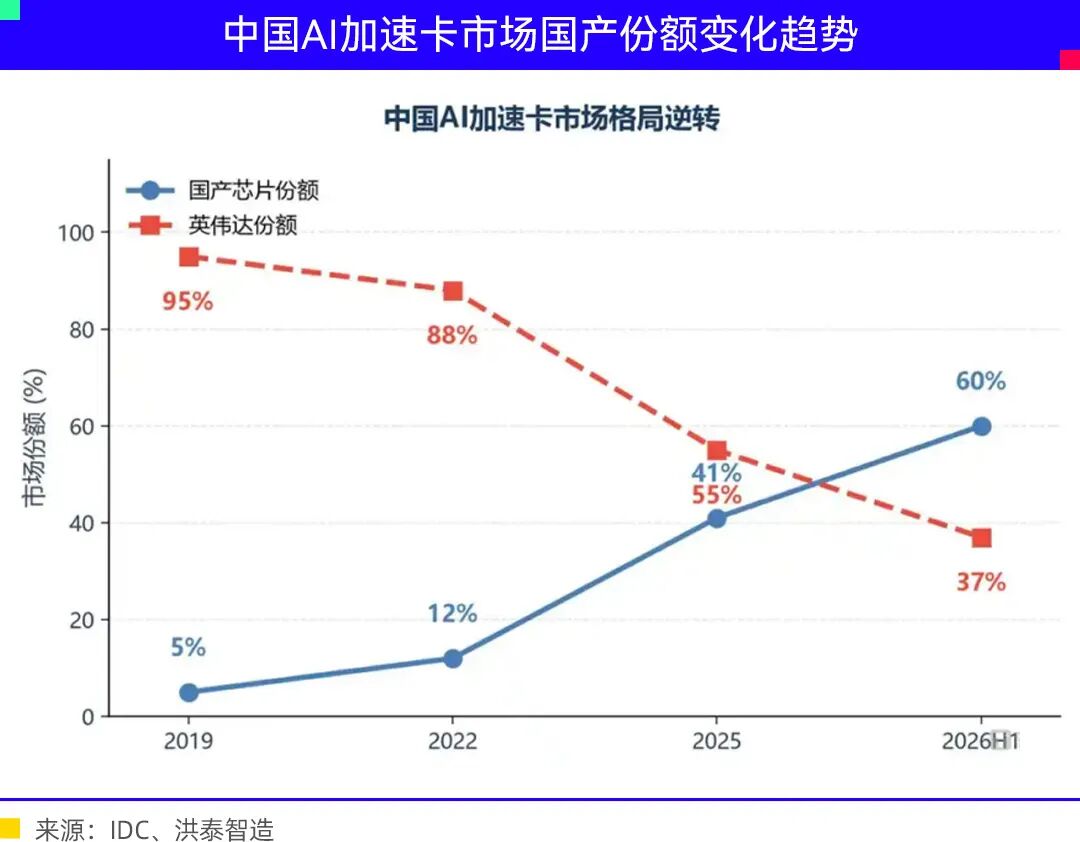
By the first half of this year, the Chinese market's contribution to NVIDIA has been greatly reduced, and its market share in the Chinese market has also dropped to 37%, overtaken by domestic peers — of course, this does not represent NVIDIA's proportion in all usable computing power for Chinese AI enterprises, because there are also institutions and equipment providing computing power for Chinese enterprises outside the Chinese market.
At present, domestic GPUs have gone through the stage of "whether products can be made" and have begun to enter the period of large-scale delivery. In the 2026 three-quarter report, the revenue of core manufacturers generally achieved several times of growth, and the profit quality has improved significantly.
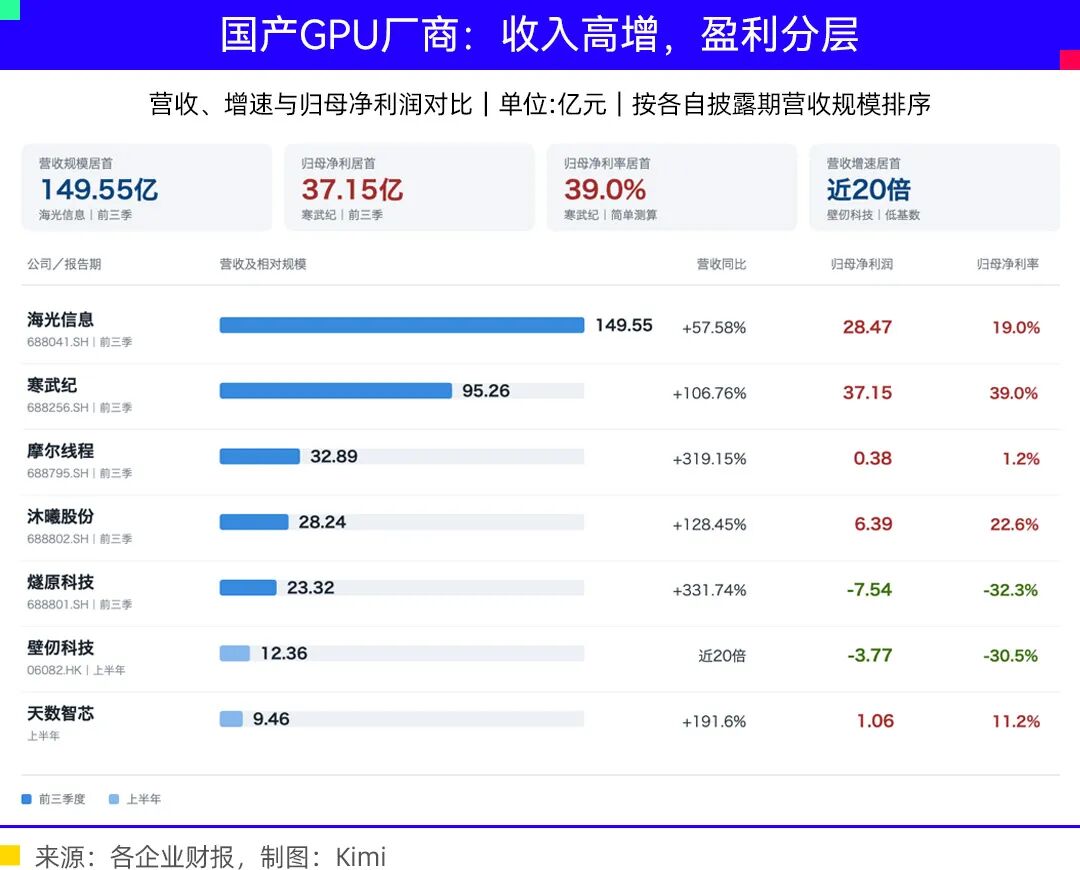
Cambricon and Hygon Information are the first two to enter a positive profit cycle with leading scale.
In particular, Cambricon's net profit margin in the first three quarters was close to 39%, with a net profit of 3.7 billion yuan, indicating that it has passed the critical point of survival and has real profitability. Hygon Information has the largest scale, with revenue in the first three quarters approaching 15 billion yuan and a net profit of 2.8 billion yuan.
Moore Threads, known as the "first domestic GPU stock", has seen rapid revenue growth and its profitability has crossed the break-even point. Its revenue in the third quarter reached a new quarterly high of 1.552 billion yuan, and the non-recurring net profit turned positive for the first time to 20.07 million yuan. However, its cumulative non-recurring loss in the first three quarters was still 131 million yuan, and the net operating cash outflow was 3.309 billion yuan.
Moore Threads takes the route of full-featured GPUs, with products covering AI computing, graphics rendering, scientific computing and video codec, which leaves huge room for imagination, but R&D and ecological construction also consume a lot of cash.
Muxi's attributable net profit in the first three quarters was 639 million yuan, and after deducting the large impact of fair value changes, its non-recurring net profit was 259 million yuan. Moreover, the company has achieved non-recurring profit for two consecutive quarters, indicating that its revenue has begun to cover costs such as R&D.
Enflame Technology, which was listed later, saw its revenue surge 3.3 times in the first three quarters, but it is still in the stage of high investment. Its loss in the third quarter alone has narrowed to 122 million yuan, and there is still a distance to achieve sustained profitability. However, due to the continuous sharp rise in its stock price, its market value has surpassed that of Moore Threads and Muxi Co., Ltd., which hold more leading positions in the industry.
Biren Technology, listed on the Hong Kong Stock Exchange, saw its revenue grow by nearly 20 times in the first half of the year, its gross profit margin increased to 42.7%, and its loss narrowed significantly, but its stock price retreated by nearly 70% from its peak. The company still needs to cross more thresholds such as customer repurchase, software adaptation and delivery to achieve sustained profitability.
Another Hong Kong-listed enterprise Iluvatar CoreX achieved profitability in the first half of the year, with revenue of 946 million yuan, nearly three times that of the same period last year, and adjusted net profit of 246 million yuan, turning a profit for the first time since its listing. However, its profit mainly came from an equity investment income of 760 million yuan, and its main business is still at a loss after excluding this item.
It can be seen that domestic GPUs have entered a period of rapid volume expansion, the revenue of domestic players has increased significantly, and profitability has begun to improve. Some leading enterprises have even achieved sustained profitability, and the operating status of domestic AI chip enterprises is much better than before.
02
Game
Jensen Huang's departure occurred during the sensitive period after the US midterm elections, further disrupting the stability of the global AI supply chain.
For many years in the past, based on NVIDIA's commercial interests, Jensen Huang has long advocated relaxing chip exports to China. After A100 and H100 were restricted from being exported to China, NVIDIA immediately launched the "reduced-specification" versions A800 and H800. After A800 and H800 were included in the sales ban list, H20 was quickly launched.
He also used his personal prestige, status and influence to mediate between the Congress and the Ministry of Commerce. In the discussions in the United States on chip export control to China, Jensen Huang was also one of the opponents with the clearest stance and the greatest influence.
Dario Amodei, founder of Anthropic, is the representative of the "blockade faction" in Silicon Valley. He has long taken a tough stance to advocate strict restrictions on China's access to advanced US AI chips, and even stated that selling H200 chips to China is a "huge mistake", "as crazy as selling nuclear weapons to North Korea".
Subsequently, Jensen Huang responded in a podcast program, directly comparing AI chips to nuclear weapons as "too crazy", saying that the logic of export control is "extremely stupid" and a "loser mentality".
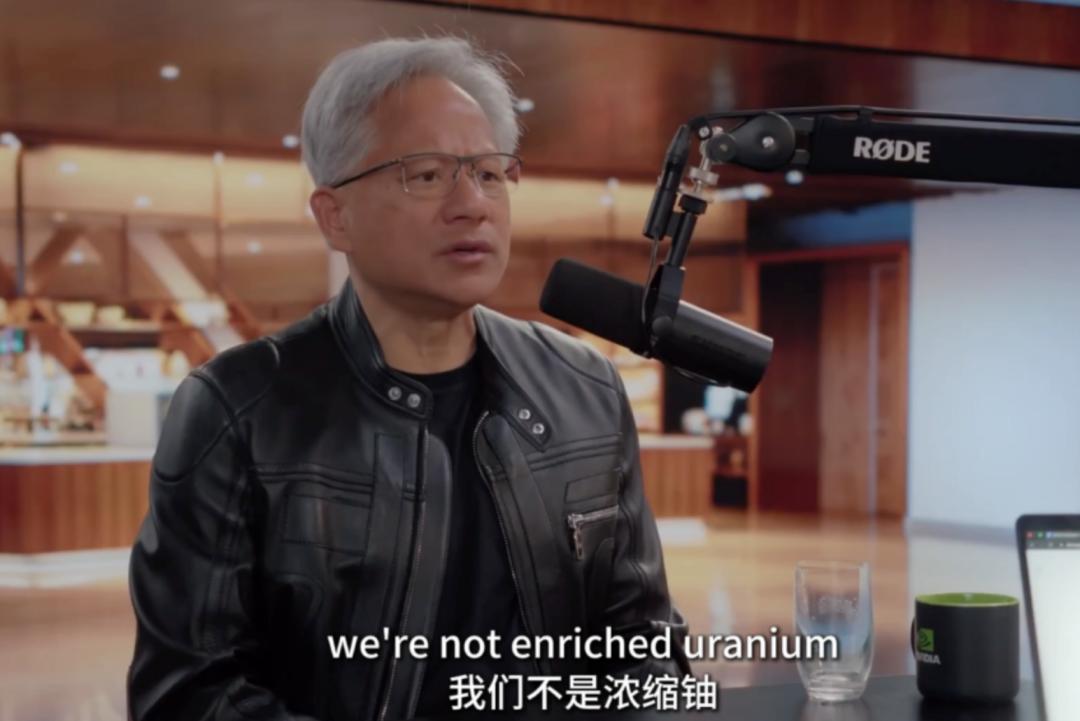
To a certain extent, Jensen Huang was a "buffer" in the Sino-US chip game. His departure is equivalent to the disappearance of the most influential voice opposing US chip export controls, and a heavyweight countervailing force is missing in the internal debate in the United States.
After Jensen Huang resigned, US House Speaker Johnson stated that the consensus within the Congress on restricting the export of semiconductor chips to China is "constantly expanding". At the same time, the US Department of Commerce is also studying new chip export control rules, planning to include Southeast Asian countries and other regions into stricter export license management to block the transshipment path.
Some other reports show that when Jensen Huang was in office, NVIDIA left a certain ambiguous operating space when selling to China, and some Chinese data center projects could obtain a certain number of NVIDIA chips. These projects generally signed contracts many years ago, and some have already started construction.
After Jensen Huang left, once the control measures are tightened again, the "fuzzy zone" that was originally operable for these projects will be completely interrupted, the project may be stranded, or forced to redesign the system at a higher cost.
The drastic change in the external environment has directly blocked the strategy of many domestic large models that regard NVIDIA chips as "high-performance chips" and domestic GPUs as supplements, forcing the entire industry to turn to endogenous alternative solutions.
If the use of NVIDIA chips is subject to more restrictions, domestic chips will by default become the "first choice", and the "alternative window period" for domestic computing power will come at an accelerated pace.
For example, DeepSeek's next-generation large model V5 will for the first time natively rely on Huawei Ascend to complete pre-training, while previously Ascend only undertook inference or post-training, and DeepSeek V3 and V4 were both trained on NVIDIA chips and its ecosystem.
If successful, it will mark that domestic chips have shifted from the inference side to the more difficult training side, and have the ability to support the full-process development of top large models.
03
Overtaking
At Huawei's Full Connect Conference on September 17, Xu Zhijun, Rotating Chairman of Huawei, mentioned: "It is very difficult to count NVIDIA's market share in China, and according to the data we can count, Ascend should have surpassed NVIDIA."
While NVIDIA is caught in the double attack of management vacuum and congressional investigation, domestic GPUs are growing freely at the "gap" of AI demand explosion and the export obstruction of international giants.
At present, domestic GPUs have formed a pattern of "one super (Huawei Ascend) + many strong (T-Head, Cambricon, Kunlunxin, etc.)". According to IDC statistics, in the first half of this year, NVIDIA shipped 678,000 units in China, a year-on-year drop of 44%, while Huawei's shipments rose sharply to 572,000 units, and the market share gap between the two sides was only 5.3%.
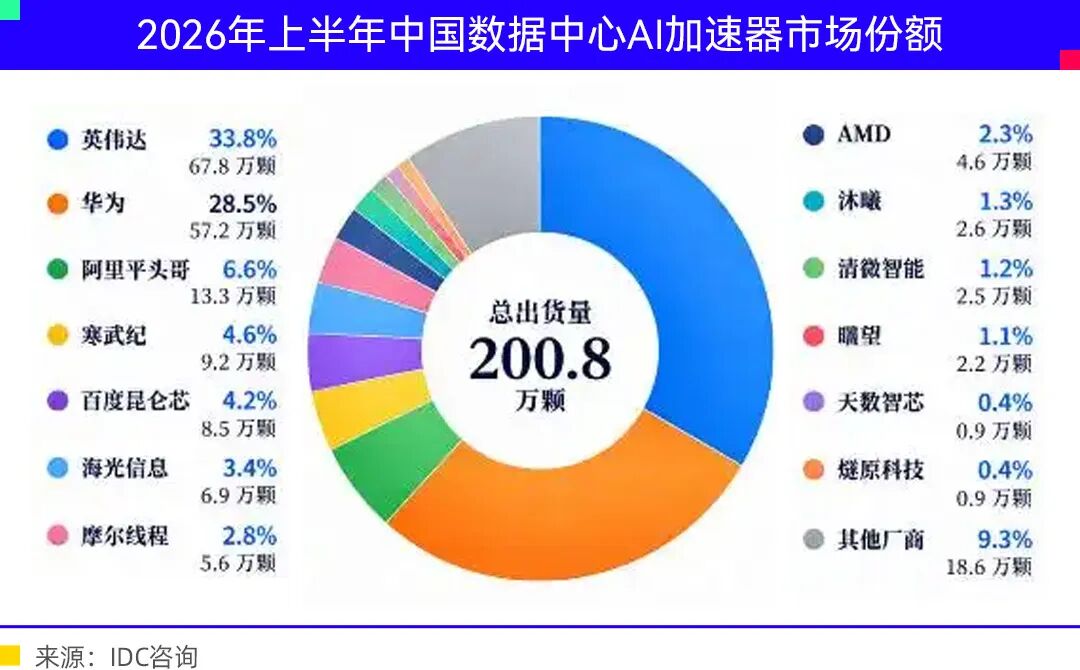
Alibaba T-Head shipped 133,000 units, ranking third, followed by Cambricon, Baidu Kunlunxin, Hygon Information and Moore Threads, with shipments ranging from 50,000 to 100,000 units.
Moreover, some institutional analyses believe that Huawei Ascend's share in the Chinese market has reached half, while NVIDIA may only have about 8% left. Compared with the situation in 2022 when NVIDIA occupied 95% exclusively and Ascend only accounted for 3%, a huge reversal has taken place in four years.
Morgan Stanley estimates that China's self-sufficiency rate of AI chips will be 35% in 2025, reach 45% in 2026, jump to 68% in 2027, reach 77% in 2028, and reach 95% in 2030, basically achieving complete independent substitution.
The current turmoil in NVIDIA's management has further accelerated the process of localization. Only 5 days after Jensen Huang left office, NVIDIA newly established the National Security and Export Control Supervision Committee, which is responsible for supervising the company's national security policies, export control compliance and global trade at the board level.
The US side also quickly began to investigate the Singapore company Megaspeed, accusing it of illegally transshipping NVIDIA chips to China. Some foreign media reports said that former executives of this Singapore company may have a personal relationship with Jensen Huang.
From all signs, the window for purchasing overseas high-end chips is getting smaller and smaller, and further localization of GPUs is imperative.
Compared with NVIDIA, domestic manufacturers still have gaps in advanced manufacturing processes, single-card performance, HBM supply, ultra-large-scale training stability and system ecology.
In particular, CUDA has been accumulated for a long time, and its ecological rainforest is extremely prosperous, so domestic chips have to face huge migration costs. The core foundation for NVIDIA to become the global hegemon of AI chips lies in the moat of CUDA. Developers are used to CUDA, which has become the biggest threshold in front of new chips such as Ascend, and the gap in hardware itself is not the first priority.
However, domestic manufacturers are already looking for new solutions.
Liao Heng, Chief Scientist of Huawei Semiconductor, admitted frankly that the first obstacle Ascend encountered was not hardware, but mainly ecological barriers. Now, with the emergence of new compiler languages, the barriers of CUDA software are gradually dissolving, and cutting-edge AI laboratories no longer attach as much importance to CUDA as they did two years ago.
In terms of performance dimension, since a single card cannot compete, thousands or even tens of thousands of cards are assembled into a supercomputer to improve performance in the form of a cluster, which is the "super node" route that Huawei and Alibaba are currently betting on.
As Xu Zhijun pointed out, Huawei is taking the lead globally in overall computing power through the systematic innovation of "super node + cluster".
Huawei has released the world's first super node Ascend 960 based on NPO technology, which can be expanded to 4096 cards; Alibaba launched the first SNPO optical interconnection super node Panjiu AL64 at the Yunqi Conference. Sugon, Unigroup, Muxi and other companies have also joined one after another.
Just like DeepSeek's alternative approach, this kind of innovation that focuses on engineering and system gives Chinese chips the possibility to catch up with NVIDIA in performance.
04
Final Note
"The leather jacket is still there, but the crown is lost".
Jensen Huang used to be the "buffer zone" for NVIDIA's trade with China, quotas, and even gray transshipment channels. He coordinated the Sino-US computing power contradiction in a relatively informal and somewhat gray way.
But after changing the commander, the control of NVIDIA and even more US technology companies over China will most likely continue to tighten, which will inevitably push China's AI industrial chain to completely abandon the illusion of "taking a detour to get chips" and fully bet on the independent route.
From a longer time dimension, NVIDIA's leadership change is not a starting point, but an accelerator. As Jensen Huang once emphasized many times, restricting US chip exports can only force China to achieve more independent innovation.
Now, the consensus in China's AI chip industry has been