Jason Wei, the first author of the Chain-of-Thought paper, has left his position. Why did he quit after only staying at Meta for just one year?
Whoa! Last year, Mark Zuckerberg offered a sky-high annual compensation package worth over 100 million USD, and Jason Wei, the author of the "Chain of Thought" paper who he poached from OpenAI after great efforts ——
He just worked at Meta for a little over a year, and surprisingly, he has now left the company directly!
Moreover, his next employer is not a tech giant, but a fledgling data startup company...
Just now, Jason Wei officially announced the news in a post on X:
He will leave the TBD Lab at Meta to join the startup Mercor as Chief Scientist.
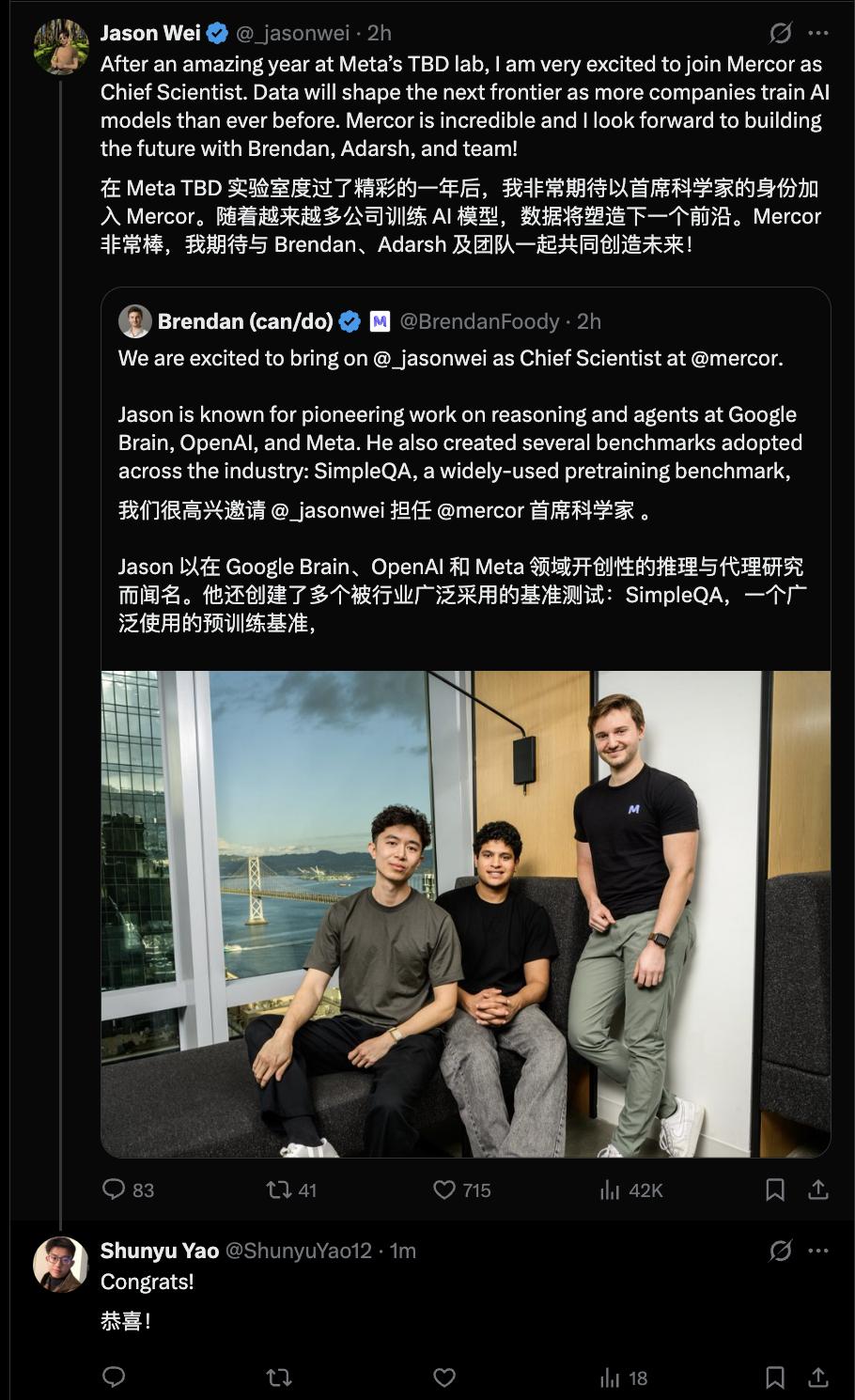
At the same time, he also shared his judgment on the next stage of AI development in the post: As more and more companies start training AI models, data will shape the next frontier.
In his welcome post, Brendan Foody, Co-founder and CEO of Mercor, further revealed that Jason will help build the research team and take full charge of all data and evaluation work.
It is worth mentioning that Edward Hu, the first author of the LoRA paper, will also work alongside Jason, and he will be responsible for model training.
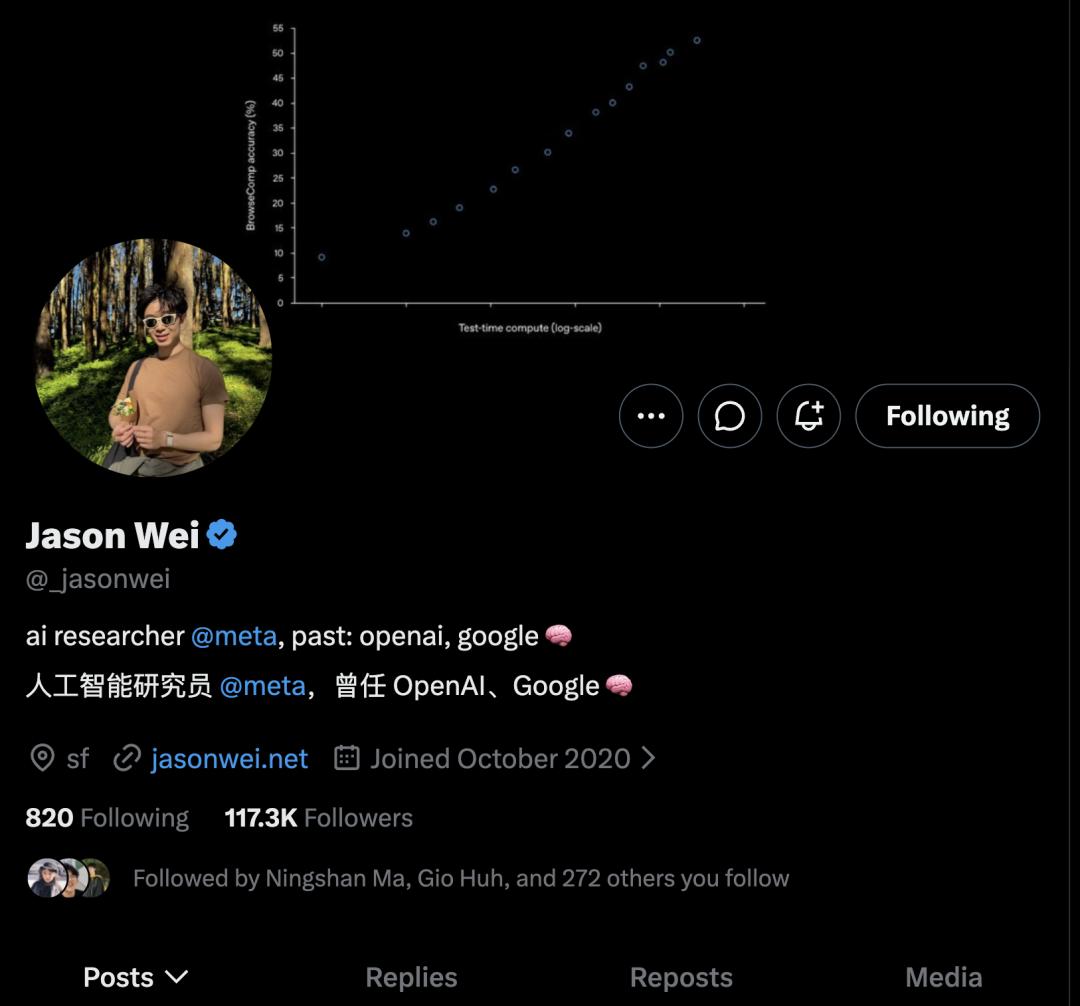
Although the incident happened so suddenly that Jason did not even have time to update his personal profile on X when he made the official announcement, this job change is not completely without warning.
It is reported that Meta has been a client of Mercor for the past few years, and the TBD Lab where Jason works has also used Mercor's data labeling services.
Not only that, the CEO of Mercor also said that he has maintained close communication with Jason over the past few years.
It can only be said that big tech companies pay startups to buy data, and the startups conveniently poach the people who buy the data for them.
In the future, big tech companies need to be more cautious when cooperating with startups.
Who is Jason Wei?
Jokes aside.
The reason why Jason Wei's movements attract so much attention is not only that he is the author of a series of classic works such as "Chain of Thought", but also that he is a "wunderkind" who directly broke into the core of the AI industry after graduating from undergraduate without pursuing a PhD.
(Although there is no official announcement, according to Jason Wei's previous posts, he is only 27 or 28 years old this year.)
After graduating from Dartmouth College with a bachelor's degree in Computer Science in 2020, Jason did not follow the conventional path to pursue a PhD, but chose to join Google Brain directly.
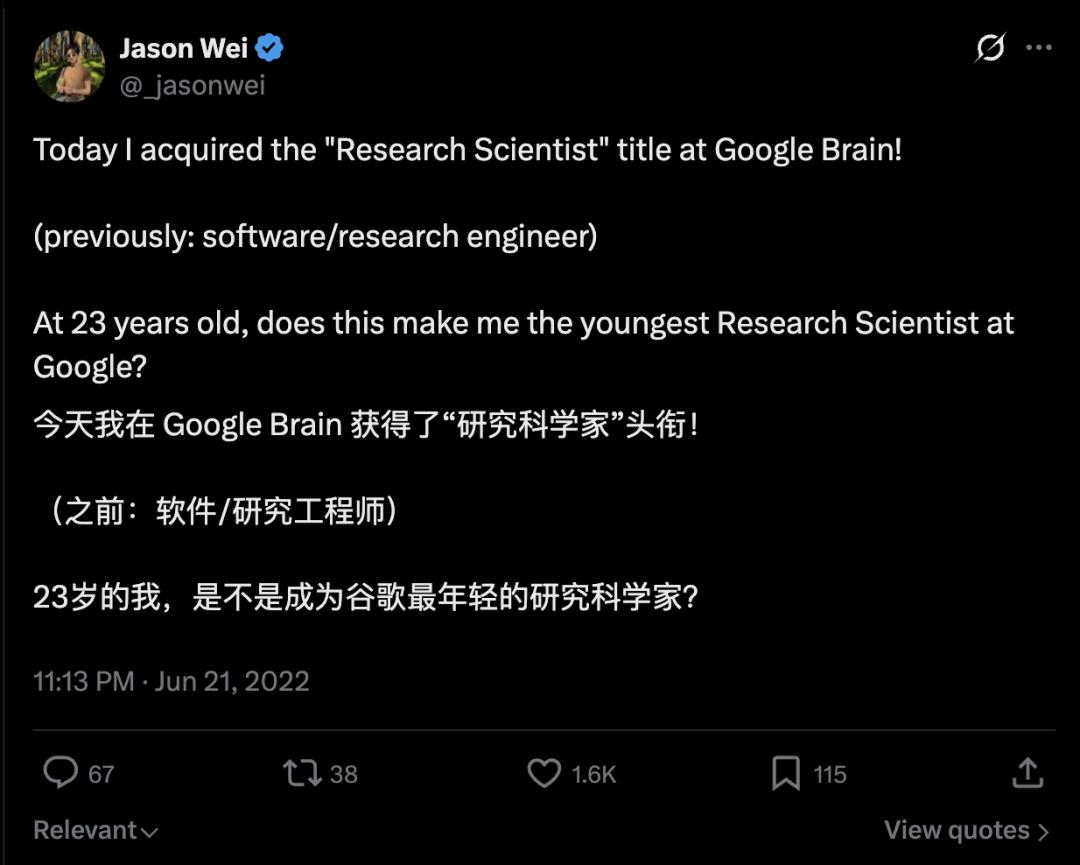
In 2022, at the age of only 23, he got the title of "Research Scientist" at Google.
(He is also likely to be one of the youngest Research Scientists in Google's history)
In the same year, he published the pioneering work of Chain-of-Thought (CoT for short) as the first author.
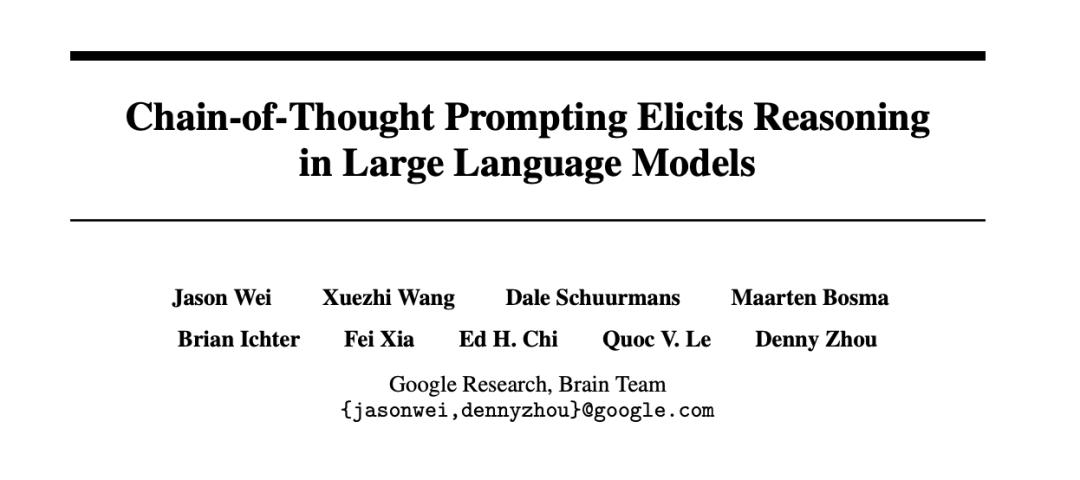
At the same time, he is also the first author of FLAN, a classic work on instruction fine-tuning.
It can be said that the reason why large models can "think step by step" today originates from his work.
Later, he joined OpenAI in 2023, deeply participated in the core R&D of the first-generation reasoning models o1 and Deep Research, and independently built SimpleQA, BrowseComp, as well as HealthBench, a health evaluation benchmark formulated jointly with 262 doctors.
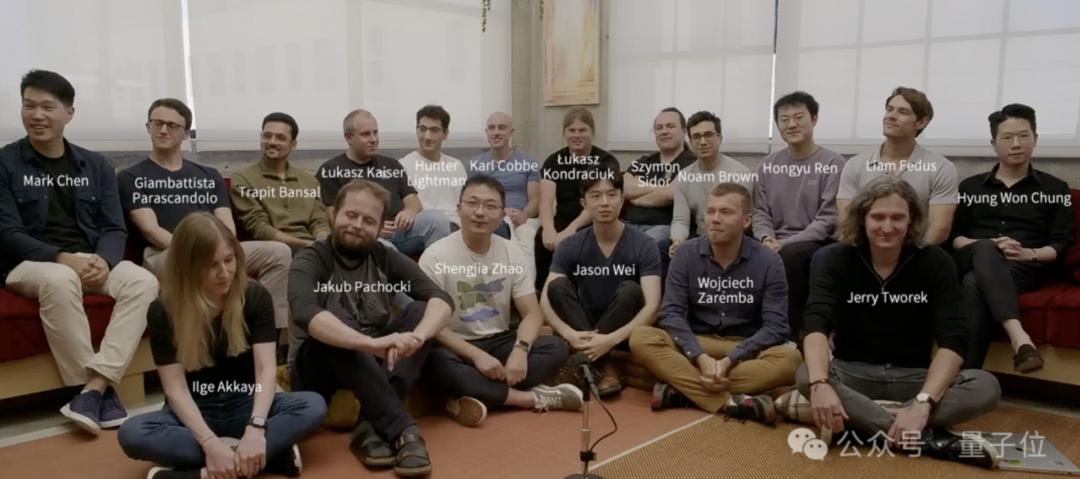
(At the "o1 fan meetup" in 2024, Jason Wei is sitting in the center of the first row, next to him is Zhao Shengjia, another key figure of o1 who is still working at Meta now)
Up to now, Jason Wei's Google Scholar citations have exceeded 160,000 times.
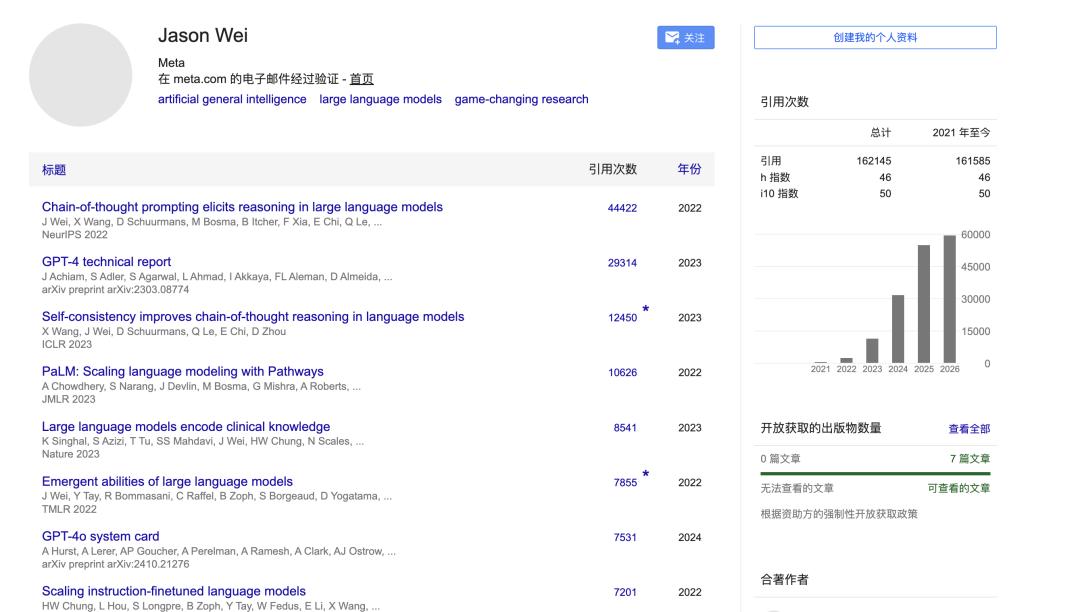
After being poached by Mark Zuckerberg with a sky-high compensation package last July, he joined the TBD Lab under the Superintelligence Lab, led the R&D of the Muse Spark series of models, and promoted the implementation of large models in cutting-edge medical research.
Just one month before he left his job, he also shared an experiment of his team using Muse for medical research. Medical researchers can call programming tools powered by Muse Spark 1.3 and Muse Wonder to analyze about 5 million de-identified electronic medical records.
Doctors are responsible for raising questions, and the models are responsible for writing code and running analysis. In just four weeks, the team produced ten research manuscripts.
Jason has a key observation on this work: although models allow doctors to verify a hypothesis faster and try more directions, there is a lot of noise in medical record data — which variables are worth looking at and what a set of results can actually explain, ultimately depends on the judgment of professionals.
And Mercor, the company he joined this time, is exactly a company that focuses on "high-barrier professional data".
What kind of company is Mercor
Mercor was founded in January 2023, with its headquarters in San Francisco.
The three founders Brendan Foody, Adarsh Hiremath and Surya Midha are old acquaintances from their high school debate team, and the three of them even worked in the dormitories of Harvard University and Georgetown University in the early stage of starting the business.
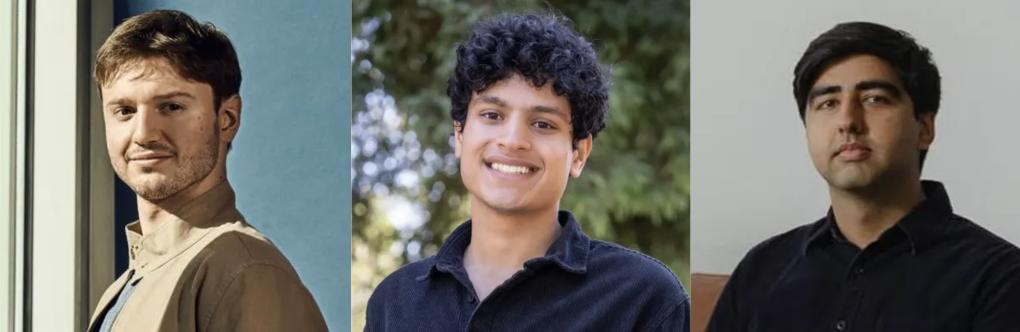
Now, this young company has not only recruited top researchers such as Jason Wei and Edward Hu, but also gathered a large number of doctors, lawyers, investment bank analysts and senior engineers behind it, building a huge network of industry experts.
According to the official website, Mercor's main business is AI training data and evaluation services. It organizes experts in various fields to break down actual work into difficult training tasks, and formulate strict scoring rules to help AI labs and enterprises train models and test the ability of models to solve complex professional problems.
In addition, Mercor also assists enterprises to monetize their own business data, and deploy AI in their daily workflows.

After Felicis led the Series B and Series C rounds of financing successively, just 8 days before Jason officially announced his job change (November 10), Mercor just announced that it had completed $750 million Series D financing with a valuation as high as 20 billion USD.
Its investors include not only top venture capital firms such as Benchmark, General Catalyst and Sapphire Ventures, but also industrial giants such as NVIDIA, Salesforce and Zoom.
It is reported that the core logic of capital betting on Mercor is: general Internet corpus is almost exhausted, and only the "implicit judgment" of senior experts (such as the contract risk points that senior lawyers can spot at a glance) can teach AI to really work effectively.
At present, Mercor's clients have extended from basic model labs to vertical track giants such as legal AI company Harvey and financial software Ramp.
As Jason once sighed on X, now creating a high-quality question for a top benchmark may have as much influence as publishing a paper in *Nature* or *Science*.

As more and more enterprises start training proprietary models, companies like Mercor are trying to define the next frontier of AI evolution by controlling "high-quality data and evaluation standards".
One more thing
Speaking of which, with the departure of Jason Wei, the saying of "you can only work at Meta for at most one year" seems to have become a curse.
Previously, Pang Ruoming, former head of Apple's basic model team, gave up a compensation package worth over 200 million USD and jumped to OpenAI decisively after only 7 months of employment;
Earlier, OpenAI researchers Ethan Knight and Avi Verma, who also received sky-high offers, even stayed for only a few weeks before quickly returning to their old employer;
In this regard, many people in the industry joked that big tech companies usually set a "1-year cliff" when poaching people with sky-high compensation packages.
The first large signing bonus and stocks are usually unlocked and cashed in a centralized way when the one-year mark is reached. Once this time node passes, it is equivalent to the "player option" being automatically activated. Whether the person can be retained depends entirely on the real combat effectiveness and technical vision of the lab.
Of course, AI talents come and go, but Yann LeCun stays firmly in place.
Wang Alex, Meta's Chief AI Officer born in 1997, is still standing firm and still highly valued by Mark Zuckerberg.
Rock solid.
References
[1]https://x.com/BrendanFoody/status/2122825607763689873
[2]https://www.mercor.com/
This article is from WeChat official account "QbitAI", author: henry, published with authorization from 36Kr.