CXO players take their seats at the AI poker table
Will CXO orders be snatched by AI? Faced with repeated inquiries from investors, WuXi AppTec (603259.SH / 02359.HK), the industry leader, has recently shifted its tone.
Previously, listed companies in the CXO industry always responded in an almost "cut-off" tone, but with the rapid development of algorithms, "AI design + CXO empowerment and implementation" has gradually become the new official statement.
In fact, in 2026, all CXO players have taken their seats at the table of AI pharmaceutical research. AI has continuously lowered the threshold for molecular creativity, but raised the implementation threshold even higher. This positional battle centered on "physical implementation" has already begun, and it is also re-pricing the value of the entire industry.
01
The Shift in the Leader's Stance
WuXi AppTec has long maintained restraint in its public statements about AI. At the earnings call in March 2025, the company's executives emphasized that AI applications are still in the early stage, and immediately added a statement: WuXi AppTec has never independently developed new drugs, nor has it used AI to develop new drugs.
At that time, there was a reasonable narrative behind this restraint. When AI pharmaceutical research was at its peak, if the company followed the trend to "hitch a ride on the concept", it would not only cause misalignment of expectations, but also be hard to avoid the suspicion of mistaking virtual molecules for real drugs. In the early stage with extremely low implementation success rate, drawing a clear boundary is a kind of prudence.
However, the shift is progressive. In June and September 2026, WuXi AppTec put forward systematic new statements twice: AI can efficiently design molecular structures, but it still requires an integrated, end-to-end CRDMO platform to complete complex synthetic delivery and biological verification. In October, this statement was verified by the industrial side. AI pharmaceutical company Boltz announced that its small molecule discovery pipeline BoltzMol-1 can directly search the GalaXi virtual chemical space under WuXi AppTec.
The key to understanding this cooperation lies in the design principle of BoltzMol-1: candidate molecules must be available from commercial catalogs or can be synthesized on demand. In other words, if the molecules selected by AI cannot be produced, no matter how high the prediction score is, it is meaningless. What WuXi AppTec opens up is exactly this "synthesizable chemical assets".
In essence, this is the insurmountable essential difference between dry experiments and wet experiments in new drug R&D. AI conducts dry experiments, relying on computing power, algorithms, existing literature and compound databases to complete operations in the virtual space.

However, drug R&D is not a scoring game. AI only learns historical data, which makes it difficult to predict a large number of realistic variables, and even produces a lot of prediction blind spots. Therefore, it can only rely on wet experiments for trial and error and verification one by one.
That is to say, the core value of CXO is concentrated in this transformation stage. Integrated CRDMO platforms like WuXi AppTec have not accumulated algorithms over years, but a complete set of chemical assets. When the AI model is connected to a synthesizable virtual chemical space like GalaXi, the essence is not that AI depends on CXO, but that AI is constrained by "real chemical rules" in advance, giving priority to recommending molecules that the platform has the ability to implement, which greatly reduces invalid designs.
02
Do Not Compete with AI on Algorithms
The transformation of WuXi AppTec is the epitome of the industry. In 2026, Chinese CXOs collectively adjusted their strategies. Although the paths are different, the underlying ideas are highly unified: they will not compete with AI companies on computing power and models, but embed AI into their original deepest moat.
For example, GenScript Biotech (01548.HK) focuses on macromolecules, and has reached a cooperation with Eli Lilly's AI drug discovery platform TuneLab to undertake standardized verification of AI-optimized protein sequences. In 2026, the company raised a net of about HKD 2.327 billion through placement, of which about 70% was invested in automated high-throughput wet laboratories. At the same time, Chen Rui, President of the Life Sciences Business Group of the company, judged that how fast AI-empowered drug discovery can make progress depends on the speed at which the industry generates reliable biological evidence.
In addition, Pharmablock (300725.SZ) restricts AI generation from the source, and reconstructs the molecular generation logic with the dual constraints of "synthesizability" and "solid building block resources"; Chengdu Leadgene (688222.SH) and Viva Biotech (01873.HK) build differentiated competitiveness based on DEL library and structural biology respectively.
It should be pointed out that almost no CXO spends heavily on self-developing general drug large models. Capital expenditures are concentrated in automated laboratories, building block libraries and protein libraries, rather than GPUs and algorithm teams.
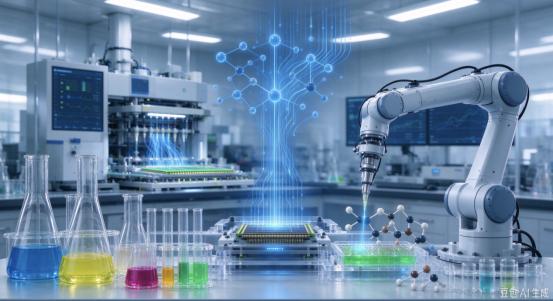
As a traditional giant, Pharmaron (300759.SZ / 03759.HK) aims at the intelligence of wet laboratories. In 2026, it reached a strategic cooperation with Zhisquare to develop embodied intelligent automated workflows around chemistry, biology and analytical experiments, allowing robots equipped with large models to enter real R&D scenarios, and feeding back model iteration with data reflux.
The tangible returns have also emerged. In the first half of 2026, Pharmaron's AI pharmaceutical revenue accounted for more than 7% of its laboratory service revenue; GenScript's AIDD-related revenue was close to 40 million US dollars, a year-on-year increase of over 105%.
At this time, the market's view has completely reversed, believing that the more popular AI is, the more valuable CXO is, because every additional virtual candidate molecule at the front end will bring one more order that must be physically verified at the back end.
03
The Ongoing Game Between AI Pharmaceutical Companies and CXOs
Symbiosis is the current mainstream, but the risk of substitution is not just empty talk. Many market views make a simple dichotomy, either believing that AI will subvert CXO, or thinking that the two will always live in peace. But the real picture is more complex, with layered symbiosis, partial erosion and structural differentiation happening at the same time.
In the short term, it is difficult for AI pharmaceutical companies to subvert CXO systematically. Leading listed AI companies such as Insilico Medicine (03696.HK), XtalPi (02228.HK) and Metis (07666.HK) generally have two business models: self-developing in-house pipelines and exporting AIDD platform services externally.
In fact, building a full-chain laboratory requires accumulating mature SOP, stable technical team, quality control system and supply chain, and continuously bearing fixed expenses for instrument maintenance, reagents and consumables, and compliance audits. Even if they get large financing, investing funds in algorithm iteration and pipeline advancement is far more capital efficient than building a full set of wet experiment platforms by themselves. That is why from the perspective of order sources, AI pharmaceutical companies themselves have become a new fast-growing customer group for CXOs.
However, the erosion of partial orders is happening in reality, and will continue to squeeze the low-barrier businesses in CXO. Under the tide, the industry will experience drastic structural differentiation, and the dividends will not benefit all CXOs, but only concentrate on leaders with hard core assets.
In the final analysis, the irreplaceability of leading CXOs is reflected in undertaking a large number of high-difficulty and unconventional molecules output by AI. In order to pursue target affinity, AI often generates molecules with novel structures, complex synthetic routes and poor stability. Such molecules cannot be handled by simple high-throughput platforms, and rely heavily on chemical experience accumulated over years, multi-route trial and error capabilities, and complex purification and impurity control capabilities.
In contrast, a large number of small and medium-sized CROs are limited to simple chemical synthesis and single experimental links, without self-owned building block libraries, high-throughput automation systems, integrated verification chains, and data closed-loop capabilities. In the AI era, the upstream AI supplies massive candidate molecules, but small and medium-sized CROs cannot undertake high-difficulty projects, and can only compete in low-end orders, with intensified price wars and continuously compressed profits.
In the long run, the industrial chain will move towards a clear hierarchical division of labor, rather than one side eliminating the other. The optimal solution for the upstream AI creativity layer and the downstream physical transformation layer is ecological binding: AI is responsible for broadening the imagination of R&D, and CXO is responsible for fulfilling the certainty of R&D.
This article is from the WeChat official account "Investor Network - Thinking Finance", written by Cai Jun, and authorized for release by 36Kr.