From 63 AI hardware startups, I have witnessed these two changes.
The financing boom for AI consumer hardware is starting to cool down.
According to public data from AIWatch and our incomplete statistics, after excluding tech giants and enterprises that have not yet achieved product delivery, we have screened out 63 AI consumer hardware startups. Among them, there are 15 AI glasses startups and 14 AI companion startups, accounting for a combined 46% of the total.
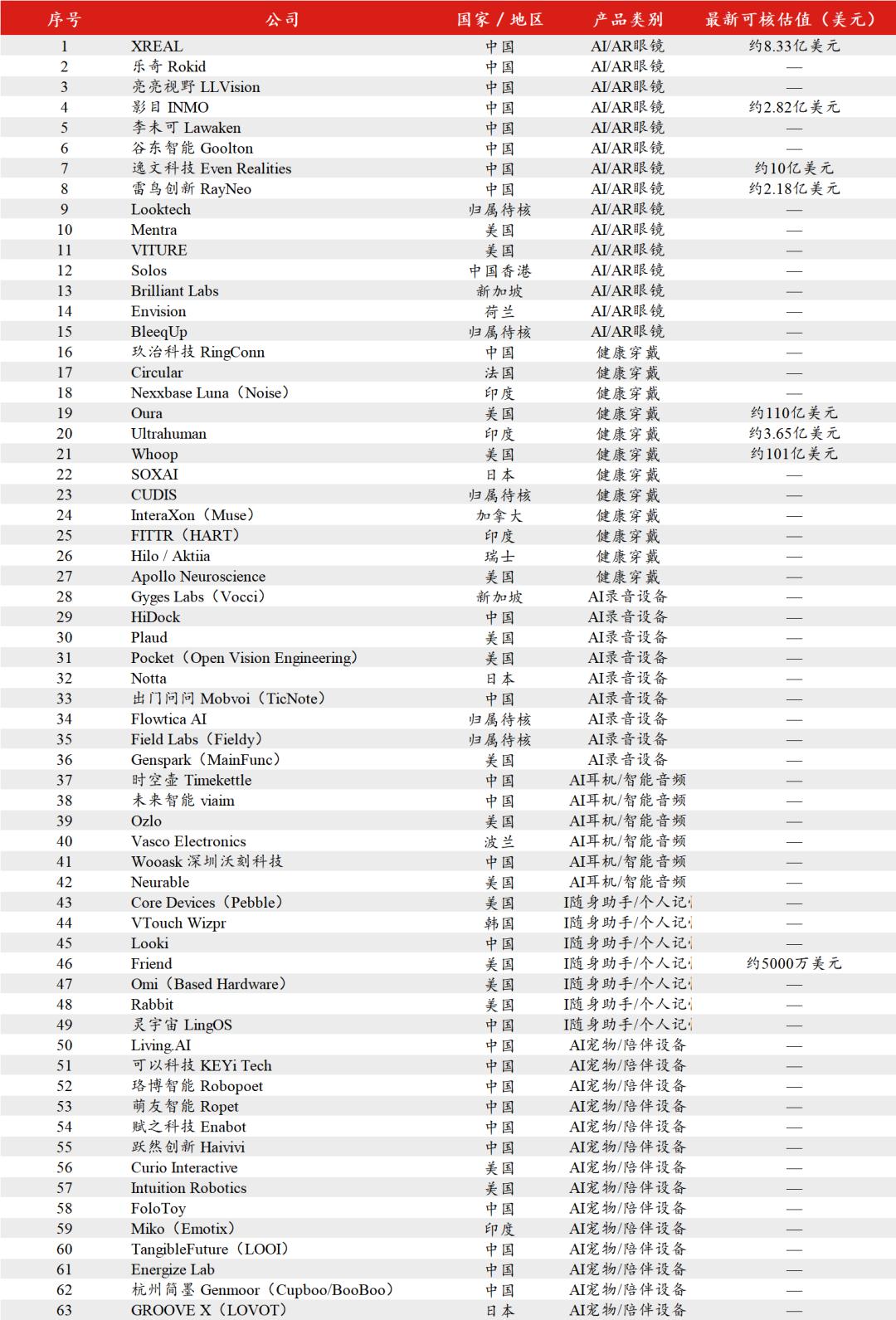
However, judging from financing data, the enthusiasm of capital is cooling down significantly.
In 2025, 27 of these 63 enterprises received financing; as of November 11, 2026, only 15 enterprises have obtained financing, a 44% decrease compared to the full year of last year.
Among them, the number of AI glasses enterprises that received financing dropped from 9 to 5, and the number of AI companion enterprises plummeted from 7 to only 2.
Judging from the business performance of enterprises, industry differentiation has also begun to emerge. Among these 63 enterprises, only 14 have publicly disclosed operating data such as revenue, annualized income, order value or sales volume, accounting for only 22% of the total.
Although public data is limited, from the perspective of scaled enterprises such as Oura and Plaud that have achieved notable market performance, two noteworthy trends are emerging in AI consumer hardware.
On the one hand, the products that take the lead in achieving commercial breakthroughs are often vertical products that solve clear, specific demands, rather than general-purpose AI hardware with a wide range of functions. On the other hand, more and more AI hardware companies are starting to make profits by relying on subscription services instead of simply selling hardware.
Today, Silicon-based Observer will talk about the changes in AI hardware combined with relevant data.
01
Investors no longer pay for unsubstantiated stories
Statistically, AI glasses have gathered the largest number of startups.
The reason is not hard to understand. In September 2023, Meta launched Ray-Ban Meta, which made the market see for the first time the possibility of large-scale sales of AI glasses. In 2024, the sales volume of Ray-Ban Meta alone exceeded 1 million units.
Huge market potential has attracted a large number of startups to enter the track. Interestingly, among the 17 AI glasses startups we counted, the highest-valued one, Even Realities, is only valued at 1 billion US dollars.
Why has no higher-valued startup been born in this fast-growing track?
One important reason is that although AI glasses are growing rapidly, the market that first achieved large-scale penetration has been largely occupied by tech giants.
Data from Counterpoint shows that in the first half of 2026, global AI glasses shipments increased by 263% year on year. Among them, display-free glasses contributed 96% of the total shipments, and Meta holds a 94% market share in the display-free glasses segment.
This means that the vast majority of current market demand for AI glasses is concentrated in the product segment where Meta holds an absolute advantage.
More importantly, display-free AI glasses mainly realize functions through shooting, audio and AI interaction, with relatively simple hardware functions. Product experience increasingly depends on large model capabilities, software ecosystem and mobile phone collaboration, which are exactly the advantages of tech giants such as Meta, Alibaba and Xiaomi.
For startups, even if they can develop similar products, it is difficult to compete with giants in terms of cost, ecosystem and channels in the long run.
As a result, capital began to look for new opportunities. Among the 5 AI glasses enterprises that received financing this year, Thunderbird, INMO, LLVision and Even Realities all deploy display-equipped AI glasses, while VITURE focuses on XR display.
The reason is simple: this market is far from reaching maturity. At present, display-equipped glasses only account for 4% of global AI glasses shipments, technical problems in optics, power consumption and cost remain to be solved, and no enterprise with absolute market advantage has emerged yet.
Apart from AI glasses, another important AI hardware track, AI companion, has also undergone obvious changes.
In 2025, AI companion was once one of the most popular startup directions in the AI consumer hardware sector. Different from AI glasses, this startup boom was mainly driven by the rapid decline in product development thresholds.
On the one hand, the cost of large model calls continues to decrease; on the other hand, chip manufacturers such as Espressif and Beken have begun to provide mature AI voice solutions.
In 2025, the cost of PCBA modules for some AI toys had dropped to 10-30 yuan. Startups do not need to self-develop chips and large models, they only need to purchase mature solutions, plus appearance design and IP operation, to quickly launch an AI toy.
Low development cost and short product cycle made capital willing to invest in multiple teams at the same time to look for the next hit IP.
But the problem is, although AI toys are getting easier to manufacture, consumers are not necessarily willing to use them for a long time.
A report from LatePost in February this year mentioned that a salesperson from a cloud platform learned from the toy industry association that some AI toys have a total service life of less than two months, with an average voice input duration of only 6 hours and output of less than 8 hours.
The return rate also proves this point. For BubblePal, which has accumulated more than 200,000 units in net cumulative sales, the return rate of its first-generation product once exceeded 30% in the early stage of launch, and the overall return rate was still above 20% as of August 2025.
In other words, AI toys can attract consumers by novelty, but there is still great uncertainty about whether users are willing to continue using them after bringing the products home.
This has directly changed the investment criteria of capital. Compared with last year's scattered bets on potential hit products, this year capital gives priority to enterprises that have already presented verifiable sales and user usage data.
For example, Luobo Intelligent, which obtained financing this year. According to the company's disclosure, the cumulative sales of its AI pet product Fu Zai increased from about 120,000 units at the end of 2025 to nearly 300,000 units in June this year; ordinary users have an average daily conversation duration of 40-50 minutes, and the omni-channel return rate remains at around 8%.
Another financed company, FoloToy, also disclosed that its repurchase rate exceeded 20%, and the sales volume of its core product increased 5 times year on year.
The importance of these data lies in the fact that they begin to prove that AI companion is not entirely a business driven by novelty, and some products already have the ability to continuously attract users.
02
Two changes behind the profitability of AI hardware
Among the 63 enterprises we counted, only 14 have actually disclosed specific operating data. But from the perspective of scaled enterprises that have achieved notable market performance, the products that take the lead in achieving commercial breakthroughs are often vertical products that solve specific, well-defined problems.
For example, Oura, a smart ring manufacturer focused on health monitoring, achieved revenue of 1.215 billion US dollars in the first three quarters of fiscal year 2026, a year-on-year increase of 74%. AI recording device manufacturer Plaud posted revenue of 250 million US dollars in 2025.
The common feature of these two companies is that the value of their products is very clear.
Oura focuses on sleep, physical recovery and long-term health management, and users can get feedback through continuous monitoring. According to Oura's disclosure, the ratio of daily active users to monthly active users is about 65%, and paying members open the App more than 3.5 times on average every day. Plaud solves high-frequency work demands such as meeting recording and interview sorting.
The user scenarios of the two companies are different, but their business logic is highly similar: users are willing to pay because the products can continuously solve a specific problem.
In contrast, many general-purpose AI hardware, although integrated with functions such as shooting, recording, translation and Q&A, have not formed sufficiently high-frequency and irreplaceable usage scenarios. The number of functions does not necessarily translate into consumers' willingness to pay.
Another more noteworthy change is that software subscription is becoming an increasingly important source of revenue for AI hardware.
Although Oura is still a company whose main revenue comes from hardware at present, its fastest-growing business has already become member subscription.
In the first nine months of fiscal year 2026, the company's member revenue reached 240.5 million US dollars, a year-on-year increase of 121%, and its proportion in total revenue has increased from 16% in the same period of the previous year to 20%.
Plaud's performance is more straightforward. In June 2026, Plaud announced that its annualized recurring revenue (ARR) from software subscriptions exceeded 100 million US dollars. TechCrunch also disclosed that nearly 50% of device users will upgrade from the free version to Pro or Unlimited paid plans.
Even AI companion products have begun to try similar business models. After Luobo Intelligent's AI pet product Fu Zai entered the Japanese market, it launched a 980-yen monthly membership plan, which increased the daily AI conversation quota from 20 minutes to 60 minutes.
From smart rings to AI recording devices, and then to AI companion products, more and more enterprises are beginning to explore the same business model: acquire users through hardware, and then continuously generate revenue through software and AI services.
Why do such changes occur in AI hardware?
First of all, AI is changing the way hardware creates value.
In the past, the functions of most consumer hardware were mainly determined by the hardware configuration and pre-installed software at the time of delivery. When consumers purchased a device, they basically obtained most of the functions it could provide.
But the emergence of AI gives hardware the possibility to continuously expand functions. To put it simply, sensors such as cameras and microphones are responsible for collecting information, AI models are responsible for understanding and processing information, and software converts the processing results into services that users need.
Plaud is a typical case. Before the emergence of Plaud Note, voice recorders had long been a very mature consumer electronic product. However, traditional voice recorders mainly solve the problem of sound recording, and users still need to sort out and analyze the recorded content by themselves.
Plaud uses AI to expand the functions of the voice recorder from sound recording to speech transcription, content summarization, and further to extracting to-do items and generating structured documents.
The hardware has not undergone disruptive changes, but AI software has turned a recording device from a recording tool into a productivity tool that can participate in information processing.
More importantly, with the continuous improvement of model capabilities, manufacturers can also continuously add functions and improve services through software updates, without requiring consumers to buy new devices every time. This creates the foundation for software subscriptions.
Secondly, high-quality data provided by sensors, coupled with the powerful information processing capability of AI, makes customized software services possible.
The sensors of AI hardware themselves can be understood as extensions of human organs. Sensors such as microphones, speakers and cameras can collect data corresponding to human mouth, ears and eyes, and further collect data related to human beings. Theoretically, as long as enough user data is accumulated, AI hardware can even become a personal data center for users.
At the same time, AI itself has powerful information processing capabilities. With the increase of input data volume, AI hardware can also improve products accordingly, realize deeper and more complex functions, and thus make it easier to implement the subscription-based business model.
From this perspective, the business model of AI hardware is evolving from relying on hardware sales growth in the past to a direction where hardware sales and continuous service revenue coexist.
This is essentially a change in the value distribution method of AI consumer hardware. When chips, sensors and basic models become more and more accessible, what is really scarce is no longer the ability to manufacture an AI hardware, but the ability to continuously occupy user usage scenarios, accumulate high-value data, and convert it into paid services.
To be more precise, AI hardware is evolving from a business of selling devices to a business of operating user relationships.
This article is from the WeChat Official Account "Silicon-based Observation Pro", author: Yuanyuan, published with authorization from 36Kr.