The AI stock trading prodigy has seen the value of his positions shrink by 92%
The Q3 13F holdings report submitted by Situational Awareness LP to the U.S. Securities and Exchange Commission shows that as of September 30, the nominal value of its public holdings plummeted to 1.58 billion U.S. dollars, a staggering 92.2% drop from 20.24 billion U.S. dollars at the end of Q2.
Leopold Aschenbrenner, who leads this phenomenal fund, is only 25 years old this year.

The former researcher on OpenAI's Super Alignment team rose to fame in 2024 after publishing a 165-page paper predicting that artificial general intelligence would arrive between 2027 and 2030, before founding his eponymous fund with $225 million in seed capital provided by Silicon Valley heavyweights.
The fund's core strategy is to directly translate the convictions laid out in that lengthy manifesto into aggressive asset allocation, going all-in on long positions in computing power, power and storage infrastructure while shorting selected software stocks on the opposite side.
Backed by this highly offensive portfolio, the fund posted a staggering 439% rate of return in the first half of 2026, with its assets under management rapidly swelling to a peak of 45 billion U.S. dollars, and Aschenbrenner was fanatically hailed by the market as the "AI stock god".
However, this dazzling performance was underpinned by a reckless financing leverage ratio as high as 400%.
In July this year, the AI infrastructure sector suffered violent volatility, and the software stocks that had been shorted in the early stage triggered a fierce reverse squeeze. Caught in a pincer attack from both sides, brokerages frantically issued margin calls, forcing the fund to carry out brutal sell-offs at the market lows.
Previous reports from Reuters showed that most of its stock holdings were forced to be sold at a discount to Citadel, the investment firm owned by Ken Griffin, with its net value plummeting by as much as 67% in a single month.
In a letter to investors, Aschenbrenner admitted that the fund once slid to the verge of permanent capital loss and was forced to completely wipe out its leverage.
With the end of the liquidation wave at the end of July, the fund's assets under management plunged from its peak of 45 billion U.S. dollars to around 10 billion U.S. dollars, and the bulk of the remaining assets turned into equity of unlisted companies with relatively poor liquidity.
The latest disclosed 13F holdings outline the tattered portfolio in the aftermath of this blow-up catastrophe.
The number of held positions was abruptly cut from 26 to 9, and the underlying stocks of Western Digital, Micron, TSMC and CoreWeave were all liquidated. The total exposure to underlying stocks was slashed from 20.17 billion U.S. dollars to 533 million U.S. dollars, a drop of as high as 97.4%.
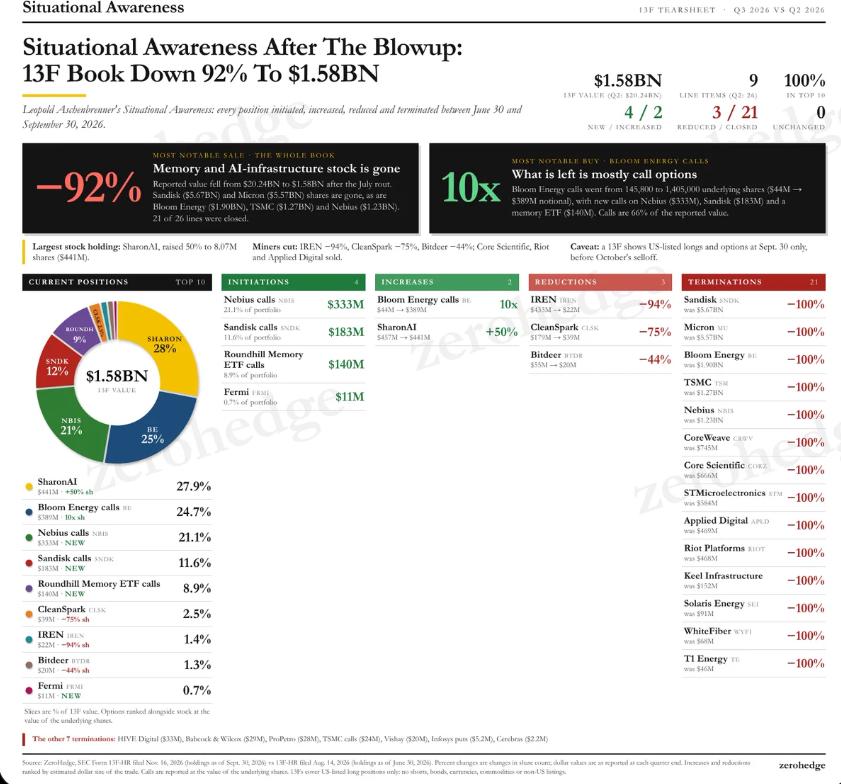
While its position in underlying stocks shrank across the board, the aggressive leverage tools were entirely replaced by call options.
At the end of Q3, the nominal value of the underlying assets corresponding to its call options was about 1.045 billion U.S. dollars, accounting for roughly 65% of the portfolio, mainly distributed in Bloom Energy, a data center power supplier, Nebius, a computing power cloud company, Western Digital, and the Roundhill Storage ETF.
It should be noted that the 13F filing is only disclosed based on the nominal value of the underlying stocks and does not represent the actual premium cost paid, and the real amount of capital invested is far lower than this figure.
Almost all the chips in the underlying stock position were bet on SharonAI, an Australian computing power cloud company.
The size of its position reached 441 million U.S. dollars, accounting for 27.9% of the total portfolio. The number of shares held increased to 8.07 million, accounting for 22.6% of the company's total tradable shares, and the concentration of its top five positions was as high as 94.2%.
This extreme concentration of positions on a single asset reflects his all-in gambler mentality after experiencing the fund blow-up.
The full shift to options is the direct bitter consequence of the July forced liquidation wave.
While buying call options can avoid the risk of serial blow-ups from successive margin calls by paying a limited upfront premium, the fatal cost is the limit of the time window: once the underlying asset fails to rally as expected before expiration, the premium will face the desperate situation of being wiped out to zero.
Overseas media and market rumors indicate that the continuous volatility since the end of September may have caused it to suffer another heavy loss in the secondary sell-off wave in October.
Beyond the stormy public market, there is a crucial hidden card deep in its balance sheet.
The largest part of its remaining assets is Anthropic equity worth about 5 billion U.S. dollars, accounting for half of its total assets. This investment came from a stake grab in early 2025 when the company was valued at 61.5 billion U.S. dollars.
As Anthropic officially launches its IPO process, based on the current market expected offering price range, its post-listing valuation is expected to hit the staggering level of 1.3 trillion to 1.4 trillion U.S. dollars.
However, the paper wealth cannot be directly realized in the short term.
According to the arrangements in the prospectus submitted by Anthropic, pre-IPO shareholders face a tiered lock-up period of one year, which will be lifted gradually at 23 separate nodes, which means that it cannot resolve its liquidity crisis through large-scale share reduction in the short term.
Deeper hidden risks are intricately rooted in the complex network of personnel and compliance.
Aschenbrenner's wife Balvitt currently serves as chief of staff to Dario Amodei, CEO of Anthropic. This subtle marital relationship exposes his huge equity investment to severe regulatory compliance and conflict of interest review risks.
From the myth of spending two years writing a 165-page paper that spawned 45 billion U.S. dollars in assets under management, to suffering a total wealth avalanche and leverage wipeout in a single month, Aschenbrenner's trajectory reflects the extreme collision between technological conviction and capital greed.
The outside world once crowned him with the dazzling title of "AI stock trading prodigy", trying to deconstruct this high-leverage financial gamble with the narrative of a genius teenager.
However, the underlying logic of the capital market is ruthless. Real technological forward-looking insight and secondary market trading profitability are never the same thing, and the reckless sprint with four times leverage can never replace mature risk management.
When conviction is alienated into blind speculation, the boundary between genius and gambler blurs instantly.
This capital adventure from myth to disillusionment leaves a profound footnote: the great wave of artificial intelligence requires long-term patience and tenacity to get through the cycles, and any myth that tries to overdraw the future in advance with leverage and luck will eventually be mercilessly washed away by the ruthless tide of the times.
This article is from the WeChat Official Account "Gelonghui APP" (ID: hkguruclub), written by Aragon, and published with authorization from 36Kr.