Jensen Huang steps down, and the deceleration button has been pressed for the storage market.
The rapid growth that AI has brought to the storage industry is now being tested by payment capacity. Whether consumers can afford higher terminal prices and whether computing power customers can commit funds for purchases in the coming years in advance will jointly determine how fast storage vendors can continue to expand. In my view, the most noteworthy change in this round of market trend next is how much new production capacity enterprises can find reliable buyers for: PC client SSD purchases have shrunk, while investment in AI construction is still increasing, and the two trends are converging in the same industry.
Jensen Huang's departure from NVIDIA provides a window to re-observe this round of expansion. On November 12, NVIDIA announced his departure, and subsequently strengthened the board of directors' supervision over national security and export control. Investors' concerns about AI returns and consumers' reactions to price hikes emerged earlier than this incident. Putting these changes back into the development environment of AI in the United States, it is worth asking: under what conditions can the policies, capital and market expectations that previously favored rapid construction support the next round of investment? The storage industry serves both consumer terminals and data centers, and needs to build production lines for the market several years in advance. How customers arrange their next sum of money will be incorporated into vendors' judgment on future investment.
Expansion Begins to Differentiate by Capital Sources
The policy support provided by the United States for AI construction is an important background for understanding this round of investment. In July 2025, the White House issued an executive order to speed up the approval of data center infrastructure, requiring the reduction of federal regulatory burdens and the use of federal land to advance construction. Supporting measures can include loans, loan guarantees and tax incentives, covering power transmission, power generation, semiconductors and data storage. When enterprises plan projects, they can incorporate construction acceleration and policy support into their expectations, and capital is also more likely to invest in advance around future demand.
Policies supporting construction are still in place, but the requirements of capital for returns are changing. On November 10, Michelle Bowman, Vice Chairman for Supervision of the Federal Reserve, pointed out that corporate bond spreads have widened and valuations of technology stocks have declined, and investors are re-evaluating the expected returns of AI projects and external financing risks. On November 16, Fed Governor Michael Barr further mentioned that enterprises with weak credit and relying on external financing have seen their financing costs rise significantly in recent months.
The capital transactions that Barr focuses on also explain why this change may affect equipment procurement: large cloud vendors and GPU manufacturers invest in computing power startups, which then use the funds to purchase or lease equipment and computing power from their investors. Suppliers' investment helps customers form procurement capacity, but customers ultimately still need to obtain revenue by providing services. If financing becomes more expensive, or investors require a shorter payback period, the originally scheduled construction plans may need to be adjusted.
Microsoft still has a large existing business to support its investment. The company disclosed in October that its operating cash flow in the first quarter of fiscal year 2027 was 58 billion US dollars, and its capital expenditure including finance leases in the quarter was 45.2 billion US dollars. For such customers, the funds required for construction come from internal cash sources; other computing power enterprises need to continuously obtain financing or get customers to pay in advance. Even if both types of enterprises see demand, the procurement commitments obtained by suppliers have different fulfillment conditions.
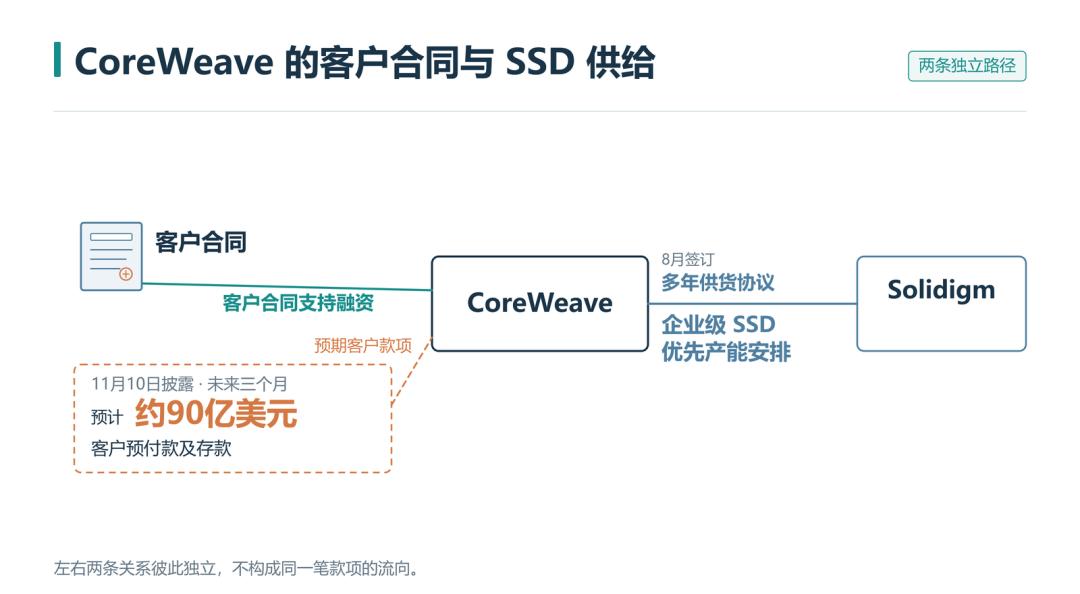
CoreWeave's disclosure makes this difference more specific. The company stated on November 10 that its growth is supported by sources such as financing backed by customer contracts and operating cash flow, and it expects to receive about 9 billion US dollars in customer prepayments and deposits in the next three months. In the same announcement, the company also raised its 2026 capital expenditure guidance from 35-39 billion US dollars to 37-39 billion US dollars, on the grounds that it expects to deploy infrastructure and deliver to customers earlier. Customer commitments are supporting further expansion, and changes in the financing environment cannot be generalized as all AI enterprises beginning to reduce investment.
There is another condition that needs to be re-included in overseas operations. The Bureau of Industry and Security of the U.S. Department of Commerce recently announced an interim final rule involving remote access transactions for some advanced chips and servers, which intends to strengthen due diligence on relevant customers to prevent restricted entities from bypassing existing controls through data centers in third countries. As of November 17, this rule has not yet taken effect. For computing power projects planning to serve overseas customers, who can be served in the future will affect the expected revenue; if the customer scope or approval conditions change, the construction scale and equipment arrangement may be adjusted accordingly.
These differences will eventually be incorporated into storage procurement contracts: how long customers are willing to commit and how much funds they invest in advance is related to how much production capacity suppliers can prepare for future demand.
Behind Long-term Agreements: Who Bears the Cost of Waiting
AI customers have extended supply guarantees to the storage sector. In August, CoreWeave signed a multi-year agreement with Solidigm to obtain priority supply arrangements for enterprise-level SSD production capacity. The same computing power enterprise not only needs customer contracts to support financing, but also needs to secure future supply from upstream. Contracts at both ends undertake different tasks, but both serve multi-year construction plans. Whether customer funds can arrive on time and whether suppliers can deliver as scheduled, any change at either end may affect the implementation of this plan.
These agreements mean that storage suppliers can already demand clearer commitments from customers when judging demand. SK Hynix disclosed in October that long-term agreements cover more than half of its total production capacity from 2027 to 2028, with customers including large cloud service providers; the company is also discussing extending the contract term, which is usually five years. The two parties agree on a price range that reflects market conditions within the range. Customers get a relatively stable supply arrangement, and manufacturers also have a basis for arranging production capacity. Part of the risk of market fluctuations is put into the contract and shared by both parties.
Micron, on the other hand, allows customers to bear cash investment earlier. Its 2026 fiscal year annual report discloses that strategic customer agreements include multi-year minimum procurement commitments and take-or-pay arrangements, and the company received about 12.75 billion US dollars in customer deposits in that year. If customers meet the minimum procurement commitments, the deposits will be returned; if not, Micron can retain all or part of the funds. Almost all of these deposits are scheduled to be returned between fiscal years 2029 and 2031.
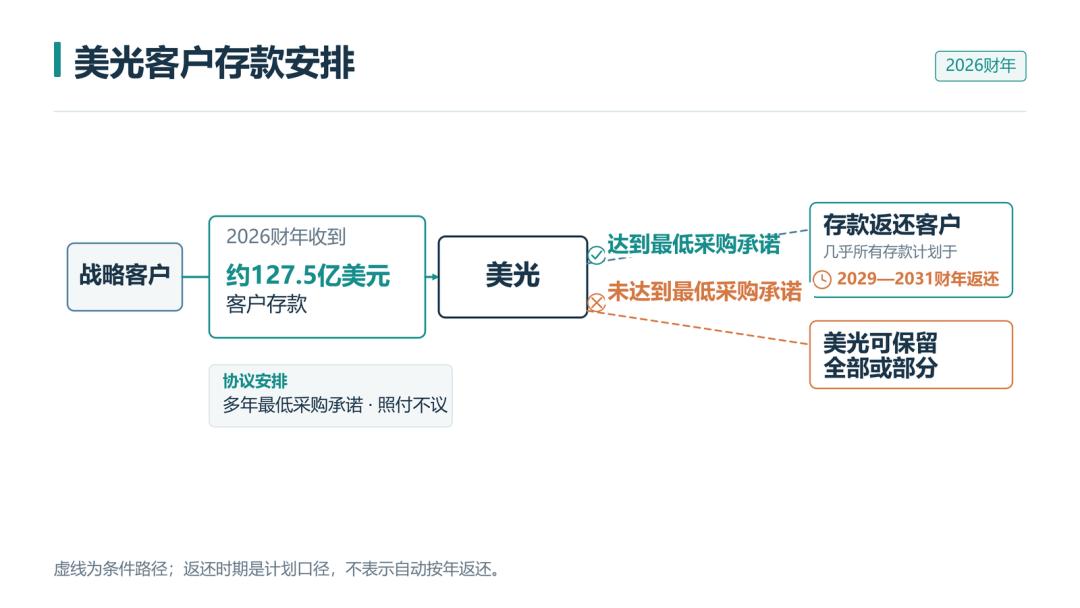
This sum of money is not yet completed sales, but it changes the distribution of capacity expansion risks. The risk that manufacturers build production lines first and wait for customer procurement is partially transformed into the cost that customers occupy cash in advance and fulfill long-term commitments. Buyers with sufficient cash and clear demand can accept this arrangement; buyers who rely on loans for expansion need to calculate the capital cost for several more years. The tighter the financing conditions, the more different the burden of the same supply guarantee will be on different customers.
For storage manufacturers, the stronger the upfront commitments, the more fully the new investment is protected, but the higher the threshold for customers to start projects. It is difficult to have only one unified standard between securing orders and protecting investment. The larger the AI market, the more it is necessary to distinguish which demands are already supported by contracts and funds, and which still depend on the next round of financing.
Products also limit the substitution between orders. HBM is used to provide high-bandwidth memory for some AI accelerators, and servers also use system memory and enterprise-level SSDs based on NAND flash. These products have different uses, certifications and delivery arrangements. If a project delays equipment procurement, even if another customer is still expanding, the originally planned production capacity may not be transferred to it at the same time and according to the same specifications. Long-term agreements can enhance certainty, but cannot turn all storage demands into a total order that can be adjusted at any time.
Procurement Can Be Adjusted, But Production Lines Have Their Own Cycles
There has been a clear slowdown on the consumer side. A survey released by TrendForce on November 11 points out that PC manufacturers previously moved part of procurement and production to the first half of this year to cope with storage price hikes, but rising retail prices suppressed sales in Asia and Europe, and complete machine inventory gradually accumulated. In the fourth quarter, PC brands generally reduced client SSD procurement, only purchasing the quantity required to maintain necessary production, and lowered the procurement plan for the first quarter of 2027.
This adds a practical constraint to the storage market. Manufacturers can raise prices due to tight supply, but end consumers may not continue to accept price increases of complete machines; the inventory in the hands of brand manufacturers will pass on consumer reactions to component procurement in the next quarter. Reduced client SSD procurement does not mean that enterprise-level SSDs will weaken synchronously, but this part of consumer procurement can no longer continue at the previous stocking speed. If AI customers continue to increase investment, they can support more investment; if some of the projects also begin to adjust their budgets, the room for manufacturers to digest pressure through product mix will become smaller.
Storage manufacturing is difficult to turn around in lockstep with procurement. In the fiscal year ended September 3, 2026, Micron's expenditure on plant and equipment acquisition was 30.712 billion US dollars. Its first new wafer fab in Idaho started construction in 2023, and according to the annual report plan, it will not begin to produce DRAM wafers until mid-2027. The products that can be delivered today come from previous investments, and the production capacity decided to be increased today needs to be digested by demand in the coming years.
Manufacturers can adjust subsequent equipment introduction and capacity expansion time, but the funds already invested still need to be recovered. If customers delay procurement, continuing construction requires judging whether there will be enough orders in the future; delaying investment may lose delivery opportunities when demand is fulfilled. This is exactly where the significance of long-term agreements and customer deposits lies: they allow capacity expansion to not rely entirely on suppliers' judgment of the market trend, and also transfer part of the waiting cost to customers.
The financing method itself is also being adjusted. SK Hynix announced in October that it would stop evaluating Solidigm's IPO, explaining that the original plan was to expand production facilities and reduce its own investment burden through external capital, but after considering factors such as recent financial market conditions, it believed that advancing the IPO at that time would not achieve the expected effect. This is a change in financing choice, and it cannot be judged that the factory has reduced production. The company still expects a significant increase in investment in 2027, and said it will adjust the scale and time according to customer demand, profitability and investment efficiency.
The next round of expansion in the storage industry is likely to see more obvious differentiation. Production capacity with reliable long-term buyers and continuously available funds still has reasons to move forward; plans that rely on consumption recovery or subsequent financing fulfillment need to leave more room for adjustment. The observation window provided by Jensen Huang's departure from NVIDIA should eventually fall on this level of industrial judgment: the conditions supporting the rapid expansion of AI are being revalued, and storage manufacturers need to reassess the production capacity scale corresponding to different customer demands and the timing of various investments accordingly.
This article is from the WeChat official account "Feng Wei Feng Dabai", author: Feng Dabai, published with authorization from 36Kr.