NVIDIA, Duan Yongping's investment stress test
Duan Yongping started selling off NVIDIA shares in large quantities.
Yet oddly enough, when Jensen Huang first left NVIDIA, Duan Yongping did not sell his holdings.
As the share price plummeted, he even prepared to buy back the portion of stocks that had been called away earlier.
The reason Duan Yongping gave was: I believe most of the reasons why I bought NVDA still hold, except that Jensen is no longer at the company.
This statement laid bare the core issue: A company is still performing strongly in its business, but the person who gave investors the confidence to hold its shares for ten years has suddenly left. Is it still reasonable to maintain a heavy position in it?
From his first purchase in 2025 to his current re-evaluation of this investment, Duan Yongping has gone through a full cycle of tentative positioning, heavy allocation, position reduction, and wait-and-see on NVIDIA.
This is a very representative investment stress test for him in recent years.
I. From Tentative Positioning to Heavy Allocation
If we turn back the clock to 2025.
Duan Yongping's purchase of NVIDIA actually started with a very interesting starting point.
In March 2025, before the opening of the NVIDIA GTC Conference, he shared a transaction on Xueqiu: he bought 100,000 NVIDIA shares at a net cost of $92.52, and at the same time sold call options expiring in March 2026 with a strike price of $120.
This is a typical Buy Write transaction.
According to his explanation, if NVIDIA's share price rises to $120, the stocks will be sold, with a return of about 29.7%; if the price does not reach that level, he will continue to hold the shares.
He first sets a satisfactory purchase price for himself, then calculates all possible returns in advance. This transaction already reflects Duan Yongping's cautious attitude towards participating in the investment.
A month later, the market was hit by tariff shocks, and NVIDIA's share price fluctuated sharply. Duan Yongping started buying Apple, NVIDIA, Google and TSMC again, and also considered participating by selling Put options.
At that time, he said a very representative sentence: The mountain is still the same mountain, the ridge is still the same ridge!
Behind this sentence lies his distinction between corporate value and short-term price fluctuations.
But there is still a long way to go from making a purchase to fully understanding the business.
In the second half of 2025, when Duan Yongping had a conversation with Fang Sanwen, the founder of Xueqiu, he talked about why he bought NVIDIA, and the reasons he gave were not complicated.
He watched many videos of Jensen Huang, admired him, and particularly noticed that what Jensen Huang talked about more than a decade ago is still consistent with what he advocates today.
An entrepreneur who sticks to the same direction for a long time makes him think it is worth putting a small amount of investment in the company.
But he also admitted that his understanding of AI is not deep enough. In particular, he is still completely unclear about whether there will be alternative solutions to NVIDIA ten years from now.
"It's hard to make a move if you can't see clearly what the business will look like in 10 years", this sentence is very important.
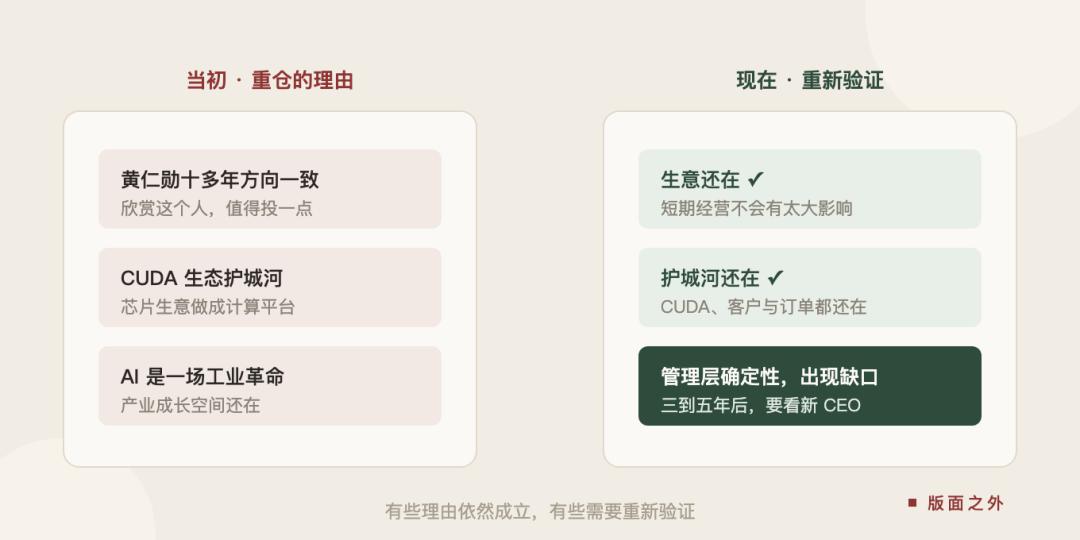
Duan Yongping recognizes that AI is an industrial revolution, and also acknowledges NVIDIA's current competitiveness, but he has no answer for the technology landscape ten years later.
Therefore, at the very beginning, NVIDIA was only an object worth researching and participating in.
The real change took place in the fourth quarter of 2025.
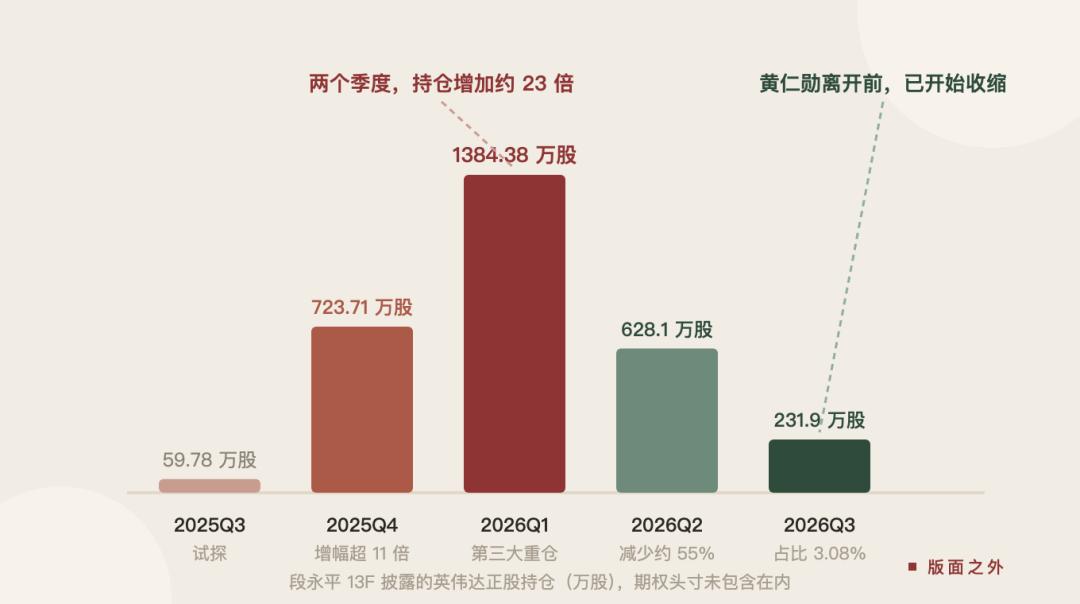
Duan Yongping increased his NVIDIA position from 597,800 shares to 7,237,100 shares in one go, an increase of more than 11 times, with a market value of about 1.35 billion US dollars.
In the first quarter of 2026, he continued to increase his position to 13,843,800 shares, with a market value of about 2.4 billion US dollars, accounting for 12.07% of his entire investment portfolio.
In two quarters, the size of his position increased by about 23 times.
NVIDIA has evolved from a tentative investment to his third largest heavy position.
This is not an ordinary position adjustment. A person who once had doubts about NVIDIA ten years later began to allocate more than 12% of his portfolio capital to this company.
Duan Yongping's trust in NVIDIA has obviously risen to a new level.
But there is a key figure behind this trust: Jensen Huang.
II. He Bet on Jensen Huang
Why would Jensen Huang's departure make Duan Yongping so tangled? The answer lies in the reasons why he first bought NVIDIA shares.
Duan Yongping has repeatedly emphasized that he admires Jensen Huang, especially that the things Jensen Huang talked about more than a decade ago, he is still insisting on doing today.
This actually touches on the most critical layer of NVIDIA's competitiveness.
NVIDIA's current advantages have long gone beyond GPU performance.
From the CUDA ecosystem to developer tools, and then to the complete software and hardware system, NVIDIA has spent many years turning its chip business into a highly complex computing platform.
This path did not take shape overnight.
As early as before the generative AI boom, Jensen Huang had already promoted GPUs to evolve from graphics computing to general-purpose accelerated computing. Facing the long-term uncertain market, he chose to keep investing, which once put the company under huge operational pressure.
Looking back today, one of NVIDIA's most important moats comes precisely from these layouts made many years in advance.
Long-term investment requires managers to have strong enough strategic determination. Jensen Huang is not only the founder of this system, but also its most important promoter. (Extended Reading:Jensen Huang is a Kind of Cycle)
This also explains why Duan Yongping attaches so much importance to Jensen Huang.
When he talked about this turmoil on November 13, he said that it will not have much impact on NVIDIA's business in the short term, but in a few years, it will depend on whether the company can find a good CEO.
He also said that NVIDIA is a company that can be "managed in a foolproof way", but its business model requires a very good management team, otherwise it may not be so strong three to five years later.
This sentence is worth pondering carefully.
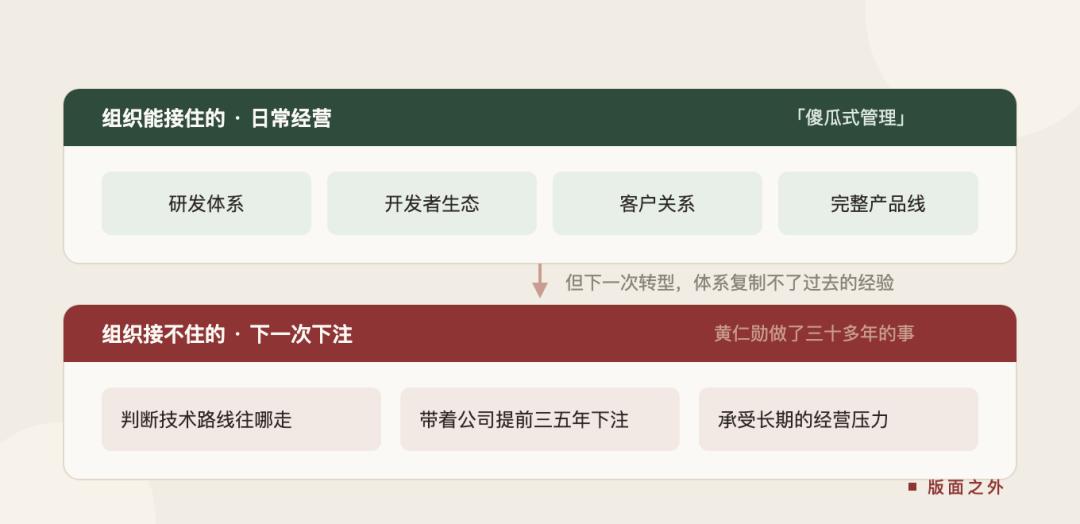
The so-called foolproof management refers to the organizational capabilities, technical systems and business models that a company has already formed. A mature system can support daily operations, so that the company does not have to rely on the founder's personal decisions for everything.
But the choice of strategic direction still requires extremely strong judgment.
Especially for companies like NVIDIA, technical routes, product pace, ecological construction and customer relationships all require layouts many years in advance.
What Jensen Huang has done over the past 30+ years is precisely to continuously judge where the computing industry will go next, and lead the entire company to place bets in advance.
After he leaves, NVIDIA will not lose CUDA immediately, nor will it suddenly lose its customers and orders.
The real problem lies further ahead. When the next technical route changes, when competitors start to catch up, when customer demand shifts, who will make those decisions that require placing bets three to five years in advance?
What Duan Yongping is worried about is NVIDIA's strategic judgment in the future.
III. Reducing Positions Does Not Mean Being Bearish
Let's look at the changes in Duan Yongping's holdings again.
In the second quarter of 2026, he reduced his NVIDIA position from 13,843,800 shares to 6,281,000 shares, a decrease of about 55%.
In the third quarter, he further reduced it to 2,319,000 shares, a decrease of about 63%.
As of the end of the third quarter, NVIDIA's proportion in his portfolio had dropped to 3.08%, falling out of the top five heavy positions.
If you only look at the 13F filing, this is a fairly obvious contraction curve.
But Duan Yongping's investment approach never only includes buying and selling underlying stocks.
The previous Buy Write transaction is an example.
He sells call options. If the share price rises to the agreed strike price, the stocks may be bought away by the counterparty, which is what he calls "being called away".
At the same time, he also sells put options, waiting for buying opportunities at the price he is willing to take delivery of the stocks.
Therefore, the 13F disclosure only shows the US stock underlying stock holdings at the end of a certain quarter, and cannot fully present his option positions.
This is why we cannot directly interpret the large reduction of NVIDIA positions in two quarters as Duan Yongping being bearish on AI.
In fact, as early as before Jensen Huang left his job, he had already adjusted the structure of his NVIDIA position through options.
On November 13, in response to public discussions about whether he had liquidated all his NVIDIA holdings, Duan Yongping made it clear that he would not sell NVIDIA, and he sold a lot of Puts that very day.
There is a very notable change here.
Duan Yongping still recognizes NVIDIA's business and is willing to buy back at an appropriate price. But after Jensen Huang left, his certainty about holding this company obviously needs to be re-evaluated.
If he had completely denied NVIDIA, the simplest choice would be to exit the position.
If he thought Jensen Huang's departure would have no impact on the company at all, he could also continue to increase his position while the share price fell.
He did neither of the two things.
This precisely shows that Duan Yongping is going through a real investment test: Some of the reasons that supported his heavy position in NVIDIA in the past are still valid, while some need to be re-verified.
IV. NVIDIA Needs New Answers
Duan Yongping's hesitation this time has brought to the table the issue that long-term investors care most about: How much of a company's competitive advantage comes from the organization, and how much comes from the person who created the organization?
NVIDIA obviously has a very strong organizational foundation.
It has a mature R&D system, a huge developer ecosystem, long-term accumulated customer relationships, and a complete product system covering chips, systems and software. These things will not disappear just because the CEO leaves.
On November 12, NVIDIA officially announced that Jensen Huang had resigned from his positions as CEO, President and Director, and CFO Colette Kress would serve as interim CEO. The company stated that the board of directors will launch the selection process for a permanent CEO, and emphasized that the existing management team will continue to advance the product roadmap and customer delivery.
This announcement sent two signals.
NVIDIA already has an organizational system that can maintain daily operations, and the company will not stop functioning just because one person leaves.
But the interim CEO position also means that the succession issue has not been resolved. What the board needs to find is a person who can not only manage the company well, but also understand NVIDIA's technical route and business ecosystem, and promote the next round of strategic transformation.
Duan Yongping set the observation period at three to five years.
This time scale is very noteworthy. For a company with a market value of trillions of dollars, this is an exam about organizational inheritance.
For Duan Yongping, who holds its shares, this is also a test of his long-term investment belief.
V. Duan Yongping Wants to Wait and See for Longer
Let's go back to Duan Yongping's recent operations.
On November 16, he said he is not bearish on NVIDIA, but he will not add positions for the time being, and he will see how the new CEO performs next.
At the same time, he said he would buy back the part of stocks that had been called away earlier.
This is a very subtle state.
He has not abandoned his original investment logic, but he is not willing to add positions back before the key variables become clear.
More interestingly, when he talked about whether Jensen Huang might return, he did not completely rule out this possibility: I am not sure about this, but I think the probability is not zero.
Of course, Jensen Huang's return is still only one of the possibilities in Duan Yongping's personal discussion, and it has not become a confirmed succession plan for NVIDIA.
This also means that Duan Yongping's current action of buying back shares has a different starting point from his previous large-scale increase of NVIDIA positions.
Back then, he was gradually building trust in the company; now, he needs to reconfirm whether this trust can continue.
Duan Yongping has a sentence that I think is particularly suitable here: Whether you should sell has nothing to do with your cost, and whether you should buy has nothing to do with the highest price the stock once reached.
This sentence talks about trading principles, and it is also a kind of ability to face cognitive changes.
After buying, you cannot take past judgments as the reason to continue holding; after selling, you should also allow yourself to re-understand the enterprise.
This time, he did not completely deny NVIDIA just because Jensen Huang left, nor did he stick to his original holding method just because he had held a heavy position in the company in the past.
He chose to continue observing.
For Duan Yongping, long-termism means continuously testing his own judgments. When the enterprise changes, when the management changes, investors must recalculate that certainty.
Duan Yongping did not say how much position NVIDIA still deserves to have.
But this stress test has already begun.
Words Beyond the Layout:
The most thought-provoking part of Duan Yongping's investment in NVIDIA is that he once increased his position because of Jensen Huang, and now he re-evaluates the company because Jensen Huang has left.
One person can create a great company, but what is more difficult is to make the company still great even after he leaves.
This time, Duan Yongping is waiting for NVIDIA to give its answer.
This article is from the WeChat official account "Beyond the Layout", authors: Ban Jun, Hua Hua, published with authorization from 36Kr.