NVIDIA plunges, and short sellers have reaped $24 billion in profits within 40 days.
NVIDIA's stock price has continued to plummet recently, while short sellers have reaped huge profits from this trend.
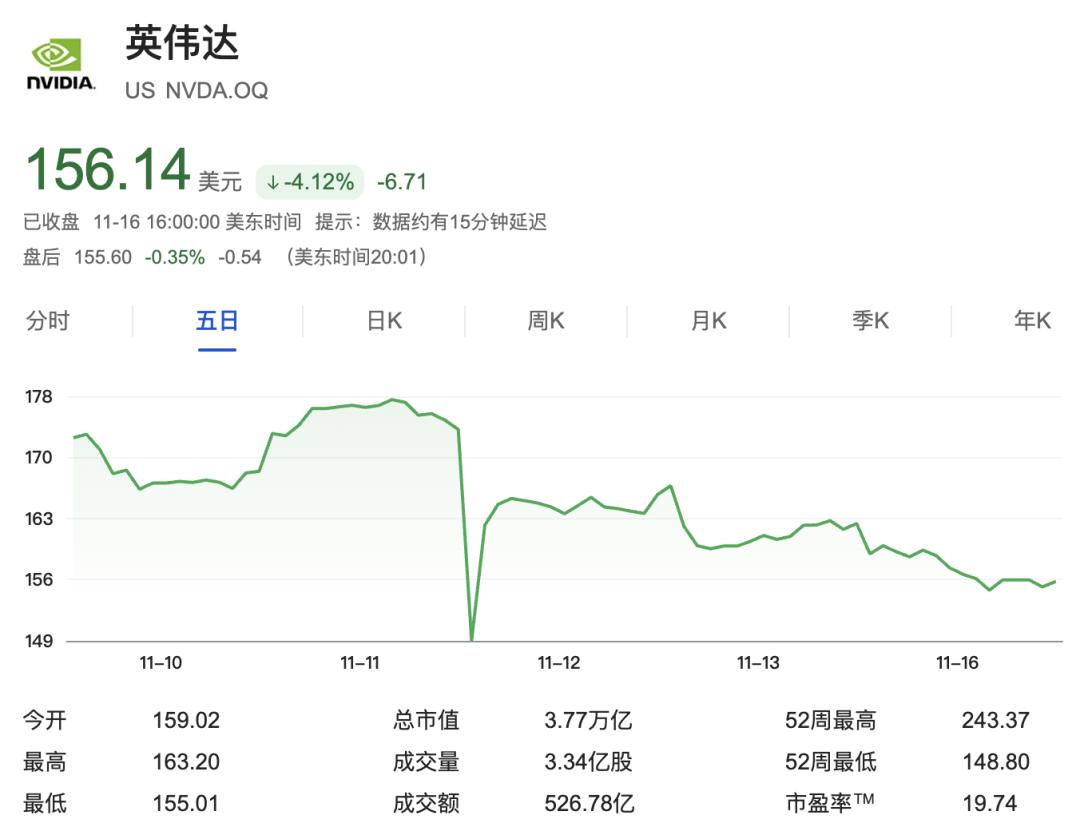
NVIDIA's stock price has fallen by a cumulative 35% from its high on October 6 to date. It closed at $156.14 on Monday Eastern Time, down 4.12% in a single day, extending the previous downward trend. The weekly decline last week marked the largest single-week drop since the Trump administration's tariff policies took effect in April 2025.
Tracking data from financial data firm S3 Partners shows that as selling pressure continues to build up, short positions have risen synchronously, accounting for 1.22% of the outstanding shares, with a nominal value of approximately $46 billion. The short seller group has recorded a total of about $24 billion in paper profits during the roughly 40-day downward trend.
In fact, as early as before Jensen Huang announced his resignation as NVIDIA CEO, divergences had already emerged within the market. Some institutions began to cash out their high-position returns in advance, while gradually building short positions, believing that changes in the competitive landscape of AI computing power and order diversion from customers' self-developed chips will compress NVIDIA's long-term profit space. According to a previous research report released by JPMorgan Chase, among the publicly announced future computing power procurement agreements of cutting-edge AI laboratories, NVIDIA's GPU share is only 28%, far lower than the 80% to 90% revenue proportion in the previous two years.
At the end of August this year, "big short" Michael Burry bought NVIDIA call options expiring in December with a strike price at the mid-to-high $200 range, saying the position is a "hedging tool" to hedge the risks of his short positions and put options.
Burry also further shorted stocks of NVIDIA, Oracle, Palantir, Nebius and Caterpillar. His stock short positions now account for more than 21% of his investment portfolio (excluding put options). He believes that NVIDIA's monopoly advantage may be difficult to maintain for a long time, and its profit margin may decline accordingly. At the same time, the company may allocate more funds to capital expenditure and investment rather than giving sufficient returns to shareholders.
In mid-September, Burry continued to reduce the risk of his investment portfolio, closed out the December 2026 put options of NVIDIA and Palantir, and chose to increase his cash holdings to observe the market trend in autumn.
In sharp contrast to the continuous increase in short positions, retail investors chose to go against the trend and enter the market. Statistics from market research firm Vanda show that in this round of selling wave, net buying of NVIDIA stocks by retail investors reached $2 billion last week, hitting a record single-week purchase volume. Many retail investors regard this sharp drop as a rare pullback window for the AI leader, believing that NVIDIA's advantages in chip orders and cash flow remain solid, and the short-term volatility is only driven by sentiment.
Dave Maza, CEO of Roundhill Financial, said: "NVIDIA has gone from the market's favorite to the market's outcast. This repricing makes the stock very attractive now. The bearish voice is loud, but retail investors are entering the market. Except for the worst-case scenario, the stock's valuation multiple is attractive under all scenarios. This is buying on panic, not selling after good news is fully priced in."
Jensen Huang's resignation has become the direct fuse that accelerated the decline of NVIDIA's stock price in this round. The market is worried that Huang, as the core figure in building NVIDIA's ecosystem, maintaining customer relationships and planning chip roadmaps, his departure will lead to strategic discontinuity. In terms of market value changes, NVIDIA's peak market value was close to $5.8 trillion. After this round of decline, its latest market value has dropped to around $3.8 trillion, with the market value evaporating by more than $2 trillion from the high point.
Discussions about whether Jensen Huang will return are also continuing. Sources say Huang's Silicon Valley allies are lobbying the board of directors, hoping to promote his return to the CEO position, and even plan to seek support from the White House. However, some insiders said that NVIDIA's board of directors is currently focusing on relevant investigations and has not launched consultations on Jensen Huang's reinstatement.
On local time November 16, Sam Altman, CEO of OpenAI, said when talking about Jensen Huang's departure that he believes the AI industry can survive the uncertainty caused by Huang's resignation last week. Altman also said he has "strong personal empathy for this situation", mentioning his experience of being fired by the OpenAI board of directors about three years ago. At that time, a large number of OpenAI employees threatened to leave with him, and less than five days later, he returned to the position of CEO.
In Altman's view, even without Jensen Huang, NVIDIA will continue to play its role in the industry.
It is worth noting that after U.S. stock trading on Tuesday, NVIDIA is about to release its first financial report after Jensen Huang stepped down, that is, the performance for the third quarter of fiscal year 2027. Investors will focus on revenue, gross margin guidance, and the company's statements on AI capital expenditure, customer orders, and the ramp-up pace of new products. How interim CEO Colette Kress responds to issues such as ecosystem and supply chain will also directly affect the short-term stock price trend.
However, on the eve of the earnings release, a number of investment banks have lowered NVIDIA's target price. Mizuho Securities lowered NVIDIA's target price from $250 to $220, but maintained the "outperform" rating for the stock. UBS lowered NVIDIA's target price from $300 to $240, maintaining the "buy" rating.
Brian Colello, equity strategist at Morningstar Investment Services, said: "We originally expected NVIDIA to deliver a regular quarterly report with better-than-expected performance and raised guidance, just as it did in many previous quarters. You know, these changes even happened after the books for the third quarter were closed. But if NVIDIA is in trouble and announces that problems already existed in the third quarter, this stock will face a huge crisis."
However, some institutions hold a relatively optimistic attitude. Morgan Stanley maintains its overweight rating on NVIDIA and a target price of $267. Analysts at the institution believe that despite the uncertainty brought by changes in NVIDIA's leadership, the recent fundamentals remain strong, and even the slowdown of some projects in Southeast Asia cannot meet the demand.
This article is from the WeChat Official Account "Jiemian News", written by Song Jiannan, and published with authorization from 36Kr.