The materials science agent MatOS is officially open-sourced, greatly improving the success rate of materials R&D tasks.
Large language model-powered agents are now capable of retrieving literature, invoking simulation software, and even collaborating with automated laboratories. However, enabling them to independently complete a full materials research process still faces considerable challenges:
A single research project may require stepwise screening from tens of millions of candidate structures, or iterative search across hundreds of alloy formulations over several days, with constant plan adjustments based on intermediate results. Each time a new database or software is integrated, the workflow often needs to be rebuilt from scratch, and the experience accumulated in one research project is extremely difficult to reuse for other studies.
To address these pain points, Beijing Zhongguancun Academy, Zhongguancun Institute of Artificial Intelligence (the two Zhongguancun institutions) released its annual scientific research progress in September this year — MatOS, a scientific research agent system tailored for materials R&D.
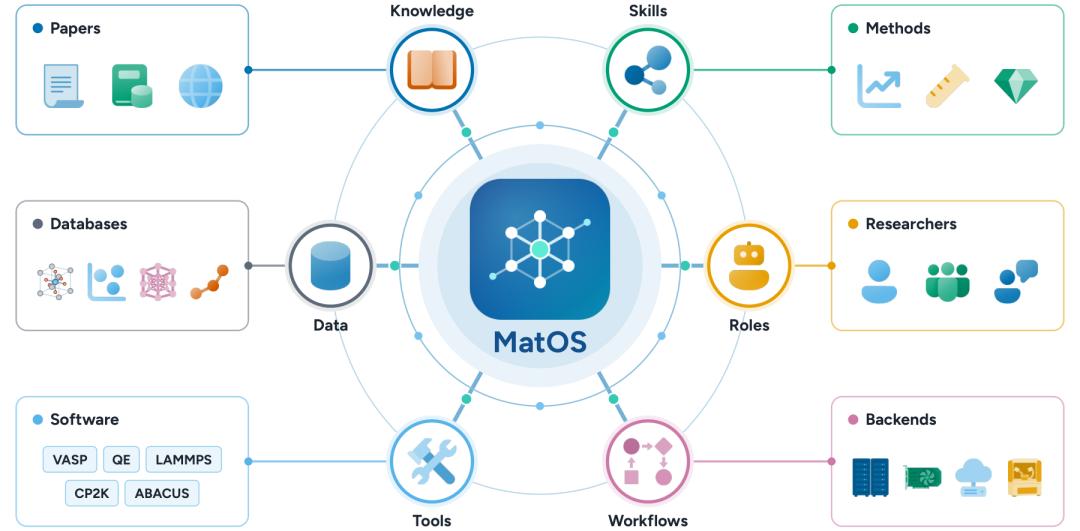
This project is developed by the team from the AI Materials Research Institute of the two Zhongguancun institutions. It unifies data, knowledge, tools, skills, roles and workflows into organized scientific assets, supporting researchers and MatOS itself to build new capabilities on top of existing assets. It executes research tasks through stateful workflows, and applies verified, reviewed asset revisions to subsequent studies, so that scientific research capabilities can keep evolving during usage.
At present, MatOS's asset library contains 3,135 datasets, 386 skills, 104 workflows and 51 expert roles, and integrates 48 materials computing software packages. Its technical report has been published on arXiv, and the code is open-sourced on GitHub.
In 3 agent benchmarks and 8 research cases, MatOS has completed a wide range of tasks from end-to-end autonomous research, tool invocation to large-scale screening, formulation design and new method development, for example:
On the end-to-end autonomous scientific research benchmark ResearchClawBench, it scores 33.6% higher on average than Codex CLI that uses the same base model, and 80.8% higher on materials-related tasks;
On the materials software usage benchmark MatTools, when using the same base model as Codex CLI and Claude Code, its full problem success rate reaches 97.96%, the highest among the three;
It builds a hierarchical screening process, and filters out 97 solid electrolyte candidates from more than 30 million candidate structures;
It supports the development of the alloy melting point prediction model DuoCompNet, whose mean absolute error on the fixed test set drops to 3.18°C, 13.6% lower than the second-best model.

From answering questions to conducting research, and further to continuously delivering high-quality scientific assets
In recent years, works such as ChemCrow and LLaMP have enabled large models to call professional tools, and systems such as MARS have connected agents with automated experiments. Scientific research agents are evolving from simply answering questions to independently carrying out research.
Materials research puts forward three sets of requirements for agent systems:
With the continuous emergence of new databases, simulation software and machine learning potentials (methods that use machine learning models to approximate interatomic forces and accelerate simulations), the system needs to support integration of new capabilities without full reconstruction;
Research spans literature analysis, computation and experiments, which requires the system to preserve state and check results in long-cycle tasks;
Most experiences such as simulation duration and sampling strategies come from practice, so the system needs to store these experiences and effectively reuse them in subsequent tasks.
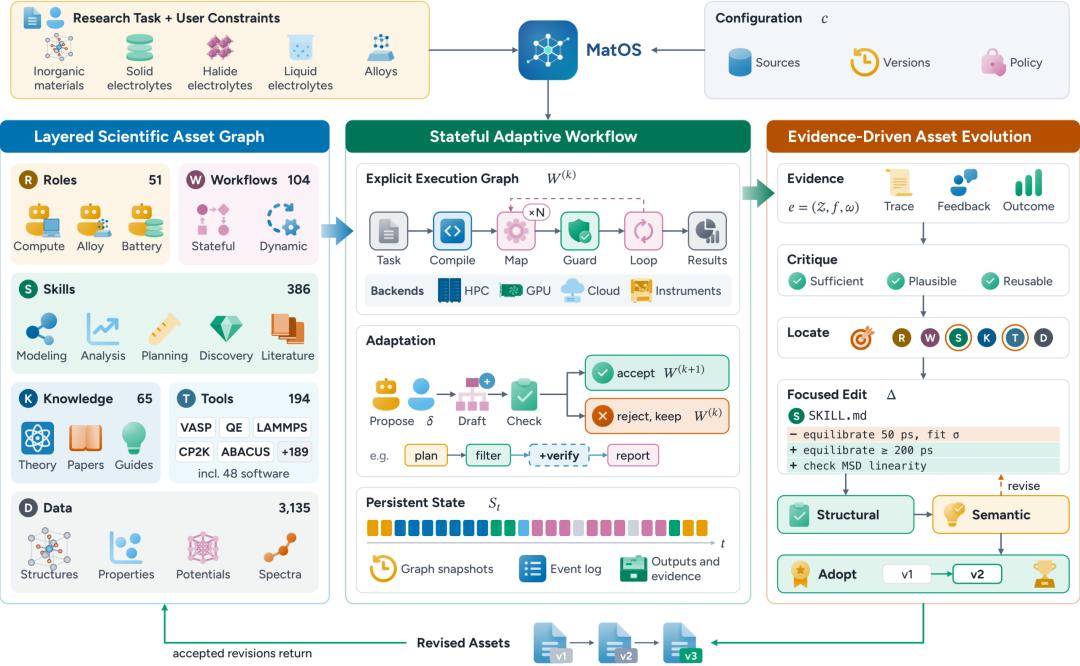
MatOS responds to these requirements with three core designs: a hierarchical scientific asset graph that organizes and expands R&D capabilities, a stateful adaptive workflow that invokes assets to execute tasks and preserves evidence, and evidence-driven asset evolution that converts reusable experience into verified and reviewed asset revisions.
△
Three core designs: Construction, execution and evolution
Hierarchical scientific asset graph: Combine existing capabilities to build new capabilities
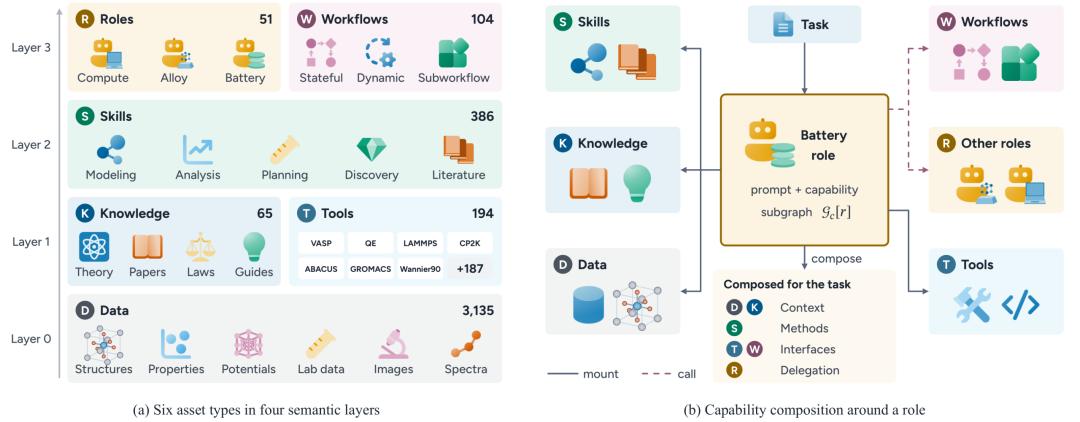
MatOS organizes data, knowledge, tools, skills, roles and workflows into six categories of scientific assets.
Each asset has a unique identifier, declared dependencies and source records. It can either store content directly, or reference external databases or computing software.
Assets are connected through typed relationships such as dependency, invocation, evidence and verification. When receiving a task, the agent combines the required capabilities according to these relationships.
Among them, a skill is equivalent to the operating procedure for a certain type of research problem, which specifies when to use it, how to select methods, what prerequisites are required, how to execute, and how to check results. A role is an expert agent defined by responsibility descriptions and invocable assets. A workflow describes how multiple research phases are connected. One skill can be used by multiple roles, and one role can also participate in different workflows.
Both researchers and MatOS itself can build new capabilities on top of existing assets.
Researchers can register databases, software or methods as assets, and combine them into skills, roles or workflows according to interfaces and dependency relationships. MatOS can also create or revise assets based on task evidence, which can be reused for subsequent tasks after inspection and review. All usage and revision records of assets are kept, so every improvement is traceable.
△
Stateful adaptive workflow: Stable execution and on-demand adjustment
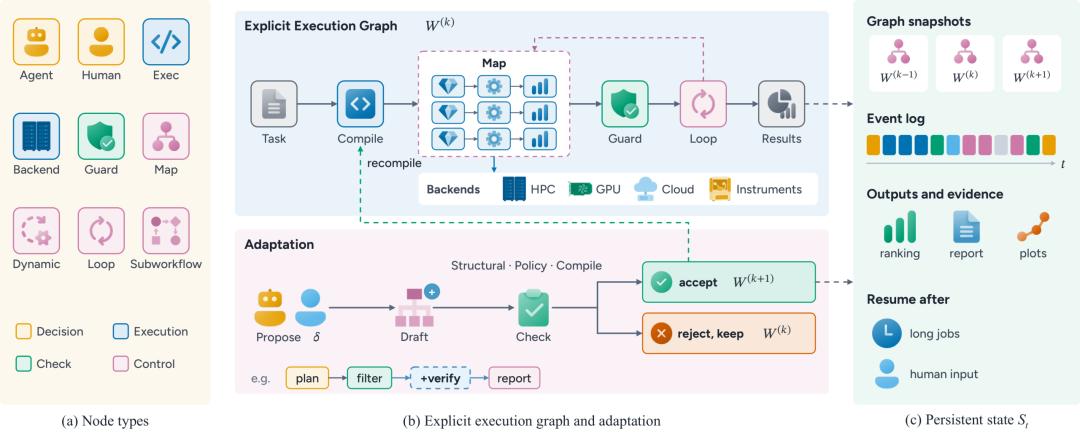
Workflow assets are reusable process descriptions, while a specific research project runs through an execution graph. Each node in the execution graph clearly states the goal, input and output, completion conditions and referenced assets. The system schedules and checks according to the graph, only leaving judgment-required links such as method selection, plan adjustment and anomaly interpretation to the agent, and steps requiring researcher confirmation can be set as manual nodes.
Since large models may output different results even for the same input, decisions in long tasks are prone to deviate from the goal as the context changes. Therefore, MatOS reduces the execution's dependence on model sessions through explicit steps and check conditions, lowering the risk of deviating from the research goal in multi-step execution.
Snapshots of the execution graph, node status, results and event records are all stored in the system, independent of the model's sessions.
Computations that take several days are handed over to background execution. The system will actively notify the agent when the task is completed, input is required, or the process loses response. Tasks waiting for external results or manual input will preserve progress and resume execution later. Each output is associated with the node and execution attempt that generated it.
Intermediate results may require adjustment of subsequent steps, for example, adding an extra verification step first, and making subsequent analysis based on the verification results. In this case, the agent or researcher can propose adjustments to the execution graph, adding or modifying nodes, and changing dependency relationships. The adjustment must pass three checks: structure check, strategy check and compilation check, and a new version of the execution graph will be formed after passing. If it fails, the original execution graph will continue to run. All adjustment proposals, check results and adoption decisions are recorded, so the evolution process of the execution graph is fully traceable.
Adjustments to the execution graph first serve the current task. Process improvements with reuse value will be taken as evidence for asset evolution, and will be used to revise the corresponding workflow asset after inspection and review, for invocation by subsequent similar tasks.
△
Evidence-driven asset evolution: Continuous improvement during usage
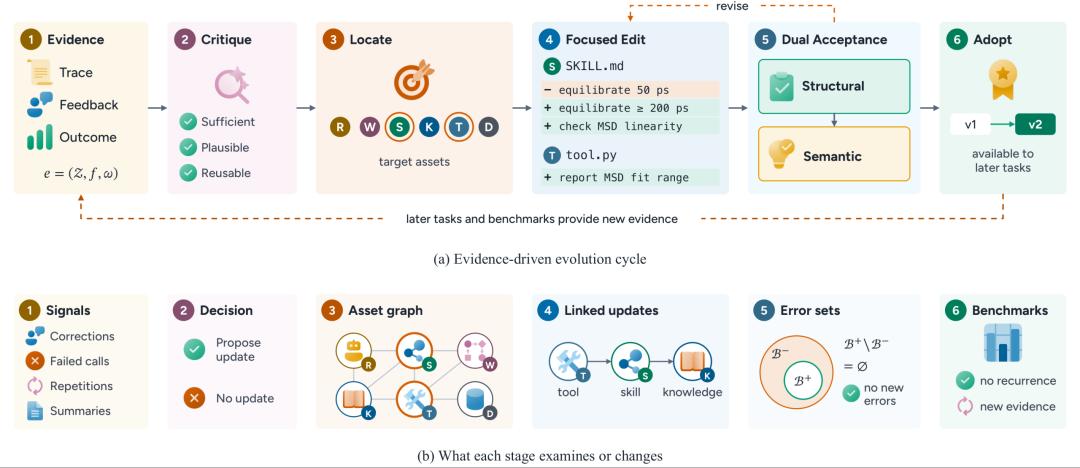
User corrections, failed tool invocations, recurring operations and workflow results may all indicate that a certain asset needs improvement.
MatOS first evaluates whether the evidence is sufficient, whether the problem is valid, and whether the experience is reusable, then locates the asset responsible for the corresponding function: wrong method selection may require revision of knowledge or skills, incorrect tool behavior requires tool repair, missing research steps require workflow revision; when necessary, new assets can also be created, or multiple related assets can be revised synchronously.
For example, if feedback shows that the equilibrium time of molecular dynamics simulation is too short, the system can change the equilibrium duration in the corresponding skill from 50ps to at least 200ps, and add a check to confirm that atomic diffusion has entered a stable state.
Candidate revisions must pass structural inspection and model-based semantic review: the structural inspection mainly judges whether new structure, interface or combination errors are introduced; the semantic review judges whether the revision responds to the original evidence, retains the applicable conditions of the method, and remains consistent with related assets.
Only revisions that pass inspection and review will be adopted, and the results of subsequent tasks will become evidence for the next round of evaluation. These experiences are stored in assets outside the model, and the parameters of the underlying large language model remain unchanged; assets are not bound to a specific model. In the evaluation, the same set of MatOS is paired with GPT-5.4 and DeepSeek series models respectively.
△
Benchmark evaluation results
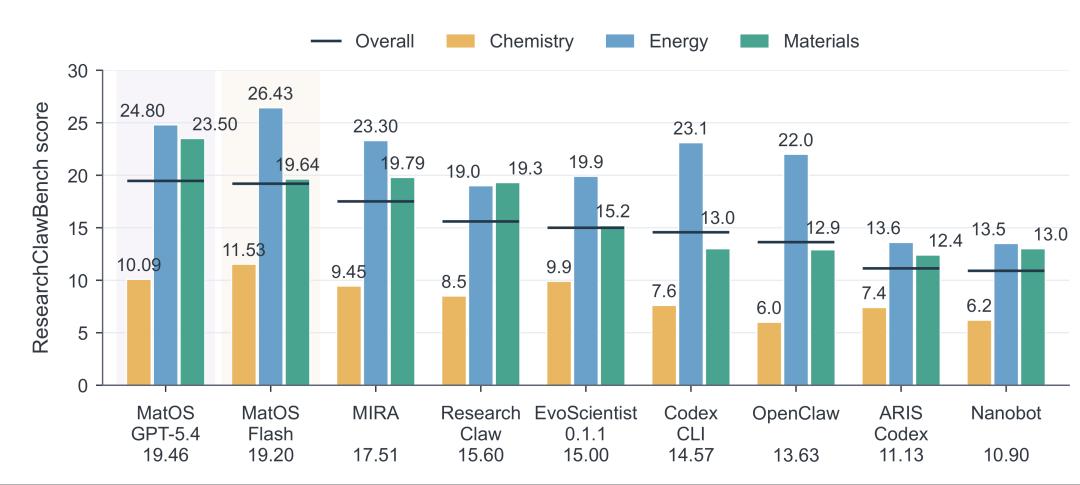
ResearchClawBench requires the system to conduct research and submit reports based on literature and raw data. The team selected 12 tasks in the fields of chemistry, energy and materials, and compared MatOS with 7 other GPT-5.4-powered scientific research agents including MIRA, ResearchClaw, EvoScientist and Codex CLI.
When using GPT-5.4, MatOS gets an average score of 19.46, 11.15% higher than the best baseline MIRA, and 33.6% higher than Codex CLI. Its performance on materials tasks is even more prominent: 18.7% higher than MIRA, and 80.8% higher than Codex CLI. When switching to the lower-cost DeepSeek-V4-Flash, MatOS gets an average score of 19.20, which is also higher than all baselines.
△
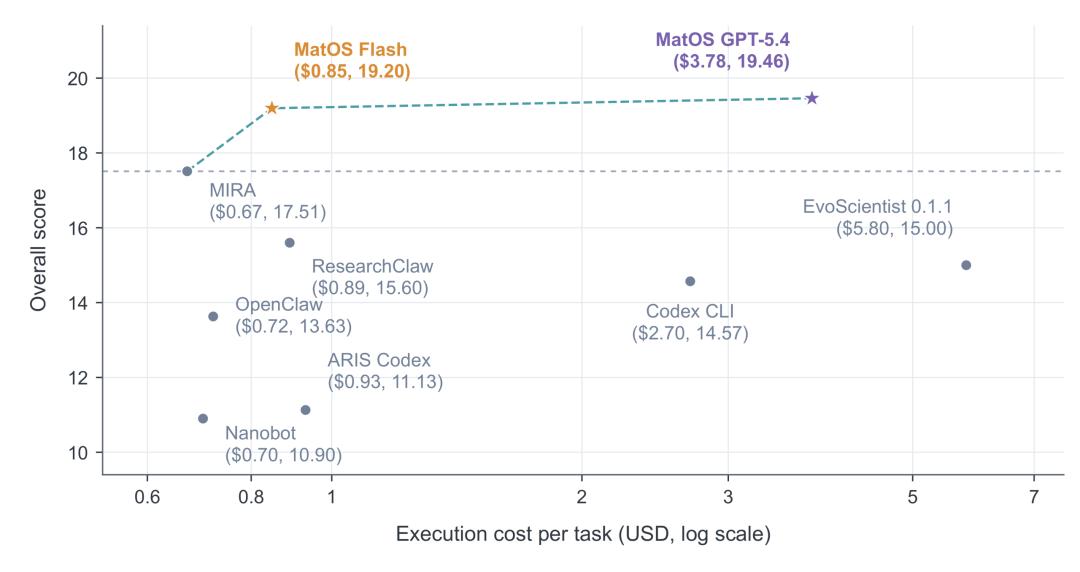
In terms of cost, the average cost per task for the DeepSeek-V4-Flash configuration is about $0.85, less than one third of Codex CLI's $2.70, with a higher score; the GPT-5.4 configuration achieves the highest score at a cost of about $3.78. The two MatOS configurations jointly expand the cost-score Pareto frontier in this evaluation (that is, among multiple objectives, a set of optimal choices that make trade-offs with each other, none of which can be fully surpassed by other alternatives).
△
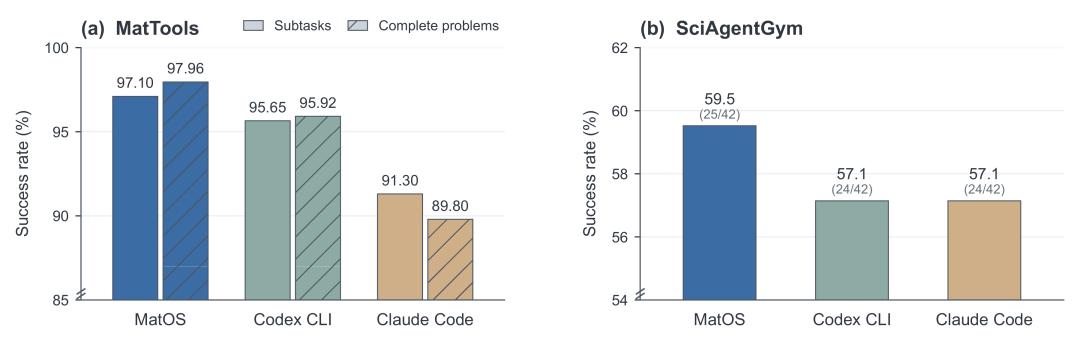
On the materials software usage benchmark MatTools and the multi-step tool invocation benchmark SciAgentGym, the three systems MatOS, Codex CLI and Claude Code all use DeepSeek-V4-Pro as the base model.
MatOS's full problem success rate on MatTools is 97.96%, higher than 95.92% of Codex CLI and 89.80% of Claude Code; its subtask success rate is 97.10%, compared with 95.65% and 91.30% for the other two respectively. On SciAgentGym, MatOS's case success rate is 59.5%, higher than 57.1% of the other two systems.
△
Research cases: From large-scale screening to new method development
The 8 research cases cover materials fields including machine learning potentials, solid and liquid electrolytes, and alloys, and extend to fluid mechanics. The task types include large-scale screening, molecular simulation, formulation design and new method development.
In terms of large-scale screening, MatOS follows the hierarchical screening framework proposed by Du et al.: it first conducts fast coarse screening with a model based only on chemical composition, then uses a graph neural network that predicts properties from crystal structures for fine screening, and finally uses molecular dynamics simulation to analyze ion motion, to evaluate ionic conductivity, electrochemical stability and mechanical properties step by step. It filters out 97 solid electrolyte candidates from 30,364,908 initial structures, whose calculated ionic conductivity reaches up to 59.0mS/cm.
