Is AI Killing the Gaming Industry? | Gaming Trendsetter
Text by Erji
In the gaming industry, AI is becoming a "Rashomon" centered on the future: some regard AI as a productivity revolution, while others fear that AI will destroy the existing developer ecosystem. Supporters and opponents hold their own arguments, and no one can tell for sure which kind of future will come first.
The *2026 Game Industry Report* recently released by GDC shows that 40% of practitioners in the game industry have used generative AI in their work, while at the same time, 55% of respondents believe that AI is bringing negative impacts to the game industry.
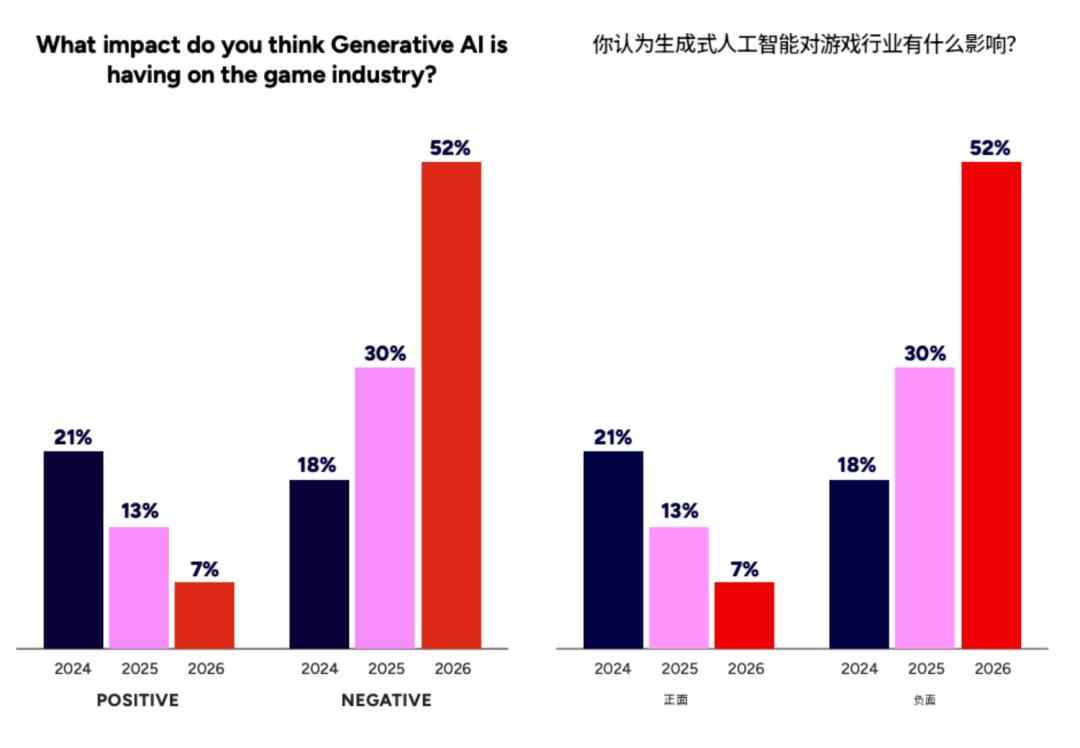
Data from *2026 Game Industry Report*
A recent public controversy involving Tencent has made this contradiction more intuitive. On November 11, during Tencent's 28th anniversary headquarters LinkTime event, Ma Huateng talked about organizational restructuring in the AI era, proposing that core businesses should fully embrace AI and explore AI Native businesses. However, this statement was quickly misinterpreted as "Tencent will lay off 50% of its staff", and even the rumor of "8,000 people being laid off" spread. On November 12, Zhang Jun, Director of Public Relations at Tencent, came forward to clarify that the so-called "50%" refers to the allocation of resources to AI businesses, not the layoff ratio.
Behind this misinterpretation is the anxiety of employees who are afraid of being replaced by AI. At the end of the LinkTime notes released by Tencent Culture on November 16, it reads: "We hope all colleagues can turn anxiety into excitement."
Can this anxiety really be turned into excitement?
For game developers, this anxiety is not only about whether their jobs will be replaced, but also about whether the works they have worked so hard to create will be easily copied by AI.
On social media, articles and opinions often claim that AI plagiarism has brought the game industry into the era of "Dark Forest": Once the demo is made public, it will be copied immediately, and too many low-quality AI games may trigger a new round of "Atari Shock", which will eventually lead to the destruction of the entire industry.
The independent game sector is the most obviously impacted. After the video of *Needle in a Haystack Simulator* went viral on X, 14 knockoffs appeared on Roblox within 48 hours, followed by 9 on Steam, and there are now more than 40 on WeChat Mini Programs. *The Drunken Goddess's Drunken Deception* canceled its originally scheduled public demo and switched to closed playtests; the originally scheduled Steam public beta for *ReVamp* was changed to a small-scale test on Discord.
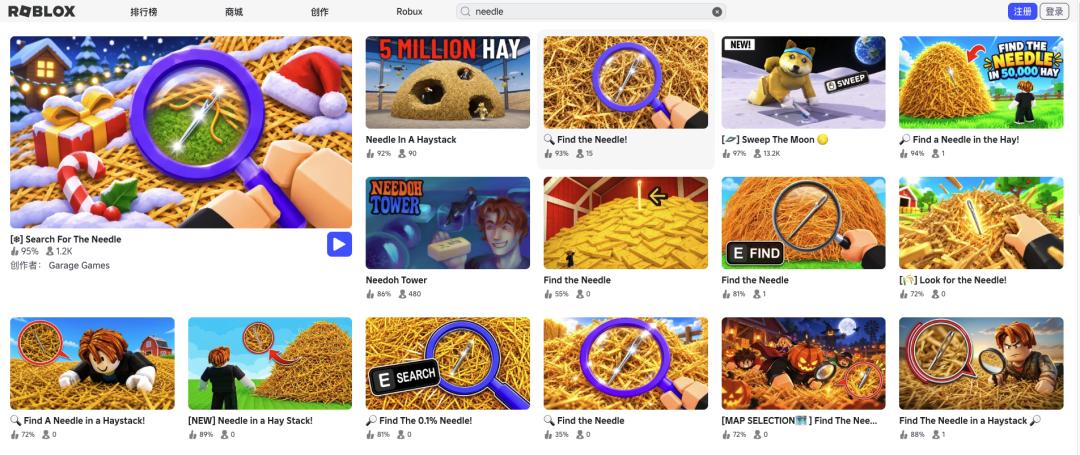
*Needle in a Haystack Simulator* knockoffs on Roblox

*Needle in a Haystack Simulator* knockoffs on Steam and Mini Programs
Large game companies are not completely insulated from this impact. Many game manufacturers have revealed to us that unreleased projects have been quickly unpacked by players with the help of AI tools, and some assets that should not have appeared in the test version but were not cleaned up in advance were thus exposed ahead of schedule.
At the same time, AI also plagues players. Too many low-quality AI works take up platform recommendation slots, making it hard for players to discover new excellent works as they did before.
The just-concluded Steam Next Fest saw more than 8,000 games sign up, double the number from the June event. itch.io, a platform with a stronger independent game atmosphere, also stated that the number of new game pages added daily on the platform has doubled compared to August, reaching 6,000, but downloads and purchases have not grown synchronously.
It is obviously unrealistic to expect platforms to "purge" AI games. The Steam team stated at the Steam Indie Connect event held in South Korea that "we do not want to act as gatekeepers telling developers which tools they should or should not use", and hopes to filter works by optimizing algorithms. The measures taken by itch.io are more in line with players' expectations: it not only requires developers to categorize and mark all uploaded assets and provides filter tags for players, but also actively removed several terabytes of low-quality AI games.
AI makes game development faster and more convenient, but almost all the news we hear seems to be bad news: People who want to speculate with AI are draining the pond to catch fish, while players who want to play games are searching for a needle in a haystack.
This article does not intend to repeat the panic, but to discuss what future game developers should do.
01Who is panicking, and who doesn't care?
First of all, let's see what kind of games are most vulnerable to AI plagiarism.
Most of the plagiarism incidents that sparked online discussions in the past were projects by overseas developers, such as *Needle in a Haystack Simulator* and *The Drunken Goddess's Drunken Deception* mentioned at the beginning. For similar domestic cases, I found *Jade Scratch Card* developed by Insomnia Games.
The producer Penpen said that *Jade Scratch Card* was originally a Game Jam project. Only 4 days after the project was made public, a friend told him that the game had gone viral on Douyin. A few days later, works with almost identical gameplay and level details appeared on Steam, and the knockoff was even launched earlier than the original work, which was not yet finished. There was also a publisher that had contacted the team and obtained the game installation package, and finally launched an almost one-to-one copied work.
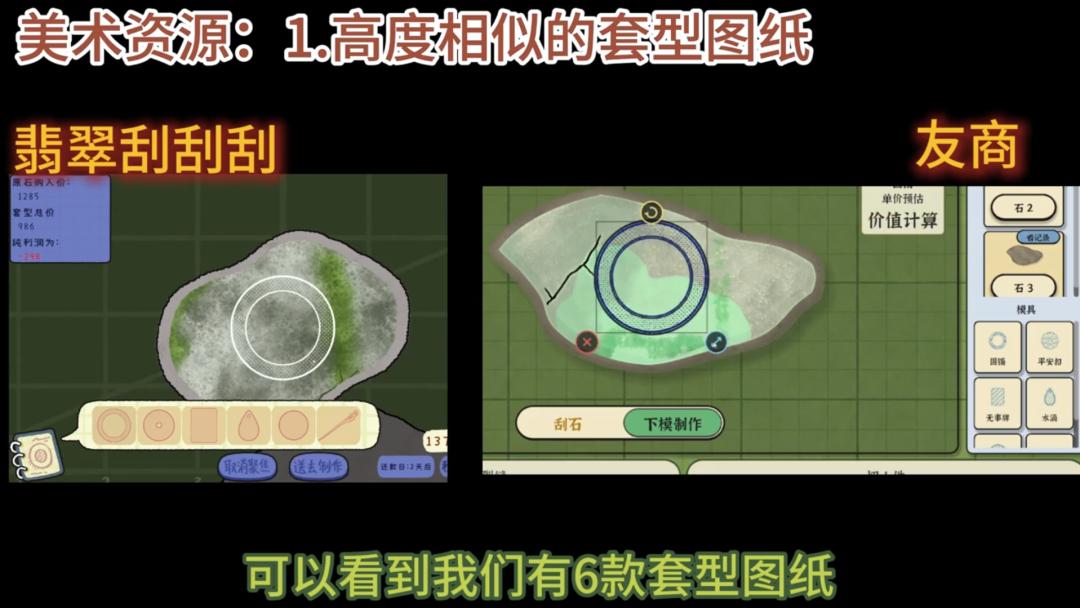
Rights protection video released by Penpen, detail comparison

Rights protection video released by Penpen, detail comparison
At first, Penpen was even a little pleasantly surprised, thinking that at least it proved that his gameplay and theme had been verified by the market.
But the surprise faded quickly. AI knockoffs consumed an incomplete gameplay and idea in advance, greatly shortening the market window of the original game. Even if the original work has more complete design and production, players' sense of freshness has been completely exhausted before it can be put on sale.
In his post on Xiaohongshu, Penpen initially blamed the Game Jam creation model itself for this plagiarism. In his view, Game Jam was originally a great opportunity for new creators to quickly make mistakes and accumulate experience, but now it has been targeted by many ill-intentioned companies, who treat it as an idea bank and "scout for projects" on the platform.
In fact, phenomena like plagiarism, content scraping, unpacking and homogenization have always existed in the "handmade" era when AI was not well developed. The emergence of AI only made these phenomena happen faster.
Back when hyper-casual games were on the rise, many companies got their start by drawing references from existing works. Voodoo's hit *Hole.io* drew reference from the core setting of the independent game *Donut County* and simplified its narrative and gameplay. *2048* also has its prototype *Threes!* with simplified design. The latter took more than a year to develop, while the former only took one week to replicate.
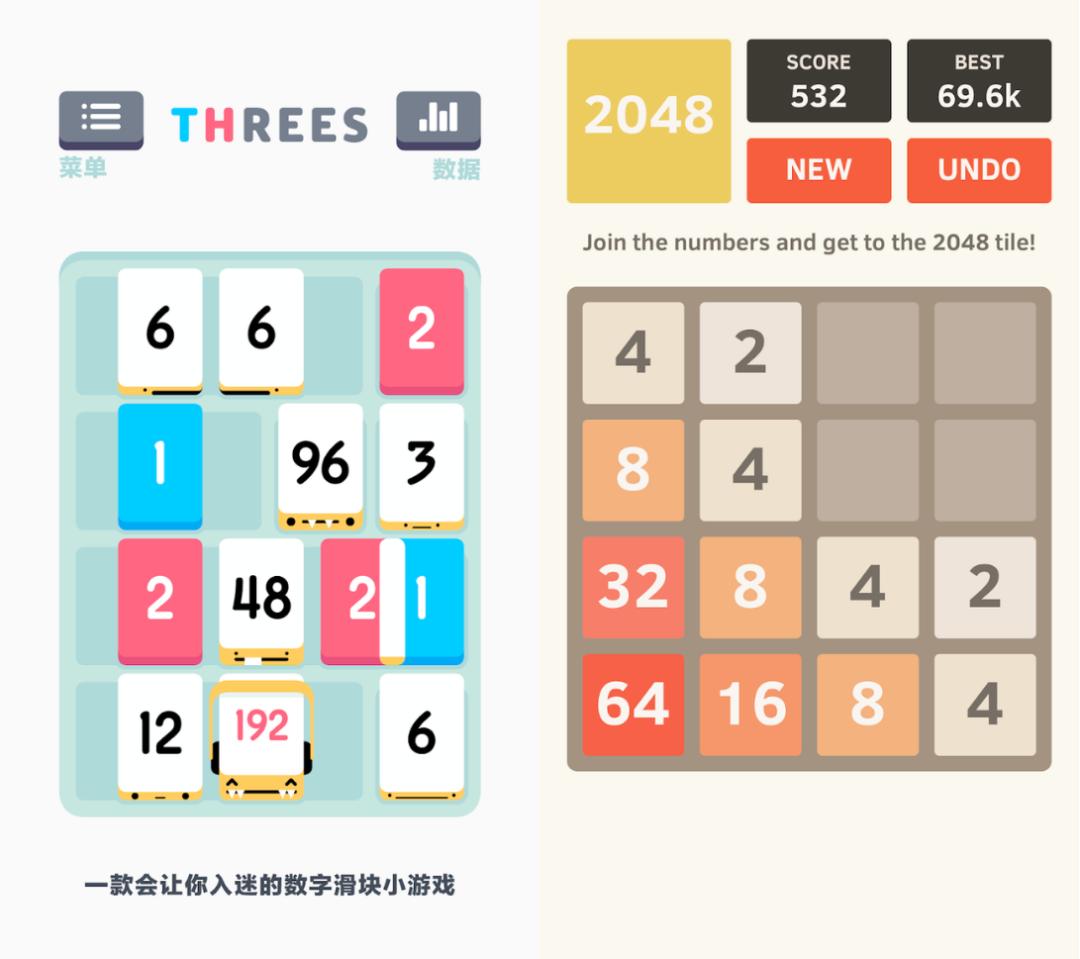
Left: *Threes!*, Right: *2048*
In other words, AI has not fundamentally changed the competitive logic of the game industry, it only makes the ongoing changes happen faster, more intensely and more extremely.
Penpen is quite pessimistic about the future of independent game developers, feeling that they cannot get external support. Apart from morally condemning plagiarists, there are no practical measures that can truly protect original works.
From a technical perspective, all major manufacturers hope their models are higher, faster and stronger, and no one cares whether users use AI for plagiarism. Only Anthropic has officially modified the prompt words of Claude Code to target game cloning, trying to prevent users from directly copying original works. But prompt words are just a piece of text after all, and it is extremely easy to bypass them.
Defending rights through platforms is also full of obstacles. Penpen said that if you want Steam to intervene and take down the infringing work, you first need to submit evidence based on the DMCA (Digital Millennium Copyright Act). But if the plagiarist claims they did not plagiarize and submits a "Counter-Notification", you need to file a lawsuit locally in the United States to prevent the removed content from going back online, which brings extremely high costs for overseas developers.
From a legal perspective, the cost of rights protection is extremely high. There is not even a clear standard for identifying gameplay plagiarism, let alone AI-related plagiarism. Insomnia Games has already taken legal action. Penpen mentioned that most of the profits earned from the team's previous work *Bug Vivarium* have been invested in this rights protection process.
What about relying on players' morality? There are indeed a group of well-meaning players who will take the initiative to speak up for original works. But for most players, they have no obligation to investigate whether a game is original before purchasing it, and this cost should not be borne by players in the first place.
When all the above approaches do not work, the only self-protection method Penpen can think of is to delay the release of the public demo as much as possible, and strive for a longer market window before the official launch.
He said that many developers around him have already given up creation. Those who have not given up can only take things one step at a time. We seem to have no choice but to admit that AI technology is advancing at a tremendous speed.
Of course, not all developers are so pessimistic.
I originally wanted to have an in-depth conversation with a friend from a European independent game studio about this issue, after all, the discussion in the overseas indie game circle is equally heated, but I got the answer: "It has little impact on us, we don't pay much attention to AI, we are quite old school."
I was speechless for a moment, but later I thought it made sense. This studio already has several mature works and a stable audience base, and has been cooperating with large IPs. The influence of the IP and the deterrence of large manufacturers are enough to protect their works.
Another domestic creator with a more distinct style also said that AI has little impact on his actual work. The reason he gave was "my works have little potential to be replicated".
02 If you can't fight it, can you avoid it?
From the above examples, we can easily draw an intuitive conclusion: the smaller, simpler, more straightforward, and more meme-like a game that can spread quickly with no threshold, the faster and more enthusiastically AI will copy it. On the contrary, creating works that are complex enough and stylized enough can ensure a certain degree of safety.
Producer Ivan G. Lago holds a similar view. He once wrote on social media: "If AI can copy your game overnight, it is not a real game in the first place, but a quick money-grabbing project that relies on a single mechanism and lacks soul and vision. AI is not cloning real games."
Chris Z, a well-known independent game publishing consultant, also summed it up this way: "If you suspect that your game only relies on a fast and interesting 'gimmick' to attract attention instead of providing a profound experience, it is indeed likely to be copied."
This conclusion is reasonable to some extent. If I have to list which games are definitely not afraid of AI plagiarism, the first work that comes to my mind is Jonathan Blow's latest work *The Order of the Fallen Stars*. The reason is very simple: no one else would spend 10 years handcrafting thousands of box-pushing puzzles. The core selling point and characteristics of this game are tightly bound to Jonathan Blow as a person.
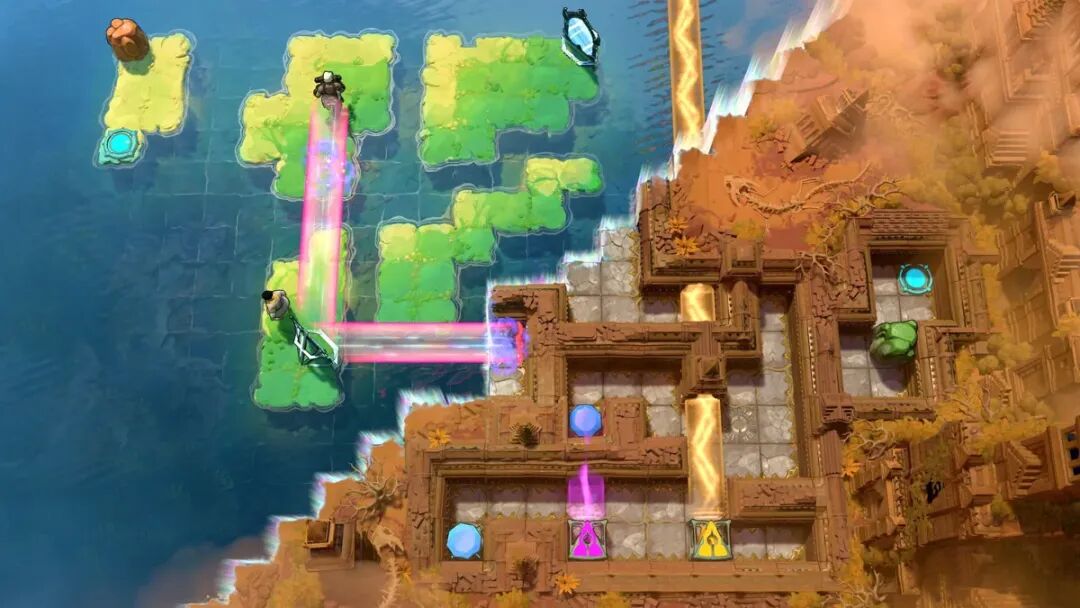
Screenshot of *The Order of the Fallen Stars*
But I still think this conclusion is too arbitrary. The implication seems to be that only ideas that are complex and profound enough deserve protection, and if a simple gameplay is copied, the creator can only blame themselves for not making it good enough.
From a moral perspective, a game that is easy to copy does not mean it is not worth existing. A simple mechanism can also be extremely exquisite, and a game built around a single gameplay can also be an excellent work. Moreover, small-scale, short-cycle works are an important way for many independent developers and new creators to enter the industry, practice, grow and verify their ideas. Without the accumulation of simple works, developers may not be able to grow into mature creators with the ability to develop complex projects.
What really makes independent game developers panic is not that they cannot make complex games, but that the past successful experience of being "small" and "fast" may now become the sharpest blade that AI can use against them.
Especially in the past few years, with the emergence of a number of low-cost, short-cycle games that became popular for their simple gameplay and multiplayer online experience, fast development and fast trial and error have gradually become the most talked-about successful experience in the independent game circle. The model of working hard in obscurity like *Stardew Valley* is a thing of the past. For small teams with limited budgets, making projects smaller and shortening the development cycle is a reasonable choice to control risks and improve the success rate.
And this type of small-scale game is exactly the kind that AI can replicate quickly and easily.
03 In the AI era, publishing is more important than ever
If we continue to break down why "being complex and stylized enough" can become the moat for independent games, we can get two key words: IPization, and community.
The logic behind it is not hard to understand. "Complexity" gives creators enough space to build characters, worldviews, stories