"Straight-A Student" Surrenders in AI Cheating Scandal, South Korea Rushes to Deploy Urgent Safeguards for Its National College Entrance Exam
The top scorer of this year's Korean tax accountant exam has turned himself in.
On November 15, 34-year-old Won Seok Han admitted that he used electronic devices and generative AI to cheat in both rounds of the exam. Not long before that, he was still giving interviews to share his exam preparation tips, which even included strict rules for managing his mobile phone.
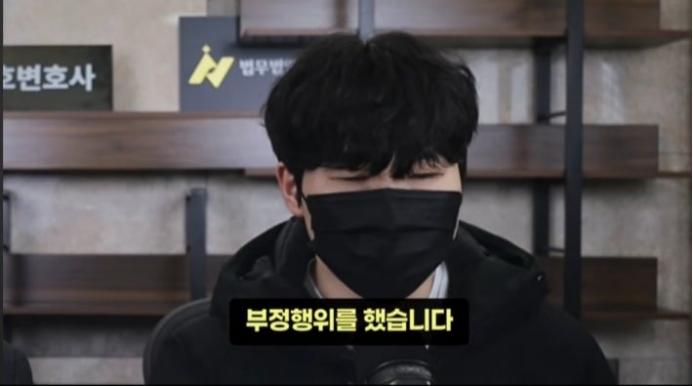
The whole of South Korea has been thrown into an uproar. When Won Seok Han turned himself in, there were only four days left before the South Korean national college entrance exam scheduled for November 19. A candidate with a camera and mobile phone sat right in front of the invigilators and took first place, yet no one in the exam room noticed anything unusual. The Blue House held an emergency meeting the very same day to review the anti-cheating preparations for the national college entrance exam.
Increasingly "smart" cheating methods have become a headache for exam administrators all over the world.
Previously, two universities in South Korea caught candidates wearing smart glasses in violation of exam rules. The UK requires test centers to disable AI functions on the computers used for answering questions, and smart glasses have also been included in the inspection scope for the national college entrance exam in China.
It's not just candidates who are cramming for exams - invigilators also have more and more new things to learn.
01
The Top Scorer Who Turned Himself In
In the golden autumn and early winter, a new "top student" emerged in South Korea. He went on interviews, recorded YouTube videos, and shared all kinds of his success stories.
He is 34-year-old Won Seok Han (transliteration), who took first place in South Korea's tax accountant exam. This exam is notoriously difficult. This year, the pass rate for the first round was less than 20%, and only about 10% of candidates passed the second round. He passed both rounds on his first attempt and even took the top spot.

His experience really reads like an underdog success story. He used to work in the manufacturing industry and ran his own business, and only decided to switch careers in his 30s. After two years of exam preparation, he took the tax accountant exam for the first time and walked away with the first place.
According to his account, he got up before 4 a.m. every day and spent about 8 hours studying effectively. One of his review tips was to close the book, take out a blank piece of paper, write down everything he had just learned from memory, and check how much he actually remembered.
He also had the support of his mother. Every early morning, his mother would prepare gimbap for him. He said that when the exam pressure got too high, he would sit on the stairs, and tears would fall before he even took a bite of the food. After crying and finishing the meal, he would go back to studying.
He was especially disciplined when it came to his mobile phone. He would turn it off and put it in a drawer while studying. In the three months leading up to the first round of the exam, he even left his phone at home and only turned it on once a week.
This kind of experience post is very familiar to readers in China. It is easy to come away thinking that there must be a good reason why someone else can top the exam.
What's more, his scores were extremely convincing.
The South Korean tax accountant exam is divided into two rounds. The first round in April was a multiple-choice test with 160 questions across four subjects, and he only got one wrong. He got full marks in Introduction to Tax Law, Introduction to Accounting, and Commercial Law. Especially for Introduction to Tax Law, the average score of all candidates was only 30.18 points, and 74.21% of candidates failed to reach the 40-point passing line for this single subject.
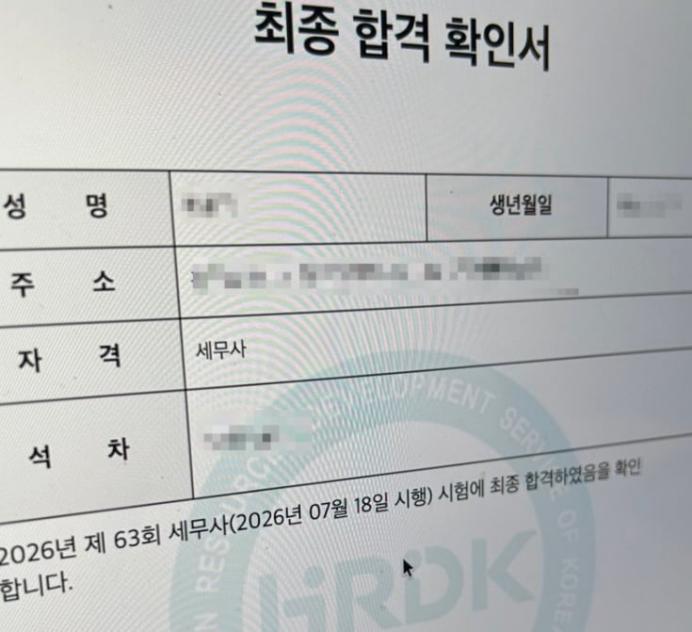
In other words, nearly three quarters of the candidates did not even reach the passing threshold, while he got a perfect 100 points.
In the second round in July, where the question type changed to essay questions, he still took first place.
But this transcript also raised suspicions.
Some reporters received tips and began to investigate this top scorer. They found that this wunderkind seemed to appear out of nowhere, and few people had heard of him before.
On the night of November 11, the reporters finally got through to his phone. Faced with the suspicion of cheating using AI glasses, he retorted that if AI glasses could solve these questions, why would anyone even need to study? As for why he only got one question wrong out of 160, he explained that there were questions he could not answer, but he was good at using the elimination method.
"Guessing answers is also a skill."
He also used his second-round score to defend himself. Even if the suspicion for the first round was true, the second round was all essay questions, so how could that be explained?
Unexpectedly, only four days later, the whole case took a 180-degree turn - this top student who seemed to appear out of nowhere actually turned himself in for cheating, and he used AI to do it.
On November 15, Won Seok Han appeared on his attorney's YouTube channel, admitting that he used electronic devices and generative AI to cheat in both rounds of the exam, and had submitted a letter of surrender to the Seoul police. He also admitted that he had lied in his previous exam preparation notes and interviews.
According to his confession, he used a miniature camera to take pictures of the exam questions during the test, sent them to AI, and then checked the answers on his mobile phone.
It turned out that the reason why this top student was so restrained with his mobile phone during exam preparation was to use it to his heart's content in the exam room!
It has to be said that the supervision of the South Korean tax accountant exam was very lax. This tax accountant exam was held in school classrooms, and both rounds were in-person paper-and-pencil tests. There were two invigilators in his classroom. He sat in the middle of the second row in the first round, and even in the middle of the first row in the second round.
In other words, the invigilators were right in front of Won Seok Han.
But mobile phones were not collected uniformly, and candidates were only asked to turn off their phones and put them in their bags. There were no surveillance cameras inside the classroom, so after the incident happened, there was no chance to review the footage.
What is even more frustrating is that after the suspicion arose, the exam organizer checked with the four invigilators who were in charge of the two rounds of exams. They were told that no suspicious behavior or abnormal situation was found at that time.
This was purely a self-exposure. If Won Seok Han had not been too arrogant and eager to promote his "success theory", he might really have lived happily ever after as the top scorer.
02
Countdown to the National College Entrance Exam, South Korea Panics
Won Seok Han's surrender directly broke the defenses of the relevant South Korean authorities.
Because the day he turned himself in, there were only four days left before the South Korean national college entrance exam on November 19.
Someone brought a camera and a mobile phone to a professional qualification exam, sat right in front of the invigilators and took first place. How can the upcoming national college entrance exam ensure that the same thing will not happen?
On November 15, the Blue House held an emergency meeting the same day, deciding to comprehensively investigate cases of suspected AI-assisted cheating in national qualification exams, and inspect the anti-cheating preparations for the national college entrance exam, including arranging dedicated personnel to identify AI devices and strengthening invigilator training. Measures such as thermal imaging cameras were also required to be taken into consideration.
The next day, the Prime Minister of South Korea convened a meeting of relevant departments, requiring candidates to hand over all smart devices, and proposed to study shutting down public Wi-Fi at test centers during the exam period.
What makes the South Korean exam authorities even more embarrassed is that the Won Seok Han incident is not an isolated case. This kind of thing has happened before, and it was in the college entrance exam.
On October 10 this year, Yonsei University held a self-enrollment math essay exam. Before the exam started, the invigilators specially checked candidates wearing glasses to confirm that they were not wearing smart glasses.
One candidate passed the inspection smoothly, because the glasses he was wearing at that time were indeed ordinary glasses.
But after the exam started, he changed into a different pair of glasses.
This pair of glasses was a smart glasses equipped with a camera. The invigilators later noticed that the appearance of the glasses looked unusual, notified the exam administration department, and then confiscated the device.
Coincidentally, just a week earlier, almost the same scene played out in the entrance selection exam of the University of Seoul. The candidate wore ordinary glasses during the inspection, changed into smart glasses during the exam, and was discovered by the invigilators.
The University of Seoul directly ordered him to leave the exam room and banned him from taking the university's exams for the next three years.
These two incidents at least illustrate a very practical problem: checking glasses at the entrance does not mean you can rest assured for the next few hours.
What's more, invigilators have to rely only on "observing from a distance" to tell which pair of glasses is problematic after the exam starts.
To this end, the South Korean Ministry of Education announced as early as October 29 that it would arrange a dedicated person to identify smart glasses at each of the 1312 national college entrance exam test centers across the country, who would go to each exam room to assist with inspections when necessary. The government also plans to revise relevant regulations to extend the ban period for cheaters in the national college entrance exam from one year to three years.
On November 11, the Seoul Metropolitan Office of Education organized training for 239 dedicated smart glasses inspectors in the local area.
Candidates are busy reviewing, and invigilators also have to take extra classes.
03
When Cheating Becomes Increasingly "Smart"
In fact, it is not just South Korea that is troubled. AI-assisted cheating and smart hardware cheating have become problems that exam rooms all over the world have to face.
The exam regulations of the UK's Joint Council for Qualifications have already included smart glasses in the list of prohibited items. Some exams in the UK allow candidates to type their answers on computers instead of writing by hand. But test centers must disable the AI functions on the computers in advance, to prevent the typing tools from solving the questions by the way.
In China, cheating using AI and smart devices also happens from time to time.
There was a recent incident that was both funny and ridiculous. On October 16, a man in Chengdu took the theoretical exam for a motorcycle driving license. When he took the car driving license exam before, he struggled four times to pass the theoretical test. This time, when he applied for additional permission to drive a motorcycle, he was afraid that he would fail again, so he bought AI glasses and a smart ring online.
He had all the equipment ready, but his psychological quality was really poor. During the exam, he fiddled with the glasses and the ring so frequently that the patrolling police noticed something unusual, and he later admitted to cheating.
What is even funnier is what happened next.
During the investigation, he used his mobile phone to do practice questions and got an accuracy rate of over 85%. The police randomly selected questions and asked him to demonstrate with the expensive equipment he bought, but the answers were shockingly wrong - he got all the multiple-choice questions wrong.
He wanted to pay for a top student to help him, but ended up hiring a poor student.
In the end, he was fined 1900 yuan and was not allowed to apply for a motor vehicle driving license again within one year.
Of course, we cannot count on every cheating device to be this useless.
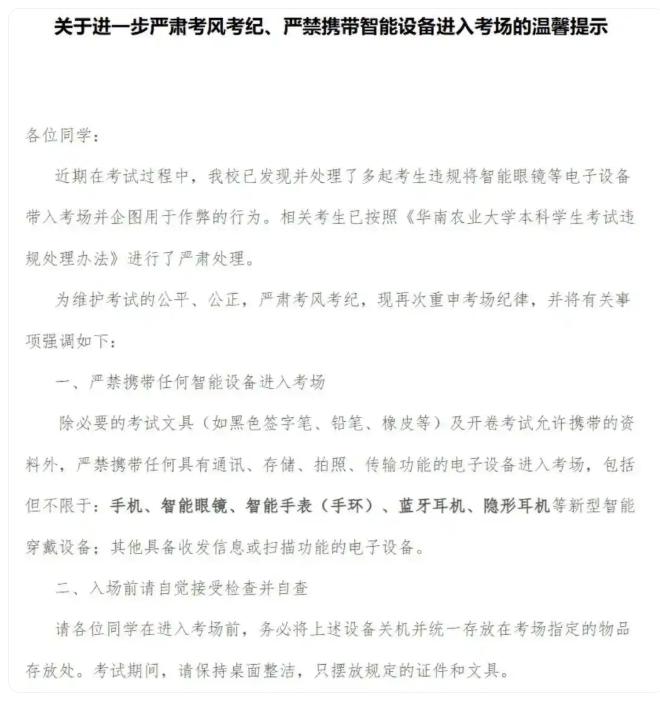
In July this year, South China Agricultural University publicly announced that it had investigated and dealt with multiple cases where people tried to cheat by illegally bringing electronic devices such as smart glasses into the exam room. The university later reaffirmed that no matter whether these devices are turned on or not, or whether the candidate has viewed the information on them, if they are found to have brought such devices into the exam room, they will be treated as cheating.
The anti-cheating measures for the national college entrance exam in China have also been refined down to the level of glasses. Before this year's national college entrance exam, Guangdong and Hubei both explicitly required that the glasses worn or carried by candidates must be taken off by themselves under video surveillance, placed on the table, and specially inspected by invigilators.
The exam administration training in Fujian specifically emphasized the prevention of smart glasses, and staff need to pay attention to features such as the size and shape of glasses. Inner Mongolia also reminded candidates who usually wear smart glasses to prepare ordinary optical glasses in advance, and cannot use smart glasses instead.
As for the excuse that "I'm just wearing it and not using it", there is no room for negotiation. The national college entrance exam warning issued by the Ministry of Education in June this year has made it clear that no matter whether it is used or not, carrying devices such as mobile phones, smart watches and smart glasses into the exam room constitutes cheating.
Candidates should not learn the "success experience" of people like Won Seok Han for now. But it is quite suitable to be used by invigilators as teaching material for their anti-cheating preparation.
This article is from the WeChat official account "Alpha AI", author: Jin Xiao Ya, editor: Wang Jing, published with authorization from 36Kr.