With its valuation doubling within a year, the U.S. AI unicorn has secured 2 billion in new financing.
Reported by Zhidx on November 17, on November 14, LangChain, the US AI agent management unicorn, announced the completion of US$300 million (about RMB 2.001 billion) Series C financing, with a post-money valuation reaching US$3 billion (about RMB 20 billion).
This round of financing was led by CapitalG, the capital arm of Google, an existing shareholder, with large participation from new investors GIC and DFJ Growth, and follow-on investment from existing shareholders including IVP and Sapphire Ventures.
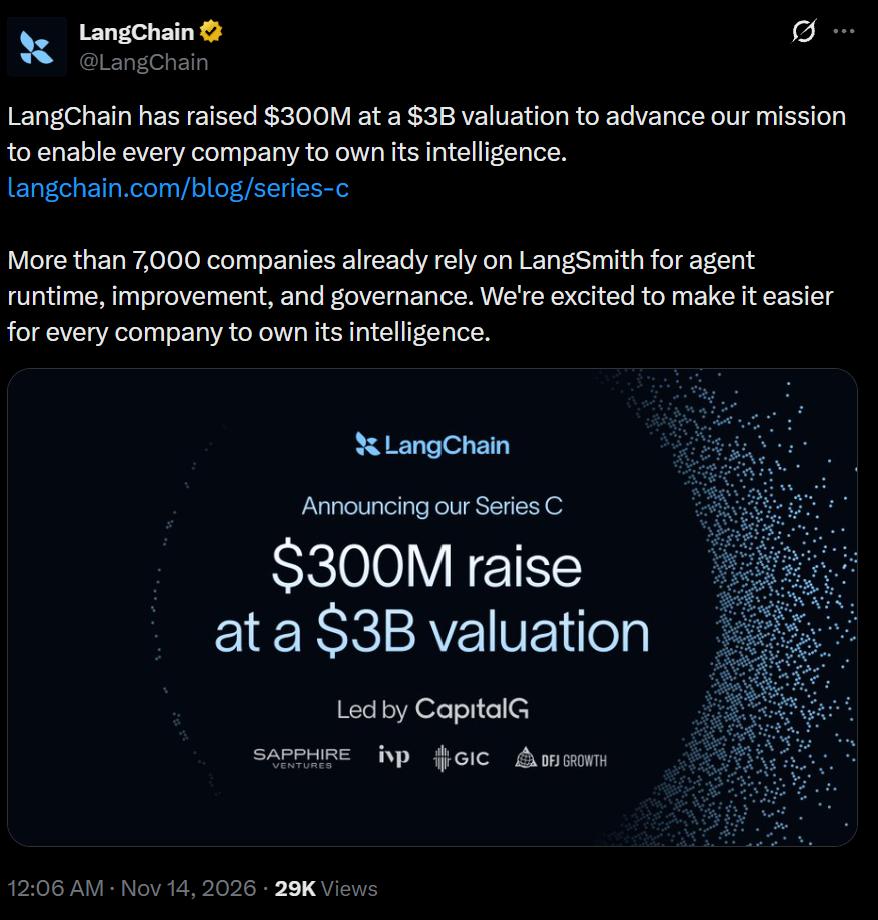
▲LangChain announces completion of US$300 million Series C financing (Source: X)
In October 2025, LangChain completed US$125 million (about RMB 834 million) in financing, with a valuation of US$1.25 billion (about RMB 8.337 billion). After this round of financing, LangChain's valuation has more than doubled compared to a year ago.
LangChain started at the end of 2022 as a personal open-source project of co-founder Harrison Chase, mainly helping early large language models complete some relatively difficult tasks, such as web searching, API calling and database accessing. The company was officially established in early 2023, headquartered in San Francisco, USA, with offices in New York, Boston and Amsterdam.
LangChain's products include development, deployment, evaluation and governance tools for large model applications and Agents. Its products including LangChain, LangGraph and LangSmith help enterprises connect models, data and external tools, build and manage Agent systems in production environments.
Harrison Chase, co-founder and CEO of LangChain, graduated from Harvard University, majoring in Statistics and Computer Science. He previously worked on machine learning related to entity linking at fintech and data analytics company Kensho Technologies, and later served as a machine learning engineer at machine learning testing and validation firm Robust Intelligence.
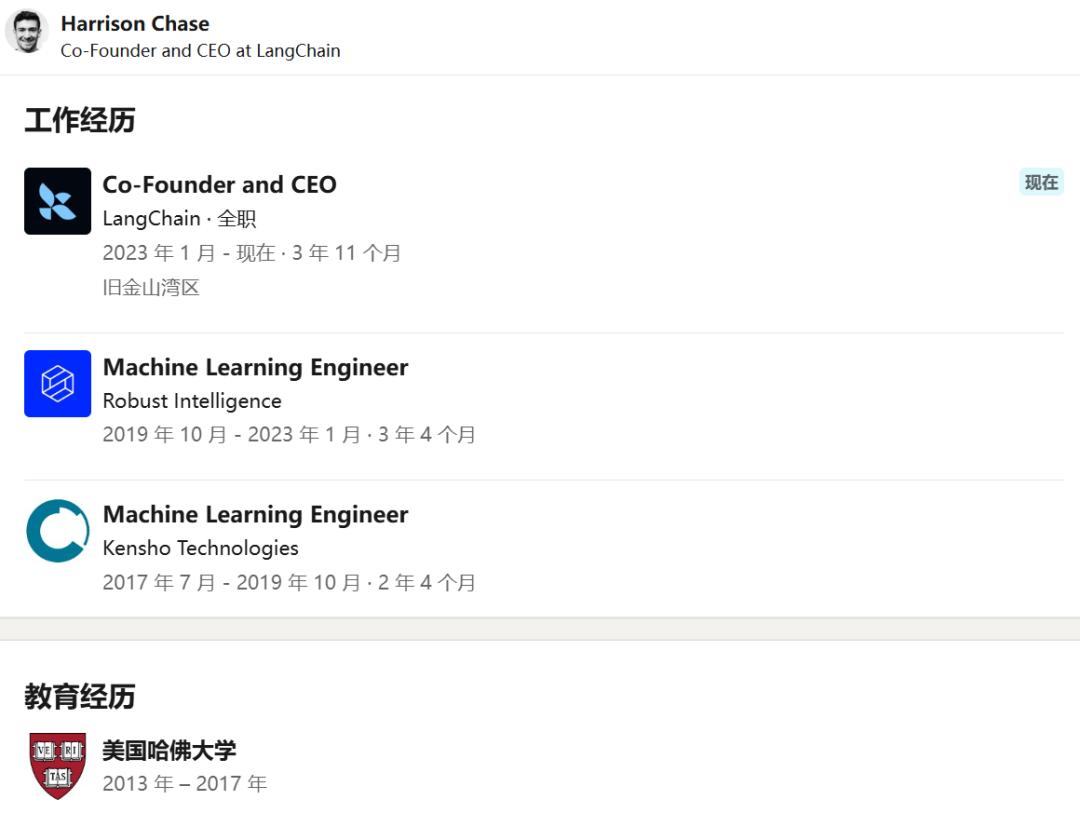
▲Harrison Chase's work experience and education background (Source: LinkedIn)
LangChain believes that Agents will reshape the economic structure. Future Agents will form differentiation around vertical domain knowledge, enterprise data and user experience, which can be sold as independent products, or used to transform internal enterprise operation processes.
Under this trend, enterprises need to master their own intelligent systems, including independently selecting models suitable for their business, controlling data and infrastructure, and continuously improving Agents, while meeting the security and governance requirements for large-scale deployment.
Therefore, the company launched the AI development and management platform LangSmith. LangChain states that more than 7,000 organizations are already using LangSmith, whose customers include AI startup Harvey, enterprise software company Rippling, voice market research firm Listen Labs, as well as Fortune 500 companies such as NVIDIA, Toyota, Salesforce.
LangSmith's product system mainly focuses on three major directions: Agent Operation, Agent Improvement and Agent Governance.
Agent Operation provides teams with the architecture and infrastructure required to run Agents reliably. Deep Agents, LangGraph and LangChain provide developers with capabilities for Agent architecture, model selection and context management; LangSmith Agent Server and Sandboxes support teams to deploy Agents securely in the cloud or their own environments. LangSmith Managed Agents and Fleet provide hosted Agent construction, deployment and operation services.
Agent Improvement helps teams test, monitor and improve Agent performance. LangSmith Observability and Evaluation are used to monitor Agent behavior, test operation effects and evaluate quality. LangSmith Engine is a built-in Agent of the platform, which can automatically detect errors, write code and prompt repair schemes, and monitor performance regression in production traffic. LangSmith Fine-Tuning can convert Agent operation traces into training data for fine-tuning and evaluating dedicated models.
In terms of Agent Governance, LangChain provides LLM Gateway and Tool Gateway to help enterprises uniformly manage model budgets, model degradation strategies, sensitive data protection, tool access permissions and identity authentication.
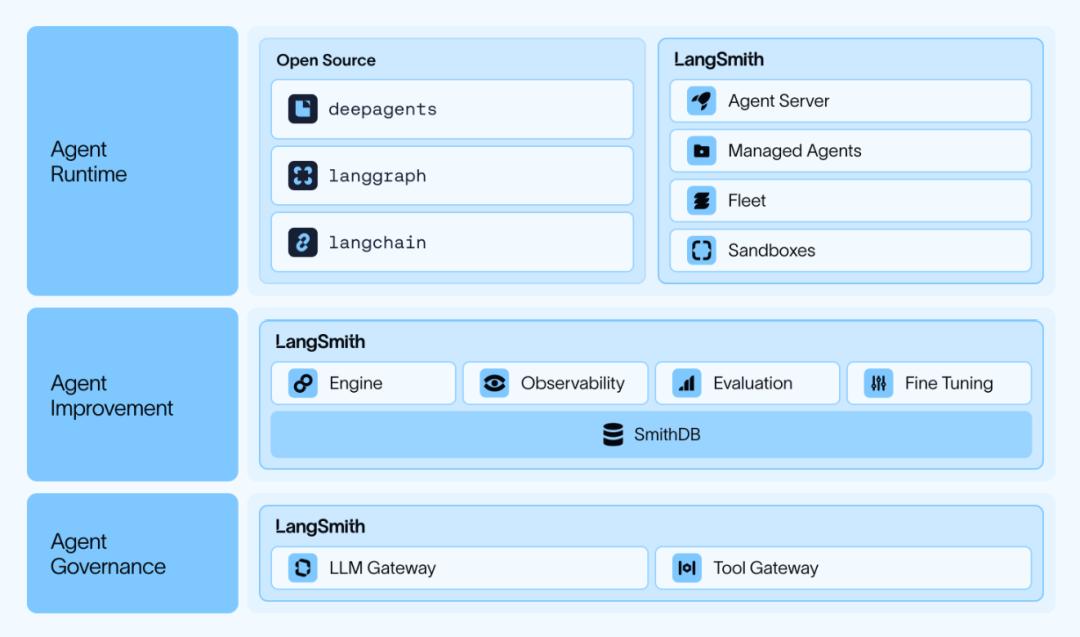
▲LangSmith Product System (Source: LangChain)
LangChain says the company will hold an online launch event on November 20 to announce a number of new capabilities of LangSmith. In the future, LangChain will continue to improve its product system around the construction, deployment, evaluation and governance of Agents, lowering the threshold for enterprises to develop high-performance Agents.
Conclusion: Enterprise-level Agent Competition
Shifts to Full Lifecycle Management
This round of financing of LangChain shows that the enterprise-level Agent market is gradually moving from the stage of model and application exploration to the stage of infrastructure construction and large-scale deployment. The focus of enterprises is gradually shifting to how to make Agents run stably, improve continuously, and be used safely in multi-team and multi-business environments.
As more enterprises put Agents into production environments, demands around operation efficiency, effect evaluation, data security and cost control will continue to grow.
Sources: LangChain, X, LinkedIn
This article is from the WeChat official account "Zhidx", written by Yang Jingli, edited by Li Shuiqing, authorized for release by 36Kr.