9-day Spring Festival, 1-day Dragon Boat Festival: the 2027 holiday schedule completely fragments the peak season of the hotel industry.
The newly released 2027 public holiday schedule has created a huge perception gap between hotel practitioners and consumers.
On one hand, for consumers, the "longest Spring Festival holiday in history" is coming again. Since people no longer deliberately piece together leave days, many consider 2027 the "most comfortable" year for holidays.
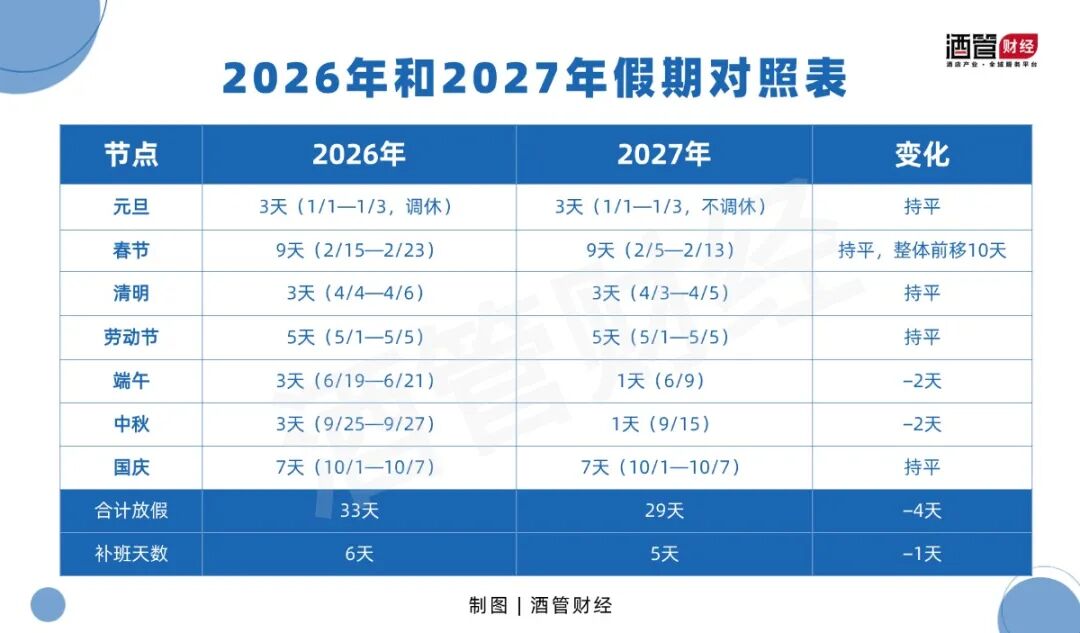
But on the other hand, for hotel practitioners, the total number of public holidays in 2027 is only 29 days, 4 days less than that in 2026. Most critically, the Dragon Boat Festival and Mid-Autumn Festival holidays are each only 1 day, which almost makes the industry miss two "small peak seasons".
However, the autumn vacation system is being popularized across China, and there will most likely be an "unexpected" order peak in 2027.
It is not hard to see that China's public holiday system is changing, and the fixed business models that the hotel industry has followed in previous years can no longer be directly applied. Will 2027 be a turning point for hotel practitioners?
01 With 4 fewer holiday days, why is 2027 called the "most comfortable" year?
The officially designated "longest Spring Festival in history" can be even longer for office workers.
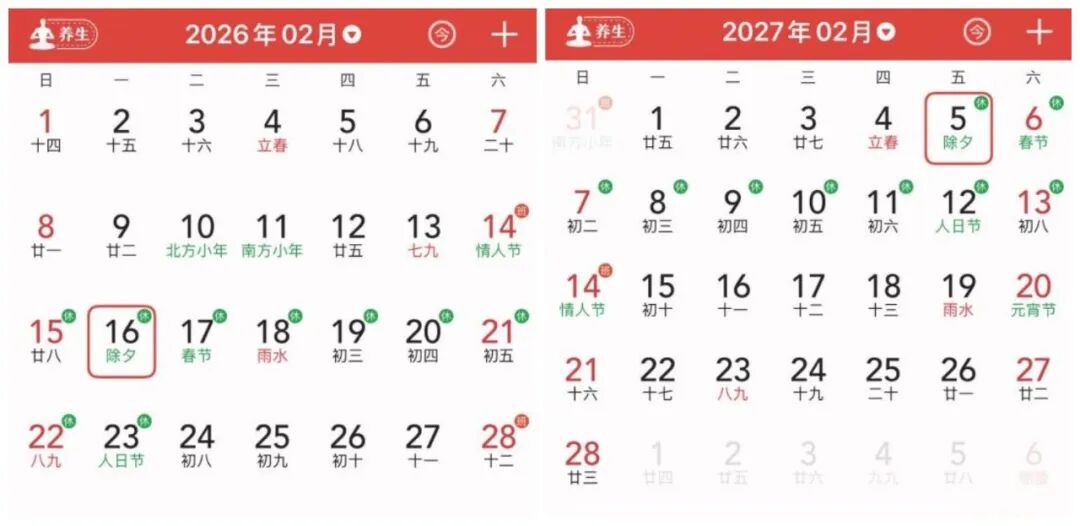
The notice shows that the 2027 Spring Festival holiday lasts 9 days (from New Year's Eve on February 5 to February 13), which is the same as the 2026 Spring Festival, the longest Spring Festival holiday in history. Meanwhile, to make up for the 9 consecutive days off, one workday is scheduled before and after the holiday respectively (January 31 and February 14).
At first glance, it is a 9-day holiday, but for office workers, the Spring Festival in their minds is far more than just 9 days.
On Xiaohongshu, netizens' leave-piecing plans have gone viral: taking 5 days of annual leave before the holiday can piece together a 15-day vacation; if you connect it with the Sunday that is a compensatory workday after the 9th day of the Lunar New Year, you can unlock an ultra-long 16-day vacation.

Source: Xiaohongshu
Xiao Li, who has worked for 8 years, must do the math every end of the year to figure out the most cost-effective way to piece together leave days. For the 2026 Spring Festival, New Year's Eve fell on a Monday, and only one Saturday was arranged as a compensatory workday before the holiday. She immediately took one day of annual leave, connected it with the 9-day holiday to get 10 days off, and booked a hotel for a trip to Chengdu very early.
But for the 2027 Spring Festival, New Year's Eve falls on a Friday, and the compensatory workday on January 31 before the holiday is a Sunday. Although the two days are far apart, making leave piecing a bit more difficult, once successfully pieced together, for people like Xiao Li who plan long-distance trips during the Spring Festival, the 15 consecutive days of ultra-long annual leave is undoubtedly a rare opportunity.
Source: the Internet
Apart from Xiao Li, other netizens' expectations for Spring Festival travel are also extremely high.
Topics such as "2027 may be the most comfortable year", "the 9-day longest Spring Festival in history returns", "4 holidays in 2027 do not require compensatory work", and "Spring Festival flight searches surge in 2027" immediately became hot topics among public discussions.
Some people have even started arranging their New Year travel itineraries, and the search volume for flights and hotels has risen sharply.
On November 5, less than half an hour after the official holiday schedule notice was released, the search volume for flights departing during the Spring Festival on the Qunar Travel App directly increased by 3.2 times.
Tongcheng Travel data also shows that as of November 5, the search volume for flights and hotels on the platform during the 2027 Spring Festival surged by 189% month-on-month, and the booking volume for flights departing in the week before New Year's Eve increased by 61%.
02 Two Wednesday holidays cut off two key business nodes for hotels in the whole year
For hotel practitioners, holidays directly affect the annual business performance.
The ultra-long Spring Festival will naturally lead to a sharp increase in hotel orders. However, this year's Spring Festival holiday is overall 10 days earlier than previous years.
The 2026 Spring Festival holiday starts from February 15, while the 2027 one is moved forward to February 5. This means that the division of low and peak seasons in January and February 2027 will change greatly.
In addition, Valentine's Day (February 14) in 2027 is a compensatory workday for the Spring Festival, and it is closely attached to the end of the 9-day long holiday.
In previous years, Valentine's Day was a small peak season for urban hotels, and this node will most likely need to be re-evaluated next year.
The biggest change lies in the Dragon Boat Festival and Mid-Autumn Festival holidays.
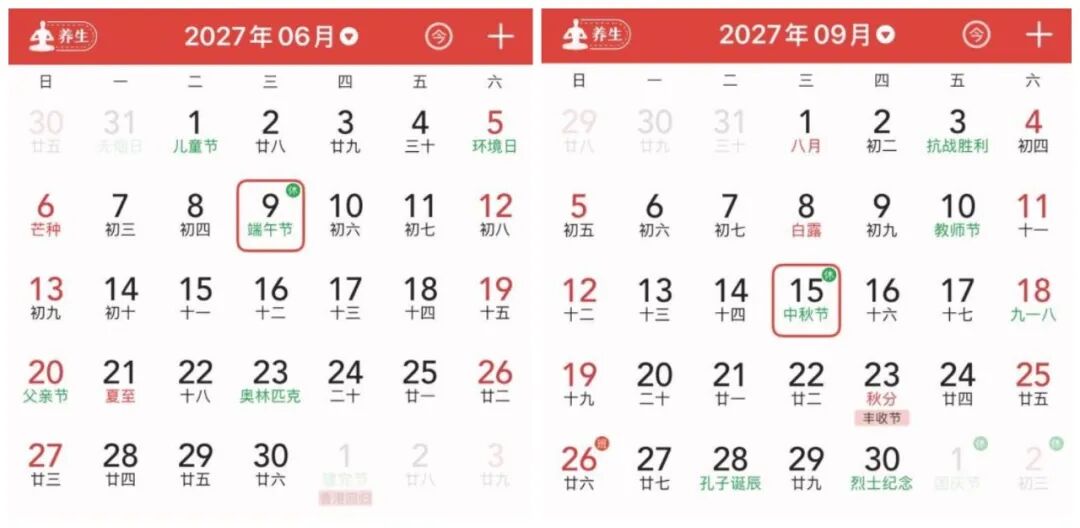
Next year, both the Dragon Boat Festival and Mid-Autumn Festival fall on Wednesday, with no compensatory work arrangements, and only one day off on the day itself.
Source: the Internet
In previous years, the 3-day small long vacation pieced together from these two festivals was a golden window for many people to take surrounding trips, short-distance trips and mini-vacations, bringing stable overnight orders to a large number of suburban resort hotels and homestays, and serving as an important source of profit for the whole year.
But if it is changed to only one day off, the demand for short-distance travel will be greatly reduced. The vast majority of families will not choose to travel across cities for an overnight stay, and most of them will just go shopping and have meals in local areas. Even if there are tourists in scenic spots, most people can only make a day trip, and there will not necessarily be accommodation orders.
For central urban business hotels, the Dragon Boat Festival and Mid-Autumn Festival are originally dominated by local individual guests, family guests and business guests, so the loss impact is relatively small.
But for those suburban resort hotels and county-level homestays that rely heavily on short-distance trips and surrounding trips, once these two nodes disappear, it is not just a matter of earning less, but equivalent to directly cutting off two profit growth nodes for the hotel in the whole year.
It is obviously impossible to expect the Dragon Boat Festival and Mid-Autumn Festival to replicate the 3-day small peak season of previous years.
However, from another perspective, the two hidden losses brought by the Dragon Boat Festival and Mid-Autumn Festival are not completely impossible to make up for.
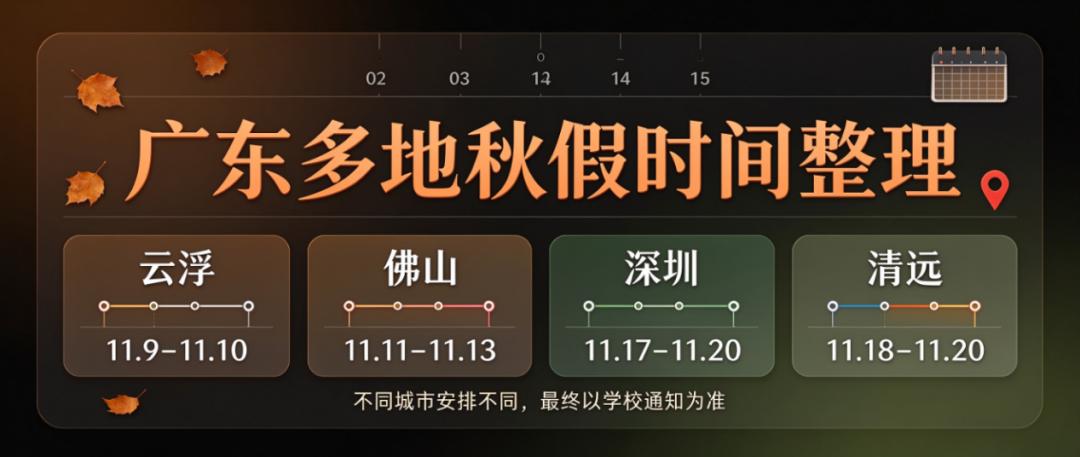
In November this year, the hotel industry ushered in an unexpected tourism peak season — the autumn vacation. The autumn vacation system is being implemented in many places across the country. Many parents connect the 3-day autumn vacation with the weekend to get 5 consecutive days off, and take their children to visit the scenic spots described in textbooks.
From Sichuan, Zhejiang to Jiangsu, Guangdong, Hunan and other regions, hundreds of cities across the country have successively announced their autumn vacation arrangements this year. Most regions connect the 3-day autumn vacation with the weekend to form a 5-day small long vacation.
Source: the Internet
Some industry observers call this trend the "fifth consumption season", which comes after the Spring Festival, May Day, summer vacation and National Day.
If this dividend continues in 2027, November next year may no longer be a low season gap, but create an exclusive travel window for the hotel industry independent of winter and summer vacations, National Day and Spring Festival.
Perhaps some hotel practitioners will think: the occupancy rate in November is guaranteed.
However, there is an essential difference between autumn vacation and holidays such as Spring Festival, National Day, Dragon Boat Festival and Mid-Autumn Festival: the vacation time is scattered.
Although most autumn vacations are scheduled in November, the vacation time varies in different provinces, even in different cities within the same province, and the whole vacation period can last for as long as one month.
For some non-nationally popular scenic spots, the November vacation will not bring orders to every hotel. Whether your hotel can receive orders in November most likely depends on which days the surrounding cities arrange their autumn vacations.
03 How can hotels seize the scattered peak seasons in 2027?
The average occupancy rate of hotels across China during the 2026 Spring Festival reached 64.28%, hitting a new high in the Spring Festival holiday in the past 5 years.
But this does not mean that people can be blindly optimistic about 2027.
When multiple changes of Spring Festival, Dragon Boat Festival, Mid-Autumn Festival and autumn vacation are superimposed, what the hotel industry will face in 2027 is no longer a complete and predictable big peak, but several scattered nodes. They are peak seasons, as well as unpredictable tests.
The first one is the Spring Festival.
Many hotel practitioners, seeing this year's long holiday and pre-order volume, will have the first reaction: they will definitely make a big profit during this year's Spring Festival.
But things are not that simple. The longer the holiday, the more people tend to split their itineraries into several segments. For one trip, it is very common to visit two or three cities and stay in three or four different hotels.
Take the 9-day long holiday in 2026 as an example. The 2026 Spring Festival Travel Report released by Qunar Travel mentioned that the long holiday made more people choose to take a second trip during the holiday, and the number of trips during the holiday increased by 30%.
At that time, many hotels panicked. Because the passenger flow came in successive waves: the first wave arrived on New Year's Eve and before the holiday, the second and even the third peak of check-in would come from the second to the fifth day of the Lunar New Year.
In addition, guests in different time periods have different requirements for prices and services.
Guests arriving on New Year's Eve care about whether they can have a hot New Year's Eve dinner; guests arriving on the second day of the Lunar New Year want to get local scenic spot vouchers as a gift for staying three consecutive days; guests arriving after the fifth day of the Lunar New Year expect the hotel to provide free luggage delivery, airport transfer services or room rate discounts.
At this time, it is obviously no longer applicable for hotels to use the same strategy for 9 consecutive days, because guests of different batches have completely different demand standards for price sensitivity, service requirements and rights and interests discounts.
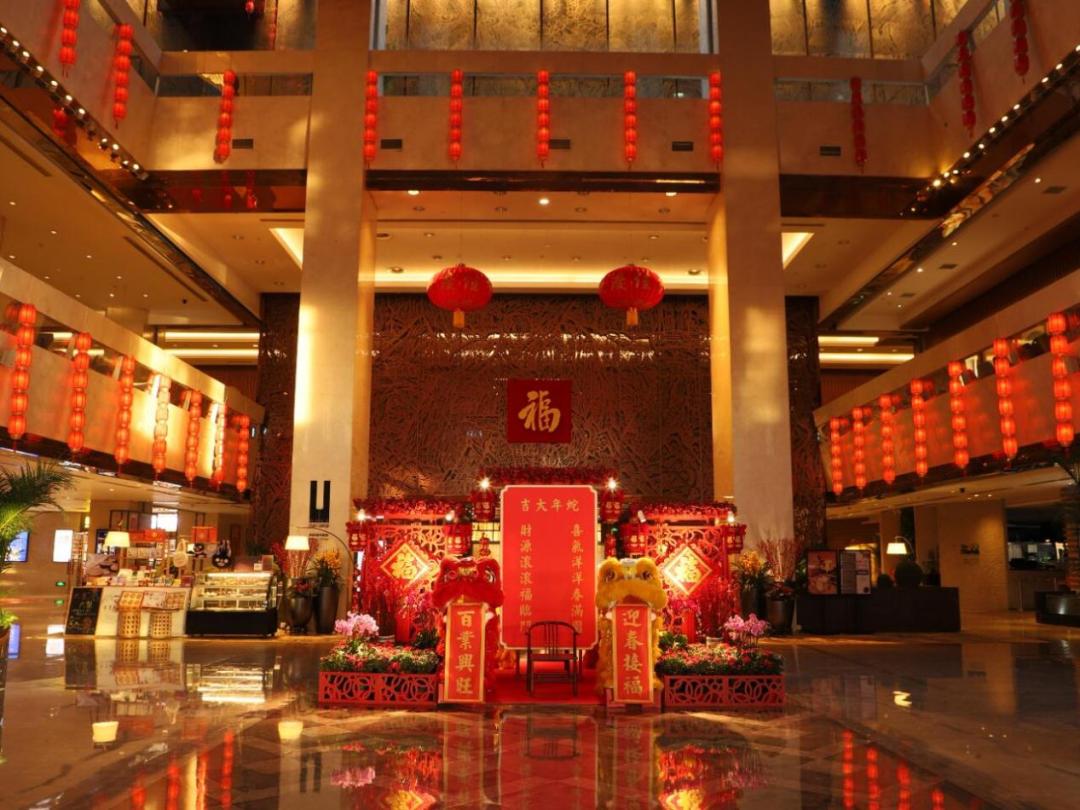
At this time, if hotels appropriately use the idea of "Tian Ji's horse racing" to attract customers, they may get unexpected results.
Source: Xiaohongshu
The next one is the Dragon Boat Festival and Mid-Autumn Festival.
For the 2027 Dragon Boat Festival and Mid-Autumn Festival, although two growth opportunities are lost, we cannot give up completely.
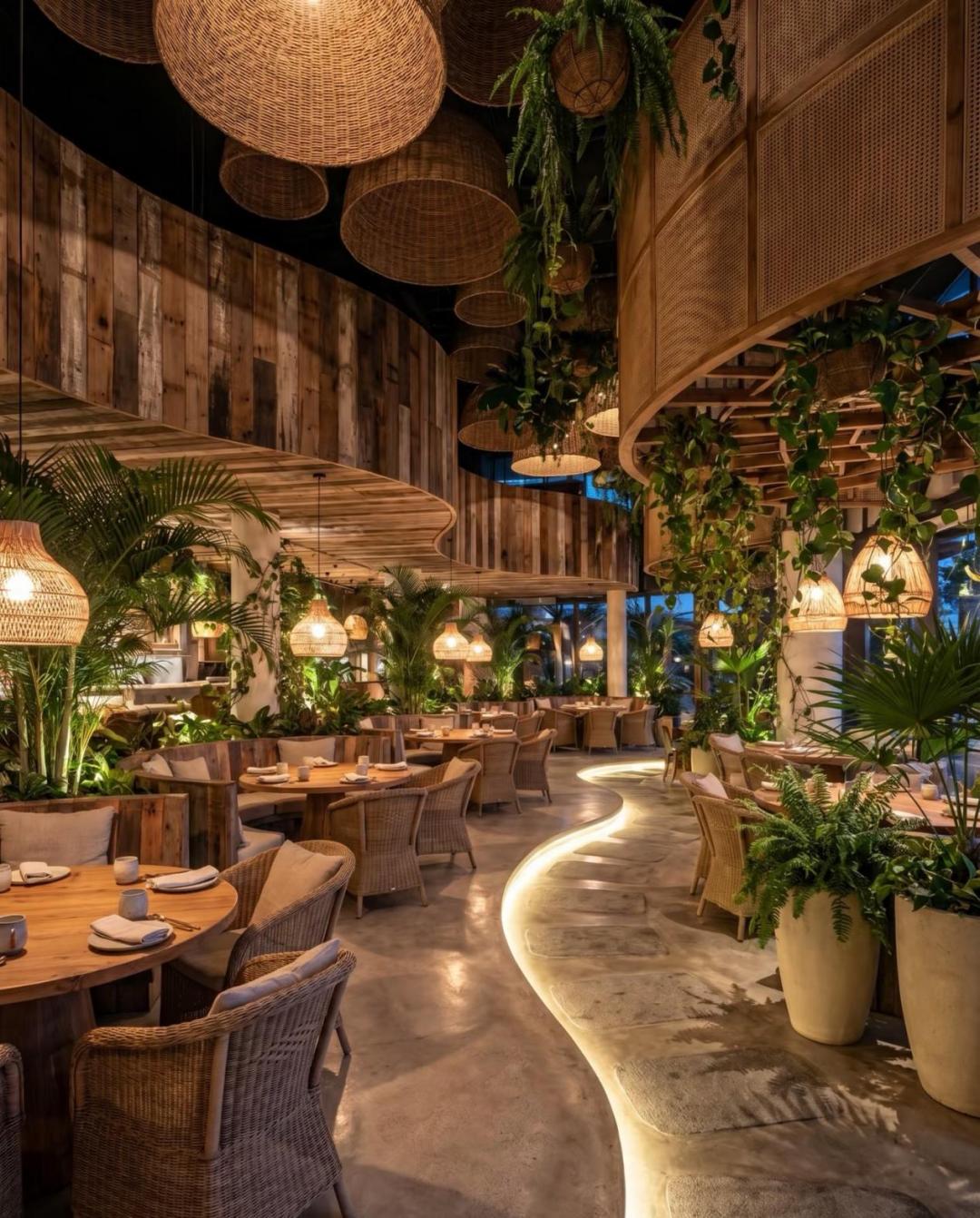
Those suburban homestays that rely on short-distance weekend customers must start thinking about new solutions now. Since the idea of only selling hotel rooms does not work, we can abandon the obsession with overnight consumption, and sell day-use packages such as a nice meal, afternoon tea, parent-child handicraft activities, and half-day childcare services.
Or make full use of the space of hotel lobbies, lawns and restaurants to hold immersive script-killing activities and intangible cultural heritage handicraft experience activities.
You can also launch long-stay packages, receive team building activities and parent-child research activities on ordinary days, to increase the occupancy rate on non-holiday days and expand the customer group attributes.
Source: Xiaohongshu
Then there is the autumn vacation, which is the biggest dividend to break the low season curse.
The autumn vacation is not uniformly arranged across the country, and each city arranges its own vacation time. This staggered vacation arrangement greatly increases the operational uncertainty for hotels.
For example, when Hangzhou arranges the autumn vacation, parents in Hangzhou will take their children to travel to surrounding cities; when the surrounding cities arrange their autumn vacation, parents there will travel back to Hangzhou.
At this time, hotels need to change from "waiting for customers to come" to "intercepting customers in other regions".
For example, if your hotel is located in Zhengzhou, Henan Province, your customer groups may come from Wuhan, Qingdao, Xuzhou, Jincheng and other places, or some cities in the province. At this time, you need to collect the vacation schedules of these places in advance, and then cooperate with relevant local education and training institutions and promotion points in other cities to promote your "autumn vacation parent-child consecutive stay + research" products.
2027 for hotel practitioners seems to be different from previous years: the peak seasons of Dragon Boat Festival and Mid-Autumn Festival have become low seasons, the low season in November may become a peak season, and even the "longest Spring Festival in history" is longer than in previous years.
The most reliable response method is