AI sparks the peak showdown in chip design, with global tech giants taking unorthodox moves.
With the release of GPT-Synopsys and the entry of AI-native startups including Agentrys and ChipAgents into the chip design sector, the AI competition in the EDA industry has reached an unprecedented height.
Faced with this change, Cadence has suddenly launched the Maestro specialized AI model portfolio, emphasizing domain-specific models, intelligent model routing, customer proprietary data, and deep integration with mature EDA and SDA tools. From general large models to domain-specialized models, and further to the integration of AI agents and engineering tools, the AI competition in the chip design field is unfolding.

01 Cadence Launches Maestro, Betting on Specialized AI
"AI agents represent a transformative market opportunity, and Cadence is well-positioned to fully capitalize on this opportunity." Anirudh Devgan, President and CEO of Cadence, stated on the Q3 earnings call that the future of AI agent design will increasingly rely on domain-specialized models, intelligent model routing, and reinforcement learning loops integrated with underlying tools to achieve recursive self-improvement.
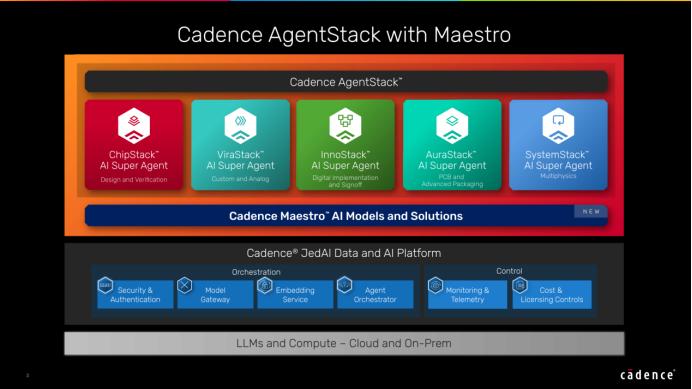
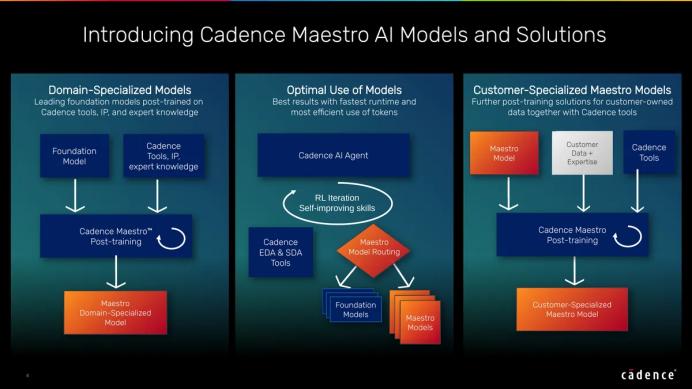
Based on this judgment, Cadence has launched Maestro, a domain-specialized AI model portfolio built exclusively for chip and system design. This portfolio covers models of different scales and architectures, including large language models post-trained after domain specialization, trained decision models, and self-improving agent skills.
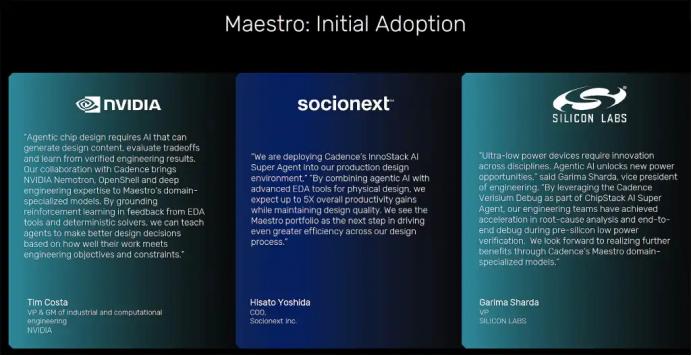
It is reported that the Maestro model portfolio includes models such as NVIDIA Nemotron, and integrates domain-specialized models, decision models and agent skills. Cadence indicates that initial results show up to 30% improvement in model quality and up to 5x improvement in Token efficiency compared with general foundation models. Moreover, customers can also use their own proprietary design data to post-train the models to improve model performance.
In addition, Maestro also introduces intelligent model routing, which selects appropriate specialized models or other cutting-edge models according to different tasks. Devgan noted that this can improve efficiency, allowing customers to complete more work at the same cost, or accomplish tasks at lower costs.
In terms of deployment, customers can choose Cadence Cloud, public cloud, or deploy Maestro in their own on-premises environments, retaining control over model usage and their own design data. As CFO John Wall stated on the conference call: "Our strategy remains focused on delivering high-value engineering software rather than building a large general-purpose AI infrastructure business."
02 Comparison with GPT-Synopsys: Two Routes Begin to Diverge
In fact, right before Cadence launched Maestro, Synopsys and OpenAI announced a partnership to co-develop GPT-Synopsys, which combines OpenAI's cutting-edge models with Synopsys' EDA professional capabilities, enabling AI to understand chip design and verification, and directly operate Synopsys tools.
Compared with GPT-Synopsys, Devgan said on the conference call that Cadence has been collaborating with OpenAI since its inception, and also maintains partnerships with leading models such as Anthropic and Gemini. He emphasized that Maestro is not limited to Cadence's own models, but is able to select appropriate models for different tasks. Corresponding cutting-edge models can also be selected for specific tasks, and Cadence is also exploring both open-weight and closed-source models.
Devgan summarizes Cadence's AI system as three layers: the upper layer is AI agents and orchestration, the middle layer is physically accurate simulation and optimization engines, and the bottom layer is accelerated computing and proprietary data. He believes that only by combining AI agents, Maestro models with mature EDA and SDA tools can better results in performance, efficiency and throughput be delivered to customers.
According to customer cases disclosed by Cadence, MediaTek has deployed ChipStack into its production digital verification flow, which has increased verification coverage by 50% to 70% and reduced engineering investment by 1.4 to 2 times. The Renesas MCU team deployed InnoStack across a variety of engineering tasks, boosting productivity by 34 times. Nokia deployed AuraStack on its Millennium supercomputer, speeding up key design and analysis workflows by 5 times.
From GPT-Synopsys allowing cutting-edge models to directly operate EDA tools, to Maestro emphasizing the integration of specialized models, model routing and mature engineering tools, although the specific paths are different, both are promoting AI from general capabilities into professional chip design flows.
03 New AI Entrants Cannot Do Without Professional Tools
Apart from the differentiated paths of the two EDA giants, AI-native startups are also looking for entry points for chip design and verification.
Among them, the two companies with core Chinese teams are particularly impressive: Agentrys and ChipAgents. The former has just completed a $24.5 million financing to advance Agentic Design Automation (ADA), exploring the use of AI to perform engineering tasks and continuously improve design flows; the latter focuses on chip design and verification, exploring AI-generated RTL code and testbenches, and improving designs by calling EDA tools and iterating based on feedback.
These explorations reflect the new trend of AI-native tools entering chip engineering. However, AI-generated design artifacts are only part of the flow. Chip design also involves verification, timing closure, physical analysis and repeated optimization, which requires collaboration with professional tools and engineering flows.
This is also the reason why Cadence emphasizes its own engineering software system. Its AI layout does not only focus on whether models can generate content, but integrates agents, specialized models, EDA and SDA tools, simulation optimization engines, computing power and proprietary data. From this perspective, AI-native tools and mature EDA platforms are not opposed, and collaboration may be formed in different links in the future.
04 From Chips to Complex Systems, Cadence Is More Than One Facet
It is worth noting that Devgan mentioned on the Q3 conference call that "About 45% of Cadence's revenue comes from system companies", which refers to companies outside the semiconductor industry. In addition to large hyperscale computing enterprises, aerospace companies, financial enterprises and other system companies have also begun to carry out chip design on their own. These enterprises have brought market opportunities in IP, hardware and design services, driving the growth of all business segments to exceed 20%.
Compared with the China market, the revenue scale in Q3 has once again reached an all-time high. According to the 2026 China Simulation Conference recently hosted by Cadence in Shanghai, its relevant capabilities cover multi-physics simulation in fields including pre-processing and post-processing, structure, multi-body dynamics, acoustics, thermal fluid, electromagnetics, materials and virtual manufacturing, autonomous driving, as well as AI-driven simulation optimization and data management, presenting integrated design and simulation solutions ranging from chips and electronic systems to complex mechatronic systems.
In terms of engineering practice, the conference disclosed that design optimization integrating AI and physical simulation, and simulation calculation accelerated by GPU hardware, have shortened the previous 69-hour CFD calculation time to 50 minutes, reduced cabin wind noise prediction calculation from 21 hours to 79 seconds, increased the speed of 3D additive manufacturing process simulation by up to 10 times, and the full-process CFD workflow can evaluate two or more design variants every day.
In addition, AI and simulation data platforms are also important topics. Relevant special sessions involve reduced-order models, AI machine learning driven prediction and simulation optimization, design exploration, as well as data and process management, reflecting that AI is penetrating multiple links of engineering simulation.
Finally, from Maestro's specialized models to the integration of AI agents and engineering tools, and further to physical simulation and system-level design, Cadence is introducing AI into a broader R&D process. The battle for AI supremacy is not only a competition of model capabilities, but also involves the collaboration of professional data, engineering tools and the entire R&D process.
This article is from the WeChat official account "Kun Shao Says", author: Kun Shao, published with authorization from 36Kr.