When Human Superstars Shine: 9 Historical Snippets Between Elon Musk and Jensen Huang
You will be remembered forever, because some things are eternal.
On November 13, 2026, the day after Jensen Huang announced his resignation as NVIDIA CEO, Elon Musk shared a video posted by the official account of U.S. venture capital firm a16z on the X platform, which cited the line above.
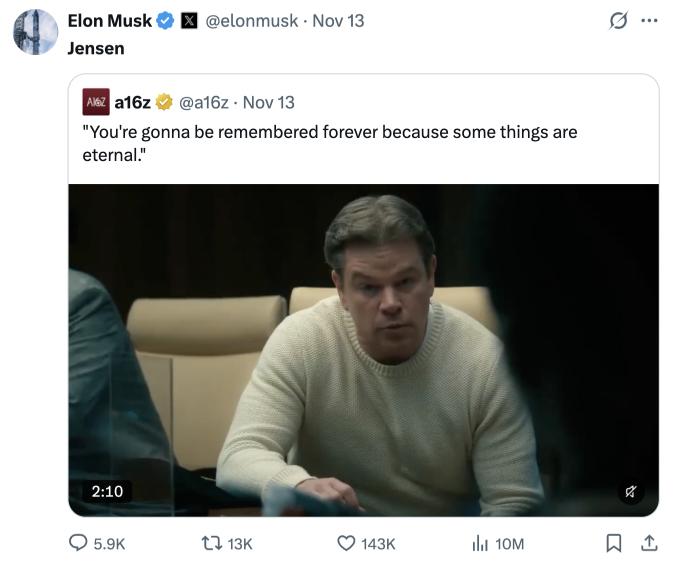
Then Musk left a short comment: Jensen.
❶
Jensen is the English name of Jensen Huang.
Since November 8, 2026, the name Jensen Huang has appeared on the headlines of major media, and almost every corner of social media. Behind this almost crazy spread pace, apart from the public's natural gossip curiosity about romantic gossip, the deliberate fueling of the situation is obvious to all.
Is Jensen Huang wrong?
Of course he is wrong — facing his wife and family, his mistake is unforgivable. But this is a matter of his personal family, and Jensen Huang's wife has also given a response. Apart from that, along with these romantic rumors, a series of more serious accusations such as national security and workplace red lines have been imposed on Jensen Huang.
But should he resign for this reason?
Regarding this matter, the famous physicist Yang Jinshui once said: "Some things weigh less than 200 grams if you don't weigh them on a scale, but once you put them on the scale, they are far more than 500 kilograms." Now the situation is completely clear: someone is deliberately putting Jensen Huang's matter on the "scale" and constantly adding weight to it.
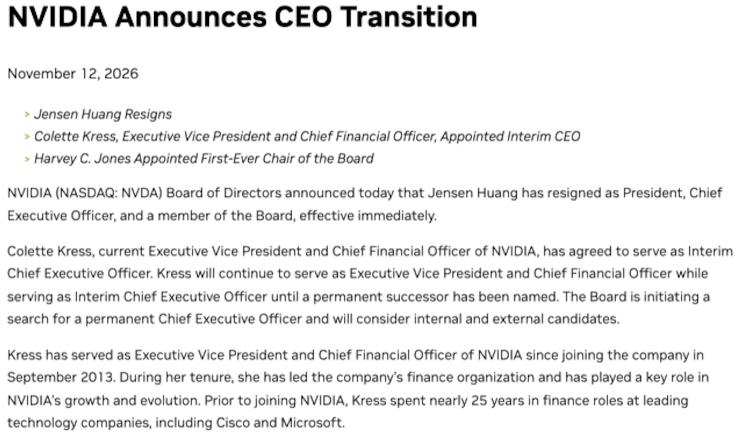
Thus, on November 12, 2026, Jensen Huang was ousted from the company he founded with his own hands, amid the astonishment and amazement of the whole world.
But he immediately received strong support from Elon Musk — this support is not accidental, but a continuation of the two people encouraging each other on the road of human AI technology innovation.
❷
What exists between Jensen Huang and Elon Musk is more a kind of mutual appreciation between like-minded peers.
Jensen Huang was born on February 17, 1963, and Elon Musk was born on June 28, 1971. Counting the two, there is an age gap of more than 8 years between them.
However, the two have many common points in their early experiences. For example, neither of them was born in the United States, but at a specific stage of their lives, they both came to the United States to seek opportunities, started businesses here and achieved huge success.
In 1993, when Jensen Huang and his partners founded NVIDIA, he had already worked in the semiconductor field in Silicon Valley for nearly 10 years. The companies he once worked for include AMD, LSI Logic and so on. During that period, he also took part in a cooperative project at Stanford University in his spare time, and obtained a master's degree in electronic engineering.
At that time, Elon Musk was still studying at the University of Pennsylvania on the east coast of the United States.
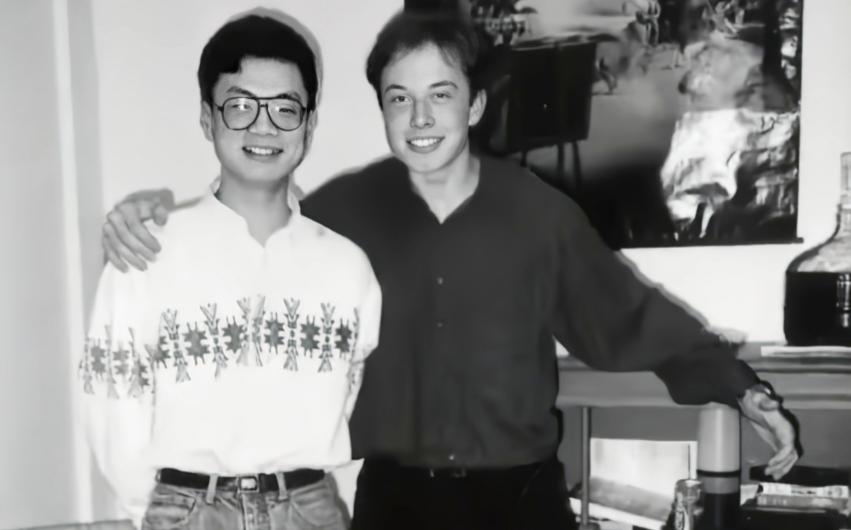
In 1995, when Jensen Huang's startup project encountered a life-and-death crisis in the early stage, Elon Musk was admitted to Stanford University and came to Silicon Valley to pursue a master's degree, but he soon chose to drop out to start a business. If you look at the timeline, having studied for a master's degree at Stanford University can be regarded as a common point in their early life stages.
But at that time, one was engaged in semiconductors and the other was engaged in the Internet, so it was difficult for them to have obvious practical intersections.
❸
From the business perspective, the earliest business connection between Elon Musk and Jensen Huang is Tesla.
In June 2012, Tesla's first mass-produced Model S was delivered at the California factory. At the scene, Elon Musk said ambitiously that through Model S, Tesla aimed to demonstrate to the outside world that electric vehicles can actually become the best cars in the world.
In fact, this "best car in the world" also owes part of its success to NVIDIA.
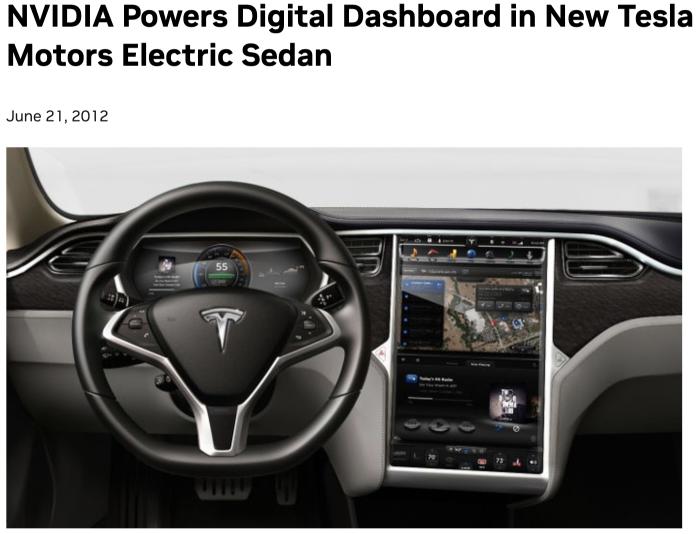
The reason is that the 12.3-inch liquid crystal dashboard and the 17-inch touch-controlled central control infotainment screen of this Model S run on two different NVIDIA Tegra chips — among them, the Tegra 3 chip is used for the infotainment system touch screen, and the Tegra 2 chip is used for the liquid crystal dashboard.
But at that time, the cooperation between the two sides had not yet reached the level of autonomous driving.
However, in May 2013, in an interview with the media, Elon Musk announced that Tesla would develop autonomous driving. Shortly after that, considering the natural advantages of GPU in algorithm operation in the field of computer vision, Jensen Huang also began to brew new opportunities for NVIDIA in the field of autonomous driving.
On November 7, 2013, during the earnings call, Jensen Huang said when talking about the development of the automotive business:
In fact, the way to think about cars should be automation. Today's cars are connected cars, so digital computing is more important than ever. Our digital clusters will provide the automotive industry with the opportunity to modernize the driving experience, instead of using traditional mechanical meters.
Jensen Huang also said that Tesla's electric vehicles have achieved success, and more and more car companies will follow its example in the future and actively add mobile computing capabilities to their cars.
❹
In 2015, Elon Musk and Jensen Huang finally sat together because of autonomous driving.
The background is that on the fourth working day after New Year's Day 2015, NVIDIA could not wait to fire the first shot for the autonomous driving industry: it first launched the DRIVE brand and its two automotive computers at CES, among which DRIVE PX is based on the Tegra X1 chip and Maxwell GPU, with a computing power of more than 1 TOPS, and can support computer vision and machine learning technologies.
Interestingly, as if to echo Tesla, NVIDIA also used the term "Auto-Pilot" when introducing DRIVE PX.
At that time, Jensen Huang was working hard to find potential customers for DRIVE PX, and Tesla was the first customer it targeted. At the same time, although Tesla had already reached a cooperation with Mobileye in the autonomous driving business, Tesla was also looking for new suppliers.
In other words, both Jensen Huang and Elon Musk were exploring the possibility of cooperation between the two sides.
Thus, at GTC 2015 in March, Jensen Huang specially invited Elon Musk to the stage, and the two talked at length about the development of AI and autonomous driving. This was the first time the two had a public dialogue on the same stage.
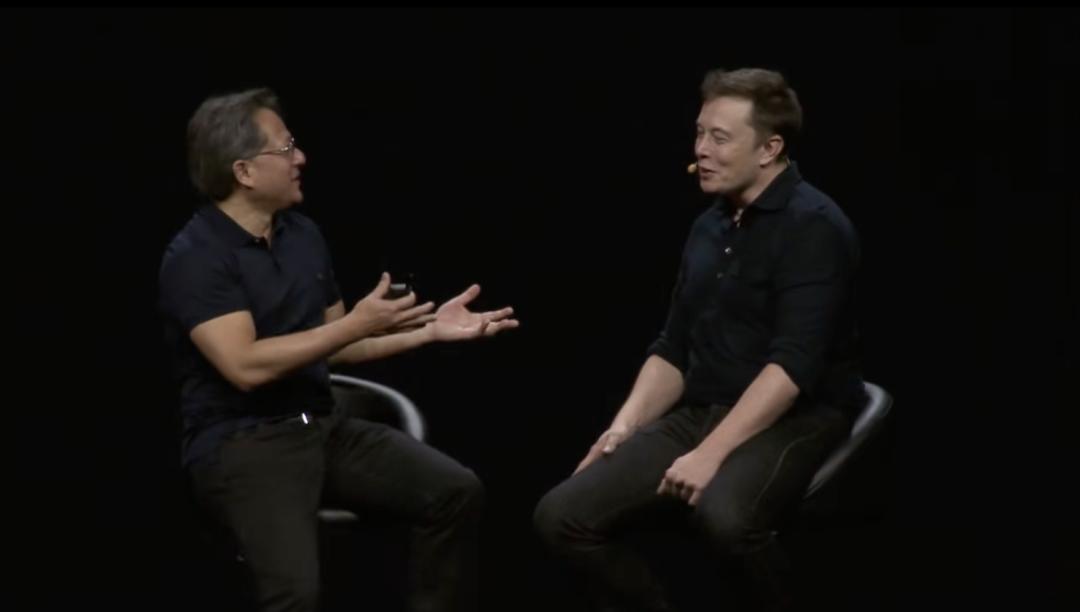
On the stage, Elon Musk said that AI does have the potential to be more dangerous than nuclear weapons, but people don't need to worry too much about autonomous driving, because it is a more narrow form of artificial intelligence. When talking about the implementation path of autonomous driving, Elon Musk said:
You need some hardware foundations, such as sensors and computing facilities, then you can continuously update the software, at least Tesla can do this, because it is always connected to the Internet, and then the functions of the car can be continuously improved... If you want to achieve autonomous driving, we need a larger sensor combination and stronger computing power...
During this meeting, Jensen Huang and Elon Musk also discussed the development of autonomous driving together, and the two also imagined the future after the implementation of autonomous driving — this meeting also laid the preliminary foundation for the subsequent cooperation between Tesla and NVIDIA on autonomous driving.
❺
One day in January 2016, NVIDIA CEO Jensen Huang carried a box and led his team to Tesla's office in California as promised, and met Elon Musk. This box contained the first-generation autonomous driving computing platform DRIVE PX released by NVIDIA; it was brought here because both NVIDIA and Tesla hoped to test its actual capabilities.
In fact, in 2015, after the conflict with Mobileye in their cooperation, Elon Musk was also hoping to find a chip that could provide sufficient computing power and at the same time allow Tesla to develop its own visual algorithms, so he turned to Jensen Huang to see if NVIDIA could develop such a chip.
Hearing Elon Musk's demand, Jensen Huang was very excited. He quickly arranged for engineers to add an independent GPU on the basis of the Tegra chip, and let Tesla test it — so the two sides contacted many times and continuously explored the possibility of cooperation.
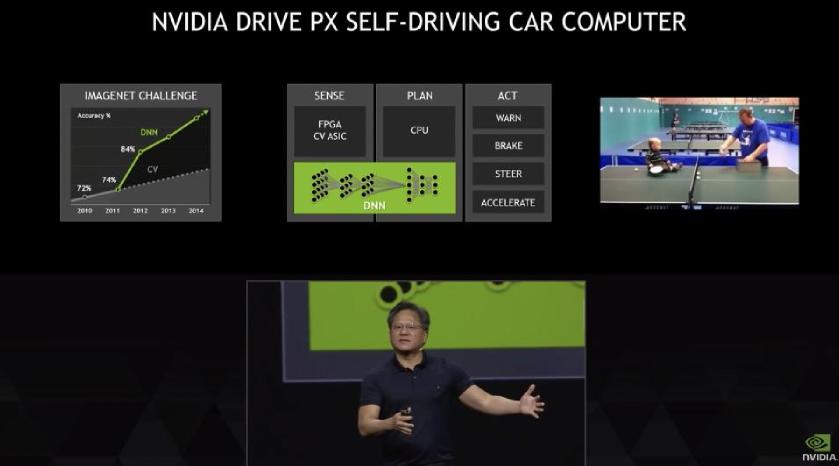
Thus, Elon Musk ran the neural network model trained by the AutoPilot team at that time for several times, and found that it could run and the effect was quite good. However, according to a NVIDIA engineer who participated in the above meeting:
In fact, Tesla's neural network model was really bad, even worse than the effect made by Mobileye based on pure rules.
This is a faltering early step in the development of human autonomous driving. It is not shocking at all, and can even be said to be completely unremarkable.
The subsequent story is that after witnessing the effect of NVIDIA's autonomous driving computing platform in advance, and with the cooperation with Mobileye breaking down, Elon Musk did not need to hesitate too much and chose NVIDIA as his new partner — from then on, NVIDIA and Tesla started their cooperation in the field of autonomous driving, and embarked on their respective journeys to promote the development of global autonomous driving.
Looking back, this was a brilliant day in the history of human autonomous driving development.
❻
But for the development of the entire AI, the more brilliant moment was a computing power delivery ceremony.
On August 9, 2016, Jensen Huang came to the office in San Francisco, and under the witness of Elon Musk, he delivered the world's first NVIDIA DGX-1 supercomputing system to the OpenAI team, which had been established for less than a year (this supercomputing system was officially released at the GTC conference in 2016).
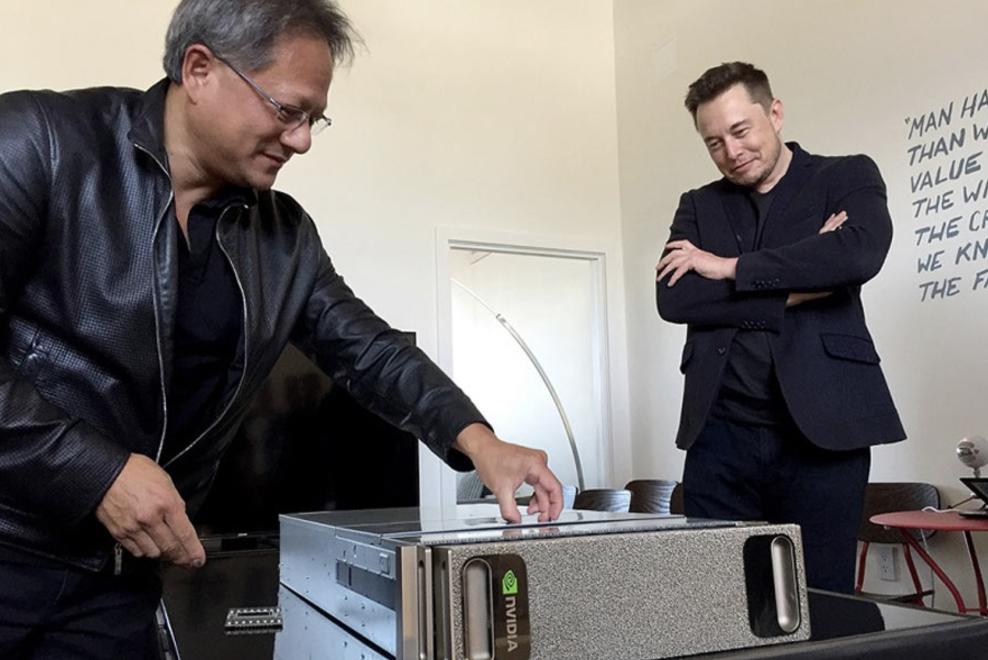
On the shell of this supercomputing system, Jensen Huang used a marker pen to express his blessings to Elon Musk and OpenAI, and Elon Musk responded with a word "Thanks".
At this seemingly unremarkable delivery ceremony, in addition to Elon Musk and Jensen Huang, there were many key figures who dominated the AI field, including Andrej Karpathy, Greg Brockman, Ilya Sutskever, Dario Amodei and so on.
Later, when Jensen Huang recalled this incident, he said that after the DGX-1 system, which cost billions of dollars to build, was released, no one in the industry wanted to buy this machine, and Elon Musk was the first customer who really supported him — Elon Musk bought it to provide support for OpenAI.
No one could have predicted that this scene became the early starting point for NVIDIA's AI computing power to participate in the big explosion of the new generation of AI technology.
So it is truly: a subtle foreshadowing laid long ago leads to a far-reaching result much later.
❼
In August 2018, during an earnings call, Jensen Huang answered the question about "Tesla's self-developed chip". He first talked about the difficulties of autonomous driving chips and software stacks, then shouted to Elon Musk across the air: If the final result is not what you want, Elon Musk can call me, and I will be very happy to help.
In response, Elon Musk also replied on Twitter:
NVIDIA makes excellent hardware, and I have high respect for Jensen Huang and his company. But our hardware requirements are very unique and need to be closely matched with our software.
The implication is that no matter how good NVIDIA's products are, they do not meet my needs.
The background of this incident is that Tesla started its cooperation with NVIDIA in 2016, and adopted a computing device with computing power more than 40 times higher than that of the previous generation product in HW2.0, that is, DRIVE PX2 released by NVIDIA at the beginning of the year, and adopted a jointly customized version.
But in January 2016, Elon Musk had already decided to develop the on-board autonomous driving chip by himself, which later became FSD.
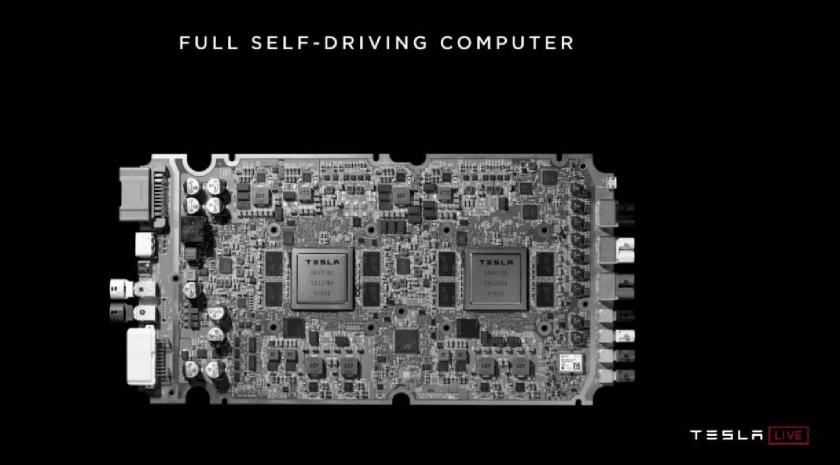
By 2018, as Tesla's self-developed chip gradually succeeded, the cooperation between Tesla and NVIDIA on the on-board autonomous driving chip gradually decoupled, which led to the above-mentioned interaction across the air. However, at that time, NVIDIA had already obtained a series of automotive customer groups around the world, including Toyota, Audi, Daimler, Volkswagen and other automotive giants, so it was quite confident.
It is worth mentioning that although Tesla gave up its cooperation with NVIDIA on the on-board chip, the business between Tesla and NVIDIA on the cloud data center level of autonomous driving is still continuing — up to today, in the progress of autonomous driving business, the two sides have not really parted ways.
❽
In July 2024, in order to promote large model training, Elon Musk announced that with the support