AI recording devices are vying for the position of "the one that understands you best"
More and more intelligent hardware products for AI voice recording have emerged.
At the beginning of 2026, Nooklab secured backing from HSG and Linear Capital while still in the idea stage, with its valuation approaching 100 million USD. In October of the same year, Flowtica raised tens of millions of RMB in financing from Vertex, Source Code Capital, 5Y Capital and Qingshuiwan Fund, which will be used for its new product verso. These products share a similar design concept: adding an e-ink screen as a display window for the magnetic voice recording card.
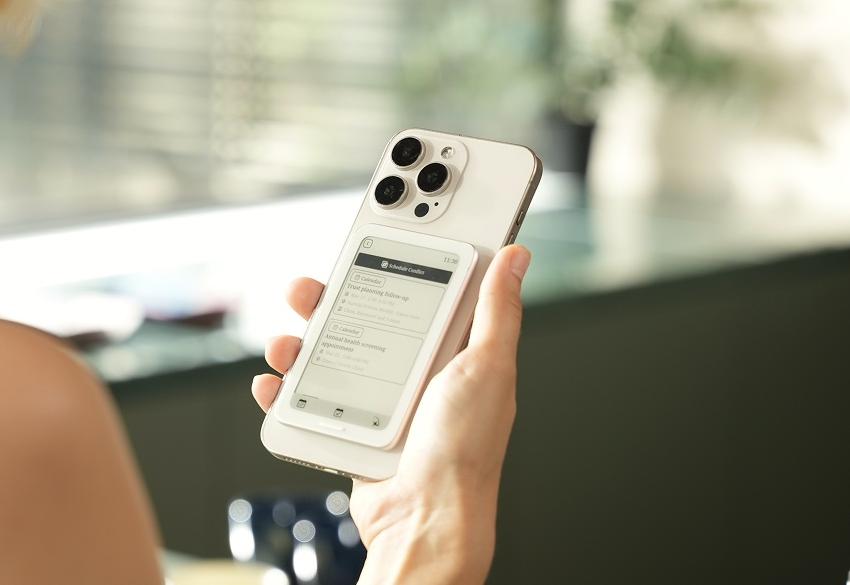
Image source: nooklab.ai
Nooklab's first product, Moonphase Flip, weighs only 54 grams. Its core function is to automatically extract to-dos and schedules through non-intrusive recording, without deliberate push notifications or unnecessary disturbances. Flowtica's Verso weighs 78 grams, supports one-tap recording, real-time transcription, summarization and automatic to-do generation, focusing on building a complete closed-loop experience covering the full process before, during and after meetings.
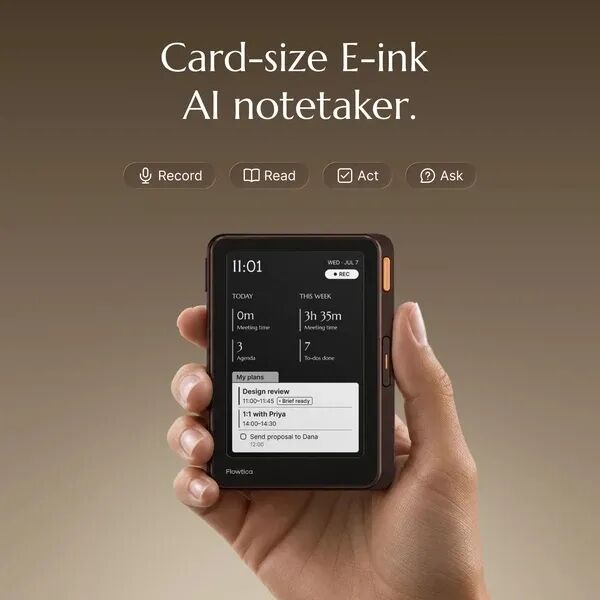
Image source: flowtica.ai
The low-profile display is their new answer to the "post-recording" scenario, but this idea did not emerge out of thin air.
As the pioneer of magnetic voice recording cards, Plaud released a set of figures half a year ago: its software subscription ARP soared from 1 million USD to 100 million USD within two years, the total shipment of devices exceeded 2 million units, and nearly 50% of hardware users upgraded to paid subscription users.
The revenue of hundreds of millions of USD and millions of users verified two facts at the same time: sticking a card on the back of a mobile phone is an entry point that is light enough, frequent enough and low-threshold enough, and AI is the core source of its value. As Mo Zihao, former CEO of Plaud China, said, compared with positioning itself as an "AI voice recorder", he prefers to place Plaud in the coordinate system of "AI Work Companion".
This market is now being given new imagination. It is no longer just a hardware business of "recording voices", but is incorporated into the narrative of "personal context agent". In order to find their own positions on this track, brands are making efforts from all dimensions, and the market no longer converges along a single line.
Looking at current products, they have various forms and dazzling functions, but what they are competing for is still the few inches of space on wrists, ears and the back of mobile phones.
When everyone tries their best to find their own position, a very specific problem arises: There are so many AI recording devices that you can't fit them all on your desk.
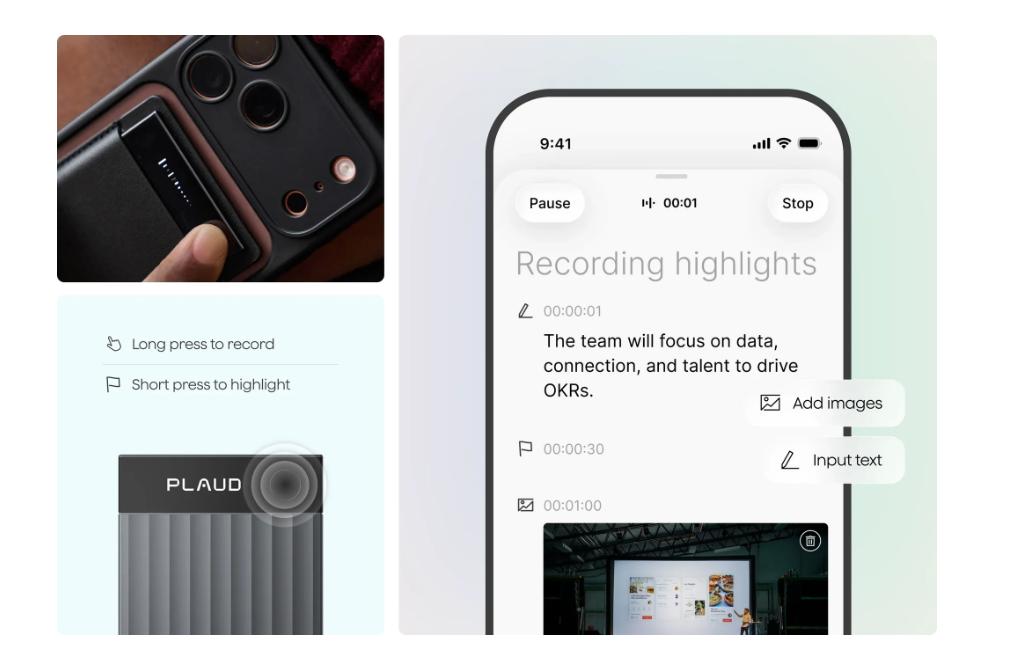
Image source: Plaud official website
Hardware is a Trojan horse, and subscriptions are the real cash flow: the truth of AI recording cards
To understand this crowded battle clearly, we must first understand how consumers use recording devices.
Before Plaud appeared, recording devices were standard "old digital products". Mobile phones support recording, software supports transcription, and Sony and Philips have been operating in the professional market for many years. For most people, a recording device is not a rigid demand.
The turning point came with hybrid work after the pandemic: online meetings often last for three or four hours, and offline communications happen one after another, disrupting the complete working hours. Asynchronous communication requires audio traces, and Plaud accurately captured this complex demand.
Mobile phones themselves carry too much information and functions, so recording needs a separate entry point. A card that can be attached to the back of a mobile phone, starts recording with one press, and automatically generates transcriptions, summaries and to-dos in the App, it delivers a combined set of advantages.
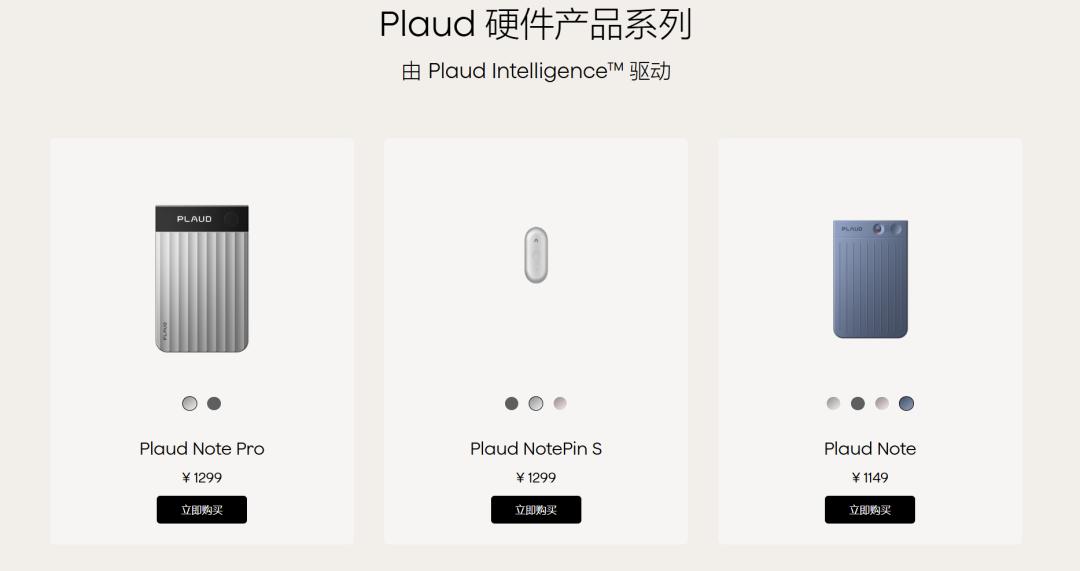
Plaud official website product information
Hardware is the Trojan horse for customer acquisition, and software subscriptions are the real cash flow. A valuation of 2 billion RMB and a 25% profit margin per unit have verified the value of the hardware-software closed loop in a market where "hardware makes no profit", which is a striking signal.
Once the signal is released, the follow-up speed is astonishing, and the table is quickly crowded with people from different backgrounds: occupying a certain physical position, and stuffing irreplaceable functional increments in a space of several centimeters.
The back of the mobile phone is the most crowded place. Plaud Note first set the benchmark with a credit card size, less than 3mm thickness and 30g weight. Later entrants no longer only compete on "thinness", but on "what more functions can be added to this back area". DingTalk A1 Pro thickens the card, embeds a 2980mAh battery, supports 180 hours of continuous recording and 180 days of standby, and can be used as a magnetic power bank to charge the mobile phone in emergency. Dreame embeds an NFC electronic business card into the recording card, and uses alligator leather and 3.5mm real diamonds to turn it into a business accessory. Flowtica Verso adds a permanent e-ink screen, leading the device to a "second interface".
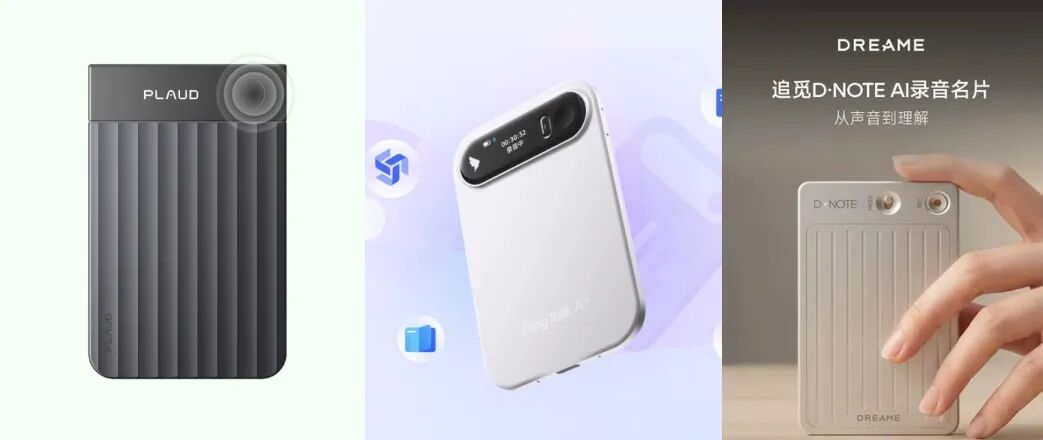
The left picture shows the Plaud product, the middle picture shows the DingTalk product, and the right picture shows the Dreame product
Wearable products go the opposite way, with the logic of lightness and non-intrusiveness. Anker AI recording bean weighs only 10 grams, which can be used as both a pendant and a magnetic button. Stream Ring chooses the ring form, providing a squeeze-to-talk whisper-to-text function. Memoket makes an 11-gram wristband, which is compatible with Apple Watch straps to combine with existing devices. Only when it is "comfortable to wear" can it be incorporated into work habits.
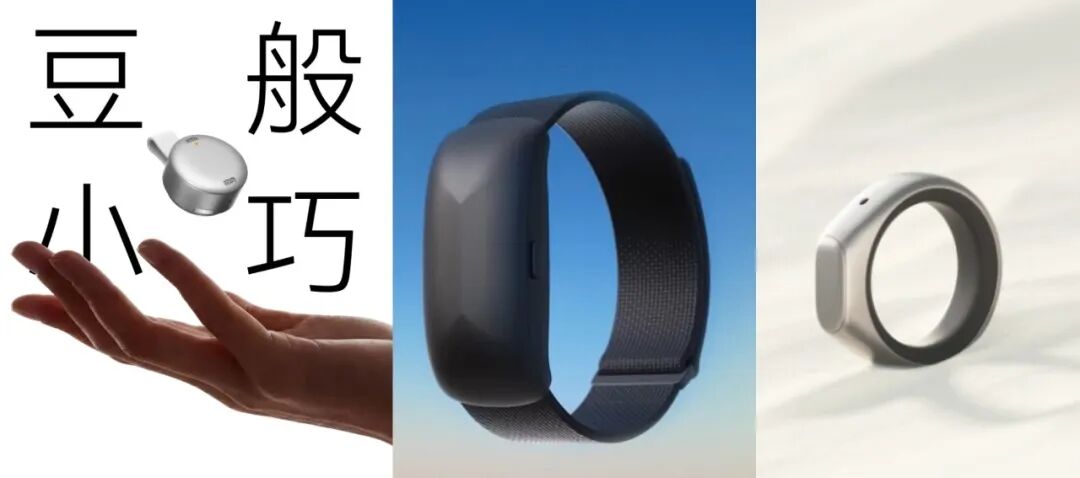
The left picture shows the Doubao product, the middle picture shows the Stream Ring product, and the right picture shows the Memoket product
In addition to new forms, Bluetooth earphones and traditional voice recorders familiar to consumers are also actively transforming. Shokz focuses on open-ear hanging design, taking comfort as the premise of recording productivity. TicWatch Pods from Mobvoi embeds 4G into the earphone, and the charging compartment supports independent audio collection, making "independent recording without mobile phone" a selling point. Pen-shaped products add multi-modal functions on the hardware: iFlytek Magic is made into a compact recording terminal with a touch screen, Flowtica Scribe retains the writing function, and adds a shooting function to the APP, so that handwritten notes, whiteboards and slides can be integrated into the audio context.
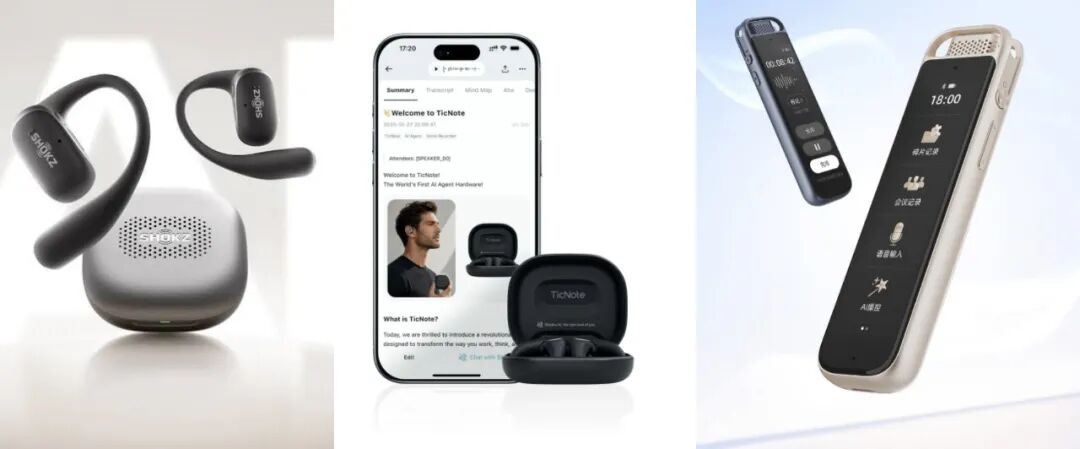
The left picture shows the Shokz product, the middle picture shows the Mobvoi product, and the right picture shows the iFlytek product
Just on November 4, Apple pushed the first developer beta of iOS 27.3 and watchOS 27.3, including two brand new AI functions: one can help users review conversations in the past 15 seconds, and the other will record the user's conversations throughout the day and organize them into summaries.
In terms of appearance, products with or without mobile phones, for social scenarios or for concealment, have different focuses. But when you take them apart, their internal structures are mostly similar, especially in terms of sound pickup.
Once the device pursues lightness and non-intrusiveness, the miniature capacitive MEMS microphone is almost the default choice. To achieve light weight, wearable products are equipped with at least 2 MEMS microphones. The card is far away from the sound source, making it convenient to arrange an array and add bone conduction functions. The voice recorder has the largest internal space, so it stacks more microphones to obtain a larger sound pickup range. MEMS microphones are low in cost, the highest price is less than 10 RMB, but they are an important physical entry point for the above products. As a result, hardware competition quickly turns into parameter list competition, and parameter lists are most easily smoothed out by the supply chain.
The answer from Huaqiangbei is very cruel: the hardware itself is not worth that much money.
An entrepreneur who makes AI meeting minutes told Xiaguang She that the BOM cost of a card recorder priced at around 1000 RMB is less than 100 RMB, including chips, storage, motherboards and shells. The most expensive chips are "purchased on behalf" from Malaysia, which is 20% cheaper than domestic ones. Magnetic AI recording cards priced at 199 RMB have appeared on e-commerce platforms, and "factory goods" with five microphones and 360-degree sound pickup can be obtained for 260 to 300 RMB on 1688. Walking into the market, countless white-label products have similar functions and use the same promotional words, and the products can fill the entire glass counter.
China's supply chain has pushed the hardware cost of products to the floor, and the lightness, magnetism and one-tap recording at the hardware level are no longer barriers. The entry threshold in China has dropped from 1000 RMB to 499 RMB, hardware profits have been squeezed thin, and price wars are almost inevitable.
In that case, why are new products still emerging continuously? Because hardware only answers two questions: where to place the device, and how low the cost can be. The more critical question is, after occupying the position, why do users stay and why do they pay?
The global answer sheet of a recording card
Hardware is the entry point for user interaction, and in the current market environment, more importantly, data is the value point behind it.
In Q1 2026, the domestic online voice recorder retail sales reached 140 million RMB, and the average price rose all the way from 334.8 RMB in January to 386.3 RMB in March. Both sales volume and price are rising, but what is rising is the value of the hardware itself. "Chinese users have low willingness to pay for software" is a consensus repeatedly confirmed by many practitioners.
According to the survey of Tencent Research Institute, the monthly payment amount of Chinese AI users is mainly in the range of 30-100 RMB. Data from institutions such as a16z and Bessemer show that the C-end payment rate of AI products in the North American market is between 15% and 40%, while that in the Chinese market is only 3%-13%, with a gap of 3 to 4 times.
The high differentiation of payment behavior means that if domestic recording cards want to transform from a hardware business to a subscription business, what they need to cross is not the product threshold, but a more stable user behavior habit. Unlimited transcription, free use for the first 90 days, even marked as "lifetime"... The common direction of these actions is: hardware can be sold, but it is difficult to collect money at the software level.
The background of the overseas market is completely different. The software subscription system has been running there for more than ten years, and users have long accepted the idea of "spending more than ten dollars a month to buy a tool that solves specific problems".
A survey by Deposit Accounts shows that American consumers hold an average of 4.5 digital subscriptions, with an average monthly expenditure of 84 USD. This habit perfectly matches the product structure of AI recording devices: a hardware starting at 159 USD, with an annual fee of 99 to 240 USD, is more like a familiar subscription extension for North American users, rather than a new consumption decision that needs to be persuaded. Plaud's path verified this point: before officially entering the Chinese market, nearly 50% of its hardware users eventually upgraded to Pro or Unlimited paid plans.
But "overseas" cannot be generalized, and the internal differences cannot be ignored.
Plaud first gained popularity in the United States, and its Kickstarter crowdfunding exceeded 1.1 million USD in less than two months, but Japan later became the largest market for its software subscription revenue, and the number of active users even exceeded that of the United States. Sales in Japan in 2025 reached 4 times that of 2024, and it has become the second largest market for Plaud hardware sales.
This structure of "blossoming at home but bearing fruit abroad, and there are many fruits abroad" shows that the demand for AI recording devices is not determined by a single habit, environment or country, but defined by a working culture: high-density meetings, strict requirements for accuracy, habits of using efficiency tools, and a sufficiently mature subscription consumption environment.
The emphasis on "recording" and "keeping traces" in Japanese workplace culture makes Plaud's transcription and summary functions well received. Europe brings another demand: meetings in the Belgian public sector are often mixed with Dutch, French and English. For them, multi-language transcription is not just a bonus function, but a prerequisite for cross-border collaboration. Singapore and Southeast Asia provide the third sample: as the hub of Asia-Pacific regional headquarters, English is the working language, but regional accents are frequently interspersed. Transcription tools not only need to recognize speech, but also stably process accents and terms.
When a product meets multiple willingness to pay at the same time, its revenue ceiling is no longer determined by the average price of any single market. But the more diverse the demand, the more layered the threshold. Multiple markets bring revenue elasticity, and also push privacy compliance from the background to the foreground.
