36Kr Exclusive | An AI4S startup founded by a Beihang University PhD has secured 100 million yuan in financing, aiming to build a self-driving laboratory.
Source / Enterprise
This article is approximately 3000 words, with an estimated reading time of 8 minutes
Author | Ou Xue
Editor | Yuan Silai
Hard Krypton has learned that Qingkui Intelligent Manufacturing, a Physical AI company dedicated to scientific research and development, recently announced the completion of a 100 million-yuan Series A financing round, with joint participation from Chuangdongfang Investment, Fastprint Co., Ltd. and Jinhui Big Data. The funds will be mainly used for core technology R&D, key industry expansion and cloud laboratory construction, to accelerate the industrial implementation of self-driving laboratories.
Founded in 2021, Qingkui Intelligent Manufacturing's core business is to provide a closed-loop dry and wet experiment solution of "AI design - automated execution - multi-modal data backflow - model adaptive iteration" for fields including biomedicine, chemical industry, advanced materials and new energy. Chen Nanjiang, the founder and chairman of the company, is a doctor from Beihang University, once worked in the School of Mechanical Engineering of Beihang University, and has more than ten years of continuous entrepreneurial experience in the field of robotics and intelligent manufacturing.
In recent years, AI4S (AI for Science) is evolving from computation-driven scientific discovery to AI autonomous experiment execution. However, the industry still faces core pain points such as "Execution Gap" and "Data Gap", that is, the intelligent decision-making in the digital world has not been fully connected with the experiment execution in the real world.
"At present, many scientific models still rely on public literature and databases for training, but public data often has problems such as incomplete record of experimental conditions and insufficient failed samples. The model can put forward many hypotheses, but without real experimental verification and continuous data feedback, it is difficult to continuously improve the ability of prediction and decision-making." Chen Nanjiang told Hard Krypton directly. With the outbreak of large model technology, the industry has gradually realized that without high-quality structured wet experiment data, AI's capabilities in condition screening and synthesis will hit a ceiling.
Based on this judgment, Qingkui Intelligent Manufacturing has chosen a route of "integration of software and hardware, closed loop of dry and wet experiments". Chen Nanjiang compared a complete set of automated laboratory solutions to the human body: the bottom layer is the hardware (hands) responsible for physical execution, the middle layer is the operating system (nervous system) responsible for scheduling, and the top layer is the large scientific model (brain) responsible for experimental design and decision-making.
Source / Enterprise
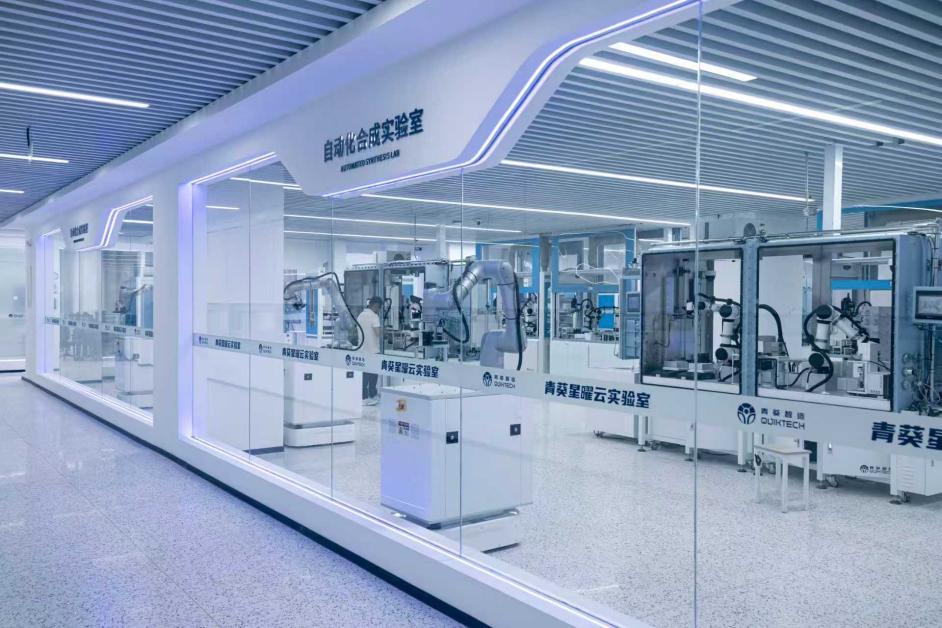
Qingkui Intelligent Manufacturing automated synthesis laboratory (Source / Enterprise)
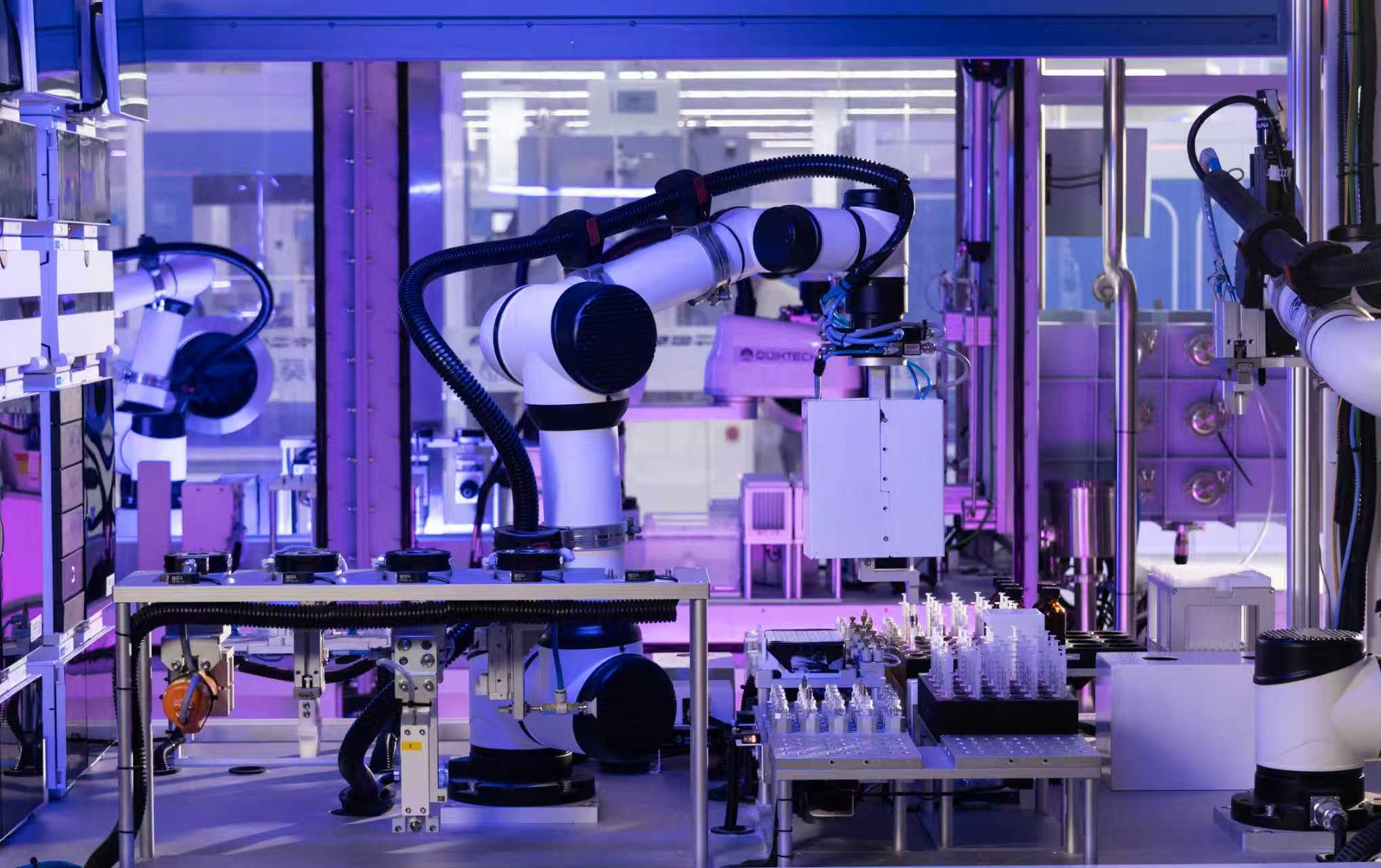
At the hardware layer, NexoLab standardizes, digitizes and modularizes the actions and processes of classic chemical experiments. From standardized execution units to workstations for feeding synthesis, sample processing and analysis, separation and purification, as well as different levels such as standard experimental processes, modular flexible configuration can be realized to adapt to various common reaction conditions and analysis methods. At the same time, giving full play to the automation and software technology accumulation of Qingkui Intelligent Manufacturing team, the reliability, repeatability and consistency of common experiments are realized.
At the management and scheduling layer, AI-LabOS abstracts physical devices into callable agents, decomposes different experimental processes into standardized experimental actions of different agents, so as to realize the adaptation of various experimental processes. At the same time, with the help of multi-level data collection solutions, it realizes multi-dimensional data collection and traceability covering execution units, experimental beats, reaction conditions, laboratory operation management, etc. It can also realize collaborative scheduling and experimental process orchestration of multiple sets of robots through scheduling simulation and digital twin technology, so that chemists who do not understand hardware programming can get started quickly, and maximize the efficiency of experimental output.
At the decision-making layer, MoleMind trains various types of models based on multi-dimensional high-quality data generated by wet laboratories, which can realize vertical models suitable for different scenarios, including intelligent experimental design, equipment state prediction, experimental data reliability evaluation, experimental optimization and self-iteration, reaction condition optimization, etc., truly applying the models to experimental auxiliary analysis, experimental auxiliary design and decision-making.
"There are many details in chemical experiments, such as the sampling and weighing of substances of different shapes under nitrogen environment, and how to carry out thermal design and structural design of parallel reactors to ensure the consistency of stirring and temperature curves. We need to understand these thoroughly, and then convert them into software interfaces and underlying algorithms." Chen Nanjiang said. At present, Qingkui Intelligent Manufacturing has been approved as a member unit of the Artificial Intelligence Standardization Technical Committee of the Ministry of Industry and Information Technology, and has taken the lead in establishing a municipal key laboratory.
In terms of efficiency and accuracy, compared with the traditional manual experiment mode, NexoLab can increase the experimental efficiency by dozens of times; at the same time, robot operation eliminates manual errors, and has significant advantages in experimental reliability and safety. AI-LabOS can maximize equipment utilization through intelligent analysis and scheduling, and realize full-dimensional data traceability, improving the disorder and inefficiency of manual management in traditional laboratories. MoleMind makes full use of the knowledge precipitation capability of AI to truly realize the integration, accumulation and burst of data and knowledge of different dimensions, and finally assist scientists to expand the scientific boundary.
In terms of commercialization path, Qingkui Intelligent Manufacturing's current customers cover leading institutions in the fields of pharmaceuticals, fine chemicals, new materials, new energy and scientific research institutes, including Chinese Academy of Sciences, Boehringer Ingelheim, Hengrui Medicine, Gotion High-tech and so on.
Chen Nanjiang revealed that since the underlying experimental links (such as solid-liquid mixing, feeding reaction, analytical detection, etc.) have achieved a high degree of modularization and standardization, the company's products have strong cross-industry adaptability, and the customer repurchase rate performs well.
In addition to equipment delivery, Qingkui Intelligent Manufacturing is exploring the second growth curve. In the second half of this year, the company built its first fully self-owned automatic AI chemical robot laboratory, which not only provides high-quality data for its own model training, but also begins to try to provide Experiment as a Service externally. Pharmaceutical, materials, new energy or scientific research institutes can realize two-way transmission from experimental tasks to experimental results through the cloud experiment entrance, and can view various experimental data including water and oxygen environment, heating curve, analysis spectrum in real time.
In addition, due to higher overseas labor costs and stricter requirements for environment and safety, Chen Nanjiang believes that the overseas market will become the key direction for the company to focus on in the next step. At present, Qingkui Intelligent Manufacturing has set up offices in Singapore and South Korea, and has launched cooperation with local universities, scientific research institutes and industrial customers.
The following is an excerpt of the interview between Hard Krypton and Chen Nanjiang, founder of Qingkui Intelligent Manufacturing (edited):
Hard Krypton: There are many teams doing AI4S now. What is the core differentiation of Qingkui Intelligent Manufacturing?
Chen Nanjiang: The differentiation can be divided into two parts. The first is the transformation of industry know-how. AI4S itself is a highly cross-integrated industry. Our team's genes are mechanical automation, software and AI, but the experimental design, experimental operation and result analysis in the chemical field have very rich contents and details. We need to fully understand these scenarios and needs, convert them into standardized and digital software and hardware modules, and make full use of AI to understand, learn and precipitate various chemical scenarios, so as to realize integration with the genes of automation and AI.
The second is the real dry and wet closed loop. The closed loop of dry and wet experiments is easy to say, but to realize the integration and closed loop of the two systems of dry experiments and wet experiments is the real problem faced by various types of enterprises in the industry at present. We have always insisted on carrying out dry experiment design on the basis of the wet experiment system, and insisted on covering the whole process verification from experimental design, experimental execution to experimental iteration with real experimental scenarios, and established an experimental quality evaluation system around this system, so that the closed loop of dry and wet experiments can iterate in real experimental scenarios. Up to now, we have verified and obtained some relatively good results in the fields of scientific research and industry.
Hard Krypton: Will customers worry about "hallucinations" or errors generated by scientific AI? What is the current trust level of AI in experiments?
Chen Nanjiang: This problem is very critical. We certainly can't use the general language model to do experiments directly, but train the model with real vertical data generated by the wet laboratory on the base of the general large model, which will greatly reduce hallucinations. At the current global level, the experimental scheme automatically generated by AI still needs chemists to make the final approval. That is to say, at this stage, it is still human-machine collaboration, not completely unmanned. But we believe that with the continuous expansion of the scale of high-quality experimental data and the gradual improvement of data standardization, the prediction and judgment accuracy of AI in some fields will become higher and higher, and eventually surpass human scientists.
Hard Krypton: What are the company's key plans for the next step?
Chen Nanjiang: The first is to vigorously develop self-owned robot laboratories, and carry out a large number of real experiments to accumulate and precipitate high-quality structured data. In the segmented competition of AI4S, the essence is the competition of real experimental data. The second is to make MoleMind smarter on the basis of a large amount of data. The third is overseas expansion. China is iterating very fast in the direction of the combination of software and hardware. From the perspective of technical goals, we hope to form scale advantages of cloud laboratories within one or two years and expand the data pool.
Investor's View:
Chuangdongfang Investment said: "We are optimistic about the development opportunity of AI4S moving from technical verification to industrial application. Qingkui Intelligent Manufacturing has built systematic technical capabilities around intelligent scientific decision-making, experimental automation and data closed loop, and continuously verified commercial value in real industrial scenarios. We look forward to the company continuing to expand its commercial applications in different fields through this round of investment."
Fastprint said: "With the rapid development of AI computing power infrastructure, liquid cooling heat dissipation and thermal management technology put forward higher requirements for material performance, R&D efficiency and process optimization. The technical accumulation of Qingkui Intelligent Manufacturing in intelligent experiments, material formula screening and automated testing has synergy potential with Fastprint's business layout in electromagnetic shielding materials, functional materials, thermal management materials and liquid cooling and other technologies. We look forward to taking this investment as an opportunity to explore the application of AI and automated experimental technology in material R&D and process optimization, and accelerate the process of technological innovation and industrialization."