The speed has surged 2.5 times, and Google has launched its new model Hydrogen, which outperforms GPT-6.1 Terra in multiple practical tests.
Just now, Google released Gemini 4 Hydrogen. This new model, focused on speed and cost performance, is launching a challenge to the mid-tier models of Claude and GPT.
For a large number of daily programming and agent tasks, users expect the model to not only solve complex problems, but also run fast and cost reasonably. This time, Google positions Hydrogen as a fast execution model, pitting it against Claude Sonnet 5.5 and GPT-6.1 Terra.
According to the results announced by Google, Hydrogen outperforms the two rivals in multiple tests such as programming and knowledge work. In the comprehensive index of third-party Artificial Analysis, the average cost per task under the same evaluation is less than one-third of that of Sonnet 5.5, yet it achieves almost the same performance.
Head-to-Head Competition Against Core Mid-Tier Models
Benchmark performance is close to Sonnet 5.5, while the cost is cut by two-thirds.
Google positions Hydrogen as a fast execution model for daily programming and agent work. It can handle multi-step tasks independently, and can also cooperate with cutting-edge models such as Carbon.
Google announced a set of results covering programming, knowledge work, computer operation and multimodal understanding. Among them, Hydrogen outperforms Claude Sonnet 5.5 and GPT-6.1 Terra in multiple items. These two models are exactly the core mid-tier models of the two leading vendors, undertaking a large number of users' daily tasks.
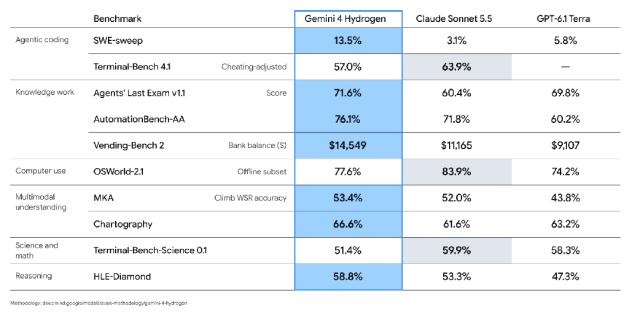
In SWE-sweep, which focuses on discovering and fixing programming problems, Hydrogen scores 13.5%, higher than 5.8% of 6.1 Terra and 3.1% of Sonnet 5.5. In Agents' Last Exam v1.1 that measures end-to-end professional workflow, Hydrogen scores 71.6%, surpassing 69.8% and 60.4% of 6.1 Terra and Sonnet 5.5 respectively; it also takes the lead in the MKA test involving complex visual files.
Apart from programming, Google also released results for real professional work scenarios. In the AutomationBench-AA test, Hydrogen scores 76.1%, while Sonnet 5.5 and GPT-6.1 Terra score 71.8% and 60.2% respectively. This test focuses on whether the model can use software tools to complete automated workflows.
In terms of multimodality, in the MKA test that requires processing complex visual materials, Hydrogen scores 53.4%, Sonnet 5.5 scores 52.0%, and GPT-6.1 Terra scores 43.8%. Google expects it to integrate materials including PDFs, tables, charts, audio and video, and generate reports and other work outputs.
There are also items where rivals take the lead in the ranking. In the computer operation evaluation OSWorld 2.1, it lags slightly behind Sonnet 5.5. In the scientific task test Terminal-Bench-Science 0.1, it lags behind both Sonnet 5.5 and GPT-6.1 Terra.
Overall, these results demonstrate that Hydrogen has capabilities comparable to the mid-tier models of the two leading companies.
Google also emphasized its speed. According to Google, under the default high reasoning level, Hydrogen completes tasks 2.5 times faster than Gemini 3.8 Flash. For developers who need to repeatedly modify code and check results, the shortened waiting time will also affect the experience of the entire workflow.
Following the convention of Gemini, Hydrogen is also equipped with four reasoning levels: low, medium, high (default) and the brand-new xhigh, which provides hierarchical choices among quality, latency and cost. It can scale up smoothly and predictably, offering more reasonable inference depth with corresponding payment time and cost.
Third-party evaluations provide horizontal references. The Intelligence Index of Artificial Analysis integrates tests of knowledge work, programming, science and other fields. As checked on November 13, the highest xhigh tier of Hydrogen scores 54, close to the 55 points of the highest max tier of Sonnet 5.5, and higher than the 51 points of the highest max tier of GPT-6.1 Terra.
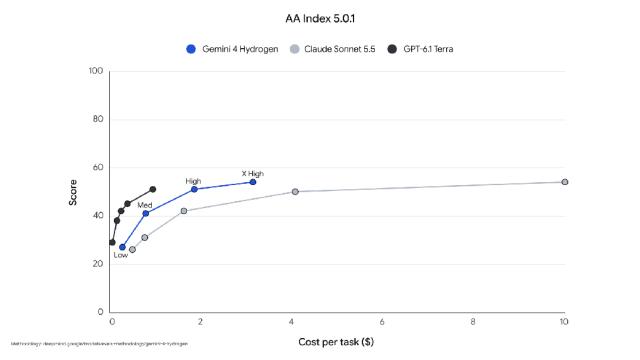
In addition to capabilities, it also has price advantages. The AA ranking also gives the average cost per task. It can be seen that GPT-6.1 Terra is cheaper, but its highest score is not as high as that of Hydrogen. The gap is obvious when compared with Sonnet at the highest reasoning tier: the costs are 3.16 USD and 10.02 USD respectively, the price of Hydrogen is only one-third of that of Sonnet 5.5.
One-Shot Generation of Code and Physics Engine
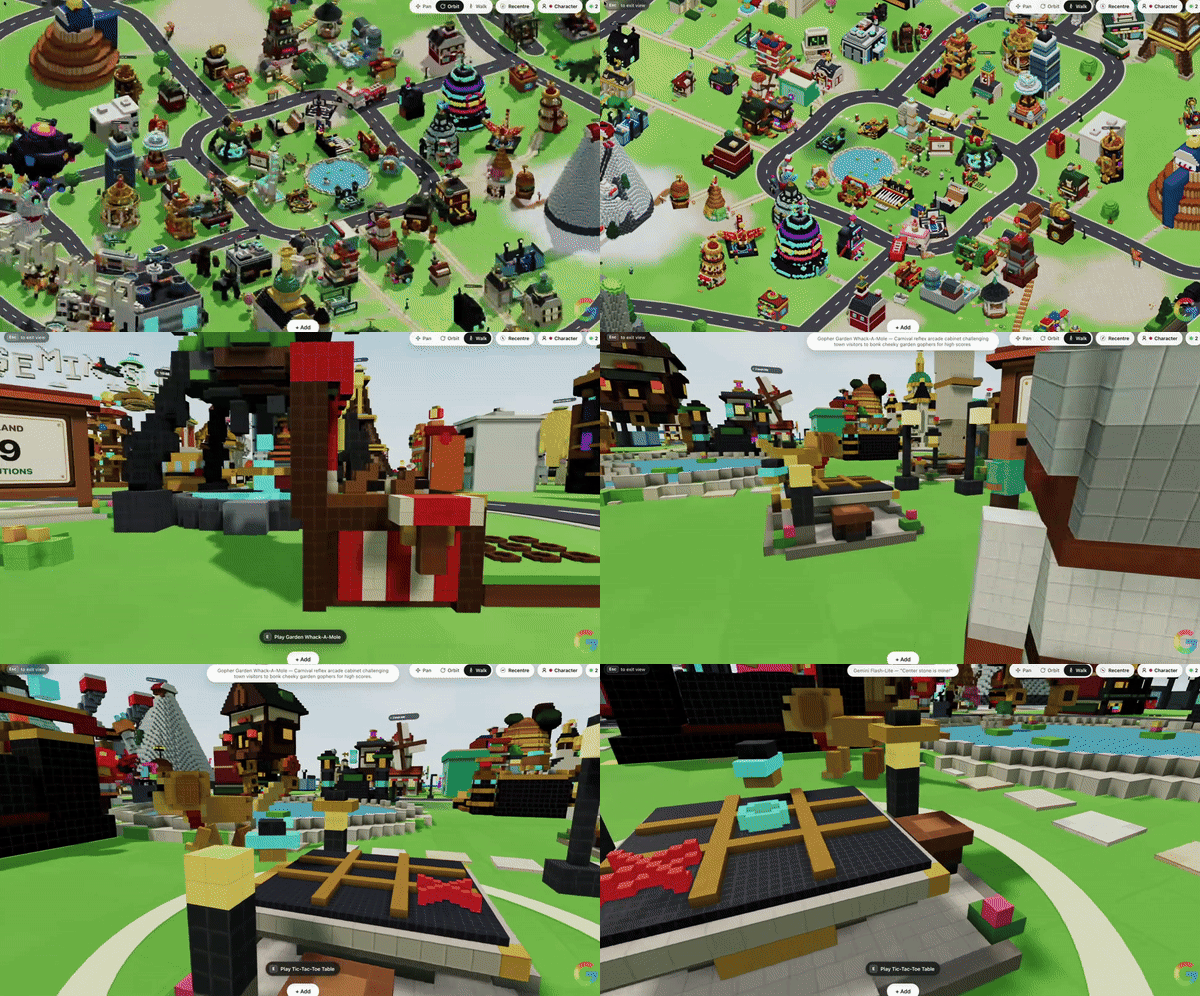
Google demonstrated a Minecraft-like game called Geminisland. When users input a prompt, Hydrogen can generate the complete game through instant 3D programming. There are roads, buildings and large animals on the island, and users can also enter the scene to explore from a first-person perspective.
Netizen kimmonismus also used Hydrogen to make a canyon flight game. The author stated that it uses Three.js, procedural terrain and dynamic water surface, and sets 25 scoring gates.

In graphics tasks that require understanding of physical rules and real-time rendering, Hydrogen also performs steadily. Hydrogen can produce 3D interactive models according to specific visual requirements. In a water and glass visualization program, the model simulates refraction, reflection, dispersion and absorption of light when passing through water and glass.
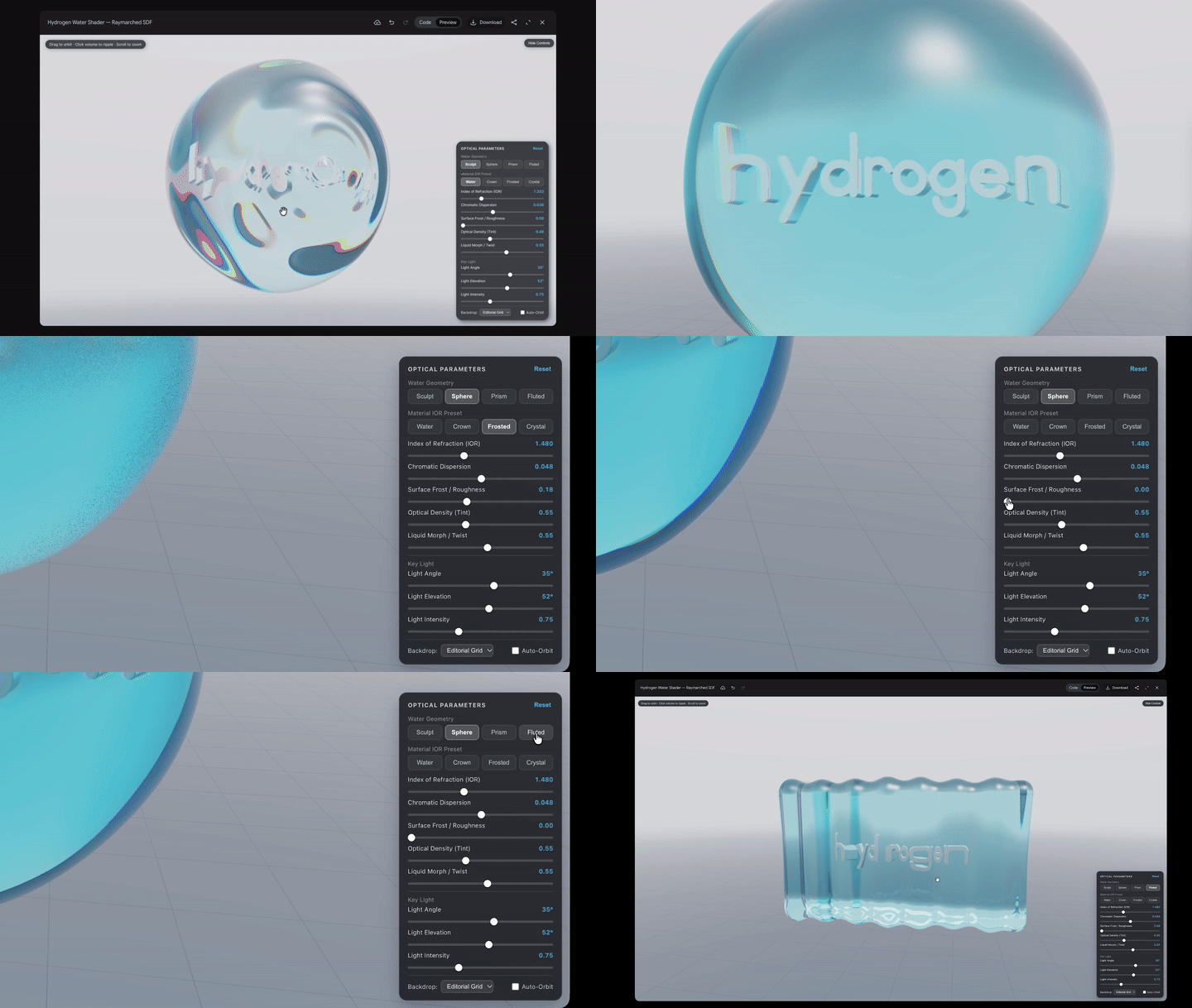
This case turns complex visual requirements into real-time images, reflecting the model's capabilities of writing graphics code, understanding physical rules, and building a complete system.
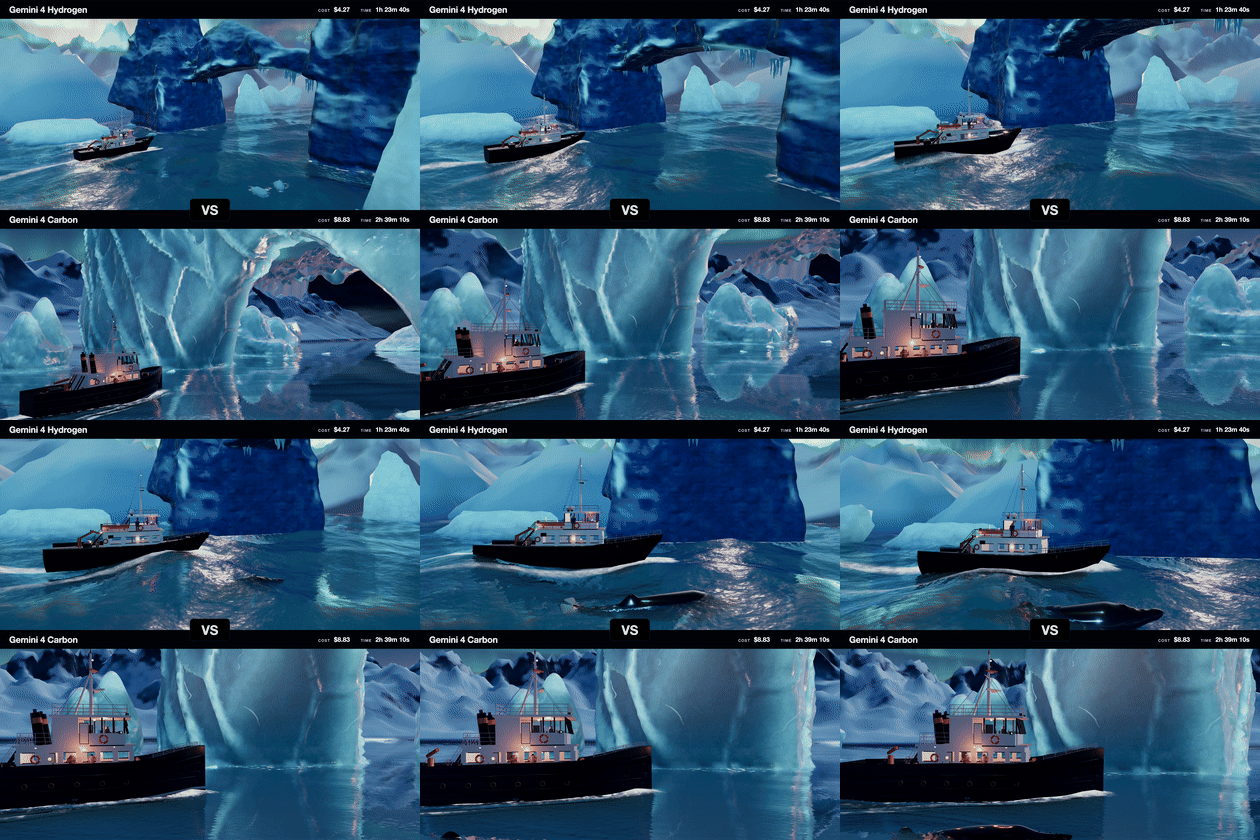
Similarly, netizens have also conducted a lot of 3D actual tests. For example, developer Tony used Hydrogen and Google's newly released flagship Carbon respectively to produce 3D images of ships sailing through glaciers.
Hydrogen took 1 hour, 23 minutes and 40 seconds, costing 4.27 USD; Carbon took 2 hours, 39 minutes and 10 seconds, costing 8.83 USD. With both time and cost halved, it can be seen that Hydrogen still maintains extremely high presentation quality, and does not significantly lag behind Google's own flagship model.
Multi-Step Video Editing and Dynamic SVG
In another case, Google directly let AI complete the full production of a video. According to creative requirements, Hydrogen uses a dedicated video assembly skill to find public materials, edit the materials into a continuous video, and add voiceover.

This case demonstrates the model's ability to call tools according to requirements to complete multi-step creation, showing the model's multimodal capabilities, aesthetic level, and the ability to complete the entire video production workflow.
Also focusing on visual effects, netizen Marcel made an advanced version of the pelican test, asking the model to generate an SVG animation of a pelican riding a bicycle through five dynamic seasons, and compared Hydrogen with Anthropic's strongest Fable 5.2.
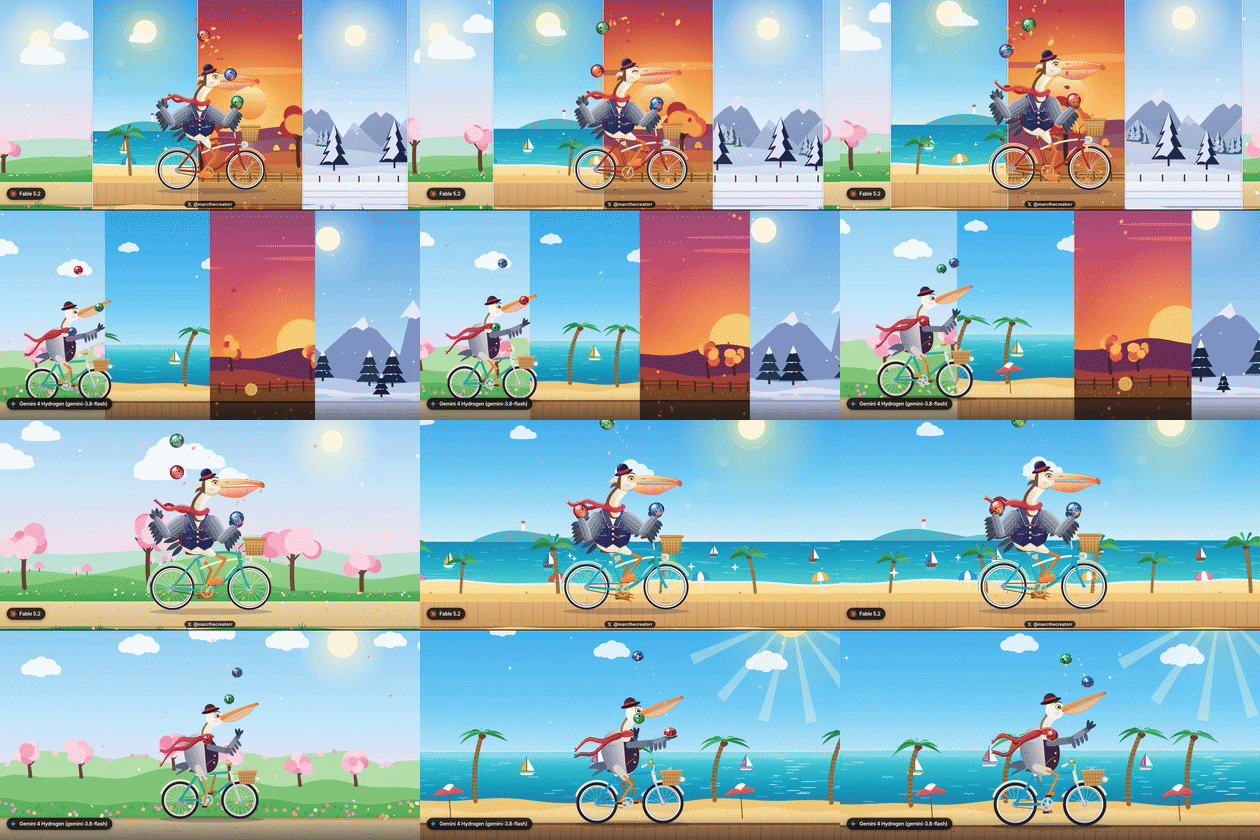
Fable 5.2 takes about 25 minutes, while Hydrogen only takes 5 minutes. With a 5-fold time difference, Hydrogen also delivers quite good presentation results.
All the above tasks demonstrate the multi-faceted capabilities of Hydrogen, from programming to 3D model production, and then to multimodality and aesthetics. There are other cases in Google's official release, showing multi-dimensional scenarios such as website production, document editing, data analysis and so on. Hydrogen has completed the tasks excellently.
Hands-On and Selection Suggestions
From 3D interactive scenes, physical graphics rendering to automated video editing, Gemini 4 Hydrogen proves one thing: In high-frequency practical engineering scenarios, models no longer need to pile up flagship-level parameters to obtain usability.
When daily programming and multi-step Agent automation become pay-per-use consumables, the combination of "close to the upper limit of the first tier + 2.5x speed + one-third cost" has more practical value than simply ranking first on the leaderboard. If your daily workflow is heavily dependent on Claude Sonnet 5.5 or GPT-6.1 Terra, Hydrogen already has the strength to directly replace them.
At present, Google has begun to gradually push Gemini 4 Hydrogen to Gemini app, Google Search, AI Studio and Gemini API. Free users can also experience it through automatic model selection in the Gemini app.
Disclaimer: This article is original by AI Front, does not represent the position of the platform, and does not constitute investment advice. Reproduction is prohibited without permission.
This article comes from the WeChat official account "AI Front" (ID: ai-front), authors: Fei Ye, Si Yue, editor: Si Yue, published by 36Kr with authorization.