First-hand Observations on the Front Line of the Robotics Industry: The Current Status of the Next Engine of China's Economy
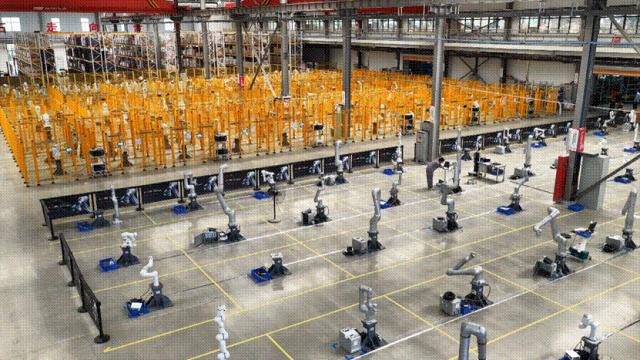
Last week, I traveled to Jining, Shandong, to visit the manufacturing plant of a publicly traded robotics company.
The company is called Rokae, listed on the Hong Kong Stock Exchange, and excels in the core control technology of robotic arms, making it an indispensable player in China's industrial robotics sector. B2B businesses have always prioritized profits over public fame, and with its listing on the Hong Kong Stock Exchange, its public visibility is naturally lower than that of frequently newsworthy names like Unitree, Fourier Intelligence (Shangwei New Materials).
The organizer of this event was JD.com, the e-commerce giant we are all familiar with, which is very likely to become the key infrastructure hub for China's future robotics industry.
In addition to visiting the factory, I also attended a symposium featuring four participants: JD Industrial, Rokae Robotics, Huaqin Technology, and CAS Motion. The four parties exactly represent four segments of the industrial chain — platform, ontology, OEM, and equipment.
Frontline operations reveal the invisible truths behind market hype. After half a day of visits, I recorded eight key observations.
01 The component segment is the first to achieve large-scale growth
JD Industrial released a set of data.
There are over 500 companies purchasing robotic components on the platform, including Unitree, Fourier Intelligence, Honor, and Huawei; there are more than 1,600 component suppliers, with over 300 new suppliers added just last month; there are more than 60,000 active selling products; the purchase amount of robotic components has increased by nearly 300% year-on-year.
The scale of complete machines is still growing behind. The component segment has already taken off.
There is a key detail here: about 30% of the purchases made by these 500 companies are completed "silently". Buyers do not contact customer service, do not inquire about prices, place orders directly, and assemble the products themselves after receiving the goods.
To put it plainly, this is the current survival state of laboratories and small teams, who even skip the step of price inquiry and assemble the parts themselves after delivery. In a sense, this proves that the industrial spark is still in the brewing stage: orders are scattered, private, and not subject to bidding.
JD.com itself is also pouring demands into this sector. The group-level plan is to purchase 3 million robots, 1 million unmanned vehicles, and 100,000 drones in five years; the retail platform has set an annual sales target of over 10 billion yuan for robots; more than 300 complete machine brands have already cooperated with JD self-operated channels. At the level of application scenarios, it also has 20,000 offline stores, 700,000 logistics employees, and self-owned factory production lines, which generate real working conditions on a daily basis.
A platform that is willing to act as a user first and then a channel proves that it believes the current bottleneck lies on the supply side.
02 Component manufacturers want standardization, while ontology manufacturers fear it
The head of the robotics business at JD Industrial put it very bluntly:
"Component manufacturers are extremely eager for standardization, because it can greatly improve efficiency and reduce costs. But ontology manufacturers are extremely averse to standardization, as their products will lose value once standardized."
This sentence thoroughly explains the current internal contradiction of the industrial chain.
Component manufacturers make profits by shipment volume. The more unified the specifications, the fewer molds they need, and the lower the cost per unit. Ontology manufacturers make profits through differentiation. The more unified the standards, the easier it is for their products to be replaced by peers, and the weaker their bargaining power becomes.
Therefore, the goal of "cost reduction" presents contradictions in the first half and second half of the robotics industry's development.
This also explains why industry standards have been slow to promote after years of advocacy: the parties that are actually promoting standards are platforms and component and equipment manufacturers, while the group with the loudest voices spends most of their time on publicity.
03 Domestic substitution has achieved volume growth, but not yet price advantage
Song Bin, Vice President of Rokae Robotics, shared two sets of data: the annual global shipment of industrial robots is about 650,000 units, of which the Chinese market accounts for 350,000 units, more than half of the total; the market share of domestic brands has risen from 15% in 2015 to about 55% in 2025.
Ten years, from 15% to 55%. This is the most familiar growth curve for Chinese manufacturing.
But we still need to see the actual situation clearly. In the four major core processes, domestic manufacturers are still catching up. The only category that has truly achieved overtaking on curves is collaborative robots — in this segment, there is basically only Universal Robots left overseas, and all the rest are Chinese companies.
Standard product tracks win by market share, while new category tracks win by first-mover advantage, and only the latter can obtain pricing power.
Rokae is a key player in this track. It was listed on the Hong Kong Stock Exchange in July, positioning itself as "the first stock of full-series intelligent robots"; its industrial product line covers a load range from 3kg to 300kg, with a reach from 475mm to 3.2m; its collaborative robot line covers a load range from 3kg to 45kg. It has deployed nearly 50,000 units globally, serving more than 1,000 customers. It ranks first in China in the light-load flexible collaborative robot segment, third among domestic multi-joint robot manufacturers, and seventh in the world.
Certification is another threshold. Rokae holds China's first national-level MTBF 80,000-hour fault-free certification, the first in China and the second globally IEC certification for medical surgical use, as well as CE and functional safety certifications.
The reason for its outstanding performance is essentially that industrial customers do not believe in empty stories, but only value the ability to solve practical problems.
04 The real bottleneck is data, and this type of data has never been collected before
Mr. Song shared a technical detail: running the same program with Gripper A, Gripper B and Gripper C does not require repeated programming.
Laypeople may find this unremarkable, but insiders know how significant it is. When the tool is replaced, the position of the robot end effector changes, and the trajectory of the same action has to be rewritten. Now the robot can adapt automatically, relying on its spatial model.
Going one level deeper is data. His exact words are: "In human history, we have never purposefully collected data of physical operations."
Large language models can capture decades of internet text, but there is no such internet for robot operation data. Polishing, gluing, screw locking, handling, and welding in factories are all skills mastered by veteran workers, which have never been recorded as trainable samples.
Therefore, two types of data are collected now: data collected on real machines, and data generated through simulation training (Sim2Real). The two types of data are marked with the same timestamp, with force sense, tactile sense and image aligned, and then fed into the world model after deviation correction.
The market implication of this technical statement is only one sentence: whoever owns the scenarios owns the data.
JD.com has 20,000 stores, 700,000 logistics employees and self-owned factories; Rokae has nearly 50,000 operating devices and more than 1,000 customers; Huaqin has production lines with an annual output of 200 million units of products.
These assets were called fixed assets a few years ago, but now they are called "mines".
05 The ChatGPT moment will most likely arrive in workshops earlier than in living rooms
The mainstream narrative is that the ChatGPT moment will come only when general-purpose humanoid robots enter households, serving tea and water, and taking care of the elderly.
The statement I heard at the frontline is the opposite.
Taking elderly care as an example, the model needs to cope with real-time changing scenarios, as well as handle safety and ethical issues, so the road ahead is the longest. The industrial side is the easiest to implement: the factory environment is standardized, the tasks are fixed, and what is needed is to learn the changes in a certain process, not to be good at everything.
An omniscient and omnipotent model is useless here. What is needed is a model that is sufficient for a specific industry and a specific end side.
This judgment deserves attention. The mainstream narrative places hopes on general-purpose models, while frontline practitioners devote their energy to end-side deployment.
Rokae's customer list already speaks for itself: Schaeffler uses its wheeled humanoid robots in its joint module automated production line; Xiaomi uses its industrial robots in its dark factories; Foton Cummins has deployed more than 100 sets of its products; Honglu Steel Structure uses its robots for steel structure welding, reducing processing costs to 2/3 of the industry average; its customers also include Bosch, ZTE, Seres Power, etc.
There are no audiences in the workshops, only the real demands of China's manufacturing industry. Whether a robot is usable and easy to use can be tested within one day.
06 At the current stage, factories prefer wheeled robots over humanoid robots
Mr. Song said a very plain sentence in the factory: since ancient times, how many master craftsmen work with their feet?
The ground in industrial sites is flat, and the process relies on the cooperation of hands, eyes and brains. Bipedal robots not only increase costs but also instability in factories, and the input-output ratio is not cost-effective.
Rokae's development path is divided into three stages: fixed installation, that is, fixed base; then composite robots, which are AGV chassis equipped with robotic arms; then wheeled dual-arm robots.
Composite robots have been deployed on site at Goertek and Foxconn. One composite robot can take care of 10 machine tools at the same time, raising the efficiency from 1-to-1 to 1-to-10.
Wheeled dual-arm robots go one step further: with built-in cameras on the head, they can handle both handling and quality inspection.
When factories calculate the accounts for purchasing robots, they measure the order of magnitude of efficiency improvement. Whether the robot looks like a human does not affect this calculation for the time being.
07 The logic of manufacturing robots is the opposite of that of manufacturing mobile phones
When Mr. Wu from Huaqin said this sentence, I didn't take it seriously at first, but I understood it after listening to the whole explanation.
The SMT automation rate of a mobile phone production line can reach more than 95%, and the assembly line has an automation rate of more than 70%, so there are almost no workers along the 300-meter line. Mobile phones are produced in large quantities after the design is finalized, with tens of millions of units for one model.
Robots are a different story: each unit may be different, and customers may only order 2 or 3 units, at most dozens or hundreds of units.
Therefore, a 300-meter mobile phone production line has been split into nearly 20 Cell lines. Each Cell line assembles one module, and after assembly and testing, the modules are sent to the main line for final assembly.
From the perspective of investment, this action is very expensive at the current stage, but it must be done. The large-scale production logic of consumer electronics cannot be applied to the robotics industry for the time being, but the quality system can be reused: MES, data traceability, and test cases can be reused, while production capacity and beat cannot.
Testing is also different. Consumer electronics products undergo functional tests in a fixed environment; robots need to be equipped with test environments according to the customer's on-site conditions. Whether it is a bipedal robot or a wheeled dual-arm robot, the aging test cases are different due to different usage scenarios.
At present, many consumer electronics companies regard robots as a new growth curve, betting that "the stability of mass production" will sooner or later become a core threshold.
08 Three unsolved knots: cost, standardization, and overseas expansion
The following frontline insights come from Dr. Yan from CAS Motion.
The first knot restricting the robotics industry lies in the processing technology.
For example, lead screws are currently manufactured by grinding, which can achieve high precision but cannot reduce costs. When domestic suppliers supply products to top international enterprises, "the quoted cost may not even cover their production cost".
The solution is to change the process from grinding to turning, or use laser heat treatment to control the deformation. CAS Motion has built the world's first fully automatic roller lead screw production line for this purpose: the beat is 30 seconds per unit for lead screws, 25 seconds for coreless motors, 30 seconds for joint modules, and 50 seconds for frameless torque motors, which can be reduced to 30 seconds if necessary.
The second knot appears before the convergence period of the industry.
There are currently four technical routes for dexterous hands — linkage, tendon rope, four-cylinder, and small joint module, none of which has converged, and a single dexterous hand is sold for 200,000 to 300,000 yuan. The strain gauge flexible wires in six-dimensional force sensors are too many to support automated assembly, so they can only be assembled on test benches.
There are no mandatory standards for robots at present. Therefore, the industry has adopted the automotive industry's TS16949 and potential failure mode analysis for quality management.
The fact that an industry has to borrow standards from another industry to manage its quality speaks volumes about its maturity level.
The third knot lies in the service radius.
A single robotic arm manufacturer cannot succeed alone, it needs to cooperate with peers and take a large platform to go global. Overseas markets demand lawn mowing robots, public cleaning robots, and performance robots — they have large yards, high labor costs, and are willing to pay for labor-saving products. The scenarios in China are completely different.
This also explains why JD.com is building 80 ROBOBASE industrial parks and training 100,000 after-sales engineers. When robots go overseas, half of what is sold is the iron hardware, and the other half is the promise that "someone will repair it if it breaks".
09 Conclusion
The statement that "robotics is the next engine of China's economy" has been widely mentioned this year. From the frontline perspective, this engine has already ignited, but the transmission shaft in the middle is still running in.
China has the most complete industrial categories in the world, which will be our biggest advantage in this round of robotics industrial revolution.
But when the speed of this engine will rise depends on whether the 30-second beat in the workshop can be further reduced to 20 seconds. Who stands in the C position at the press conferences we usually attend does not mean much.
How many processes a robotic arm has to go through from parts to finished products is very difficult for ordinary people to figure out even after a visit.
30 seconds, 25 seconds, 50 seconds. These numbers running in frontline factories are not easy to explain, nor are they suitable for being put into PPTs, but they are the real tachometer of this engine.
Every scale on the tachometer represents the real progress of China's robotics industry.
This article is written based on public information, for information exchange only, and does not constitute any investment advice.
This article is from the WeChat Official Account "Jinduan" (ID: jinduan006), written by Chen Jin, and authorized for release by 36Kr.