New Showdown Among the Three Home Appliance Giants in the Computing Center Sector
From indoor air conditioners to AI temperature control, it seems to be a natural and logical development path. Leveraging their accumulated experience over the years, home appliance enterprises have extended their business reach to the AIDC liquid cooling track.
Driven by the explosive demand for high-intensity training, the power density of AI chips has risen sharply. The power consumption of a single cabinet has jumped from the traditional 2-8kW to 20-50kW, and is expected to exceed 100kW in the future. When thousands of these chips are deployed in data centers, the surge in power density is dramatically amplified at the cabinet level.
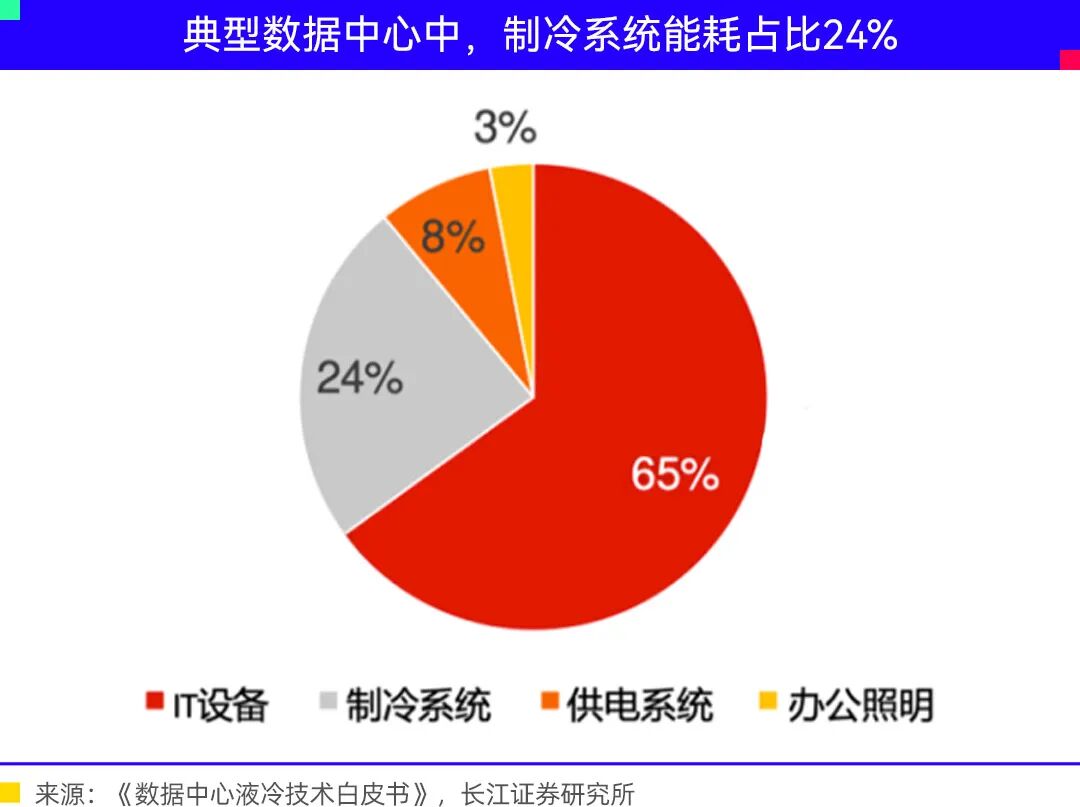
This has made AIDC a veritable "power-eating behemoth", and heat dissipation has become the second largest power consumption item second only to IT equipment.
In overseas markets, companies including Johnson Controls, Trane Technologies, and Carrier Global have all stepped into the AIDC heat dissipation field; in China, the three leading home appliance giants Midea, Gree, and Haier have all set their sights on this booming and broad track.
Affected by the downward real estate cycle, the traditional home appliance industry has entered a stock competition phase, with the overall market size continuing to shrink. The rising copper price is also constantly eroding industry profits, and even expanding losses. Home appliance giants have few other options besides diversified transformation. In this regard, neither Gree's new energy business nor Midea's industrial robot business can compare with the historical opportunity brought by AI.
Divergence
The market climate of China's home appliance industry continues to cool down as winter approaches.
According to statistics from AVC (Ovi Cloud), in the first three quarters of this year, the total retail sales of home appliances in China reached 604.1 billion yuan, down 10% year on year. The specific performance of enterprises is highly differentiated: among 29 listed home appliance enterprises, only 4 are profitable with positive net profit growth, and the performance of the three major white goods giants is generally under pressure.
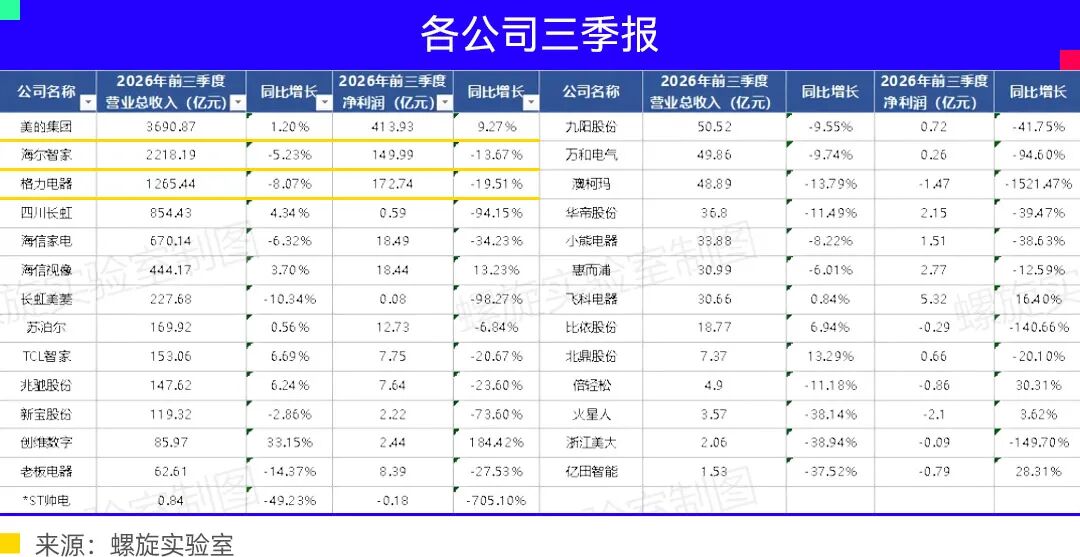
If we exclude Feike Electric, the leading razor manufacturer, Hisense Visual, a black goods enterprise, and Skyworth Digital, which mainly relies on smart terminals, Midea is the only white goods enterprise on the list that has truly achieved positive profit growth.
A detailed breakdown of Midea's business portfolio shows that in the first three quarters, its Building Technologies segment and Robotics and Automation segment generated revenue of 30.9 billion yuan and 24.9 billion yuan respectively, both growing by 10% year on year, far exceeding the overall growth rate of 1.2%.
In particular, Building Technologies has become the largest business segment outside the core smart home business, and its gross margin reached nearly 30% in the first half of the year, making it the most profitable department within the group.
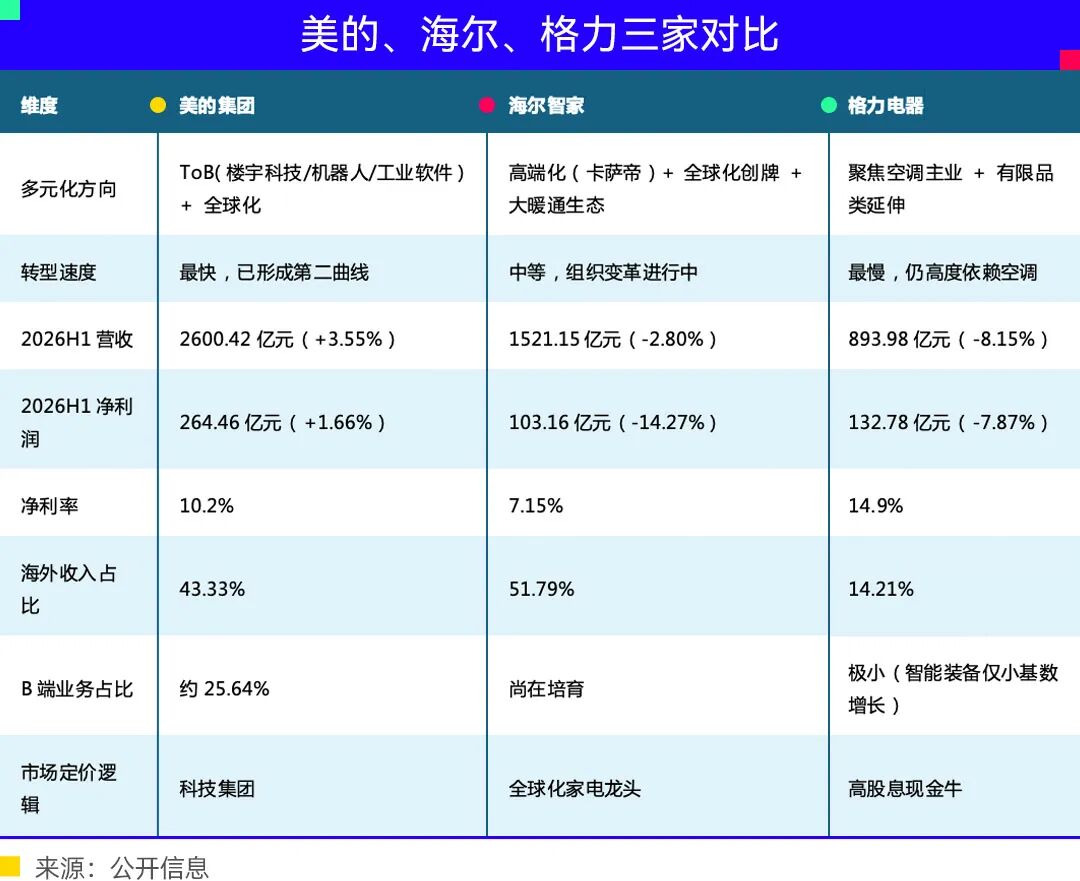
By 2026, after years of exploration, the three home appliance giants have moved from the same track to quite different development paths, and the differentiation of their enterprise performance has become increasingly prominent.
As Fang Hongbo emphasized very clearly at the 2026 semi-annual performance briefing, "ToC business is the moat for our current survival and development, while ToB business is the future guarantee for us to go through cycles."
Since taking over the leadership from He Xiangjian, Fang Hongbo has been leading Midea to transform from a traditional home appliance manufacturer to a diversified global technology enterprise. Although the previous acquisition of KUKA robots brought certain financial burdens, after surviving the most difficult years, this transaction has gradually been digested into valuable new assets.
At present, with the ToB business including commercial and industrial solutions accounting for 26.8% of total revenue in H1, Midea has withstood the risk of decline in the overall white goods market and demonstrated strong growth resilience.
In contrast, Haier and Gree still rely more on their home appliance business.
Haier adopts a development strategy that integrates global brand building, high-end positioning and ecological layout among the three giants, and its overseas revenue proportion has reached as high as 52%, the highest among the three enterprises. Through the acquisition of international brands such as Sanyo Home Appliances and GE Appliances, as well as its self-built high-end brand Casarte, Haier has built seven global high-end home appliance brands, forming long-term high-barrier competitiveness.
For Gree Electric, after the completion of the management buyout, HVAC remains its absolute core business. In the first half of the year, consumer electrical appliances accounted for as high as 83% of its total revenue, while the overseas revenue contribution was only 14%, and the air conditioning business contributed most of its revenue. Gree has been seeking diversified transformation for many years, with some moves being high-profile and others carefully planned, but most of them failed to gain real momentum.
For many years, the secondary market has regarded Gree as a cash cow stock with "high dividend, high barrier but low growth", and has not had much expectation for its growth.
However, the current explosive growth of AI infrastructure has brought an epoch-making opportunity to HVAC enterprises represented by Gree. Temperature control has become the second largest energy consumption item in data centers, second only to IT equipment. With the expansion of computing power infrastructure, the investment value of this segment has begun to be re-evaluated.
CICC predicts that the global liquid cooling market for intelligent computing centers will reach about 1147 billion yuan this year, with a year-on-year growth of 273%; Soochow Securities estimates that the global liquid cooling market will be close to 1500 billion yuan next year. In comparison, the traditional air conditioning equipment industry only has a CAGR of 4%.
The temperature control system itself is the inherent advantage of HVAC enterprises. Now, the three home appliance giants have once again arrived at the same new starting point.
Path
Consistent with their transformation ideas, the three white goods giants have taken different paths to enter the AIDC temperature control field.
Relying on self-owned production capacity, full-stack self-development and ecological partnership, Midea has quickly become a powerful player in this track. At this year's OCP Global Summit, Clivet, under Midea Building Technologies, won the Excellent Technical Sharing Award for its new generation of magnetic suspension centrifugal compressors and full-link liquid cooling solutions.
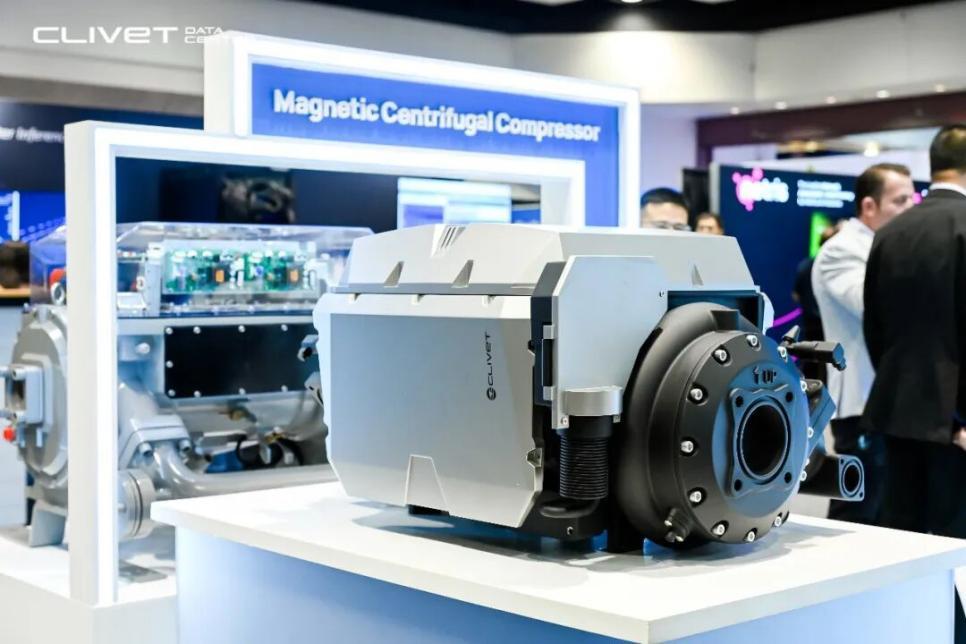
Midea has thus been included in the list of ecological partners of NVIDIA's Vera Rubin platform, and its temperature control solutions have been incorporated into NVIDIA's next-generation AI supercomputing reference architecture.
This means that Midea's AIDC solutions have received NVIDIA's endorsement. After certification, the equipment can be slightly modified and embedded as standard modules into NVIDIA's next-generation AI base. This standardization capability may be more valuable than the leading parameters of a single piece of equipment.
Behind the qualification certification is the support of large-scale production capacity. The Shunde Liquid Cooling Intelligent Manufacturing Base with a total investment of over 1 billion yuan was officially put into operation in March, focusing on core components such as magnetic suspension main units and full-series CDU (Cooling Distribution Unit); Midea Building Technologies' four liquid cooling chains in China (Shunde, Chongqing, Hefei, Longyan) have a total annual production capacity of 100,000 units of equipment including CDU, magnetic suspension cold sources, energy storage air conditioners, and air walls.
Downstream customers have placed a large number of orders. Midea won the bid for China Unicom's communication room air conditioner centralized procurement with a value of over 200 million yuan, and was shortlisted for 70% of the share of China Mobile's new round of low-pressure chiller centralized procurement project. It also cooperated with Alibaba Cloud to develop liquid cooling temperature control solutions for AI clusters, and Midea's presence can also be seen in the liquid cooling intelligent computing project of China Telecom in the Guangdong-Hong Kong-Macao Greater Bay Area.
Gree chose to enter the liquid cooling track through capital cooperation.
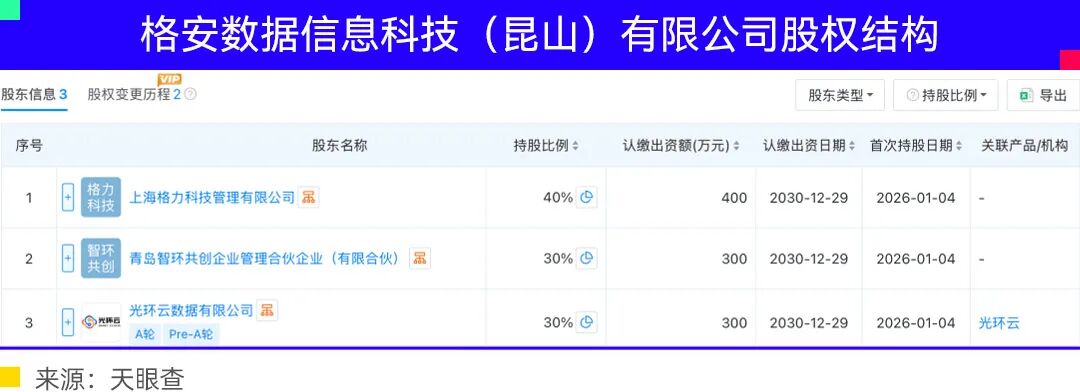
Earlier this year, Gree and GDS (Guangzhou Rings Technology) established a joint venture named "Gree An Data Information Technology (Kunshan) Co., Ltd.", aiming to promote Gree's green computing equipment production base, focusing on liquid cooling systems, high-performance computing power cooling facilities and other products.
GDS is a veteran AIDC operator in China. At present, its intelligent computing scale exceeds 4000P, and its 2026 target is to expand to 10000P. By co-developing liquid cooling solutions with GDS, Gree can skip the lengthy customer certification process and directly connect downstream procurement demands to the joint venture.
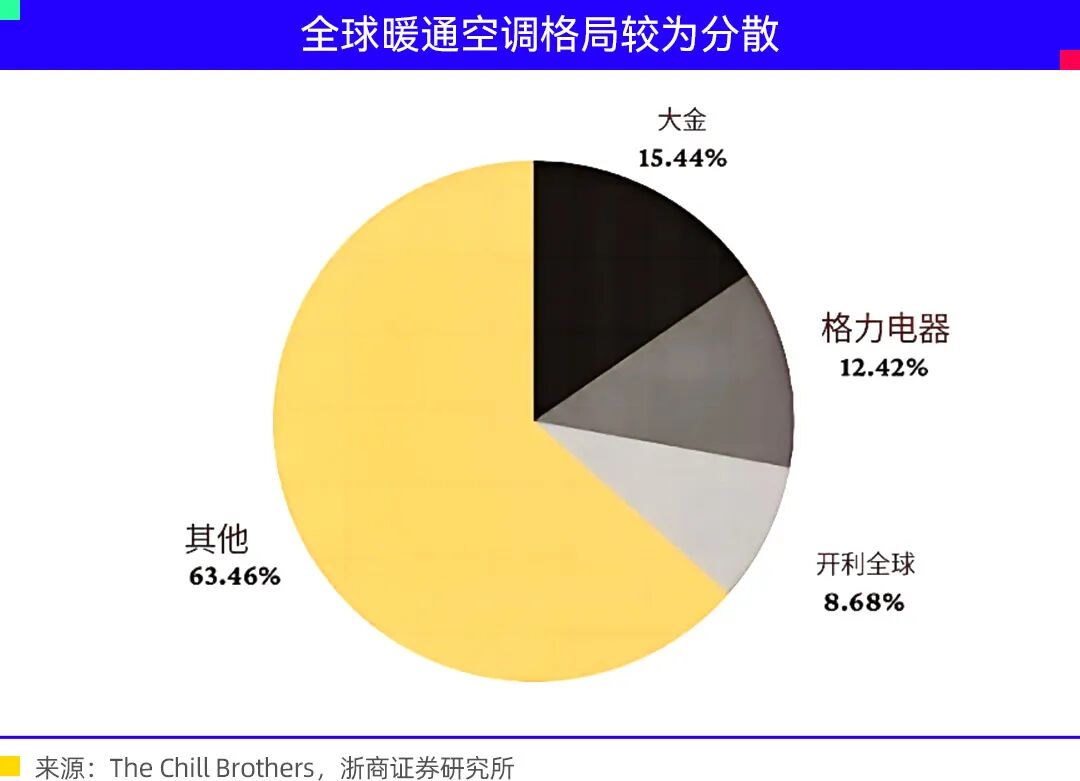
Gree's status and technical advantages in the HVAC field are obvious. After years of deep cultivation in the refrigeration and thermal management field, it has mastered key technologies such as cold plate liquid cooling systems and phase change cooling systems. Its full-stack cooling solutions can achieve the energy-saving target of PUE ≤ 1.15, and it has previously successfully delivered a number of key projects including the Yangtze River Delta Intelligent Computing Center of China Unicom and the Ulanqab Intelligent Computing Center.
Haier has adopted a global expansion strategy. In May, it invested over 1 billion yuan in the Rayong Industrial Park in Thailand to deploy data center equipment such as magnetic suspension cold sources, CDU, and intelligent air walls. At the same time, it integrated its Leishen Computing Power, Nahui New Energy and large HVAC business to form a full-chain "computing-power-cooling" global development layout.
In the third quarter, Haier's air-cooled magnetic suspension products achieved a breakthrough in North America, and data centers in Malaysia and Singapore have adopted Haier's air cooling solutions.
As a new business segment, the data center business is developing rapidly. According to available data, the sales revenue of this department in the third quarter was nearly 5 times that of the same period last year, which is a further increase after the 50% growth rate in the first half of the year.
To this end, Haier Smart Home has set the target of "expected 150% year-on-year growth for the whole year, and creating 10 billion yuan revenue in three years", which fully demonstrates the huge growth space of this track.
Convergence
Despite their different development paths, all three white goods giants have heavily invested in the same technical foundation - magnetic suspension.
In 1993, the Turbocor team in Melbourne, Australia, launched the R&D of oil-free magnetic suspension centrifugal compressors, starting the commercialization process of this technology. In 2004, Danfoss first integrated and then fully acquired Turbocor, becoming the undisputed leader in this track.
Up to now, Danfoss occupies 70% of the global market share of magnetic suspension compressors, with cumulative shipments exceeding 160,000 units, and its domestic market share in China is also close to 50%.
However, due to the explosive AI demand, Danfoss is facing tight production capacity, and it is only a compressor supplier rather than a complete equipment manufacturer. The three domestic home appliance giants have caught up by virtue of their self-developed magnetic suspension compressors and full-stack technologies.
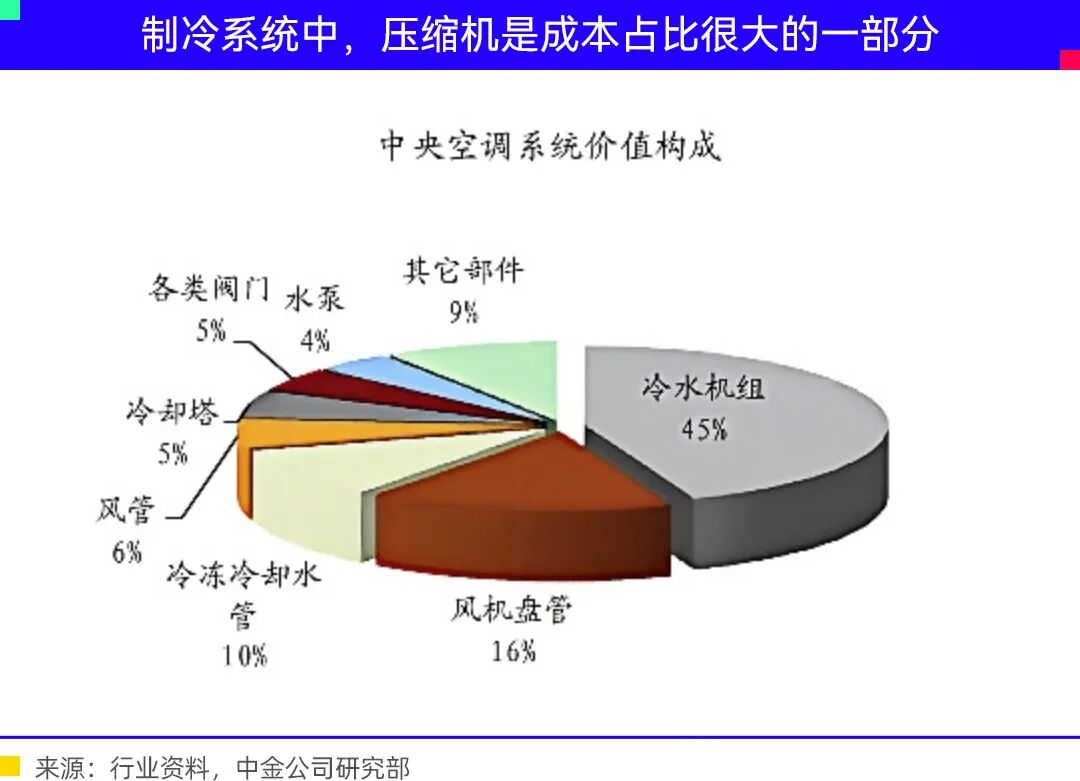
It should be noted that the compressor is the only energy source driving the refrigeration system, and its operating efficiency determines the performance output of the entire system. Data shows that the cost of refrigeration compressors accounts for about half of the total cost of chillers.
Therefore, the compressor has become the link with the highest value and technical barrier in the primary-side cold source. Home appliance giants taking magnetic suspension as the technical foundation to build full-stack capabilities can build a solid competitive moat.
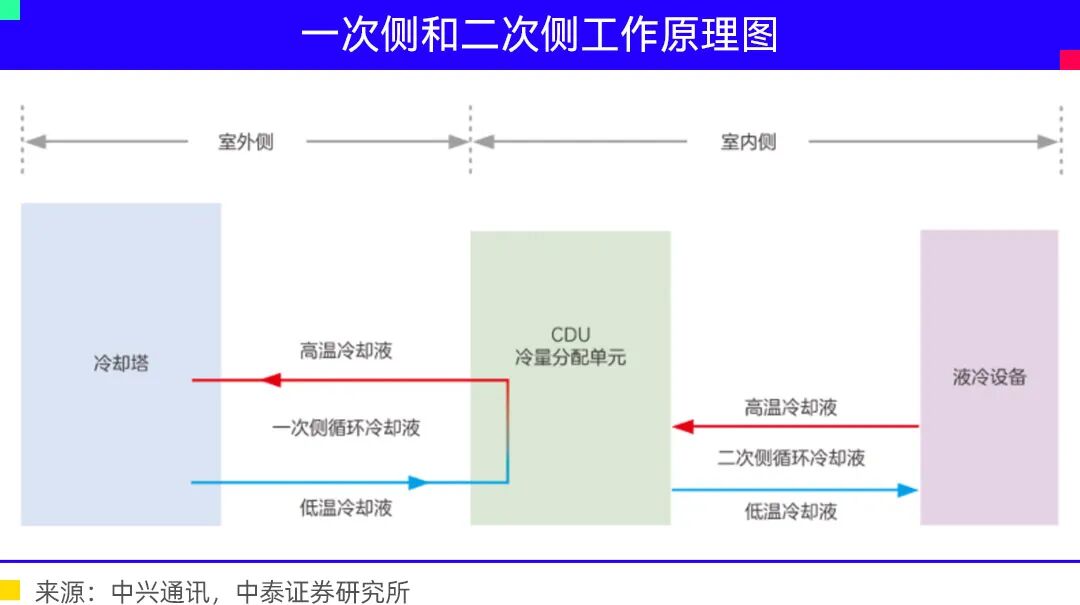
The refrigeration system can be divided into the primary side and the secondary side. The primary side is the large cold source loop, which relies on magnetic suspension chillers and cooling towers for refrigeration, and is responsible for finally discharging heat to the outdoors; the secondary side is the cabinet loop close to the GPU, which is isolated by CDU heat exchange.
At present, domestic manufacturers are mostly concentrated on secondary-side end components, such as Inwin, Shenling Environment, and Gaolan, which mainly focus on CDU, connectors, quick connectors and other products.
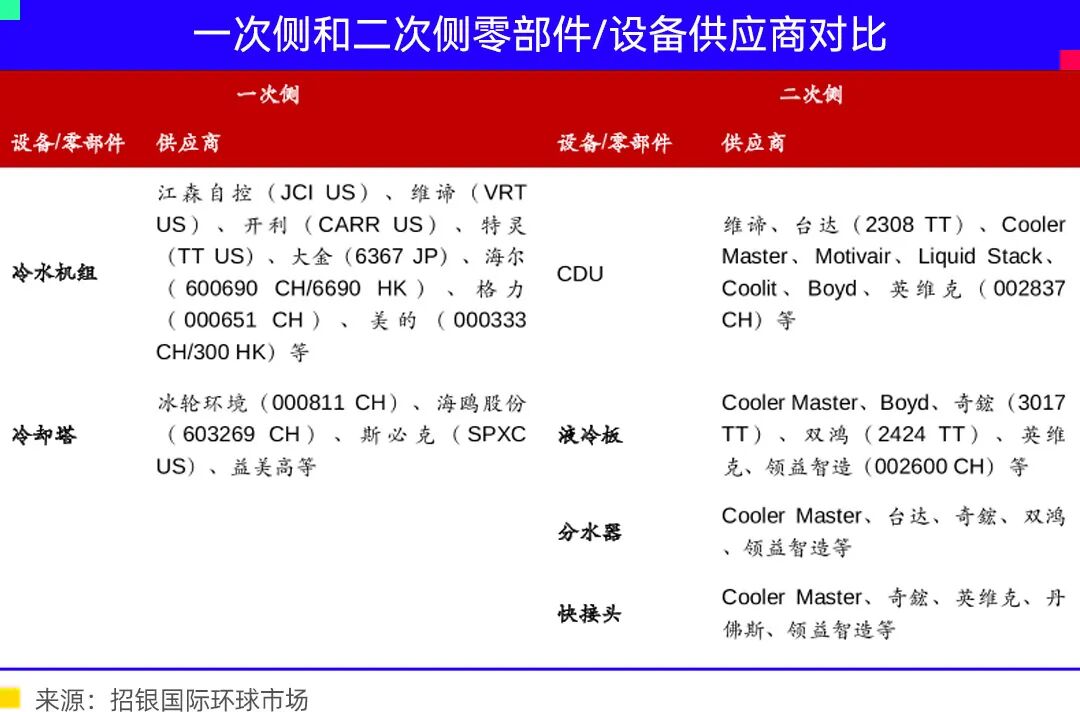
In contrast, the three giants have primary-side cold source capabilities. Starting from the core of cold sources, they jump out of the red ocean of competition of single-category products and seize the "key point" of AIDC efficiency.
For example, Haier led the formulation of China's first national standard for oil-free suspension centrifugal chillers, and its CDU supplementary cooling magnetic suspension product co-developed with leading internet companies has been put into use. In a national supercomputing center, 27 Haier magnetic suspension units help