Did Anthropic drive Microsoft crazy overnight? Claude breaks into the core domain of office software: it can attend meetings independently, create spreadsheets and generate PPTs.
Over the past few years, AI large model companies have been competing to deliver better code generation performance and answer more complex questions. Today, this competition has shifted to a far larger and more mature market: enterprise office software.
Just now, Anthropic released a series of new products for enterprises and knowledge workers on X, including Claude Meetings, Claude Whiteboards, Claude Sheets, and Claude Data.

The most high-profile offering is Claude Meetings. It allows Claude to join video conferences as a visible participant, looking up information, answering queries, formulating plans, and even directly handling tasks proposed during the discussion while people are working through issues.
This means AI is no longer just an assistant responsible for sorting out meeting minutes after a meeting concludes, but has begun to become a "digital colleague" that truly participates in work.
At the same time, Anthropic has also integrated functions such as office whiteboarding, spreadsheets, and data analysis into Claude. Users do not need to repeatedly copy and paste content between different software tools, and can let AI turn meeting discussions into project plans, budget tables, and visual reports.
This series of moves takes place at a delicate point in time. At the end of September, OpenAI launched collaboration features similar to an office suite; in early November, Meta launched Spaces for Muse Agent, which can generate small applications instantly.
Now, Anthropic has also joined the competition.
Anthropic, which once opened up the developer market with its AI programming tools, is now turning its attention to a broader group of enterprise employees. Traditional office software giants such as Microsoft and Google are also facing a group of competitors that are trying to restructure workflows starting from the AI entry point.

1 Claude breaks into the core territory of office software
Compared with Claude Meetings, the other several features launched by Anthropic this time further reveal its intention to enter the traditional office software market.
The first one is Claude Whiteboards.

In the past, people could brainstorm with Claude and ask the AI to help organize their ideas, but if they needed to continue the discussion with colleagues, they usually had to copy the results to other collaboration tools.
Now this step can be completed directly within Claude.
Claude Whiteboards provides a digital whiteboard that can be co-edited by team members and AI. Users only need to describe an unclear project idea to Claude, and it can organize the discussion content into a visual workspace, automatically sorting out timelines, task owners and deadlines.
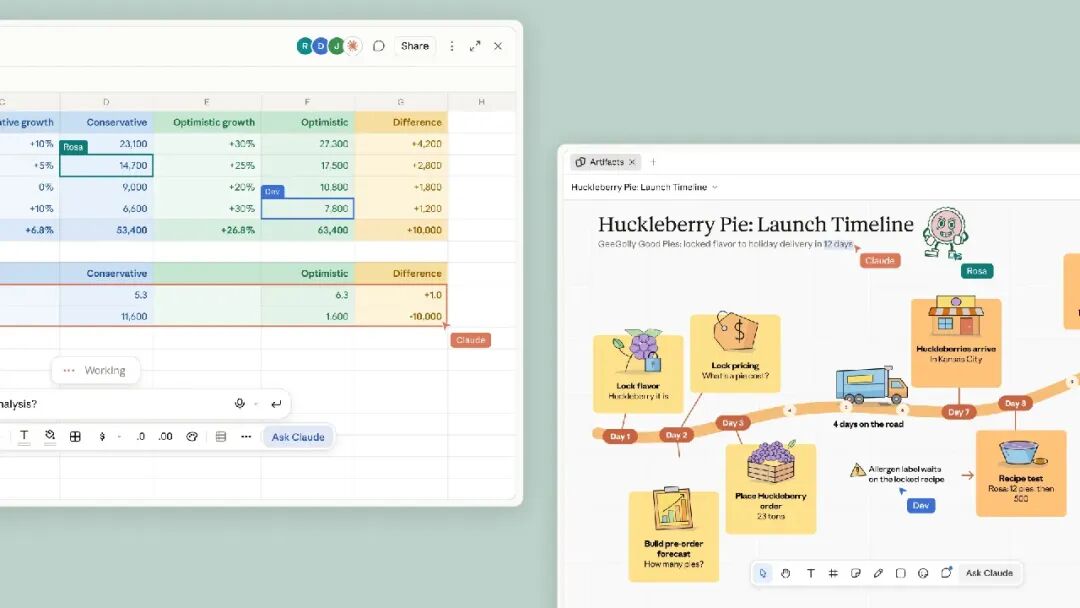
For example, during a project retrospective, team members can directly write their respective observations on the whiteboard, then Claude will categorize them by theme and draft follow-up action items for different members.
If users want to further discuss a certain part of the whiteboard, they can also select the corresponding content and directly ask Claude to explain or modify it.
After the discussion, Claude can convert the whiteboard content into documents or presentations, which can also be handed over to collaboration tools such as Lucid and Miro for further editing.
In addition, Whiteboards and Meetings can be used together to promote the synchronous progress of meeting discussions and whiteboard content.
Another new product, Claude Sheets, directly enters the spreadsheet field.
Users can ask Claude to create a marketing campaign tracking sheet or a recruitment budget. Claude will then generate a spreadsheet with multiple worksheets, formulas, formatting settings and drop-down menus.
Different from simply generating an Excel file, Claude Sheets allows team members and AI to collaborate continuously in the same spreadsheet.
Claude can modify cells directly and explain the content of each modification, making it convenient for the team to track changes.
However, Anthropic also acknowledges that Sheets currently only provides relatively basic spreadsheet capabilities. For users who need full Excel functionality, they can export files to XLSX or CSV, or use Claude for Excel.
Claude Whiteboards and Claude Sheets are currently open to paid users in beta form, supporting web, desktop and mobile devices.
At the same time, the data analysis product formerly known as Claude Dashboards has been officially renamed Claude Data, and has ended its overall testing phase to be officially open to paid users.

This feature allows enterprises to connect Claude to data systems such as Snowflake, Salesforce, and BigQuery, then ask business questions in natural language.
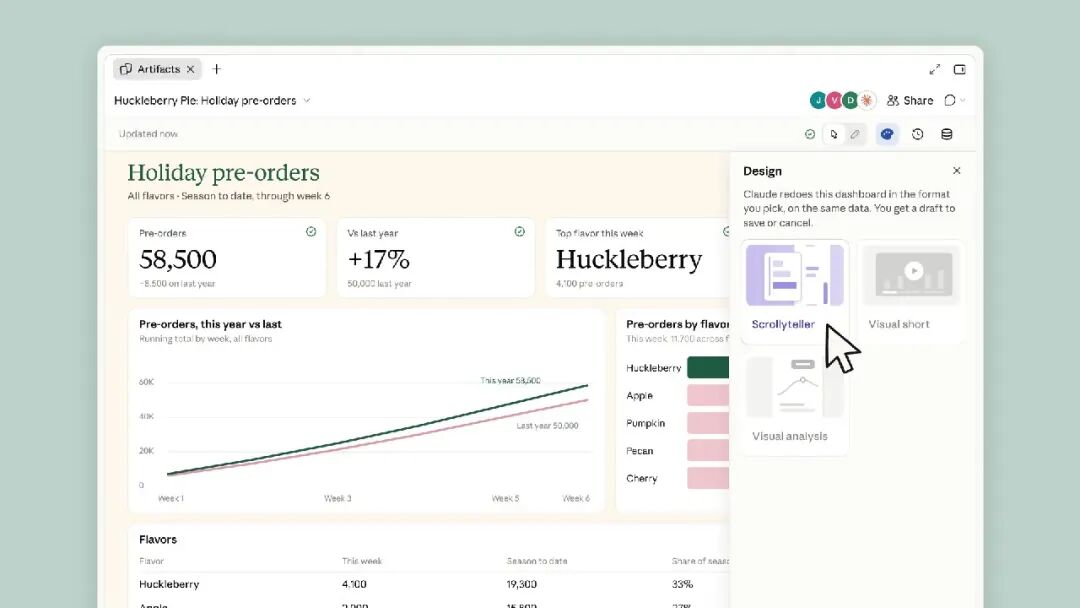
For example, managers can directly ask about sales changes in a certain quarter, and Claude will then generate dashboards, data stories, and even short videos with explanations based on the connected data.
It is worth noting that Anthropic has also introduced metric queries certified by the data team, as well as features such as real-time sharing.
For enterprises, these features may be more important than automatically generating charts. If different departments use data with inconsistent calibers, even if the charts generated by AI are beautiful, they may reach conflicting conclusions.
However, the certified query and real-time sharing features in Claude Data are still in the testing phase, which cannot be equated with the official full launch of the product.
Another update released by Anthropic this time is Interactive Connectors.
In the past, when enterprise users connected third-party applications in Claude, they mainly asked AI to retrieve information or call certain functions. Now, Anthropic begins to allow partners to embed full application interfaces into Claude.
For example, while talking to Claude, users can directly open applications such as Adobe, Atlassian, and HubSpot, view content and make edits in the same workspace, and ask Claude to assist with operations.
Anthropic says Claude Marketplace already offers more than 9,000 connectors and plugins, including community-developed tools.
This number is noteworthy, but it does not mean that more than 9,000 applications already support full interface embedding. The newly launched Interactive Connectors capability still depends on the adaptation status of specific partners.
The product logic behind this feature is very clear: Anthropic does not necessarily need to redevelop all enterprise software, but tries to make Claude a unified entry point for accessing and operating these software tools.
For users, in the past, a complete business process may require switching back and forth between meeting software, document tools, spreadsheet systems, CRM and project management platforms. Now, Anthropic hopes to concentrate these links in one AI workspace as much as possible.
But at the same time, this also raises new questions — when AI not only reads enterprise data, but can directly modify content in third-party systems, enterprises need to consider who has operation permissions, which modifications must go through manual confirmation, and how to trace and recover after operational errors. These issues will directly affect whether enterprises are willing to hand over key workflows to AI.
2 OpenAI, Anthropic, Meta enter the market collectively, AI companies target traditional Office
Anthropic's large-scale update of office features this time is not an isolated event.
On September 29, OpenAI launched a series of new products for workplace users at DevDay. Among them, Space is a shared workspace inside ChatGPT, where users can collaborate with colleagues and AI Agents to complete work; Pages allows users to directly write documents, research materials, create charts and visual content within ChatGPT.
OpenAI also announced collaborative slide features, allowing users to create presentations through natural language, and enabling multiple people and Agents to modify together.
Interestingly, these features have obvious overlaps with the work scenarios covered by Microsoft Word, PowerPoint and Google Workspace.
A few days ago, Meta also further expanded the capabilities of Muse Agent.
On November 6, Meta launched Spaces, allowing users to describe their needs, then Muse automatically creates corresponding project spaces or small applications. Users can ask it to make activity trackers, travel planning tools, and even home device control panels.
As more AI companies enter the office field, the competitive landscape has also changed. In the past, large model companies mostly provided AI capabilities for traditional software vendors, who integrated the models into their respective products. Now both OpenAI and Anthropic have begun to offer documents, spreadsheets, presentations and collaborative workspaces on their own.
Mature office software has accumulated a large number of enterprise customers, complex permission management systems, and long-term usage habits formed around document collaboration. But AI companies are trying to bypass the operation paths of traditional software, allowing users to complete work directly through natural language. The key to this competition may no longer be just which application AI is integrated into, but who can become the first entry point that users open when they start working.
3 On the eve of Anthropic's listing, why did it suddenly accelerate to seize the enterprise office market?
There is another noteworthy background for this product launch: Anthropic is in a critical period of advancing its IPO.
On November 10, Anthropic launched the roadshow for its proposed initial public offering. Reuters reported that the company plans to raise up to about $644 billion through this offering. Just as the capital market is beginning to re-examine the input and return of AI enterprises, Anthropic has accelerated the layout of commercial products.
In fact, compared with chatbots targeted at individual consumers, Anthropic has already built strong market recognition in the AI programming field.
Claude Code allows developers to gradually move from manually writing every line of code to describing goals and reviewing the results generated by AI.
Now, Anthropic hopes to replicate this working method to other professional groups.
In its official blog, Anthropic also clearly stated that its goal is to extend the work method changes that Claude Code has brought to developers to other teams.
For enterprise users, what is really valuable may not be how many words AI can write, but whether it can directly participate in the work that happens every day. Finance staff need to organize budgets, sales staff need to update customer information, project managers need to track progress, and managers need to understand business data.
These tasks do not have a clear single end point like chat Q&A, but exist in continuously updated business processes. Once AI can enter these processes, it will have the opportunity to transform from an occasionally used assistant to a part of the daily operation of the enterprise.
This is also the market that Anthropic, OpenAI and traditional office software giants are all competing for.
The office software of the future may not be completely replaced by AI chat interfaces. But it is certain that as model capabilities gradually penetrate into meetings, documents, data and business systems, AI companies are no longer satisfied with only being smart plugins for traditional software. They are beginning to compete for the way enterprise work is organized, and the primary entry point that employees use for software every day.
For Microsoft, Google and the entire enterprise software industry, the real challenge may have only just begun.

References:
https://claude.com/resources/articles/more-ways-to-work-with-claude-sheets-whiteboards-and-interactive-connectors
https://ca.finance.yahoo.com/news/anthropic-launches-meetings-whiteboards-sheets-data-ahead-of-ipo-190548601.html
https://techcrunch.com/2026/11/10/anthropic-launches-claude-meetings-to-turn-workplace-discussions-into-plans-and-tasks/
This article is from the WeChat Official Account "InfoQ" (ID: infoqchina), written by Dong Mei, and published by 36Kr with authorization.