Just now, Gemini 4 Carbon has been fully released globally, and 6.5 million lines of mathematical proofs completed over 4 weeks have verified the "Signal Security".
Just now, Google DeepMind announced that Gemini 4 Carbon is officially launched today, billed as "Google's most capable model to date", specially designed for complex, long-cycle tasks. It can allocate more inference resources to deeply explore problems, and complete complex tasks in software engineering, cybersecurity, knowledge work and scientific research through continuous execution, inspection and correction.
Compared with the previous Gemini 4 Argon, Carbon has a clearer positioning: it is not satisfied with quickly giving an answer, but is willing to spend more time and computing resources to truly complete a complex task.
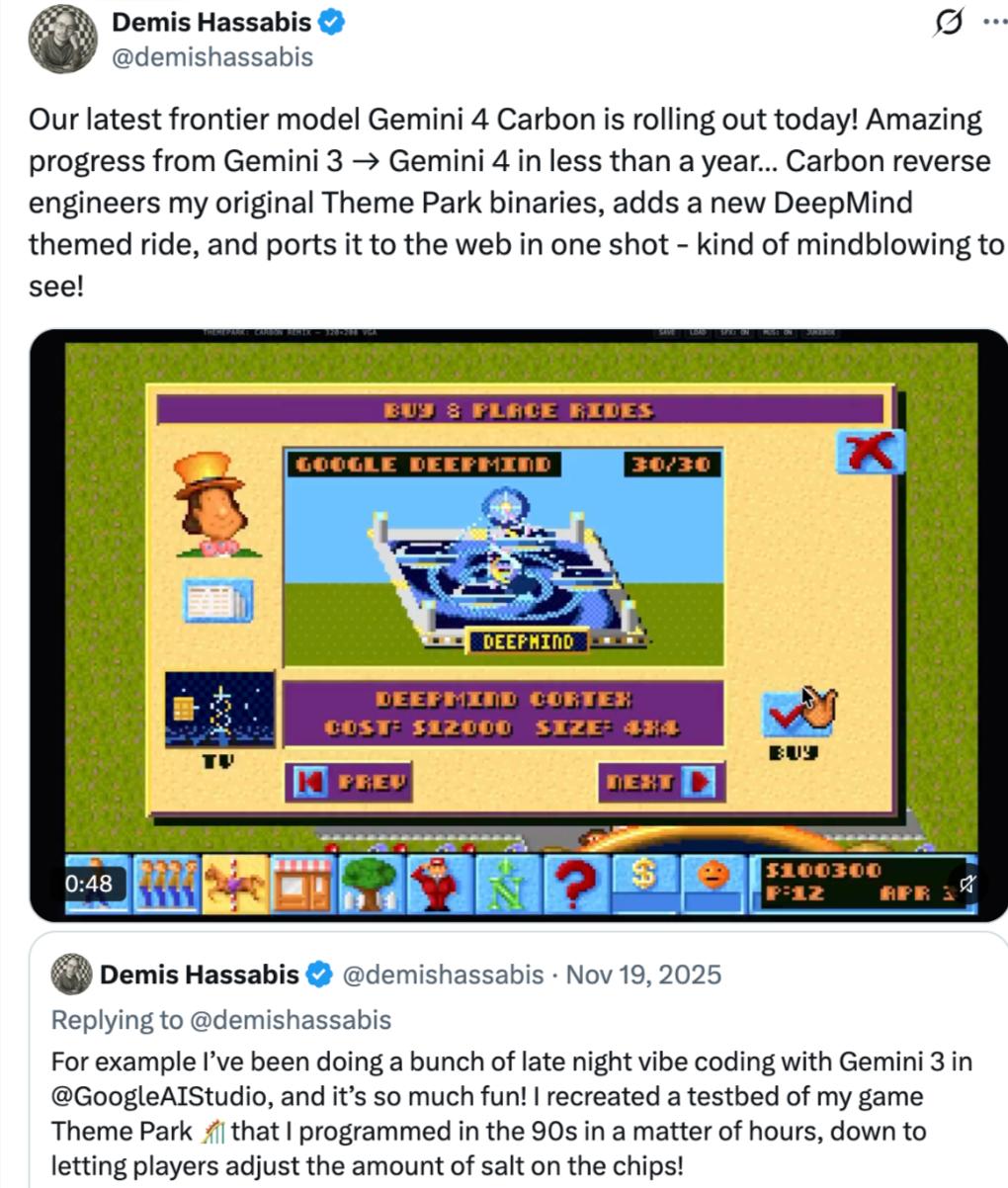
Demis Hassabis gave an intuitive case: "Carbon reverse-engineered the binary file of the *Theme Park* game I originally developed, added a new DeepMind-themed amusement facility to the game, and ported the entire game to the web platform in one go."
Then he attached a video comparison made with Gemini 3 at the same period last year, and exclaimed: "In less than a year, Gemini has evolved from version 3 to 4, the progress is really amazing……
Seeing all this with my own eyes really feels incredible!"
And such powerful capabilities are now available to users all over the world! The official stated that starting from today, Gemini 4 Carbon will be open through the following channels:
- Consumers: Google AI Ultra subscribers can use it through the Gemini App and the AI Mode in Google Search.
- Developers and enterprises: They can develop through the APIs in Google AI Studio and Android Studio; Google AI Ultra subscribers can also use it through Google Antigravity, and enterprise users can access it via Gemini for Business.
- Scientists and researchers: They can apply through Google Antigravity to get a chance to obtain a 6-month free access qualification.
- Cybersecurity defense personnel: They can apply to join the Fairwind program to get the usage permission of Carbon in the cybersecurity field.
In addition, to prove the capability of Gemini 4 Carbon in handling complex tasks in scientific research, right after the official release of the model, Google DeepMind presented a representative case, and announced a research named AlphaProof Code: Researchers used the AI Agent driven by Gemini 4 Carbon to conduct formal verification on the underlying code of the Signal encryption protocol, and finally generated more than 6.5 million lines of mathematically proven code that has passed machine inspection.
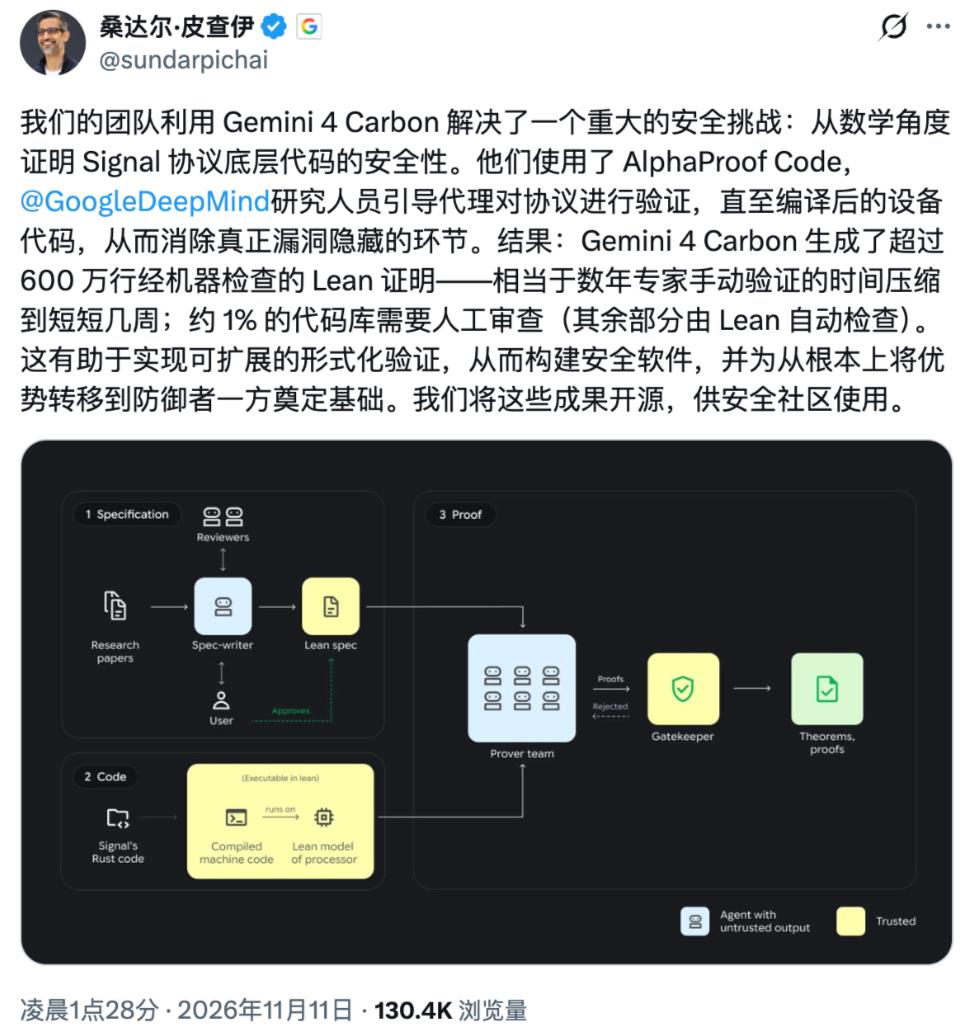
This work, which would originally take an expert team several years to complete, was finished in only four weeks in the end.
More importantly, this means that AI is beginning to move from "writing code" to "proving with mathematics that the code is secure".
From long-cycle reasoning to truly completing complex work
Google positions Gemini 4 Carbon as the most suitable model for handling high-difficulty, multi-step tasks at present.
In software engineering, it can face complex codebases, conduct cross-module problem troubleshooting, architecture adjustment and multiple rounds of debugging; in scientific research, it can continuously explore hypotheses, analyze evidence and verify results around open problems; in knowledge work, it can also process a large number of complex documents, data and structured information.
There is an important design behind this: Extended Verification Loops.
Facing complex tasks, Carbon will input more Thinking Tokens, explore different solution paths, and repeatedly check the results during the execution process. After finding problems, it can continue to modify and test until a more reliable result is obtained.
In the independent workflow benchmark tests announced by Google, Carbon ranks first on CursorBench 4.0, Perplexity WANDR and Zapier AutomationBench. Google also stated that in these tests, the cost of a single task is more than twice lower than that of the next best-performing external model.
At the same time, Google is previewing the /swarm function in Google Antigravity: Users only need to give a task, then multiple Agents can form a collaborative team to take charge of architecture design, task coordination, code implementation, review and other work respectively.
Carbon can be responsible for the links that require the most in-depth reasoning, while other lighter-weight models process specific tasks in parallel.
From model capabilities to multi-Agent collaboration, Google hopes to make the work undertaken by AI more complex and closer to the real professional workflow.
6.5 million lines of mathematical proof, the AI Agent conducted a "security checkup" for Signal
If Gemini 4 Carbon demonstrates the upper limit of capabilities, then AlphaProof Code is a very specific capability verification.
This research targets a long-standing problem plaguing the field of software security: how to prove that a set of software running in reality does meet the security attributes required by its designers?
Take Signal as an example.
As a widely used encrypted communication protocol, the security of Signal is built on a series of complex cryptographic mechanisms. In the past, cryptography experts could analyze whether the protocol design is secure from the mathematical level, and also find vulnerabilities through code review and testing.
But there has always been a gap here: a theoretically secure protocol does not mean that the code finally running on the user's device is necessarily secure.
From protocol design to actual operation, there are still code implementation, compilation and optimization in the middle. A tiny implementation error may invalidate the originally strict security design.
Traditional Formal Verification tries to solve this problem with mathematical proof: write the security conditions that the software needs to meet into strict mathematical propositions, and then prove that the actual code does meet these conditions.
The problem is that this work is extremely complex and often requires experts to invest a lot of time.
AlphaProof Code launched by Google DeepMind this time aims to lower this threshold with the help of AI Agents.
The research team first cooperated with the model to convert the security goals of Signal into mathematical specifications that can be understood by the Lean language, which were then reviewed one by one by human experts. Subsequently, multiple Agents driven by Gemini 4 Carbon began to automatically construct proofs, trying to prove that the actual code meets these security requirements.
The key point here is that the research did not stop at the protocol design or source code level, but further went deep into the final compiled device code.
The researchers established the formal semantics of the AArch64 instruction set, and included the compiled machine code into the verification scope. This means that what they are trying to prove is the code actually running on the device, not just the theoretical algorithm description.
Finally, AlphaProof Code generated about 6.5 million lines of Lean proof code for the core implementation of Signal, which is built on about 26,000 lines of reviewed formal specifications and machine code semantics.
The entire verification process took only four weeks. The AI Agent will also automatically mark the parts that require further human inspection, and finally only about 1% of the codebase needs additional manual attention, and the rest of the proofs are sent to the trusted kernel of Lean for machine inspection.
More importantly, this system will not only generate proofs for correct code.
The research team also deliberately re-implanted two vulnerabilities that actually existed in the past and have been fixed later into the isolated version of the Signal code. As a result, AlphaProof Code successfully generated counterexample proofs that passed machine inspection, and identified that these codes did not meet the original security requirements.
This shows that it can not only help verify correct implementations, but also has the ability to identify specific incorrect implementations.
The next step of AI programming is to make code trustworthy?
The significance of this research goes far beyond completing a security verification for Signal.
In the past, formal verification has always been one of the most costly security assurance methods in software engineering. Even for very important systems, it often takes an expert team several years to prove that their code meets strict security attributes.
Now, AI Agents are beginning to take over a large number of heavy tasks in it: writing formal specifications, exploring proof paths, generating Lean code, and then conducting inspection by an independent proof kernel.
Of course, this does not mean that AI has been able to independently prove that any software is absolutely secure. Human experts still need to define and review security specifications, and the proof system can only ensure that the code meets the attributes that have been clearly expressed.
But this route has already demonstrated a new possibility: when an Agent can continuously reason, call tools, construct complex intermediate results, and repeatedly check through external verification mechanisms, AI will have the opportunity to undertake the work that used to take expert teams a long time to complete.
Google DeepMind also stated that in the future, it hopes to extend this technology to critical infrastructures such as medical device firmware and power grid software, and combine it with the automated vulnerability repair tool CodeMender, so that software can form a more complete security closed loop from discovering vulnerabilities, fixing problems to formal verification.
From the release of Gemini 4 Carbon to the verification of Signal by AlphaProof Code, Google is demonstrating the same direction: the value of the model is extending from answering questions to undertaking complex work.
And when AI can not only write code, but also help humans prove with mathematics that the code meets security requirements, the boundary of Agent capabilities is pushed to a new field.
So what about you, what do you think of the fact that large models nowadays are no longer limited to competing for rankings and scores, but are exploring more complex mathematical and cryptographic problems? Welcome to leave a message and exchange ideas in the comment area!
Reference links:
https://x.com/GoogleDeepMind/status/2120219371473617099
https://blog.google/innovation-and-ai/models-and-research/gemini-models/gemini-4-carbon-now-available/?utm_source=x&utm_medium=social&utm_campaign=&utm_content=
https://x.com/sundarpichai/status/2120207062655549933
https://deepmind.google/blog/introducing-alphaproof-code/
This article is from the WeChat official account "Machine Heart" (ID: almosthuman2014), written by AI-focused contributors, and published with authorization from 36Kr.