Nearly 20,000 stars accumulated in only 10 days, the post-2000s college student has achieved impressive results, and the DeepSeek Harness mobile client has become a huge hit.
To use an open-source project, someone specifically bought an Android phone.
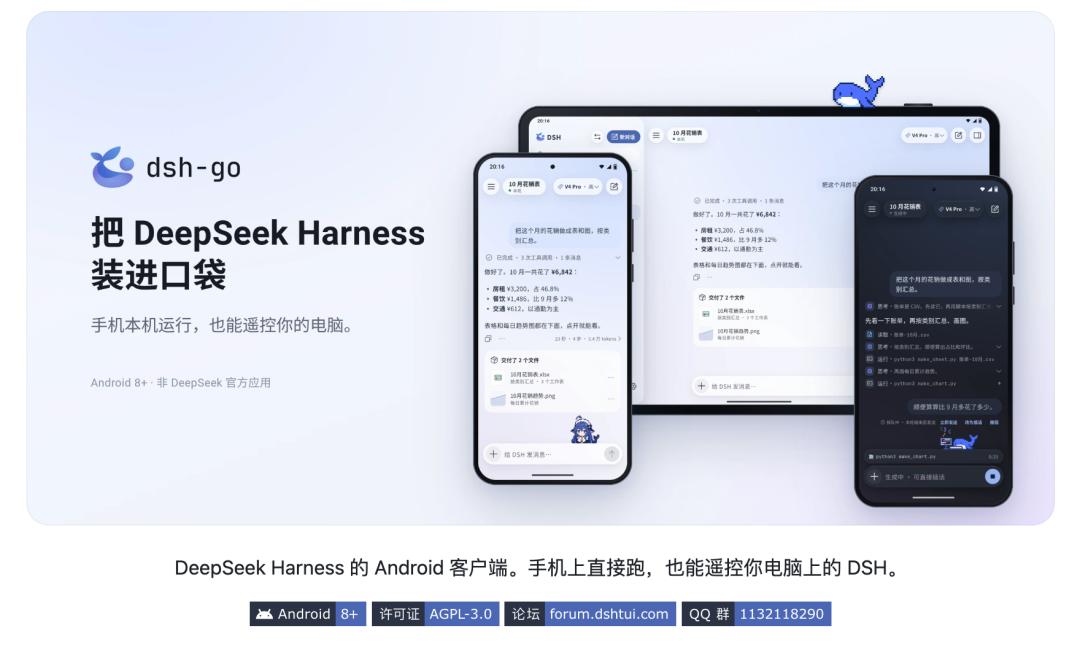
This application, called dsh-Go, is a mobile app that can run DeepSeek Harness (hereinafter referred to as DSH) on Android phones.
According to Xiao C, the author of dsh-Go, after the project was released, many users urged him to adapt to iOS and Hongmeng, and even some people really bought a second-hand Android phone specifically to experience this product.
What happened next gradually exceeded everyone's imagination: on October 30, the application had been online for only three hours, and the number of GitHub Stars exceeded 1k. As of now, the number of Stars has reached 18,000.
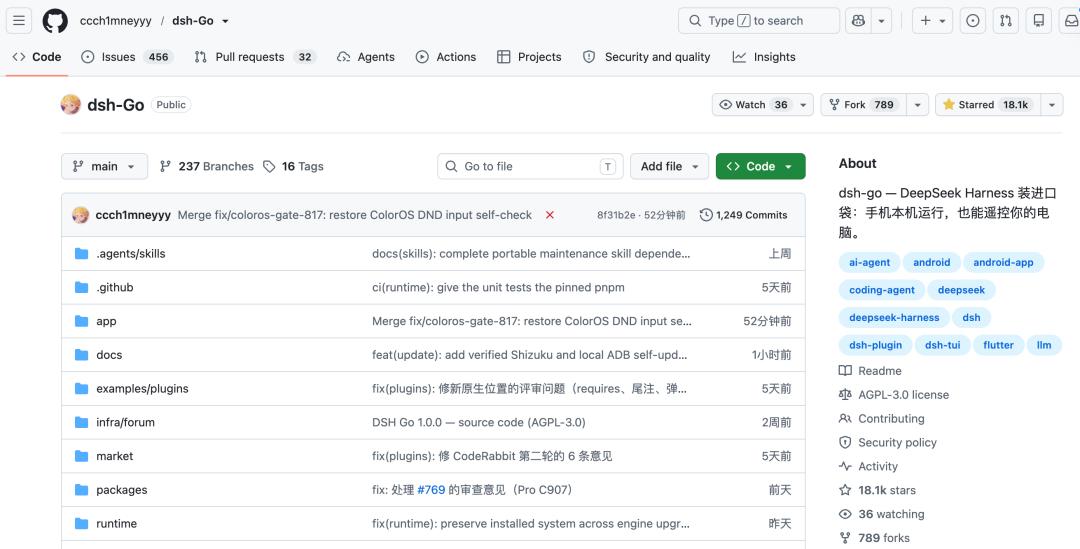
Around the public beta, Xiao C slept an average of only 4 hours a day for a whole week, busy testing and fixing bugs. The project was so popular that it once crashed the server provided for free by his friend.
And this is only the second open-source project developed by Xiao C.
Before this hit product emerged, Xiao C had developed an interactive terminal interface dsh-TUI during the DSH internal test period, which had more than 7.3k Stars on GitHub and was recommended by Cui Tianyi, the head of the Deepseek Harness team. The two projects have accumulated more than 25,000 Stars in total.
Xiao C's GitHub account only has these two projects in total, which means that both of his two releases are blockbusters.
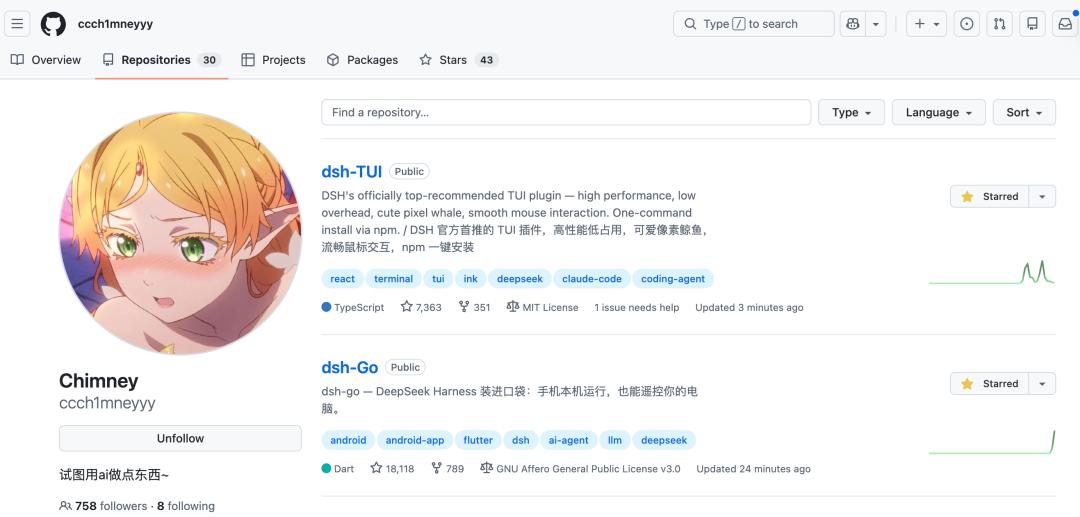
Xiao C's GitHub homepage: https://github.com/ccch1mneyyy
Out of curiosity, we had an in-depth exchange with Xiao C.
To our surprise, Xiao C is only 22 years old this year, and he is still a senior undergraduate student. He studied International Economics and Trade at Jilin University for his bachelor's degree, and has been recommended for postgraduate study in International Business at Beijing Normal University.
Xiao C does not have a formal computer science background. He admits that his programming foundation is still relatively weak compared with traditional programmers, and there is still a big gap in specific code and engineering practice.
"Without AI, I don't think dsh-Go could even run," he said.
Xiao C first came into contact with AI when ChatGPT just came out. Later, because his major involves quantitative related content, he began to try to use AI to write quantitative algorithms and programs, and gradually switched from ChatGPT to Agent.
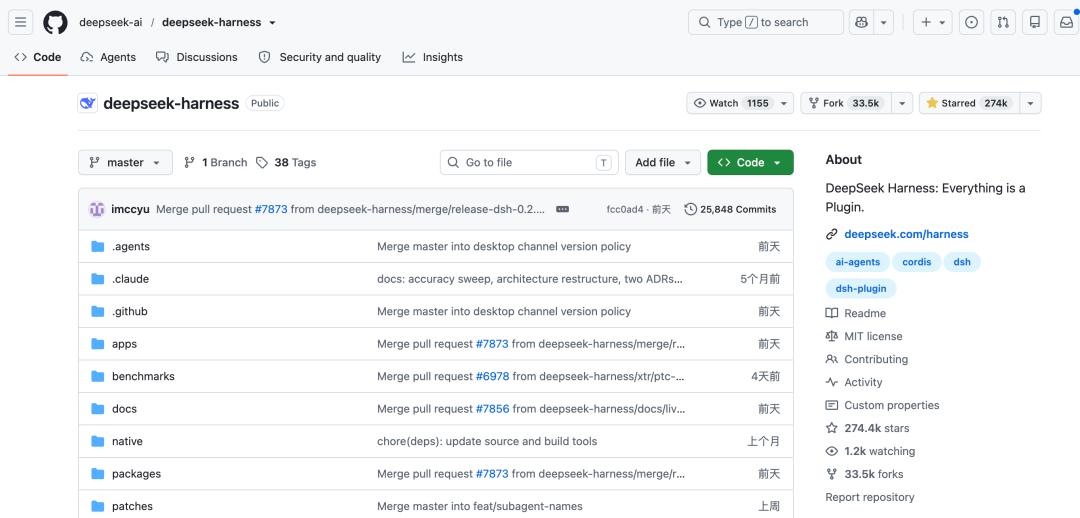
In August this year, Xiao C was invited to join the DSH internal test. At first, he just wanted to make a plugin to test the capabilities of DSH, but later found that the early terminal interface was not mature enough, so he started to develop dsh-TUI.
After the project was recognized, he realized that the users of TUI were mainly geeks and developers. In order to make more ordinary people who do not understand programming able to use DSH, he turned his attention to mobile phones and created dsh-Go.
From terminal to mobile phone, Xiao C successively seized the two unmet needs of DSH users.
The popularity of the two projects also shows us another side of the DSH open-source ecosystem. As an early internal tester, Xiao C witnessed DSH gradually develop from a product with imperfect functions to various community projects such as terminal interface, mobile terminal, remote connection, Bot, desktop pet and so on.
He described this process as "watching a child from a relative's family grow up". In Xiao C's view, the influence of DeepSeek itself attracts developers, but what really makes everyone stay is DSH's concept of "everything is a plugin", as well as the space for developers to transform products according to their own needs.
For the relationship between the official team and the community, Xiao C believes that it is a relationship of trunk and branches: the official is responsible for core capabilities and basic interfaces, building a good "trunk", and community developers develop plugins around different needs, allowing the ecosystem to grow more "branches and leaves".
For the changes that AI Coding brings to individual developers, Xiao C believes that AI has greatly lowered the threshold of software development, giving individual developers the opportunity to complete work that previously required multi-person collaboration. However, with the increase in software supply, homogenized projects will also become more and more numerous.
He believes that the most important ability for individual developers in the future is "demand capturing", followed by "taste". Only by combining the two can we make products that are truly recognized by users.
Although he has successively created two hit products, Xiao C is not blindly optimistic about his technical ability and future planning. He admits that he still has a lot to learn, and may develop in the direction of AI products in the future. But for now, he plans to finish his postgraduate studies first, and continuously enrich his abilities and experience.
The following is the essence record of our exchange with Xiao C. For better readability, Zhidx has made adjustments without changing the original meaning:
01. DSH is like a child from a relative's family, its product form has fatal appeal to developers
Zhidx: Hello, nice to meet you, please briefly introduce yourself to everyone
Xiao C: My GitHub account is ccch1mneyyy, you can call me Xiao C. I am a senior this year, studying International Trade under the economics category at Jilin University, and I have just been recommended for postgraduate study in International Business at Beijing Normal University, both of which are basically economics-related majors.
Zhidx: When did you come into contact with DSH, and how did you get involved?
Xiao C: I came into contact with DSH relatively early, because I was very lucky to be invited to participate in the internal test, around August. Because DeepSeek itself is a very powerful existence among domestic large models, and it is the belief of many people, I like DeepSeek very much, so I was very happy to join when I heard about the internal test. Then I decided to get involved and develop some plugins.
Zhidx: Do you still remember what DSH was like when you first came into contact with it? What aspects made you feel it was worth continuing to tinker with?
Xiao C: I was very excited when I got the private repository for the internal test, but at that time DSH was still relatively simple, many very basic functions were not available. But with the official updates, it has been improved step by step, and this experience is also quite wonderful, it feels like watching a child from a relative's family grow up.
Zhidx: From the time you joined the internal test to now, what obvious changes have taken place in DSH and the community?
Xiao C: There are two most obvious changes.
First of all, DSH itself has gradually grown from an early "rough house" state to a Harness that is quite usable and easy to use in practice.
The second is the change of community plugins. The things everyone makes have gradually changed from small plugins to more mature products. In the past, people might mostly make skins, but now there are projects such as terminals, mobile terminals, remote connections, Bots, and desktop pets.
The user group is also changing. Early users were more biased towards developers. Although it is still a developer internal test now, more ordinary people, such as many people who do not understand AI or programming, have begun to use DSH.
The very popular "Big Fat Fish Invasion" event on Bilibili some time ago is also a phenomenon of DSH entering the lives of ordinary people, which can reflect that DSH's user group is expanding. But I think this incident has both advantages and disadvantages, and I personally have not played this.
Zhidx: From your observation, do people participate in the DSH ecosystem more because of DeepSeek's own influence, or because the product really hits the needs of developers?
Xiao C: I think both sides are the reasons. First of all, DeepSeek has enough influence, so DSH can attract great attention when it is first launched, and everyone is willing to learn about it.
But whether developers can stay and are willing to continue to build the ecosystem in the end depends on the product form. I think DSH's concept of "everything is a plugin", as well as its core and scalability, are very attractive to developers. Where it is not easy to use, you can modify it yourself, and then share it as open source after modification. This is a very attractive thing for developers.
Zhidx: As a product launched by a Chinese company, is there also an identity recognition factor in people's attention to it?
Xiao C: I think there is a certain relationship. DeepSeek is very popular in China. In addition to being open source, it may also be affected by some national sentiment. But I won't talk too much about this, I think it definitely exists.
Zhidx: From your point of view, what are the biggest differences and advantages of DSH compared with closed-source products such as Claude Code, and open-source projects such as OpenClaw and Pi?
Xiao C: Compared with closed-source products, DSH's biggest advantage is that it opens up the overall architecture and ecosystem of Harness, leaving space for community developers, so that everyone can build their own Harness.
Compared with other open-source projects, I think DSH's advantage is that it has its own model. The combination of the DeepSeek model and Harness is its biggest competitiveness and its ace.
First, the influence of the model attracts more developers' attention. After opening up, with this group of developers, it finally depends on the architecture, opening ability and expansion ability of Harness itself.
Only by combining the two can such an open ecosystem be built. I think this ecosystem is an advantage that other manufacturers are difficult to replicate, and it is also the attractive part of DSH.
02. The official and the community are trunk and branches, Cui Tianyi suggests developers to make vertical projects
Zhidx: What will be the relationship between the open-source Agent ecosystem and closed-source commercial products in the future? Which kind of products will ordinary users and developers tend to choose respectively?
Xiao C: From a general perspective, open-source and closed-source Harness will coexist for a long time, not a substitute relationship.
For ordinary users, they may prefer mature, out-of-the-box closed-source products, which is the advantage of closed-source products. But there is also a group of developers like me, who care more about what they can control, whether they can customize tools according to their needs, and create a set of handy tools. Open-source Harness, such as DSH, can meet such needs. So I think both have their own users and will not replace each other.
Zhidx: What do you think is the value of open-source projects for ordinary users without development background?
Xiao C: I think the value of open-source projects is that they can be modified by others to meet their own needs.
Take dsh-Go as an example, many mobile users may not develop, but they want a mobile assistant or mobile Agent. Developers like us capture this demand, or we happen to have similar needs ourselves, so we can make the product to meet this group of users. Closed-source projects are difficult to achieve this.
Zhidx: From the internal test to now, what is the relationship between the DSH official team and community developers? Will the official team actively listen to everyone's needs and suggestions?
Xiao C: I think the official and the community are more like the official team making the base and the community extending outward, a bit like the relationship between the trunk and branches.
The official team is quite willing to listen to community suggestions, but they also have their own Roadmap and ideas. The general direction will not be easily changed because of some voices from the community, but in small details and small designs, they are still quite willing to listen and make improvements.
Zhidx: Do you usually communicate with Cui Tianyi, the head of the DSH team, and other DeepSeek members? Will they participate in discussions or adjust the product direction according to feedback?
Xiao C: We do have communication. My previous project was recommended by Teacher Cui Tianyi, so I also had exchanges with him. More communication is in the internal test group, the official team will collect everyone's opinions, and some good suggestions will be adopted.
Zhidx: Are there any little-known stories that can reflect the atmosphere of the internal test?
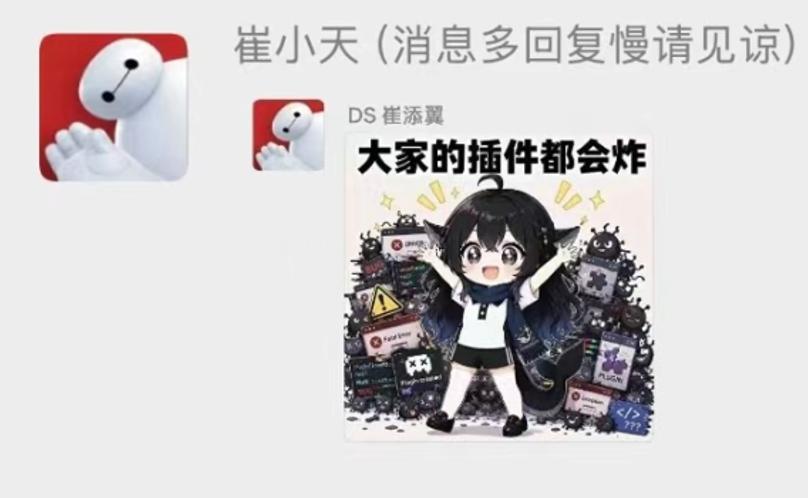
Xiao C: Yes. The atmosphere of the early internal test group was quite cheerful and harmonious. At that time, DSH's interface was not very stable, it was updated frequently, and sometimes there would be breaking changes, which made many plugins unusable. Plugin authors would make some meme images, such as "everyone's plugins will blow up", and then post pictures in the group. When Teacher Cui saw them, he would sometimes forward them, and everyone felt very happy.
Zhidx: Did Teacher Cui give you any opinions or suggestions?
Xiao C: They hope that plugin authors can make plugins in vertical and segmented fields. This is not only a suggestion for me personally, but also a directional guidance for other plugin authors in the internal test group. For example, people engaged in medical, economic and other industries can dig deep into these fields and develop more unique and segmented plugins.
03. After breaking the circle, product usability needs to be improved, it is suggested that the official team continue to recommend community projects
Zhidx: From the perspective of developers and long-term users, what aspects of DSH are still not mature enough at present? For example, interface stability, plugin system, documentation, etc.
Xiao C: I think DSH is doing very well, but after all, it is still relatively young, and there are indeed some areas that need to be supplemented and optimized.
First, interface stability still needs to be improved. The interface changed frequently in the early stage, and it is better now,