36Kr Exclusive | Dozens of sets of products are operating stably in orbit, the satellite propulsion company affiliated with the University of Chinese Academy of Sciences has completed a financing of nearly 100 million yuan.
Author | Qiao Yujie
Editor | Yuan Silai
This article is about 3800 words, and it is recommended to read for 9 minutes
Hard Krypton has learned that Guoke Xingqing Aerospace Technology Co., Ltd. (hereinafter referred to as "Guoke Xingqing"), a space propulsion enterprise, has completed multiple rounds of financing, with a total financing of nearly 100 million yuan so far. The investors include many leading sci-tech innovation investment institutions and industrial capital parties such as Ceyuan Fund of Shanghai Kechuang Group under Shanghai State-owned Assets Investment, Hangzhou Sci-Tech Innovation Group, Nanshan Strategic Emerging Industry Investment, Xingxiang Sci-Tech Innovation, Cathay Pacific Haitong, New Micro Capital, etc.
The raised funds will be mainly used for the construction of intelligent production lines and the R&D of new propulsion products, continuously accelerating the mass production and stable delivery of various types of products, as well as the on-orbit application and data accumulation of new products.
Incubated by Hangzhou Institute for Advanced Study, University of Chinese Academy of Sciences, Guoke Xingqing fully inherits the Hall electric propulsion technology system and on-orbit application experience of the Hangzhou Institute for Advanced Study, UCAS. Its core technical team is wholly formed by the transfer of personnel from the Hangzhou Institute for Advanced Study, UCAS. It is mainly engaged in space power and on-orbit service business, focusing on the R&D, mass production and commercial application of Hall electric propulsion system, the core component of satellite attitude and orbit control. The core members of the team come from domestic leading institutes and universities in the field of space electric propulsion, and have the full-chain forward design capability for thruster body, hollow cathode, power supply and control, and working medium storage and supply system.
With the acceleration of the construction of low-orbit internet satellites and satellite computing satellites in China, the total number of planned satellites of national-level and commercial constellations such as GW constellation and Qianfan constellation has exceeded 200,000. Satellites not only need to complete orbit adjustment after entering orbit and deorbit at the end of their service life, but also need to maintain orbit and control attitude during long-term operation, which makes the propulsion system that balances performance, reliability and cost become an important link in the mass deployment of satellites. In the mass deployment stage, the role of the propulsion system is also changing: it is no longer just a supporting standalone unit of the satellite, but a key link that directly affects the constellation deployment rhythm, on-orbit service life and full life cycle cost.
Compared with traditional chemical propulsion, electric propulsion generates thrust by accelerating the working medium through electric energy, which has the characteristics of high specific impulse, low propellant consumption and long service life. Among them, Hall electric propulsion is an important technical route for current satellite applications. According to the classification of working medium, Hall electric propulsion can use different working media such as xenon, krypton and argon.
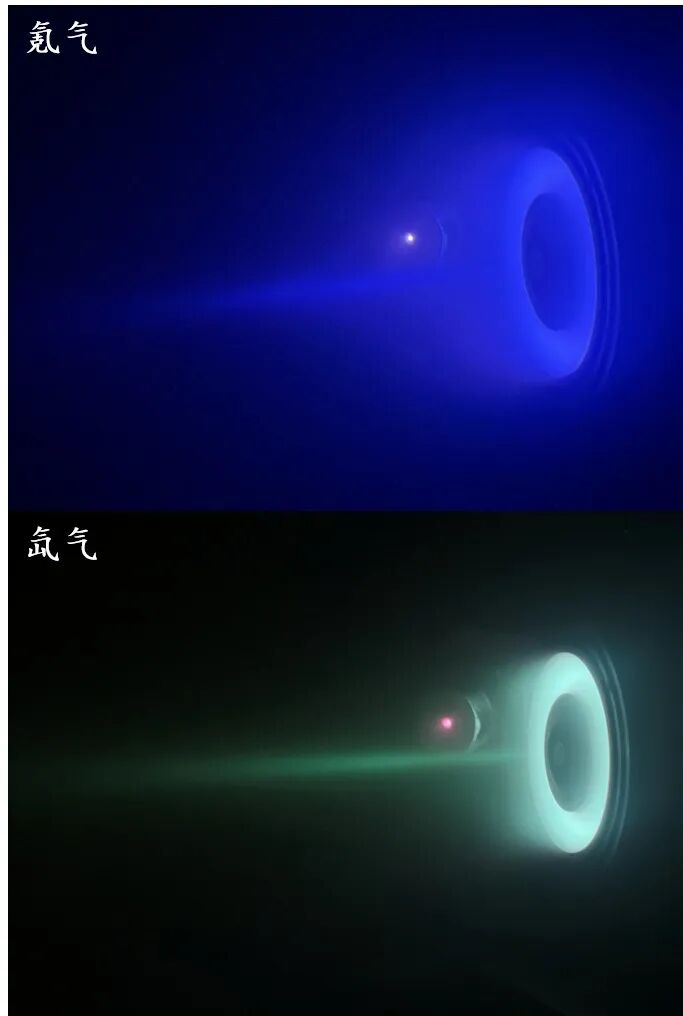
Ignition diagram of krypton working medium and xenon working medium Hall thruster
Xu Luxiang, founder of Guoke Xingqing, introduced to Hard Krypton that xenon is easy to ionize but has low reserves and high cost; krypton has sufficient reserves and its price is much lower than that of xenon, highlighting its cost advantage under the constellation of ten thousand satellites, but its disadvantages are low ionization efficiency and thrust-power ratio, and high engineering difficulty of high-pressure storage, which requires reconfiguration of the design of thruster, gas circuit and magnetic circuit; argon has the lowest raw material cost, but it is difficult to ionize, and has high requirements for power supply, devices and structure, resulting in significantly higher system cost than krypton. Combining the domestic working medium supply and the power supply capacity of mainstream satellite platforms, krypton is the first choice for large-scale deployment of commercial satellite constellations.
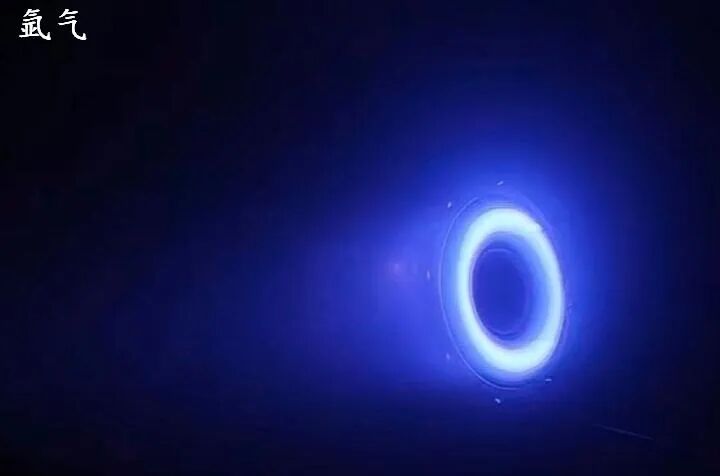
Ignition diagram of argon working medium Hall thruster
Since krypton is more difficult to ionize than xenon, it puts forward higher requirements for the discharge structure design of the thruster, the matching of the power supply system and the operation stability of the whole machine. How to ensure thrust performance, reliability and service life while reducing the cost of propellant is a problem to be solved for the large-scale application of krypton working medium Hall electric propulsion.
Xu Luxiang said that the Guoke Xingqing team is one of the early teams in China to start the R&D of Hall electric propulsion technology for krypton and argon working media. It has carried out targeted research on the problems such as difficult ionization of krypton and argon, discharge oscillation and sparking, and realized 100% self-development of core components such as cathode, anode, storage and supply, power supply and control, forming a technical closed loop from core components to the whole machine system.
Among them, the hollow cathode is a key component that determines the service life and reliability of the whole machine. The team has completed the full-process independent development from emitter material testing and finalization, structural design, working condition matching to key production and testing equipment, and built a vacuum test system for electric propulsion space environment simulation covering power circuit debugging and testing, working medium flow calibration, thrust calibration, plume diagnosis, ultra-low temperature ignition and reliability assessment.
Xu Luxiang said that the R&D of krypton working medium thruster not only needs to solve the technical problems of the thruster itself, but also involves links such as power supply, working medium storage and supply, filling and testing. Taking krypton filling as an example, relevant equipment needs to meet the requirements of high-pressure storage and supply, and there are certain thresholds in both system design and engineering implementation.
At present, Guoke Xingqing has formed a Hall electric propulsion product spectrum covering micro-newton level to 300 millinewton level, which can adapt to micro-nano satellites to ton-level large satellite platforms. Xu Luxiang introduced that dozens of sets of the company's products have been stably operated in orbit, completing the first batch of engineering application of domestic krypton working medium Hall thruster in the 1000km orbit of mainstream satellite internet, and realizing the large orbit raising of 268km and networking tasks at the same time.
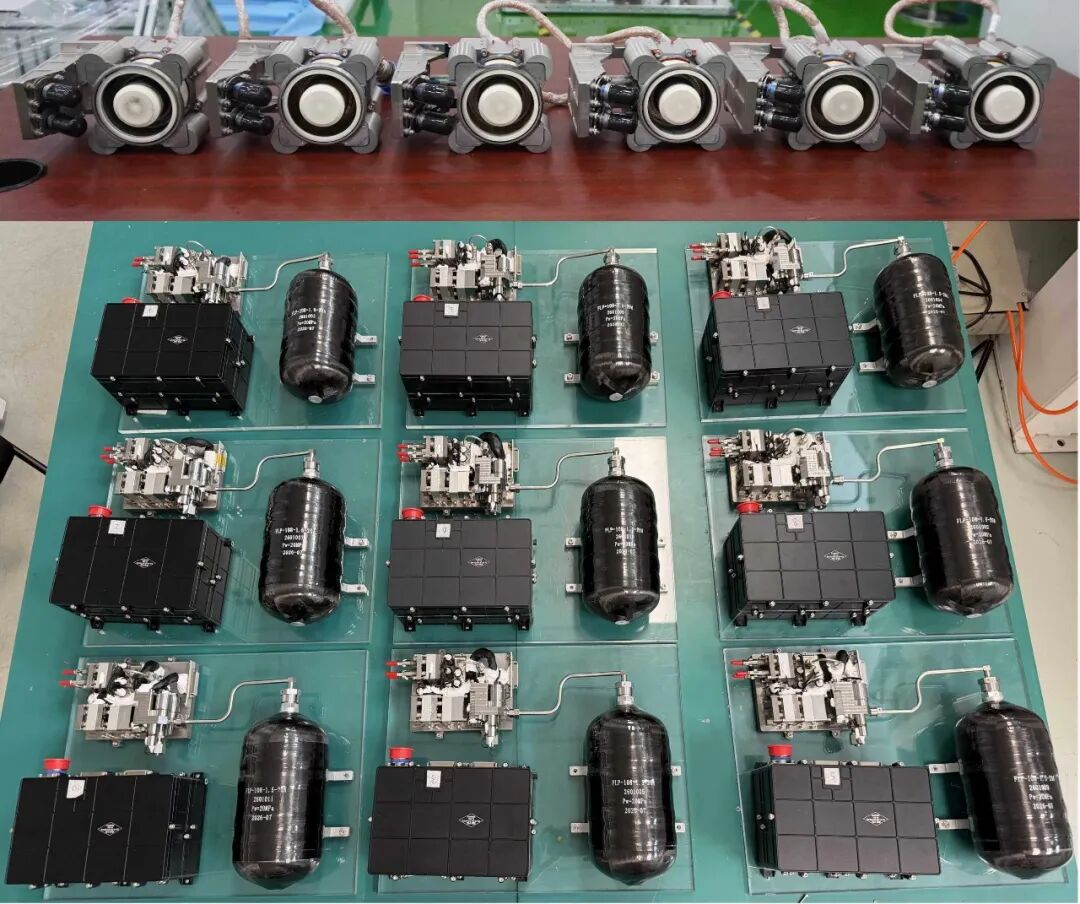
Mass production of Hall propulsion products
In terms of customers, Guoke Xingqing has established cooperation with many leading commercial satellite general contractors, and its product applications cover the two major national low-orbit broadband satellite internet constellations, providing supporting services for many leading private satellite general contractors and domestic research institutes.
In addition to providing a complete propulsion system, the company also has the productized delivery capability of core standalone units, supporting production and testing equipment and related services. As constellations enter the mass networking stage, the company is also promoting joint product definition and interface standardization with general contractors to shorten the adaptation cycle of new platforms.
At present, the company is building an intelligent production line with an annual output of 1000 sets of Hall electric propulsion systems, establishing a full-process digital quality control system, introducing intelligent inspection and testing, automatic calibration, full-process traceability of key parameters and batch consistency control measures, to improve product standardization and large-scale delivery capability. The company expects that the production line equipment will be installed and put into operation successively in November this year, and officially put into production in December.
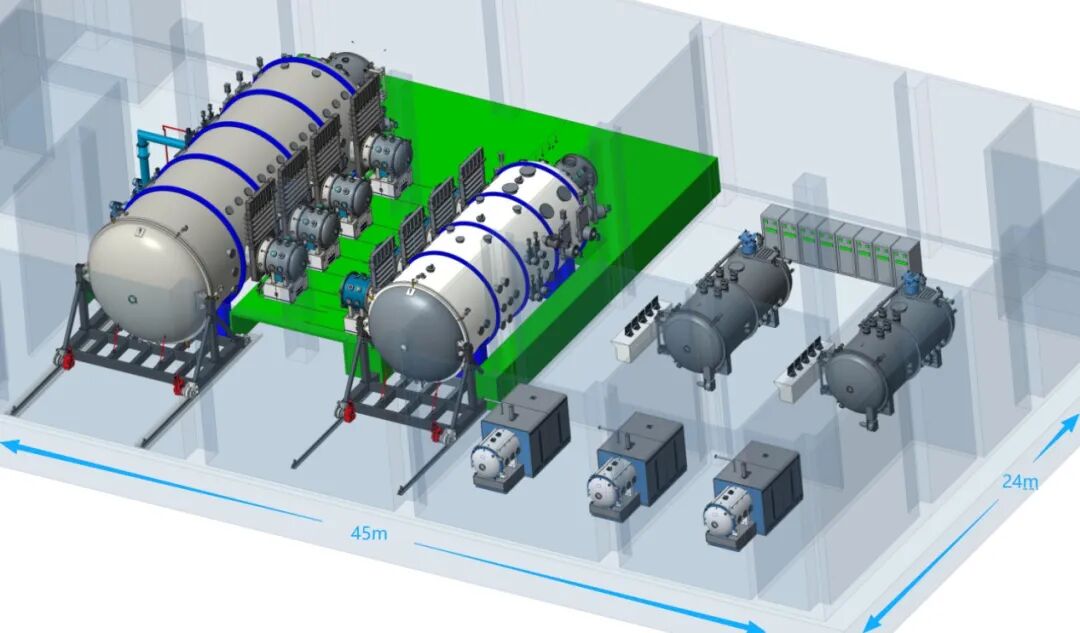
Vacuum test system for space environment simulation of the thousand-set production capacity production line
In addition to the propulsion system, Guoke Xingqing also plans to extend to "power system + on-orbit service", and lay out directions such as high-power Hall propulsion and space transfer power, intelligent attitude and orbit control, ultra-low orbit satellite propulsion, on-orbit life extension, and space debris removal. As satellite constellations enter the stage of large-scale deployment, the company hopes to further expand the service demand in the on-orbit operation stage based on the propulsion system.
The following is an excerpt from the communication between founder Xu Luxiang and Hard Krypton:
Hard Krypton: What are the main technical difficulties faced by krypton working medium Hall electric propulsion? How does Guoke Xingqing solve the problems such as difficult ionization of krypton, discharge oscillation and sparking?
Xu Luxiang: The ionization difficulty of krypton is higher than that of xenon, especially under low power conditions, ionization and discharge maintenance are more difficult. To solve these problems, we must start with the physical mechanism, and then optimize the thruster structure and power supply system. For example, thruster start-up and stable operation are two different processes. The start-up phase needs to provide sufficient energy instantaneously, and then stable discharge needs to be maintained afterwards. If the understanding of this process is not deep enough, it is difficult to solve the problem of discharge instability from the root.
In addition, the discharge oscillation under krypton working medium (often called "breathing oscillation" in the industry) is more obvious than that of xenon. If it is not suppressed, it will amplify thrust noise, accelerate the sputtering etching of the ceramic discharge chamber wall and magnetic pole, and finally reflect on the satellite bus power fluctuation and working life. We have designed targeted topology and control strategy on the power supply side, combined with the optimization of the discharge chamber magnetic field, to suppress the oscillation within a controllable range.
We will adjust the internal structure of the thruster, the power supply structure and the discharge control strategy at the same time, instead of simply improving a single component. The team has a deep understanding of the overall working mechanism of the thruster, which is also the basis for us to carry out systematic optimization according to the characteristics of krypton working medium. In terms of R&D methods, we also combine simulation and test: first use plasma simulation and multi-physics field coupling analysis to guide the iteration of magnetic circuit, discharge chamber and gas distributor, and then use ground assessment and on-orbit data to correct the model in reverse, turning "trial and error" into predictable design as much as possible.
Hard Krypton: Among the enterprises making krypton working medium Hall thrusters, what are the core advantages of Guoke Xingqing?
Xu Luxiang: I think there are three main aspects.
The first is full-chain independent R&D. We not only self-develop core components such as anode, cathode, power supply and control, but also independently develop production and testing equipment, including equipment required for thrust testing, plume testing, production process detection, working medium filling and other links, which means that we can extend from the thruster body to system integration, testing and inspection and working medium filling, instead of only making a single component. Another benefit of this approach is iteration speed — components, systems and testing equipment are all in our own hands, so problems can be adjusted in parallel when they occur, no cross-supplier coordination is required, and the R&D cycle is significantly shortened.
The second is product spectrum and engineering capability. We have formed a product layout from micro-newton level to 300mN level, compatible with different working media of krypton, xenon and argon, and completed the qualification test and model finalization of some high-thrust products and ultra-low orbit gas-collecting propulsion products. Different satellite platforms have different requirements for thrust, power, bus voltage and working medium, and a complete product spectrum can help us cover more application scenarios. More importantly, the spectrum means that the verified product platform can be migrated to new scenarios: new demands such as ultra-low orbit and orbit transfer do not need to start from scratch, but are adapted on the existing thruster, power supply and storage and supply platforms, which can significantly reduce the cost of entering new scenarios and enhance reliability.
The third is the professionalization and system collaboration capability of the team. Our core team is mainly composed of independently trained doctors, engineers and other personnel, and the members have a deep overall understanding of the power supply, cathode, anode and test equipment and other links. The propulsion system has high requirements for multi-link coupling matching, and only being proficient in a single module will restrict cross-domain collaboration and troubleshooting. Our core members are experts in one field and have multiple skills, with both professional depth and global perspective, which can reduce the comprehensive system cost while ensuring the task, and efficiently handle various problems in R&D, mass production and delivery.
Hard Krypton: The company lays out both krypton working medium and xenon working medium products at the same time. What are the differences between the two propellants in terms of performance, cost and applicable scenarios?
Xu Luxiang: Xenon is easier to ionize, with obvious advantages in small thrust scenarios; krypton has higher ionization power consumption, but its cost is only 1/100 ~ 1/50 of that of xenon, highlighting the full life cycle cost advantage during large-scale constellation deployment.
At present, our thrusters below 10mN mainly use xenon working medium, and 20–300mN products are compatible with xenon and krypton, and this boundary extends to the small thrust interval with the maturity of krypton technology. Under the same thrust, xenon consumes less power, for example, the 20mN thruster has a power consumption of more than 300 watts for xenon and more than 400 watts for krypton. The selection of working medium needs to be combined with satellite power supply and tasks: remote sensing satellites with high attitude stability and strict power limit are suitable for xenon; communication satellites with sufficient power supply and priority to control propellant cost are suitable for krypton, and we can match them as needed.
Hard Krypton: In your judgment, what are the main development directions of electric propulsion in the next step? How will Guoke Xingqing make the layout?
Xu Luxiang: I judge there are four directions.
The first is to move towards high power. The current mainstream demand is from hundreds of watts to kilowatts, but space transfer vehicles, large platform networking and future deep space missions require products with ten kilowatts or even hundreds of kilowatts of power, and thermal management, magnetic circuit and power supply efficiency all need to be redesigned, which is a new technical level.
The second is to move towards low-cost working medium. Xenon has scarce resources and large price fluctuations, and it is impossible for ten-thousand-level constellations to rely on it for a long time. Krypton is the most realistic alternative at present. China is a major krypton producer with low purification and manufacturing cost. In the medium and long term, krypton may become the mainstream working medium for large-scale application of electric propulsion in China.
The third is to move towards ultra-low orbit. The area of 150 to 300 kilometers has obvious advantages in resolution and delay, but the atmospheric resistance is large and the atomic oxygen corrosion is strong. Traditional electric propulsion can not last long with its own working medium. Once the gas-collecting and air-breathing route is put into operation in orbit, the business model of ultra-low orbit constellation will be established, which is one of our key investment directions.
The fourth is to move towards intelligence and service. The propulsion system will be more and more integrated with attitude and orbit control and mission planning, with the ability to support the general contractor to complete autonomous collision avoidance, autonomous maneuvering and health management; services such as on-orbit refueling, on-orbit life extension and debris removal are essentially extensions of propulsion capability. We hope that the company will not just be a thruster supplier, but a company that covers power systems and empowers on-orbit services.