From Elon Musk kneeling in public to Bill Gates being blackmailed: The "fatal soft spots" of Silicon Valley tycoons
On November 8, 2026, Jensen Huang, CEO of Nvidia, the head of the global AI computing power empire who is always known for his "wife-obsessed" persona and signature black leather jacket look, sent a rare internal apology letter to all employees. In the letter, the 63-year-old Huang made a rare confession of his personal moral misconduct: "I have been unfaithful to my wife. My actions have hurt her and our children, and I have no excuses for this."
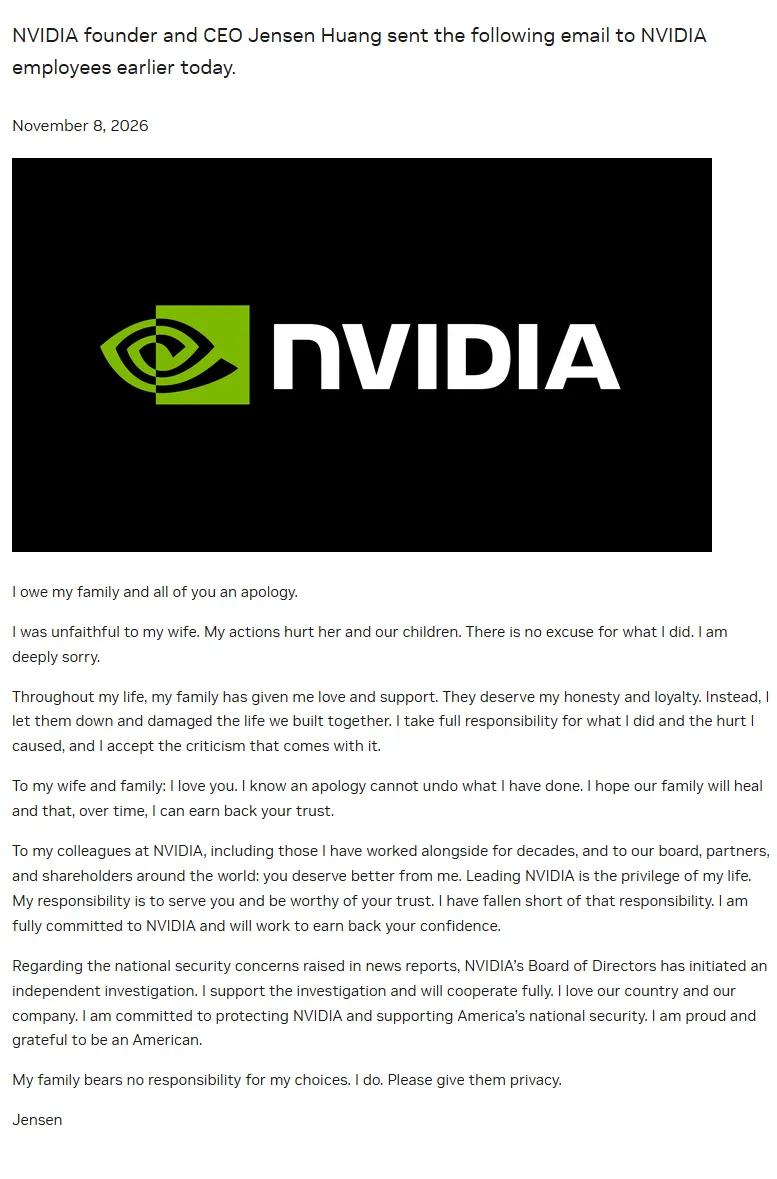
But this confession letter did not stop the storm from spilling over beyond family ethics. According to foreign media reports, the woman who had an extramarital affair with Jensen Huang is Alice Huang, an executive at Megaspeed, a Singapore-based company and a client of Nvidia. On the same day, Nvidia's board of directors announced the launch of an independent investigation.

Figure | Alice Huang, executive of Singapore-based company Megaspeed and Nvidia's client
Amid the global computing power frenzy where high-performance GPUs are in extremely short supply, when the helmsman of the world's most valuable tech giant develops an intimate personal relationship with an executive of a commercial client, this transgression of personal affection quickly evolves into a business compliance and corporate governance turmoil that jolts Wall Street.
In Silicon Valley, where capital is highly concentrated, founders and superstar CEOs are often deified as prophets who can see into the future. The more than 40 years of mutual support between Jensen Huang and his wife Lori has long been regarded as a rare "good man template" in Silicon Valley. However, looking at the hidden side of American tech history, Huang's scandal is far from an isolated case. Under the spotlight of computing power, codes and trillion-dollar market value, extramarital affairs of tech giants are never just gossip for after-dinner chats, but major capital dramas involving equity splits, falling-outs of business allies, even extortion and compliance storms.
Bill Gates: The Collapse of a 27-Year Public Persona and the "Bargaining Chip" in Jeffrey Epstein's Hands
Before Jensen Huang, the most regrettable collapse of the "model husband" myth in Silicon Valley belonged to Bill Gates, co-founder of Microsoft.
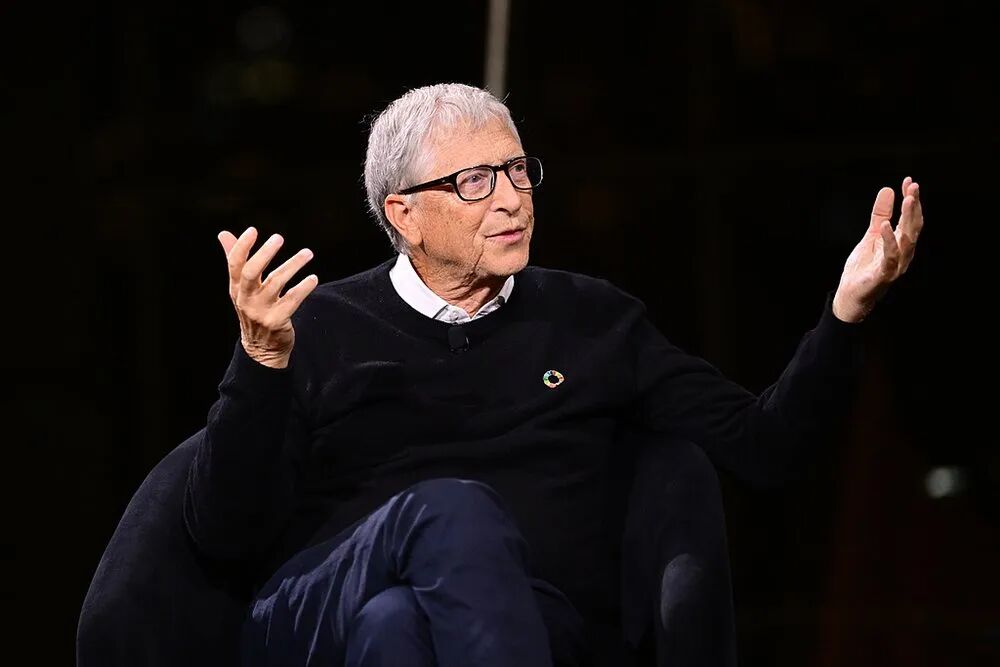
For 27 years, Gates and his ex-wife Melinda French Gates jointly built the most solid image of a philanthropic couple among global tech billionaires. Until May 2021, the two suddenly announced their divorce. As the couple did not sign a prenuptial agreement, the division of their joint assets worth up to 130 billion USD once held Wall Street's breath. The undercurrent hidden behind the seemingly decent breakup was not fully exposed until 2026.

In February 2026, at a somber all-staff meeting of the Bill & Melinda Gates Foundation, the 70-year-old Gates bowed his head to admit his mistake for the first time. He not only confessed that he had affairs with two Russian women, but also revealed that he was accused of having more than 20 extramarital relationships during their 2021 divorce proceedings.
On June 10, 2026, at a closed-door hearing held by the U.S. House of Representatives Oversight Committee on the case of the late financier Jeffrey Epstein, Gates detailed three extramarital affairs for the first time in a judicial setting in his 138-page testimony: Mila Antonova, a Russian bridge player he met around 2010; Karima Nigmatulina, a Russian nuclear physicist with a PhD from MIT who once worked at TerraPower, a nuclear energy company he invested in; and Alice Jacobs Nesselrode, an American medical entrepreneur with a Doctor of Medicine degree from Harvard.
What alerts the business world even more is the power coercion behind the extramarital affairs. Gates confessed at the hearing that Epstein once held sensitive information about his infidelity during marriage. Epstein not only funded Antonova to learn programming, but also tried to use these sexual scandals to pressure Gates, forcing Gates to keep in contact with him. This scandal that has been fermenting for several years directly damaged the reputation of the Gates Foundation, forcing it to launch an external review in 2026.
Jeff Bezos: The "Most Expensive Extramarital Affair in History" Worth 38 Billion USD
If Gates' extramarital affair is a long suspense drama, the extramarital affair of Amazon founder Jeff Bezos is a clearly priced capital blitz.

In 2019, tabloid media exposed the secret extramarital relationship between Bezos and Lauren Sánchez, a close friend of his ex-wife MacKenzie Scott, which directly ended Bezos' 25-year marriage. At that time, Bezos' personal wealth reached 137.2 billion USD. This sexual scandal eventually evolved into one of the most expensive divorce cases in business history: MacKenzie took away 4% of Amazon's shares, which were worth about 38 billion USD at that time, making her the third richest woman in the world overnight.
Although Bezos maintained control of Amazon through a well-designed voting rights retention agreement, this equity split worth up to 38 billion USD has still become a classic case for Wall Street to evaluate the "founder moral risk discount".
Sergey Brin and Elon Musk: From "Silicon Valley Love Triangle" to the Rift Between Billionaires
In the life script of Google co-founder Sergey Brin, extramarital affairs once made him play two completely different roles — he was once a betrayer of marriage, and later became a victim betrayed by his closest friend.

Back in 2013, Brin separated from his first wife Anne Wojcicki, founder of genetic testing company 23andMe, after eight years of marriage, and officially divorced in 2015. What triggered this marriage crisis was the office extramarital affair between Brin and Amanda Rosenberg, a female subordinate in the Google Glass department, and Rosenberg was even a friend of Wojcicki. Fortunately, the two signed a prenuptial agreement, so the equity structure of Google was not substantially impacted.
However, the boomerang of fate hit Brin eight years later. In early December 2021, when Brin and his second wife Nicole Shanahan had marital rifts due to pandemic lockdowns and parenting pressure, according to The Wall Street Journal, Tesla CEO Elon Musk had a brief extramarital affair with Shanahan during Art Basel Miami.

This episode instantly shattered one of the most famous business friendships in Silicon Valley. Musk and Brin have been close friends for many years — during the 2008 financial crisis, when Tesla was on the verge of bankruptcy, it was Brin who generously gave financial help to get Musk through the difficult time; in 2015, Musk even gave Brin one of the first batch of Tesla all-electric SUVs as a token of gratitude.
However, after learning about his wife's infidelity, Brin not only filed for divorce decisively in January 2022, but also instructed his financial advisor to sell off his personal investments in Musk's companies. Although the media reported that Musk once knelt down on one knee in public at a party to beg Brin for forgiveness (Musk himself insisted on social platforms that relevant reports were "total nonsense"), the rift between the two tech giants has been irreparable. In the same period, Musk was also exposed to have secretly given birth to a pair of twins with a female executive at Neuralink, his brain-computer interface company. His complicated private life once made investors worry about his energy allocation.
Brian Krzanich and Andy Rubin: The Professional Guillotine That Touched the "Red Line of Conflict of Interest"
They are all sexual scandals, why can Bezos, Musk and others still sit firmly in their positions, while other tech leaders end up leaving in disgrace? In the measurement standards of Wall Street and Silicon Valley boards, the real life-and-death line usually does not lie in "marital morality", but in corporate compliance, conflict of interest and unequal power.
The most typical negative example is Brian Krzanich, former CEO of chip giant Intel. On June 21, 2018, while releasing the Q2 earnings forecast, Intel suddenly announced that Krzanich had resigned. The reason was that an internal investigation confirmed that Krzanich once had a consensual extramarital affair with an Intel employee. Since Intel explicitly prohibits managers from having intimate relationships with direct or indirect subordinates, even if this relationship had long ended, the board of directors still did not hesitate to make the decision to dismiss him.
Andy Rubin, the "Father of Android", also fell on the internal red line of the company. In October 2018, an in-depth investigation by The New York Times revealed that when Rubin left Google in 2014, Google had concealed his improper relationship with internal employees and misconduct allegations, and even paid him a huge severance package of up to 90 million USD. After the news was exposed, angry Google employees launched large-scale strike protests around the world, forcing Silicon Valley giants to re-examine executive privileges and the mandatory arbitration system.
Calm Reflection on Capital: When CEO's Intimate Relationship Hits the Red Line of Business Compliance
Back to Jensen Huang's incident that shocked the tech circle today. Bill Ackman, a hedge fund tycoon, publicly called on the public to maintain empathy after the incident, saying "Even outstanding people make mistakes, and he has taken full responsibility"; Nvidia's board of directors also quickly stated that it will continue to maintain confidence in Huang and his leadership team, and his position as CEO will not be interrupted.
However, in the eyes of Wall Street institutional investors and corporate governance experts, the real hidden worry is not the family matter itself, but the potential business conflict of interest: the woman involved, Alice Huang, works at Megaspeed, which is itself a commercial client of Nvidia. At a time when GPU computing power is equivalent to the lifeline of tech enterprises, will the helmsman who holds the highest computing power allocation right develop an intimate relationship with a client executive, triggering commercial compliance flaws? Will it affect the fairness of key business decision-making? This is the core reason why Nvidia's board of directors has to intervene quickly and launch an independent investigation.
From Bill Gates being held hostage by Epstein, to Brian Krzanich stepping down in disgrace for violating the anti-nepotism policy in the workplace, to the current independent investigation launched by the board of directors triggered by Jensen Huang's involvement with a client executive, decades of Silicon Valley business history have repeatedly confirmed an iron law: When the business empire and market reputation of a tech enterprise are highly tied to a certain "super founder", the helmsman's private life is no longer just a matter of personal morality, but a "single point of failure" that may evolve into a corporate governance crisis at any time.
This article is from the WeChat Official Account "Phoenix Tech", author: Dale, editor: Dong Yuqing, published with authorization from 36Kr.