Net profit slumped 28% in Q3, Berkshire immediately poured 9.6 billion into share repurchases.
On November 7, Berkshire Hathaway released its third-quarter financial report with declining profits.
Dragged down by shrinking investment returns and declining insurance underwriting business, the net profit attributable to shareholders reached 22.112 billion US dollars, down 28% year on year.
However, while profits are under pressure, the company has significantly increased its share repurchase efforts, with a single-quarter repurchase hitting 9.6 billion US dollars.
Insurance underwriting is the main drag
The financial report shows that in the third quarter, Berkshire's net profit attributable to shareholders was 22.112 billion US dollars, compared with 30.796 billion US dollars in the same period last year, representing a 28% drop.
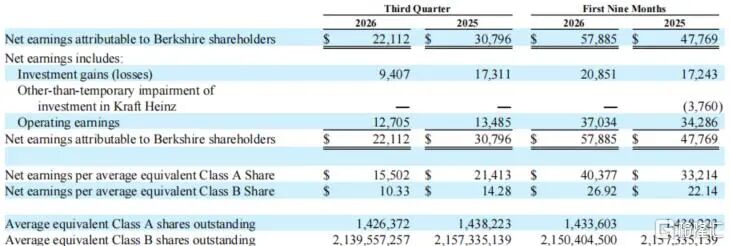
Earnings per share also declined accordingly: Class A shares fell from $21,413 to $15,502, and Class B shares dropped from $14.28 to $10.33.
However, this decline in net profit actually has little connection with the core business. Mainly affected by accounting standards, the stocks held by Berkshire are required to be revalued at market price every quarter. Once the stock market fluctuates, the book investment profit and loss will change drastically accordingly, thus dragging down the overall net profit.
The investment return in the third quarter was nearly half less than that of last year, standing at 9.407 billion US dollars. 7.7 billion of this amount is unrealized floating profit brought by rising stock prices that has not been cashed out; the remaining 1.7 billion is the after-tax income actually obtained after selling stocks. Therefore, this net profit largely reflects the stock market performance.
What truly reflects the profitability of its wholly-owned subsidiaries is "operating profit". The operating profit in the third quarter was 12.705 billion US dollars, down only about 6% year on year. Compared with the 28% decline in net profit, the core business shows much stronger resilience.
Specific to each business segment, insurance underwriting is the main drag, with underwriting revenue plummeting 43% year on year to only 1.352 billion US dollars; investment returns also decreased by 14% to 2.734 billion US dollars.
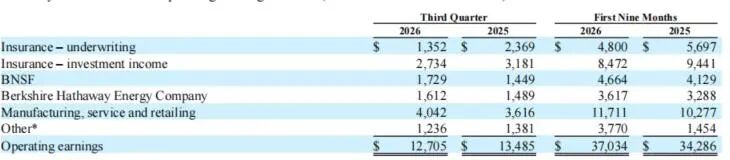
Although the financial report did not explain the reason for the plunge in underwriting profit, Reuters pointed out that its subsidiary Geico Insurance actively cut premiums to recapture customers. At the same time, the loss ratio rose from 71.5% to 76.6%, reflecting the rising claim settlement costs.
Almost all physical businesses are growing: BNSF Railway earned 1.729 billion US dollars, benefiting from the recovery of fuel surcharges and freight volume; Berkshire Energy contributed 1.612 billion US dollars, and the manufacturing, service and retail sectors even reached 4.042 billion US dollars, all higher than the same period of last year.
$9.6 Billion Share Repurchase
Under the pressure of declining profits, Berkshire chose to make a statement with real money.
In the third quarter, the company repurchased about 9.6 billion US dollars of stocks in one go, more than doubling from 4.5 billion US dollars in the second quarter; in the first 9 months of this year, the cumulative repurchase has reached 14.4 billion US dollars.
Moreover, the repurchase pace did not stop at the end of September. In October, Berkshire further increased its repurchase by about 2 billion US dollars.
The 64-year-old new head has only been in office for three quarters, and his share repurchase and M&A moves are significantly more active than before. The year with the most aggressive repurchase in Berkshire's history was 2021 (27 billion US dollars), and according to the current momentum, this year's repurchase scale is approaching this historical record.
In addition to share repurchases, he has also made frequent moves in the M&A market this year. The company acquired the chemical business of Occidental Petroleum for 9.4 billion US dollars and residential builder Taylor Morrison for 6.8 billion US dollars.
Compared with Buffett's later years, when he tended to be conservative as it was hard to find suitable investment targets, Abel is obviously more willing to make the huge cash reserves circulate.
The effect is also reflected in the share capital. The Class A equivalent outstanding shares have dropped to about 1.4189 million shares. With fewer outstanding shares, the value of each share is naturally boosted.
At the same time, the core insurance float has also increased to about 178.5 billion US dollars, 2.1 billion more than at the end of last year. This low-cost capital continues to provide ammunition for Berkshire's investment business.
As of the end of September, the company's total cash and cash equivalents increased to 377.435 billion US dollars, a 3% increase month on month.
Against the backdrop that technology stocks are being sold off due to concerns about the AI bubble, Berkshire, which holds huge amounts of cash and physical businesses, has become a safe haven for part of the capital.
Since October, its Class A shares have risen by more than 14% against the trend, while the S&P 500 has fallen by 3.59% in the same period.
This article is from the WeChat Official Account "Gelonghui Finance Hotspot" (ID: glh_finance), written by Chashan, and authorized for release by 36Kr.