You can run backtests even without any coding knowledge, Zhizhi Quant is seeking angel round financing.
Zhizhi Quantitative is a strategy backtesting and quantitative research platform developed and operated by Shanghai Zhizhi Technology Co., Ltd. Users can write stock selection and position adjustment rules on the platform, run them with historical market data, and obtain net value, maximum drawdown, expense details, as well as records of why each transaction was executed and why it was rejected.
The company was founded in July 2026 with a registered capital of 1 million yuan. Its founder Su Zhenpeng holds 100% of the shares, and the full-time team has 2 to 3 people. It is currently seeking 3 million yuan in angel round financing, offering 10% equity, with a pre-money valuation of 27 million yuan.
The Gap: 250 Million People Lack a Self-Verifiable Scenario
Data from China Securities Depository and Clearing Corporation shows that by the end of 2025, the number of A-share investors reached 250.67 million, of which natural persons accounted for 99.76%; 28.6265 million new accounts were opened in the first 10 months of 2026, exceeding the total number of 2025. In the same period, the management scale of quantitative private equity funds is about 1.8 trillion yuan, and the scale of public and private quantitative equity funds is about 2.25 trillion yuan. Quantitative methods are spreading, but individuals' ability to test these methods has not kept pace — they either follow the trend by feeling, or believe that all quantitative strategies are deceptive.
The supply of related products is roughly divided into three categories, each with its own boundaries: Professional research platforms (such as JoinQuant, RiceQuant, Uqer) have complete capabilities, but their default users are people who can write code and understand the backtesting framework, and it takes days to weeks from registration to running the first strategy. Low-threshold stock selection tools are easy to get started with, but at the cost that users cannot see how the rules are calculated and how transactions occur. Market data terminals solve the problem of information acquisition, but do not have the verification function themselves. This leaves a very specific space in the market: a verification environment that does not require pre-deployment of the environment and allows users to see the entire calculation process clearly.
Four Steps to Complete One Research Process
The platform compresses the whole process into four steps: write ideas into strategy code with AI assistance or manually, run historical backtesting, use historical daily data to run a simulated trading account, and finally export the Python source code.
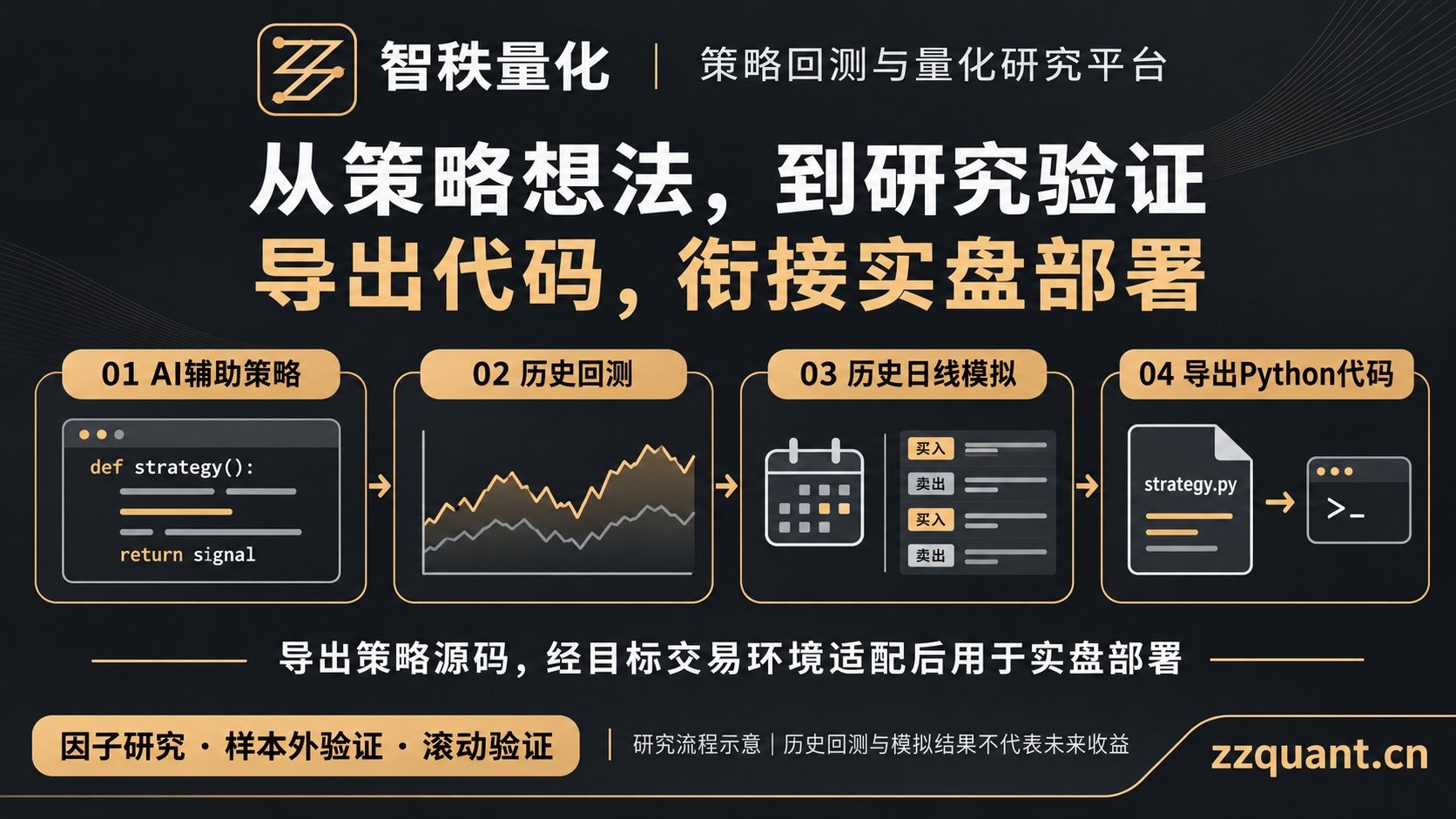
Data, adjusted price rules, expenses and matching rules are pre-set by the platform. People who cannot write code can describe conditions in Chinese, the AI will first restate the rules it understands, and editable code will be generated after the user confirms; the platform also provides 26 directly runnable sample strategies, which are divided into 5 categories: trend, momentum, value, quality and low volatility, marked with difficulty level and required historical data length, and equipped with 8 introductory graphic articles. Users can also run the strategy by writing code manually without using AI or referring to samples.
The credibility of results depends on several details: the interval, benchmark, capital, maximum position limit, commission, stamp duty, transfer fee and slippage are explicitly set before running; T+1 trading rule, trading suspension, price limit, round lot and available capital are built into the matching mechanism; research signals use forward-adjusted market data, and transaction matching uses non-adjusted market data, to avoid overestimating returns caused by transactions executed at adjusted prices. In addition to cumulative return, annualized return, maximum drawdown, Sharpe ratio and excess return, the result page also lists transaction details and reasons for order rejection one by one. The platform also provides fixed out-of-sample verification and fixed parameter rolling verification, and reminds users to check the out-of-sample results before adjusting parameters, to avoid the situation that the strategy fails when it is applied to out-of-sample data. Factor research can check IC and IR, but factors are only responsible for screening signals. Whether the target can be bought and how much is left after deducting fees still needs to be verified through transaction-level backtesting.
The exported source code is adapted and used by users themselves in the target trading environment. The platform does not connect to real funds, does not connect to broker accounts, does not recommend stocks, and does not conduct strategy matching. All result pages are marked with "Historical performance does not represent future returns".
351 Registered Users, Paid Functions Start with AI Points
From October 10 to November 8, 2026, the platform page was visited 11,087 times, with 1,267 visitors, 351 new registered users, and 347 active registered accounts; among them, 140 users saved their strategies, 114 users successfully ran backtesting, and 23 users created simulated trading accounts. Su Zhenpeng pays more attention to the depth of the conversion funnel: 40% of the 351 new registered users saved their strategies, and 32% successfully ran a backtest, which shows that users are indeed guided into the research process instead of staying on the registration page.
Paid functions start with AI points. There are three subscription tiers priced at 19.9 yuan, 99.9 yuan, and 199 yuan per 30 days, and four point recharge tiers from 10 yuan to 200 yuan. Generating new code costs 20 points at a time, and modifying the current code costs 10 points at a time; strategy editing and saving, open historical backtesting, and introductory graphic articles are free of charge, and payment is only required for consumable capabilities such as AI functions and simulated trading accounts.
There is no customer acquisition budget for promotion, and users mainly come from the official WeChat account "Mr. Z's Zhizhi AI Site" — the total views of three articles are about 24,000, and readers are guided to the platform through private message communication.
Su Zhenpeng graduated from Shanghai University with a bachelor's degree and East China Normal University with a master's degree. He has many years of experience in data products, and can independently complete the development of data pipelines, peripheral logic of the backtesting engine and product prototypes. 12 months after financing, the company plans to recruit one back-end/data engineer, one front-end engineer, and one content operation staff respectively, and no sales position will be set. The 3 million yuan financing will be used as follows: 1.2 million yuan for product and R&D, 600,000 yuan for data and cloud resources, 600,000 yuan for content and customer acquisition, 450,000 yuan for team expansion, and 150,000 yuan for legal compliance and reserve funds, with a usage period of 18 months.
In addition to individual subscriptions, the company plans to provide private deployment solutions for economics and management and financial experimental teaching in universities, vocational education institutions, and broker investment advisors, and complete 2 to 3 university pilot projects within 12 months.