KrKr | Li Jian from Honor: Take a user-centric approach, jointly build access points, co-establish trust, and usher in a new paradigm of AI terminal ecosystem in the intelligent economy era
Li Jian, CEO of Honor, delivered a keynote speech at the 2026 Mobile Network Conference, sharing his insights on industrial evolution in the smart economy era around the theme of "User-centric, Co-building Entries, Fostering Trust Jointly, and Co-creating the Future". He proposed that the competition for AI entries is not a zero-sum game of stock, and the industry should be guided by winning user trust, pursue openness and collaboration, return the sovereignty of entries to users, and jointly build a new ecosystem of the smart economy.
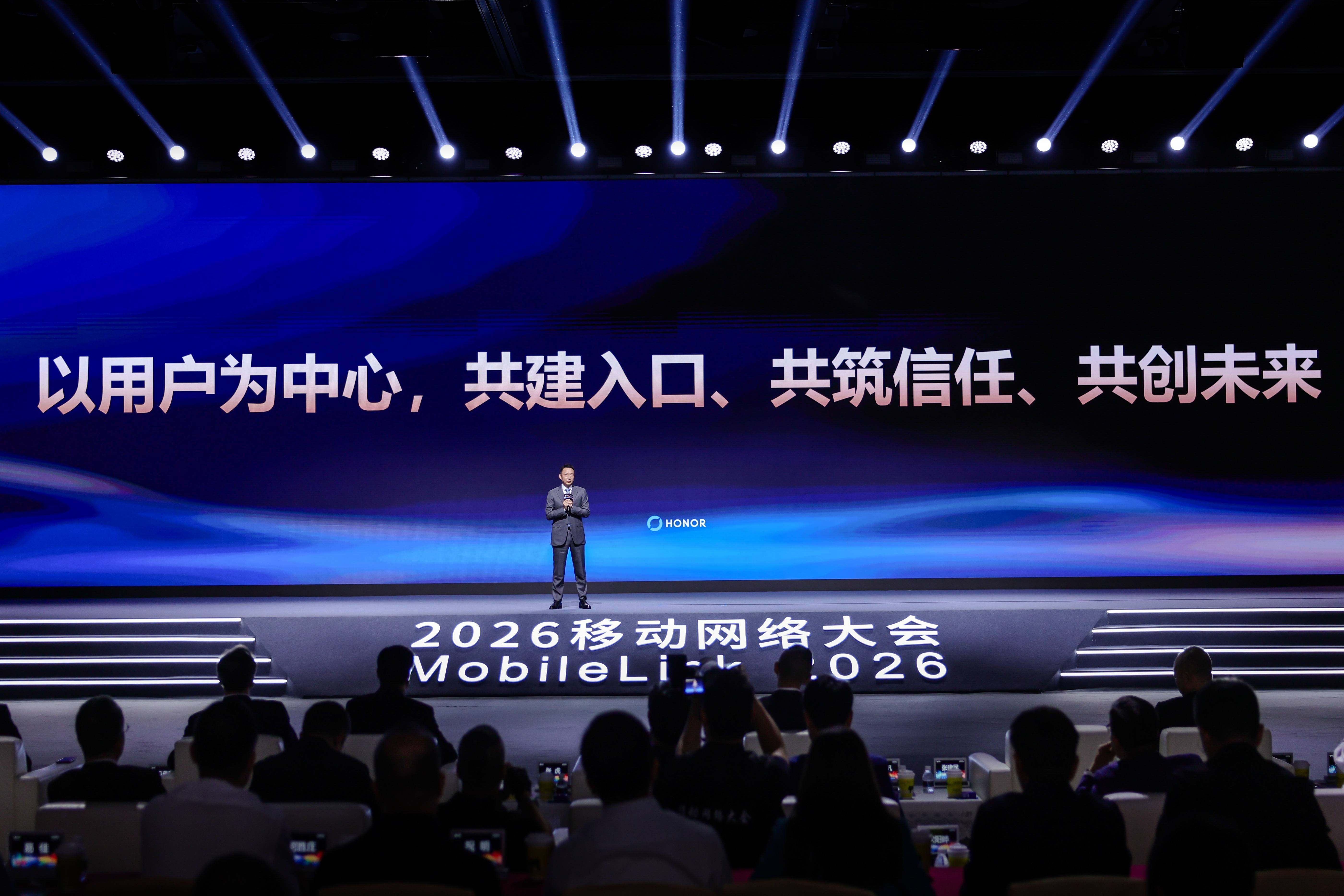
Official photo
Li Jian stated that the deep integration of computing power, large models and embodied intelligence is reshaping the underlying logic of industry, economy and society. AI does not bring partial function fine-tuning, but subversive reconstruction of the workflow and production paradigm of the whole industry. However, at present, users' daily interactions are still mired in the consumption of tedious switching between apps and repeated operations, and most human-computer interactions remain at the stage of "people seeking services".
In Li Jian's view, the core variable that determines the trend of business paradigm is "scarcity". The history of industrial evolution is essentially the process of iteration of scarce elements: in the era of mobile communication economy, connections are sufficient while information is scarce, corresponding to the channel economy of content monetization; in the era of mobile internet economy, attention is scarce, forming the attention economy of traffic monetization; entering the era of smart economy, intention delegation has become a new scarcity, and the business logic has turned to the intention economy of monetization by results. In the past, entries were clickable icons, while in the future, entries will be born the moment users generate intentions, and the core value lies in every result entrusted by users.
From intention generation to result delivery, the whole industry still needs to cross three thresholds. Intelligent capabilities continue to break through boundaries, and long-term memory capabilities make AI more and more empathetic. However, the more proactive intelligent services are, the more prominent the challenges at the trust level: the first is intelligence scarcity, which tests whether AI can be implemented to handle practical affairs; the second is context scarcity, which tests whether AI can understand users. AI does not lack basic capabilities, but lacks perception of user identity, scenarios, demands and past behaviors; the third is trust scarcity, which tests whether AI is worthy of entrustment. Context is the personal sovereign asset of users, and whether to authorize depends on whether AI can be trustworthy, reliable and controllable. "Capability determines how fast AI can go, and trust determines how far AI can go," Li Jian said.
This judgment also echoes the current trend of industry competition. Goldman Sachs' research report at the beginning of the year defined 2026 as a "critical year" for China's internet industry. The industry competition paradigm has shifted from the competition for traffic and scale to the competition for entry control and the realization of business closed loops. Zhong Xiaolei, senior analyst at Omdia, believes that the competition for AI phones is shifting from "competition for App entries" to "competition for AI task scheduling rights". Mobile phone manufacturers assume the role of intention understanding and task scheduling, while internet enterprises provide specific services, and there is still room for game in the distribution of commercial interests.
The Implementation Opinions on Standardized Application and Innovative Development of Agents jointly issued by three departments including the Cyberspace Administration of China clearly take safety, reliability and credibility as the bottom line of industrial development, and this bottom line will eventually fall on the terminals closest to users. The terminal is not only the natural carrier of user intentions, but also the natural shield of trust, which is visible, tangible and deeply embedded in users' lives; data permissions are independently controlled by users and can be stored locally. It is not just a screen, but also the entry of intentions and the exit of trust. Honor's goal is to make intelligence penetrate into every terminal and every scenario of users, promote the spirit of all things and human-computer symbiosis, make intelligence benefit daily life, and finally achieve more empowered people.
As an AI terminal ecosystem company, Honor adheres to the AHI "Human-centric Intelligence" concept, and advocates that the value of AI is to empower people rather than replace them. Following the two dimensions of IQ (Intelligence Quotient) and EQ (Emotion Quotient) proposed earlier, Li Jian added TQ (Trust Quotient) at this conference as the third core dimension of AI evolution. He used the classic 3-lens turret design of the ARRI adopted by Honor Magic9 as a metaphor: IQ, EQ and TQ are the 3-lens turret of Honor AI. Only when the three work in coordination can AI be upgraded from "capable of handling affairs" to "trustworthy"; without the constraint of TQ, the stronger IQ and EQ are, the higher the potential risk will be. Based on this, Honor has created a "user-symbiotic YOYO Agent" — it is an efficient assistant, a user-understanding partner, and even a digital doppelgänger that coexists with users, with the sole mission to understand, empower and protect users.
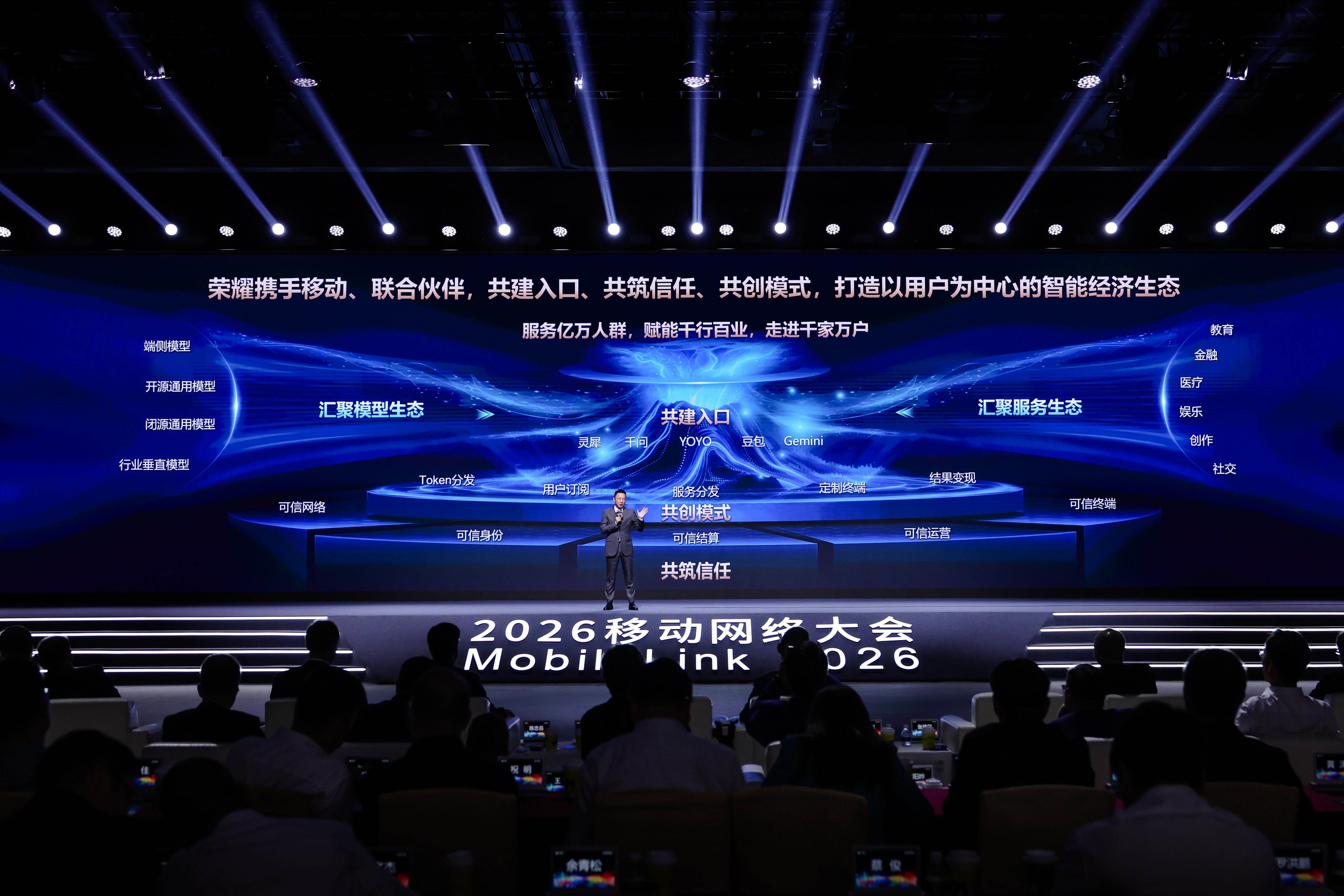
Li Jian said, "There is no need to compete for entries, trust will converge naturally." In the past, the industry often built moats by enclosing walls in a closed manner, but there are no boundaries in users' lives. Fragmented ecological barriers will eventually split the consistent intelligent experience. The entry that Honor aims to build does not mean raising the walls, but widening the paths: one end converges various service ecosystems, based on real user demands and scenarios; the other end converges the model ecosystem, connecting cloud-side models, computing power supply and the whole-chain AI service supply.
Facing the future, Honor will work with China Mobile and ecological partners to create openly, and build a user-centric smart economy ecosystem: co-build entries, YOYO links with partners such as Lingxi, Qianwen, Doubao and Gemini to build an agent network, and provide rich and diversified solutions for differentiated user demands; jointly build trust, and work with China Mobile to build a complete trust chain covering trusted network, trusted identity, trusted settlement, trusted operation and trusted terminals, so that intelligent services are not only efficiency tools, but also reliable partners; co-create new modes, Honor and China Mobile jointly launch the Token package on the customized Honor Magic9 series. Honor will also cooperate with more partners to continuously explore new business models around Token distribution, user subscription, customized terminals and service distribution.
Official photo
Li Jian quoted relevant statements from the Wuzhen World Internet Conference and said that technology should enhance people's capabilities, expand people's choices, highlight people's value, and improve people's well-being. The scale of technology is ultimately the scale of human beings. "In the past, the entry was an APP icon; today, the entry is the moment when the user generates an intention," Li Jian said. The interaction paradigm is shifting from clicking icons to direct intention delivery. In the future, entries do not belong to any single manufacturer. What the industry really needs to answer is not "who owns the entry", but "how to deliver the best experience to users". When intentions become entries, Agents act autonomously, and intelligence is everywhere, the sovereignty of entries belongs to users, the foundation of intelligence lies in trust, and the future of AI lies in co-creation.