To get iOS users to view the shake-to-trigger ads, Baidu Netdisk has come up with a bizarre trick.
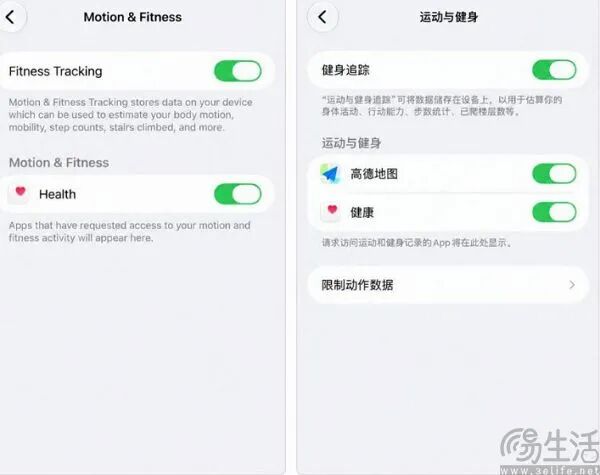
Recently, Apple rolled out the official version of iOS 27.2. In addition to improving the fluency, battery life and signal performance of iPhones, domestic users have also got a long-awaited new feature — Restrict Motion Data.

In fact, the Restrict Motion Data feature only serves one purpose: users can actively add apps to the designated list, and those apps will immediately lose the permission to access gyroscope and accelerometer data. As is known to all, the widely detested "shake-to-jump ads" are exactly implemented by sensing changes in the phone's posture based on gyroscope and accelerometer data to trigger ad redirects.
When apps lose the permission to read gyroscope and accelerometer data, the shake-to-jump ads will naturally stop working. However, real-world tests by a large number of iOS users show that the vast majority of apps on the market are effectively restricted by this feature, with only Baidu Netdisk slipping through the net: even after its access to relevant motion data is restricted, its shake-to-jump ads still function normally.
This raises a question: why can Baidu Netdisk break away from the restriction? Its product team has perfectly interpreted the saying that "there are always countermeasures against policies". When it comes to sensing changes in the phone's posture, they did not adopt the industry-standard solution, but blazed a unique path of their own.

The gyroscope and accelerometer targeted by the Restrict Motion Data feature in iOS 27.2 are exactly the industry's "standard answer". The gyroscope is used to measure angular velocity, and then calculates whether the phone is rotated or deflected through changes in angular velocity, while the accelerometer senses whether the phone is rolled or pitched through changes in gravity. Developers only need to set the call precision of the gyroscope and accelerometer to the millisecond level, and even the slightest shake of the phone, even when the user is not actively shaking it, can be captured by the app.
This is also why many users are confused: they clearly did not move their hands when opening the app, but the splash ad automatically redirects. If traditional splash ads play tricks on the "skip" button, users can still tolerate it, since accidental misclicks are considered their own operation errors. But shake-to-jump ads are different: users clearly do not move their hands, yet the ad still redirects, which makes people feel like they are being fooled.
Banning apps from reading data collected by the gyroscope and accelerometer to cut off the shake-to-jump ads at the source, Apple's approach can be described as a "radical cure". However, as the saying goes, "the law rises one foot, the devil rises ten". After analyzing the splash ad redirection logic of Baidu Netdisk with AI, some developers found that it uses a little-known motion sensor to obtain changes in the phone's posture, that is, the magnetometer.

In short, Baidu Netdisk applies the geomagnetic navigation theory to the perception of mobile phone posture, and judges whether the phone is "shaken" through changes in the magnetic field. After analyzing the ad redirection logic of Baidu Netdisk version 13.36.0 (released on October 22, 2026), some developers found that there is a variant called NoShake in its framework. Instead of using the conventional CoreMotion motion data framework to monitor the raw data of accelerometer and gyroscope, it uses the CLHeading interface of the CoreLocation framework to read magnetometer data.
CoreLocation is the positioning service framework of iPhone, in which CLHeading is responsible for providing magnetic heading, the orientation of the device relative to the geomagnetic north pole, and three-axis magnetic field data. CLHeading is usually used in navigation applications, and the function of checking the movement of delivery riders on the map of Meituan Waimai is implemented through this API.
Since the geomagnetic vector (magnetic dip) is inclined (about 50–60° in most areas of China) rather than vertical, to keep the magnetometer reading of the mobile phone unchanged, the phone has to be kept at an angle consistent with the magnetic dip of the geomagnetic field, which is obviously a very unnatural movement. Therefore, once the posture of the phone changes, the reading returned by the magnetometer will change accordingly, and the Baidu Netdisk app will judge that you are shaking the phone for this reason, and immediately redirect to the ad page.
One has to admire the wild imagination of this product manager who came up with such a novel trick. Then, why does Baidu Netdisk insist on forcing users to watch ads? There is no doubt that cloud storage is not a lucrative business. Almost every "hero" who tries to change the rules of the cloud storage industry will eventually turn into a new "evil dragon".
The operating cost of cloud storage is extremely high. Although the upfront hardware investment such as data centers can "hitch a ride" on cloud services, the consumption of broadband resources and subsequent maintenance are long-term and high expenses. Moreover, in the cloud storage war more than a decade ago, participants including Baidu Netdisk competed to offer huge storage space, giving users dozens or even hundreds of TB of storage space for free, which made the monetization path of "selling storage space" almost unworkable. Otherwise, why are all major cloud storage platforms scrambling to hype the AI concept now?
Therefore, Baidu Netdisk has to choose to monetize by clearly differentiating the file download speed between paid members and non-members. However, ordinary users do not value their time that much, and many of them can tolerate the dial-up-level download speed for non-members. In Baidu's financial reports, the only data that can be presented about the cloud storage business is monthly active users, and there is almost no trace of description of its revenue scale.

To make matters worse, AI is also making Baidu Netdisk's membership business unsustainable. With the prevalence of vibe coding and wishful programming, as well as the emergence of AI decompilation tools similar to REA (Reverse Engineer Anything), open source projects such as OpenSpeedy that bypass Baidu Netdisk's speed limit are popping up everywhere on GitHub. At the same time, office agents such as WorkBuddy and Doubao Work have simplified operations like GitHub file download and environment configuration, making cracking the cloud storage speed limit no longer a niche black technology.
Once more and more users learn that the speed limit can be bypassed, ads will become the only remaining profitable source for cloud storage. In fact, it is not that Baidu Netdisk's product managers deliberately make things difficult for users, but the market environment forces them to take this desperate measure. Although insisting on running shake-to-jump ads is like drinking poison to quench thirst, giving up on them is no different from committing economic suicide.
All images in this article are sourced from the Internet.
This article is from the WeChat Official Account "Three Easy Life" (ID: IT-3eLife), written by San Yijun, and republished with authorization from 36Kr.