ByteDance's Coze and Tencent's Yuanqi have been successively taken offline: The reshuffling and elimination wave of AI products from major tech giants
Recently, Coze, the AI application development platform under ByteDance, released the "Announcement on the Offline of Coze Enterprise Edition". The Enterprise Standard Edition and Enterprise Flagship Edition will stop accepting new customer purchases from November 30, 2026, and the existing packages will be fully offline no later than December 31, 2027, with the unused part beyond the validity period automatically refunded.
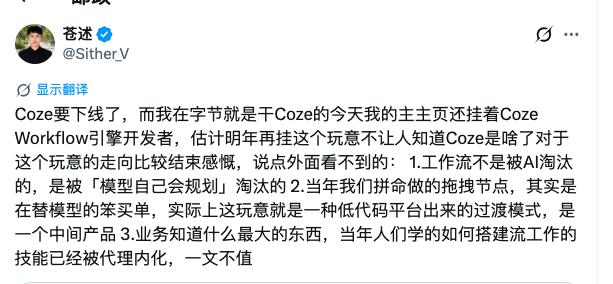
A self-proclaimed former Coze employee of ByteDance said that workflow products like Coze were not eliminated by AI, but eliminated by "the model that can plan by itself". In other words, with the continuous improvement of model capabilities, it is inevitable that transition platforms requiring low-code like Coze will be eliminated.
Coincidentally, also in October, Tencent Yuanqi entered the service suspension process. In the official notice released by the Yuanqi team on October 8, it stated that due to business adjustments, the platform will officially stop services on November 9, 2026, and the existing agents will be unavailable by then.
As Agent development platforms, two similar products have come to an end one after another.
Coze Enterprise Edition was launched in the second half of 2025, and the offline process was started after more than one year of operation; Tencent Yuanqi was released in May 2024, and the service was shut down after more than two years of operation.
Tencent QClaw, which was once extremely popular, has an even shorter life cycle. This product, which focuses on remotely controlling computers to complete tasks via mobile phones, was launched in March 2026. The number of people queuing for the first launch reservation exceeded 100,000, and it was officially announced in September of the same year that it would be shut down in December, leaving only 9 months of operation time.
According to incomplete statistics from Tech Planet, 38 products have been shut down or merged, including those from large manufacturers such as Alibaba, ByteDance, Tencent, and Baidu, as well as startups such as Moonshot AI and MiniMax.
In the past two years, large manufacturers have scrambled to launch AI search, AI writing, AI painting, agent platforms, and AI office assistants, trying to find the next traffic entry through extensive deployment. Now, with the upgrading of large model capabilities and the gradual deepening of the commercialization of AI applications, this way of repeatedly deploying product lines is changing.
The first round of trial and error wave of AI applications is receding.
25 Products Shut Down and Merged in Clusters, the Trial-and-Error Wave of AI Products of Large Manufacturers Recedes
The integration actions of domestic leading large manufacturers on AI products broke out intensively in the second half of this year. ByteDance, Tencent, Alibaba and other large manufacturers almost simultaneously started to consolidate their product lines. According to incomplete statistics from Tech Planet, 25 products have been shut down or merged. The core idea of large manufacturers is to merge scattered and independent AI product lines and project teams into the group's main AI business.
On July 20, Tencent incorporated the QClaw related business and part of the team into the WorkBuddy department; on July 30, ByteDance issued an internal document to promote the merger of the Feishu and Doubao product teams.
Entering August, the integration pace further accelerated. On August 3, Alibaba integrated three products including QoderWork, MuleRun and Wukong into Tongyi Office; on August 6, Baidu incorporated dodo into Baidu Dazi; on August 24, ByteDance completed the overall integration of the TRAE and Coze teams into Doubao, and Doubao Work was released to the public the next day.
In less than two months, multiple AI product lines that were previously running in parallel for trial and error have been successively brought under the main business. Before and after that, a large number of AI products of various manufacturers have been shut down and offline one after another.
In this round of adjustment, multiple products of Tencent have undergone adjustments one after another.
Translator King, which has been online for nearly ten years, was officially offline on March 13, 2025, and its related capabilities were migrated to Yuanbao; Zhiying, which focuses on digital human production, completed the transformation on June 30, 2025, and cleared all user data. QClaw, which only started public beta on March 20 this year, released the shutdown announcement on September 24. The product will stop service on December 24, and the data backup window will be open until March 24, 2027. Shortly afterwards, Yuanqi confirmed that the service will be suspended on November 9, guiding users to migrate to the Tencent Cloud ADP platform.
On ByteDance's side, a series of products have also completed adjustments one after another.
Volcano Writing, which was launched in 2023, shut down its site and redirected to Doubao on December 31 of the following year, and historical content will not be migrated; Little Wukong, renamed from Wukong Search and positioned as a multi-functional AI tool platform, stopped updating in October 2024 and was removed from the app store the next year; the MarsCode programming assistant was renamed as the TRAE plugin, and the team of the AI camera product Xinghui was fully incorporated into Doubao.
ByteDance's adjustments are still continuing this year. On July 15, Doubao offline the self-built agent function, and users were diverted to Maoxiang; on October 29, Coze Enterprise Edition also entered the countdown to exit.
After this round of adjustment, ByteDance's AI layout context is very clear: the C-end relies on the Doubao App, the B-end office scenario is handed over to Feishu and Doubao Work, and the underlying computing power and enterprise delivery business are undertaken by Volcano Engine.
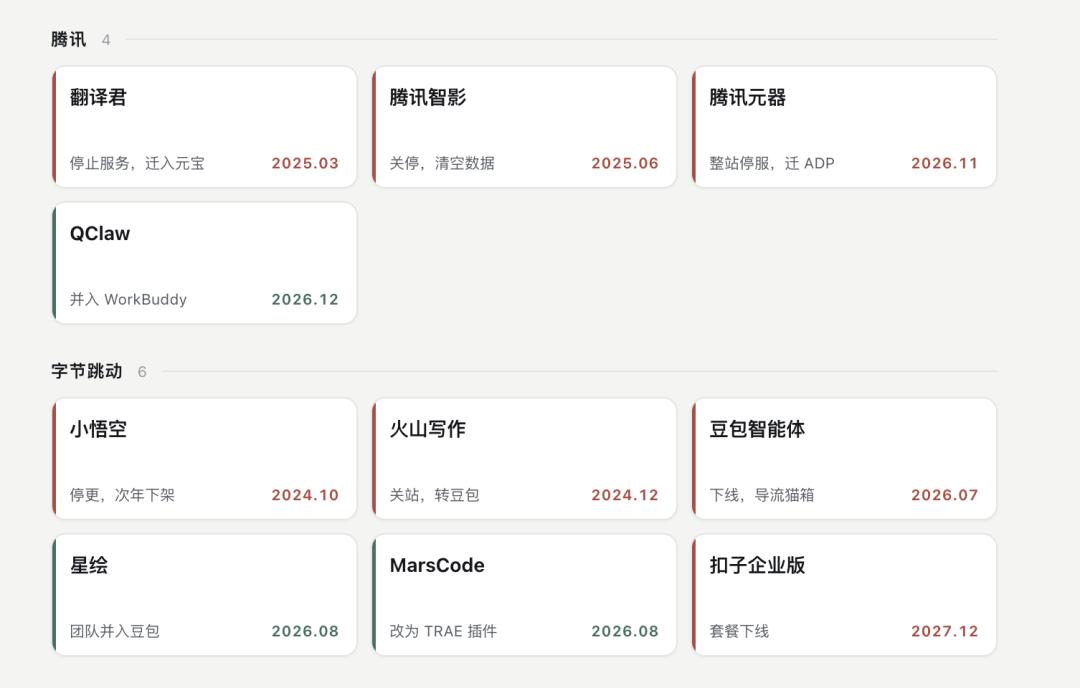
(Incomplete statistics from Tech Planet, the accompanying picture is AI-generated)
On Alibaba's side, Luban, an AI design product launched in 2015, officially stopped service on June 30, 2025; Tongyi Tingwu, an AI assistant for audio and video processing, canceled its independent App identity and was incorporated into Tongyi; in mid-July, Tongyi offline the anthropomorphic and user self-built agent functions, and completed the merger of three Agent product lines into Tongyi Office on August 3.
Tizi AI, Baidu's product focusing on "ad-free intelligent search", was shut down on March 4 this year and incorporated into Wenxin, with a life cycle of only half a year from launch to demise; Wenxin Yige and Wenxin Kuaima were also integrated into Wenxin Yiyan and Baidu Dazi respectively. Xixiang, the super agent App launched by Baidu at its developer conference, also only appeared in the public eye for less than three months.
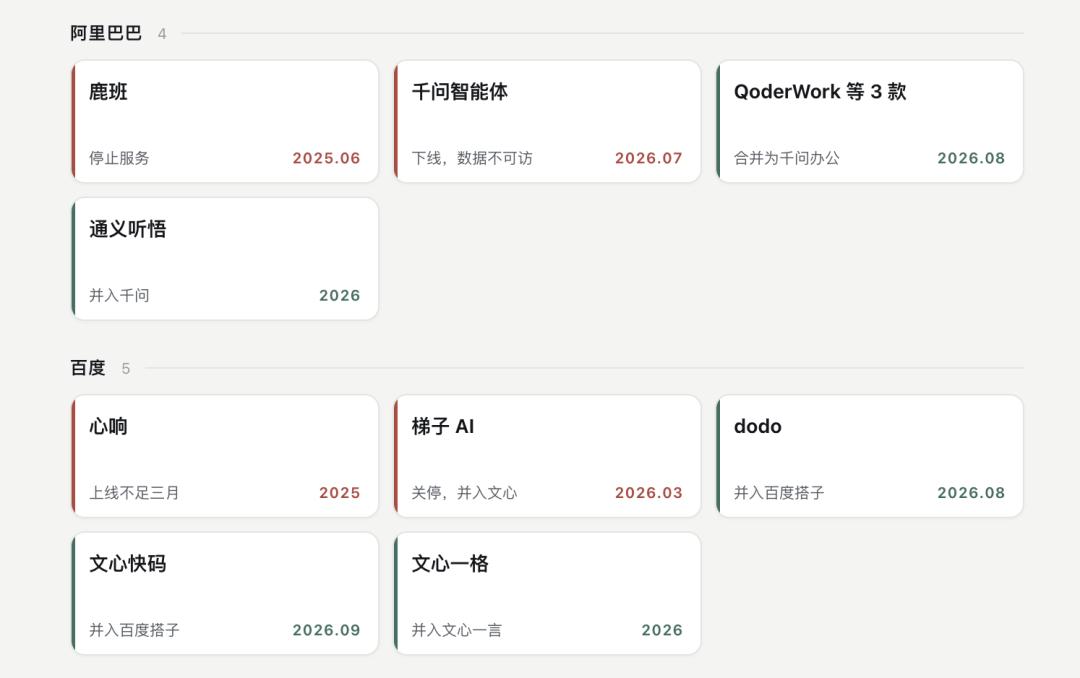
(Incomplete statistics from Tech Planet, the accompanying picture is AI-generated)
Other manufacturers are also cleaning up early AI projects. Xiaohongshu's AI painting tool Trik AI was offline due to infringement disputes, and its successor Qiyu AI was shut down in June 2025; Meituan's AI chat application "Wow" officially shut down the server in December 2025; NetEase Cloud Music's AI emotional companion App Miaoshi stopped operation on July 14, and miHoYo's Steam early access AI companion product "BSide: Olivia Lin" was removed from the shelves only one and a half months after its early access launch.
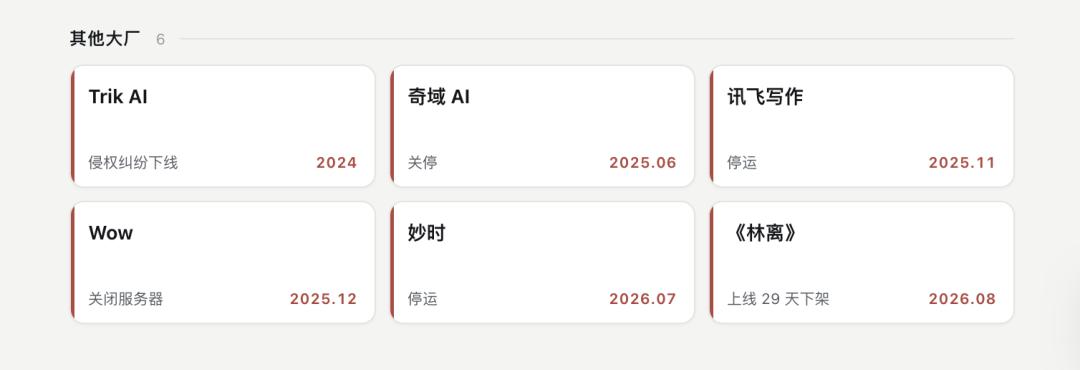
(Incomplete statistics from Tech Planet, the accompanying picture is AI-generated)
In the past, large manufacturers hoped to occupy different entrances through multiple independent products to cover user needs as much as possible. Now, they are more inclined to make AI capabilities an integral part of core products.
Differentiated Trial-and-Error Logic, Unicorns Narrow Product Layout and Focus on Main Lines
While shutting down and merging products, the trade-off logic of startups is completely different from that of large manufacturers.
When a large manufacturer shuts down a product, it can usually transfer the technology, users and team to other businesses; once a startup cuts off a product line, it often means that the business attempt behind it has ended.
They do not have a huge internal product matrix to undertake the offline capabilities, and most of the adjustments are to cut off side projects and put all funds, computing power and manpower on the main line.
Many unicorns' adjustments are to actively cut off experimental projects and concentrate resources to consolidate core products.
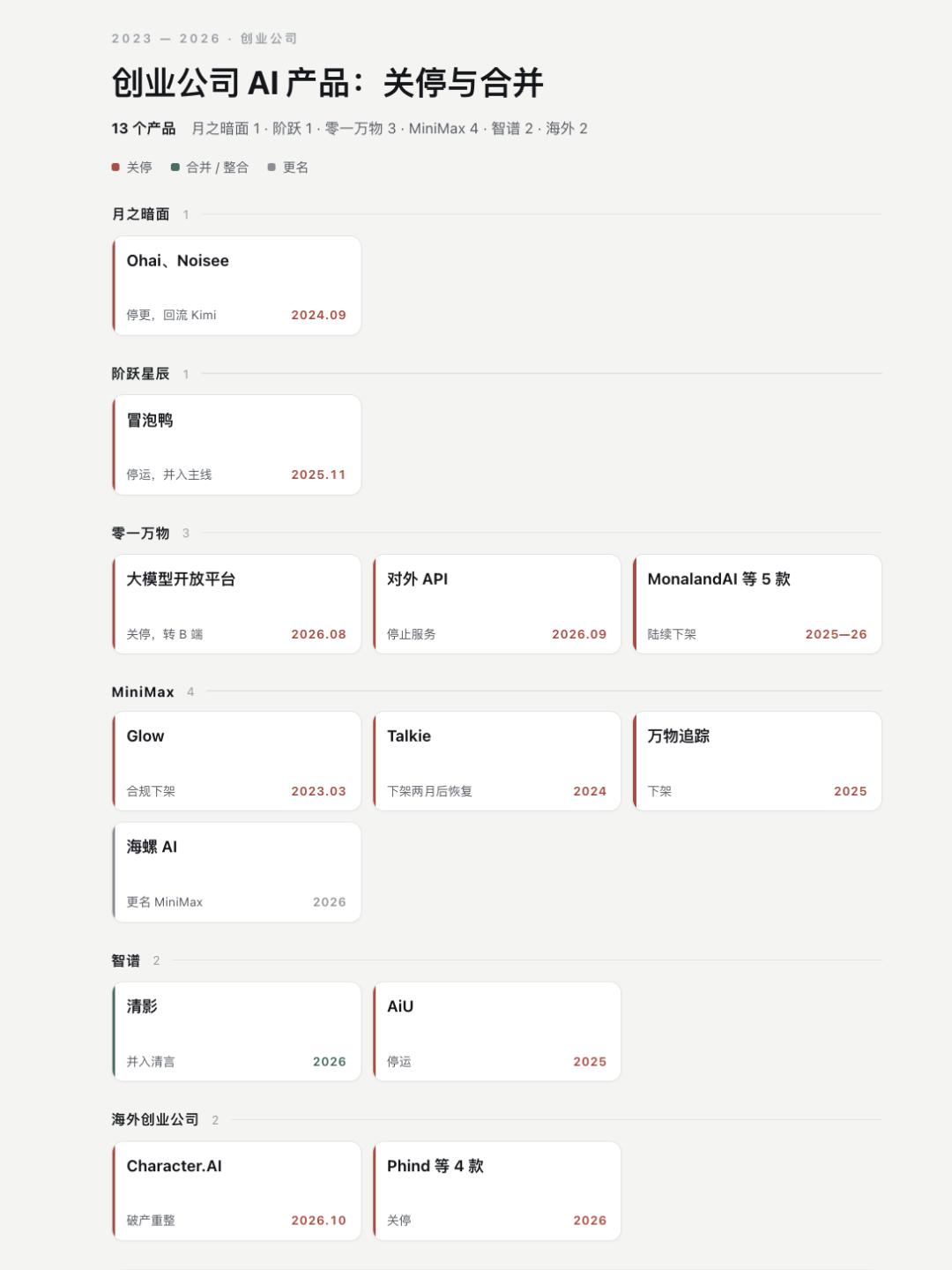
(Incomplete statistics from Tech Planet, the accompanying picture is AI-generated)
Moonshot AI tested the role chat product Ohai and the audio and video generation tool Noisee overseas in the first half of 2024, stopped iteration in September of the same year, and all resources flowed back to Kimi. Even so, after the launch of Kimi K3 this year, the user request volume once approached the upper limit of computing power.
Bubble Duck, a role-playing Agent product of StepFun, was launched in April 2024, and the total downloads across all platforms exceeded 6 million. As the company's focus shifted to basic large model R&D, the Bubble Duck team was incorporated into the main line, and the product stopped operation on November 5, 2025.
01.AI also announced on August 3, 2026 that it would shut down the large model platform open to the public, and stopped external API services on September 3, which means that it officially gave up the C-end open platform for ordinary developers and individual users, fully shrank its front, and focused on B-end business providing AI solutions for enterprise customers.
Prior to that, it had successively removed multiple exploratory products: virtual companion product MonalandAI, AI efficiency tool Wanzhi, AI search App Beago, Shado focusing on acquaintance socializing, and overseas stranger social product Bingo.AI.
There are also some products that retain their brand logos, but their business boundaries continue to shrink.
MiniMax uniformly upgraded the Conch AI brand to MiniMax, and the original brand's focus shifted to video business.
Its virtual character chat application Glow was removed from the shelves in March 2023 due to compliance issues, and was later split into domestic product Xingye and overseas product Talkie for re-launch. Talkie was also removed from the shelves by Apple in 2024 and was suspended for two months before resuming operation.
The RSS AI information assistant Wanwu Tracking, which was previously very popular on Xiaohongshu, has also been removed from the shelves.
Zhipu also consolidated its product lines, the capabilities of the text-to-video product Qingying were incorporated into Zhipu Qingyan, and the domestic virtual companion product AiU also stopped operation.
Compared with large manufacturers, startups have much narrower fault tolerance space. When large manufacturers shut down products, users and capabilities can be undertaken by other businesses within the group, and service suspension is more like internal business transfer.
However, startups lack continuous support from existing scenarios and traffic entrances, and their computing power and capital reserves are limited. Every branch line is consuming core resources. Once the track cools down and commercialization fails to meet expectations, they have no extra business foundation to fall back on.
Models Swallow Everything, Independent AI Products Enter the Value Verification Period
In IDC's "2025 China Agent Development Platform Market Share Report", Coze once won 19.3% of the public cloud market share of China's agent development platform in 2025, ranking first.
However, corresponding market calculation data shows that the overall scale of the agent development public cloud in that year was only 250 million yuan. The reality behind the first share is that the overall market space of the track is limited.
Different from traditional Internet products that build migration thresholds by relying on user usage habits, the moat of AI products is inherently weak. With the narrow market space and several inherent shortcomings, a large number of independent AI tools eventually move towards shutdown and merger, and the reasons can be roughly divided into three categories.
The first category is that product capabilities are directly incorporated into the group's main business, and large models swallow everything.
The functions of tools such as Translator King, Luban, and Tongyi Tingwu are gradually covered by general large model assistants; QClaw is incorporated into WorkBuddy, Wukong is integrated into Tongyi Office, and Coze is consolidated into Doubao, all following the same logic.
The value of such products is limited to a single point of function, and the iteration of the large model version can directly cover its capabilities. The AI writing function that could be sold separately in the past is now a basic capability that comes with general models. Most of this type of integration occurs within large manufacturers, relying on their own main products to undertake capabilities.
In the past, if users wanted to complete an industry research report, they might need to open search tools, document tools, data analysis tools and writing tools separately. Now, models with Agent capabilities can already understand task goals, decompose execution steps, call search, code and file processing tools, and finally deliver a complete result.
Processes that previously required manual configuration are gradually becoming tasks that models can plan autonomously. This is also one of the changes faced by agent development platforms such as Coze and Yuanqi.
The second category is that compliance requirements delineate business boundaries.
In April 2026, five departments issued the "Interim Measures for the Management of Artificial Intelligence Anthropomorphic Interactive Services", which officially came into effect on July 15. "Emotional dependence" was clearly included in the regulatory red line. In mid-July, Doubao, Tongyi and Yuanbao simultaneously offline the self-built agent function, affecting more than 8 million roles.
In the past two years, various manufacturers were still working hard to build agent squares, and choosing to shut down the entrance in a short period of time is essentially that compliance costs cannot match business returns, and the AI companion track has been hit the most significantly.
The third category is that the business model itself is not feasible.
The computing power cost of such products is bound to the user's usage duration. The more users use it, the more losses the platform incurs. Overseas Character.AI has 12 million active users, but still has to bear nearly 10 million US dollars in losses every month. When the willingness of users to pay for an AI product is low, it is difficult to cover the continuously rising computing power expenses.
Nowadays, market supply is still expanding. At the end of 2024, there were 302 registered generative AI services in China; by August 31 this year, the total number of registrations reached 1112, and another 731 generative AI applications or functions completed registration. More and more AI products are pouring into the market, and the scarcity of single-point capabilities is disappearing rapidly.