China's embodied intelligence going global is far more than simply selling robots overseas.
In April 2025, during Tesla's Q1 earnings call, Morgan Stanley analyst Adam Jonas asked Elon Musk who is leading between China and the United States in the field of physical AI such as humanoid robots.
Musk was very confident that Tesla would take the first place, but his next sentence shifted the topic to China. He believed that China's story of overtaking on curves in new energy vehicles might repeat itself in embodied intelligence. "I'm a little worried that on the (robot) leaderboard, the second to tenth places will all be Chinese companies."
More than a year has passed, it is still difficult to rank global robot companies. But the trend Musk predicted that "Chinese embodied intelligence enterprises are going global" is becoming a reality.
According to data from Yiou Think Tank, among the 182 embodied enterprises that have received financing in its statistics, 73 have achieved overseas expansion, and 21 are under preparation, accounting for about 51.6% of the total.
Wang Xingxing, founder of Unitree, once said that overseas business accounted for about 50% of the company's annual performance in the past. A number of embodied intelligence enterprises such as Agibot and UBTech have tacitly put globalization and overseas expansion at the center of the stage in their strategic plans and press conferences this year, and the demand for overseas talent recruitment in the embodied field has also risen accordingly.
In addition to selling robots overseas, Chinese embodied intelligence enterprises are also making continuous efforts at the "brain layer", participating in the co-construction of the global technology ecosystem by adhering to the open source of general large models for embodied intelligence. Taking Ant Lingbo as an example, the LingBot series models have accumulated more than 33,000 Stars on GitHub, with downloads exceeding 2.2 million.
This is a structural turning point. Going global is becoming another incremental growth curve for China's embodied intelligence. From winning overseas attention through ontology manufacturing and motion control, to entering the global competition coordinate with general model capabilities, China's embodied intelligence is standing on the world stage in different ways.
01
Chinese Embodied Intelligence Going Global Is No Longer an Optional Choice
It is not new for Chinese embodied intelligence enterprises to go global.
Overseas investment banks including Morgan Stanley have repeatedly raised their forecasts for the shipment volume of Chinese humanoid robots, and one of the core reasons is precisely the overseas opportunities. According to the data they provided, among the 13,000 to 16,000 humanoid robots shipped globally in 2025, Chinese manufacturers account for about 90%, and on average, 9 out of every 10 robots sold come from China.
Analysts from Morgan Stanley even believe that the humanoid robot and robotics industry will become the next key driving force for China's machinery exports in the next 5 to 10 years. "It is similar to the electric vehicle industry a decade ago."
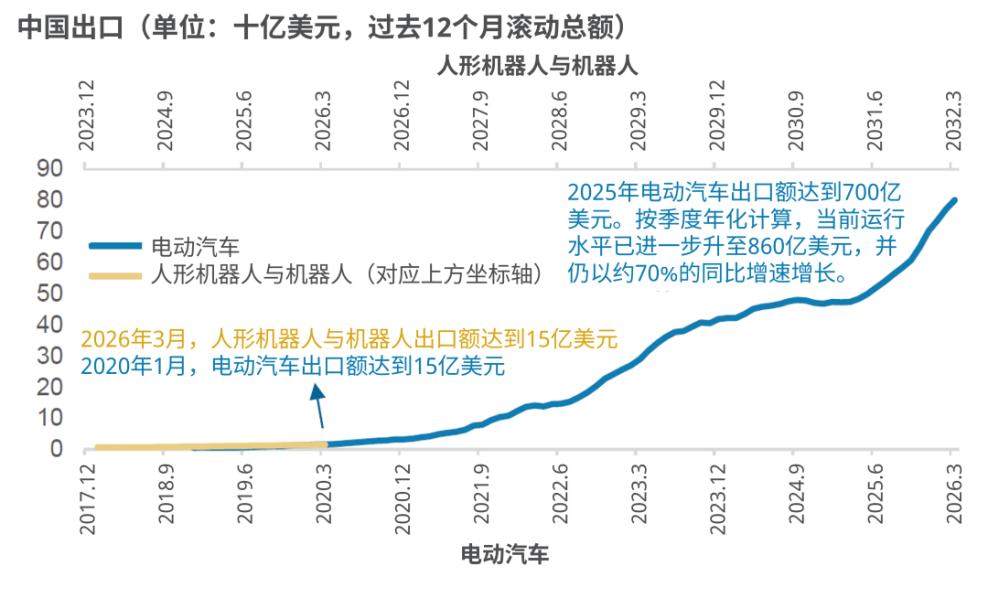
Source: CEIC, Haver, Morgan Stanley Research
Behind this "wave of embodied intelligence going global" is China's unique combined advantages in physical AI, which can be specifically divided into three layers:
The first layer is ontology - cerebellum: China has a complete supply chain, supporting spare parts, as well as advantages in cost and delivery speed. At the same time, a large number of embodied intelligence enterprises that have long adhered to the "cerebellum first" principle have accumulated leading cerebellum motion control capabilities, accelerating the integration of software and hardware.
The second layer is scenario - data: China's rich manufacturing and service scenarios provide conditions for robots to carry out real task verification, collect interactive data and conduct continuous iteration. The experience accumulated in real scenarios helps to improve product and model capabilities, and lays a foundation for expanding overseas applications.
The third layer is open source - brain: Through open source, we are committed to transforming the local innovation experience of China's embodied general models into a key force of global embodied technology infrastructure. In the global developer collaboration and co-construction of technology and industrial ecology, the technical influence and ecological discourse power of China's embodied intelligence continue to expand.
It can be seen that the three layers of combined advantages support each other, jointly promoting today's China's embodied intelligence going global, extending from hardware product export to model capability opening and global ecological collaboration. What supports this key process is the advantages of manufacturing and supply chain, data accumulation and capability iteration in real scenarios, and the participation of global developers brought by open source.
02
China's Embodied Brain Rejects "Cross-Server Communication Barriers"
If the problems solved by the ontology and cerebellum are "can be manufactured and move stably", the advantages of China's embodied intelligence are self-evident. On the contrary, as the core force of China's embodied brain that enables robots to perceive, make decisions and drive their bodies to complete tasks, it is underestimated to a certain extent.
The reason for being underestimated is very simple, which comes from the inherent consensus in the industry: China's embodied intelligence is strong in hardware and ontology, while the United States is strong in brain and models. With the emergence of GPT-6 Astra, the discussion about "whether large language models will eat up embodied models" has sounded again.

Figure | US magazine Wired reports on Chinese robots
But as many insiders said, the value of this discussion is not to decide the winner of the technical route, but to promote the industry to return to pragmatism: return to real tasks and the physical world, and re-examine what capabilities robots really need.
From "being able to understand" to "being able to work", after understanding tasks and making plans, robots also need to predict how actions will change the environment, continuously correct according to execution feedback, and meet the requirements of real-time response. These specific demands not only put forward new topics for model training objectives, architecture and reasoning methods, but also leave space for Chinese embodied teams to contribute fundamental innovations.
Long before the industry debated "whether large models can do everything", many Chinese embodied teams had begun to give their own answers, and Ant Lingbo's exploration of "embodied native" is one of them.
In LingBot-VA 2.0 released in July this year, the Ant Lingbo team chose to pre-train the causal video-action model from scratch, so that the model can learn the relationship between environmental changes and actions, and use the latest observations to correct predictions during the execution process.
The so-called "embodied native" is not difficult to understand. From the very beginning of design, the model revolves around the perception, prediction and action required by robots to complete tasks in the real physical world. More importantly, this also means that Chinese embodied brain enterprises have begun to independently build a native technical route.
To judge whether such a technical route is valuable, in addition to looking at Lingbo's own tests, we also need to see which parts external teams have chosen and what they have done after the model is opened.
The first type of usage is to continue research with the work of Chinese teams.
Researchers at Stanford University's Vision and Learning Lab want to know that there are so many world action models today, but the model base, training methods and data adopted by each company are different. How to judge which design brings about the improvement of capabilities?
The team therefore wanted to build a combinable research framework that allows different video-action interaction methods to be compared in a "uniform examination paper", which is the starting point of the OpenWAM project released in October. At the implementation layer, they directly reused the Transformer architecture, text encoder and tokenizer of LingBot-VA as the reference implementation of the entire framework.
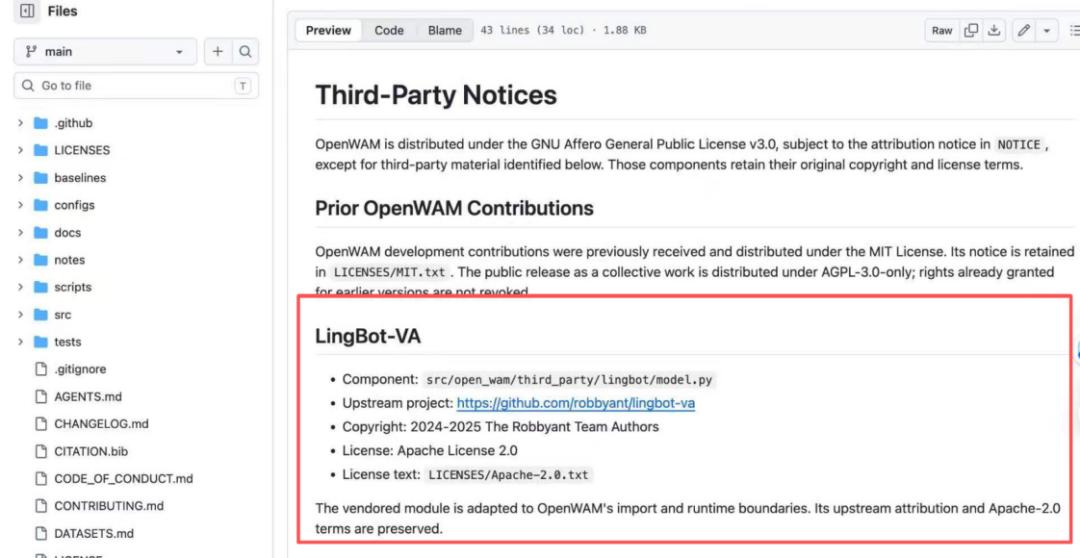
Researchers from the National University of Singapore targeted another difficult problem in embodied intelligence: when the world model generates long-term interactions, how to "remember" the previously generated scenes without getting slower and slower due to the accumulation of historical information?
To this end, they proposed a spatial memory method called Velox that makes the world model run faster and faster. The core idea is not to delete the world memory, but to make the current frame only read the really relevant historical areas. The key to achieving this is not to retrain a new world model, but to take LingBot-Fast-Cam as the base, do not modify the pre-trained generator, and only add a spatial information filtering mechanism in the reasoning stage, so that the model can read the historical content really related to the current frame according to the camera perspective and depth information.
Finally, in 158 WBench navigation cases, its API-free average score is only 0.15 points different from that based on the same LingBot-Fast-Cam, which shows that Velox basically maintains the generation quality while alleviating the problem that long-sequence generation becomes slower and slower later.
The second type of usage is to modify the model into tools that more people can operate.
For ordinary developers, no matter how advanced the model capability is, it is difficult to really use it if it only stays in papers or top-level devices. In the final analysis, the value of a model will eventually be tested by countless developers who use and transform it.
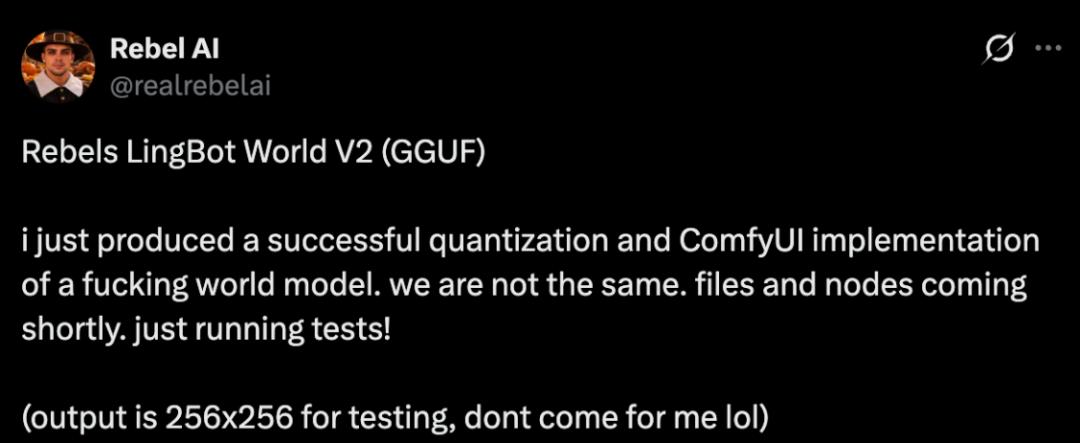
Developer RealRebelAI connected LingBot-World v2 to ComfyUI, which is familiar to creators. Users can drag in images and arrange the camera movement route to generate subsequent frames. In order to make this process run on the computer, he quantified the model and loaded it layer by layer, and ran the test on RTX 3070 8GB. The world model began to enter the workflow of ordinary developers from the laboratory.
Developer Don Allen III made a Mac desktop tool based on LingBot-Map. Users can drag the video into the window to start reconstruction locally on Apple Silicon, check the progress, and after completion, they can rotate, overlook the 3D point cloud, review the camera trajectory and save the results. The spatial understanding ability originally hidden in the code and weights has become an intuitively operable, fully visualized desktop application.
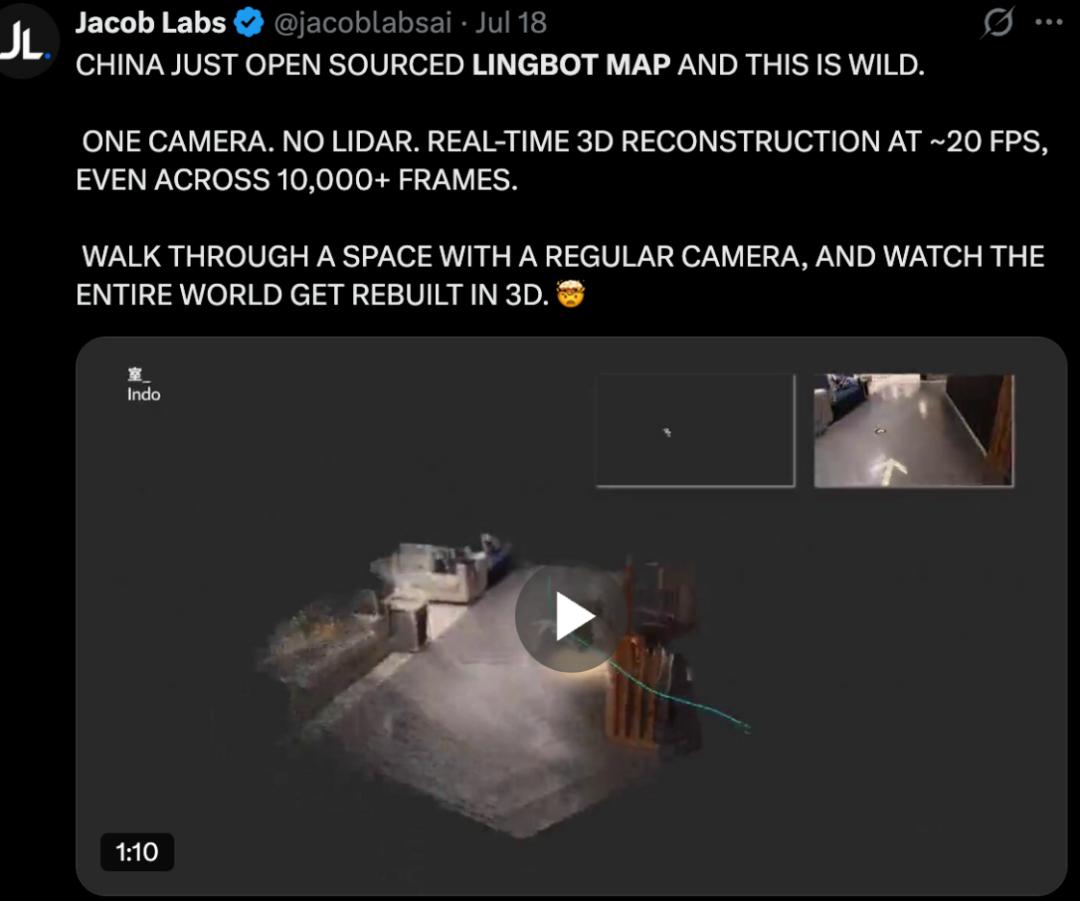
The practice of front-line community developers confirms that Chinese embodied model enterprises not only reduce the threshold of model use, but also reduce the cost for latecomers to continue innovation. The code, experience and workflow left by ordinary developers will be reused, improved by the next developer, and then passed on to more people. Individual attempts thus form a diffusion effect, and the open source ecology is activated in relay after relay.
The third type of usage is to connect the model to the existing tool chain of the engineering team.
Whether the open source embodied brain can produce practical value also depends on whether it can enter the tool chain of the industrial ecology.
NVIDIA added support for LingBot-World in its open source reasoning library FlashDreams, allowing developers to use this set of tools to run world models that can control camera movement. AWS Labs set LingBot-World-Fast as the default EC2 deployment path and flagship entry in its open source world model deployment project. According to the steps given by the project, developers can configure computing power in the cloud, load weights and call the video generation service.
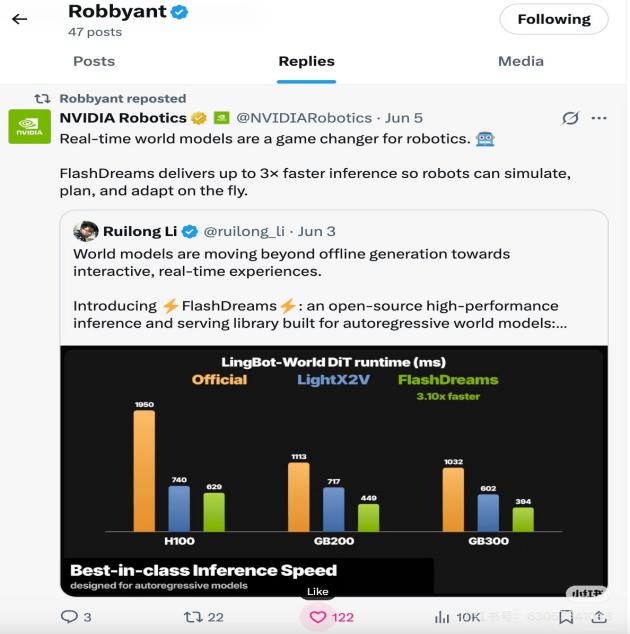
Some influences remain in the papers.
NVIDIA's SANA-WM team used LingBot-World as a control for generating picture quality. When Generalist discussed how robots can quickly learn new tasks through one or a few demonstrations, it included LingBot-VA 2.0 as a relevant research reference; Dyna Robotics also cited LingBot-VA when comparing world action models with VLA.
Overseas peers have given their own answers respectively to why a paper is worth comparing, why a piece of code is worth keeping, and why a model is worth making special deployment adaptation.
03
The More Open Chinese Embodied Intelligence Sails Towards the Age of Discovery
History will not repeat itself, but it will rhyme.
Looking back at each round of China's technological development and breakthrough, the answer is not only cost and speed, but also the connection, reuse and co-creation brought by openness. The Internet and large models are like this, and so is embodied intelligence.
To understand this point, the annual World Internet Conference in Wuzhen is a vivid footnote to this clue.
Last year, the "Six Little Dragons from Hangzhou" appeared on the same stage for the first time. Wang Xingxing recalled the story of his first participation in the conference in 2017, when he brought the company's first robot dog. Chen Deli, a senior researcher at DeepSeek at the same event, talked about how open source innovation promotes technology inclusiveness and allows the community to feed back R&D.
This year, Ant Lingbo, after intensive open source, also appeared in Wuzhen with the full-stack technology and open source practice of LingBot 2.0, and moved a real retail pharmacy into the exhibition hall.
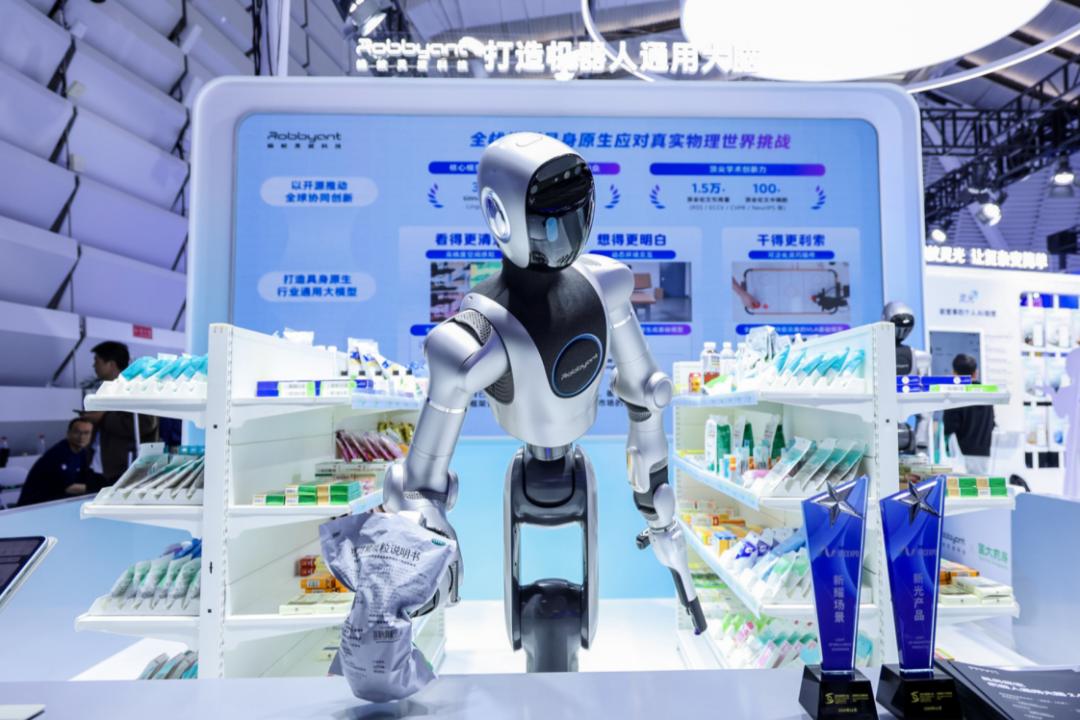
These details jointly outline a shift in Chinese technology, from bringing products to the world to beginning to try to open up innovative capabilities to the world.
Embodied intelligence is of course a long-track, high-reward competition, and overseas expansion is still in its early stage. Technology generalization, data compliance, local operation and maintenance, and commercial implementation are all hurdles that have not yet been crossed, but two overseas expansion paths have been initially clear.
One is the asset-heavy export of products and supply chains, such as Unitree, Agibot, UBTech, etc. By building factories or R&D centers overseas, they export the ontology. In the next stage, they need to move from "product delivery" to "local operation" to complete commercial verification with products, channels and customer trust.
The other is the overseas expansion of technology platform ecology, represented by Ant Lingbo, which enters the daily R&D process of overseas teams by opening models, tool chains and interfaces. In the next stage, they need to continuously iterate models, adhere to the open source strategy, and accelerate the establishment of an innovation ecology of underlying models.
The former can enter customers and scenarios