A prodigy from the Special Class for the Gifted Young of the University of Science and Technology of China has resigned from OpenAI. As the youngest Chinese tenured full professor in Harvard's history, he only stayed in the position for 5 months.
OpenAI, it seems you can't retain top talents either.
Just recently, Xi Yin — the youngest tenured Chinese professor in Harvard's history, recipient of the Sloan Research Fellowship and the New Horizons in Physics Prize, and a star scholar in the field of string theory —
Xi Yin officially announced his departure from OpenAI.
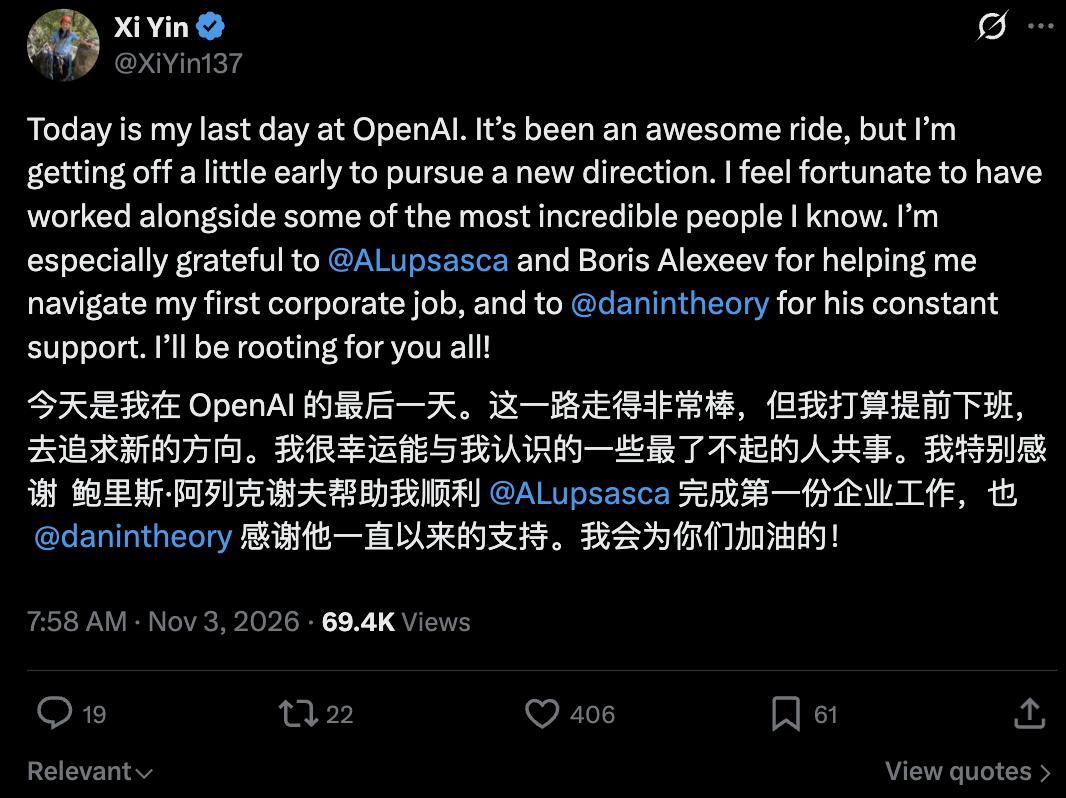
From the news of his joining spreading at the end of May this year to his personal announcement of leaving now, the whole process only took half a year.
Regarding this resignation, he stated on his personal Twitter:
This has been an absolutely fantastic journey, but I've decided to get off the train early to explore new directions.
Xi Yin also revealed that this is his first corporate job.
He specifically thanked Alex Lupsasca and Boris Alexeev for helping him adapt to this role, and also thanked Dan Roberts for his consistent support. At the end, he did not forget to cheer for his colleagues: "I will continue to root for you all!"
As for the next stop that everyone is most concerned about, Xi Yin has not disclosed it yet. His status as a professor is still listed on the official website of the Harvard Department of Physics.
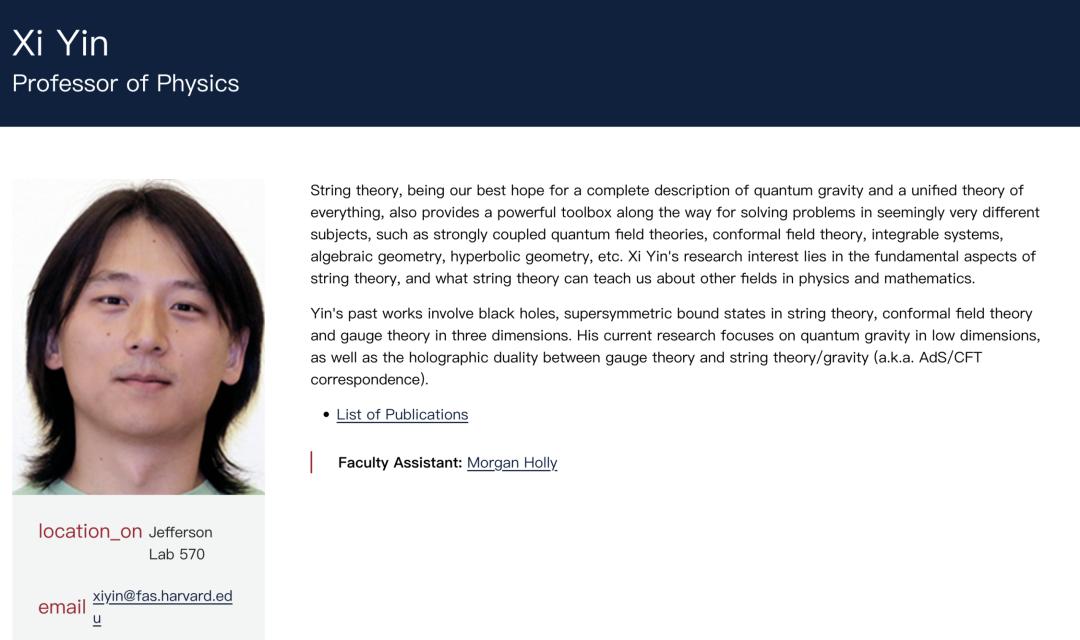
Perhaps, it really is very likely that he just took an academic sabbatical to experience a different kind of life.
Of course, some netizens directly pointed to Discovery Loop, an AI company founded by former Google Chief Scientist Jeff Dean and other figures.
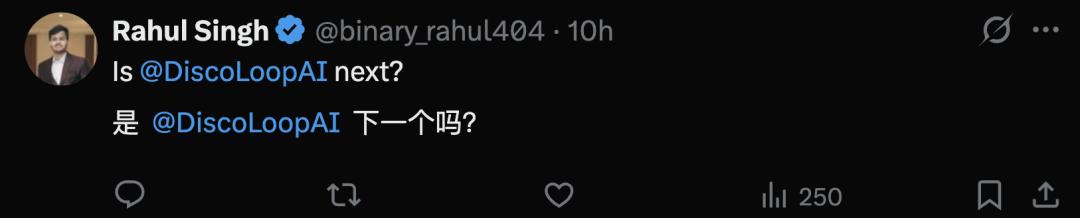
As for where he will go exactly, let's wait and see for a while.
Who is Xi Yin?
Xi Yin was admitted to the University of Science and Technology of China's Special Class for Gifted Young at the age of 12, obtained his Doctor of Physics degree from Harvard University in 2006, and was promoted to tenured full professor at Harvard at the age of 31 in 2015. He is known by many media outlets as "the youngest tenured Chinese professor in Harvard's history".
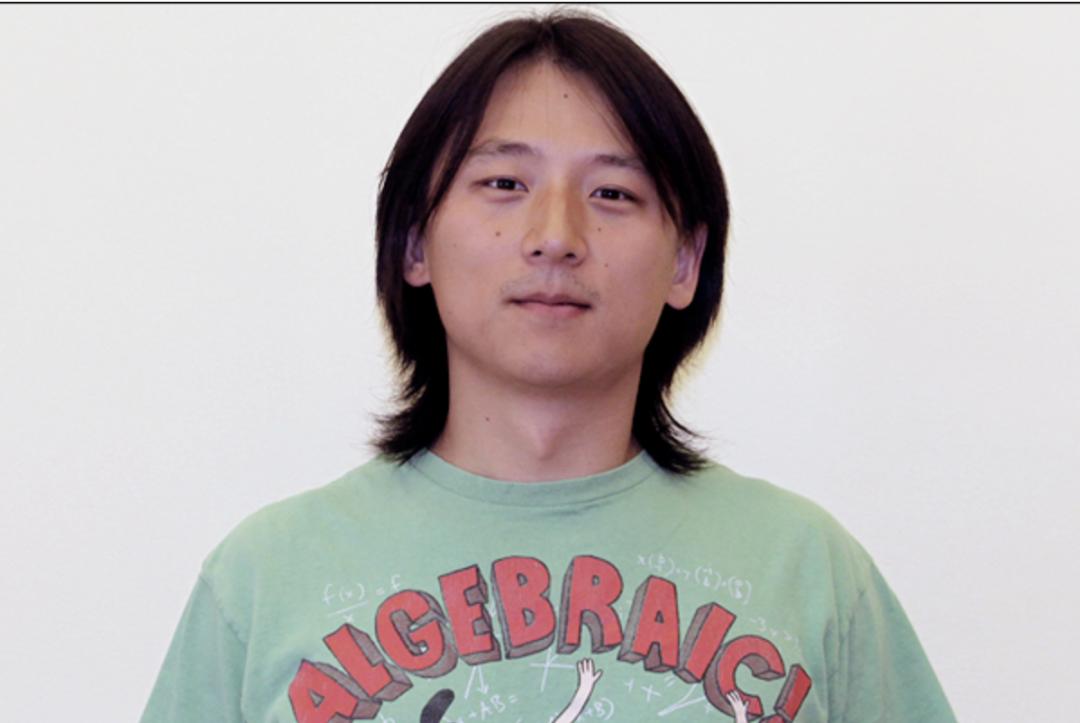
He has long been engaged in research on string theory, quantum field theory and quantum gravity. He won the Sloan Research Fellowship in 2013, and later won the 2017 New Horizons in Physics Prize together with Simone Giombi for their research on higher-spin gravity and its holographic correspondence.
In addition to his extraordinary genius resume, this physicist also holds a very distinct attitude towards AI.
In April this year, before the news of his joining came out, Xi Yin was interviewed by *The Harvard Crimson* and directly stated:
I don't think there is any human intellectual capability that AI cannot replicate.
This optimism about technology partly comes from his own experience of using AI.
Xi Yin estimated that with a large amount of human supervision, AI has still accelerated his research coding work by at least 100 times —
The code that AI writes in a few weeks would take me ten years to write on my own.
Some research projects that were once too workload-heavy to even consider carrying out can now be tried out.
By September this year, the academic circle launched another debate on what AI will bring to mathematics.
25 Fields Medal winners including Terence Tao released a joint statement, worrying that AI companies take solving difficult mathematical problems as a competition indicator: there are more and more answers, but the process of understanding, organizing and inheriting these results cannot keep up.
Xi Yin clearly stood on the side that refutes this view.
He reposted mathematician Timothy Nguyen's response and stated:
This is one of all the responses I have seen in recent days that I completely agree with and support.
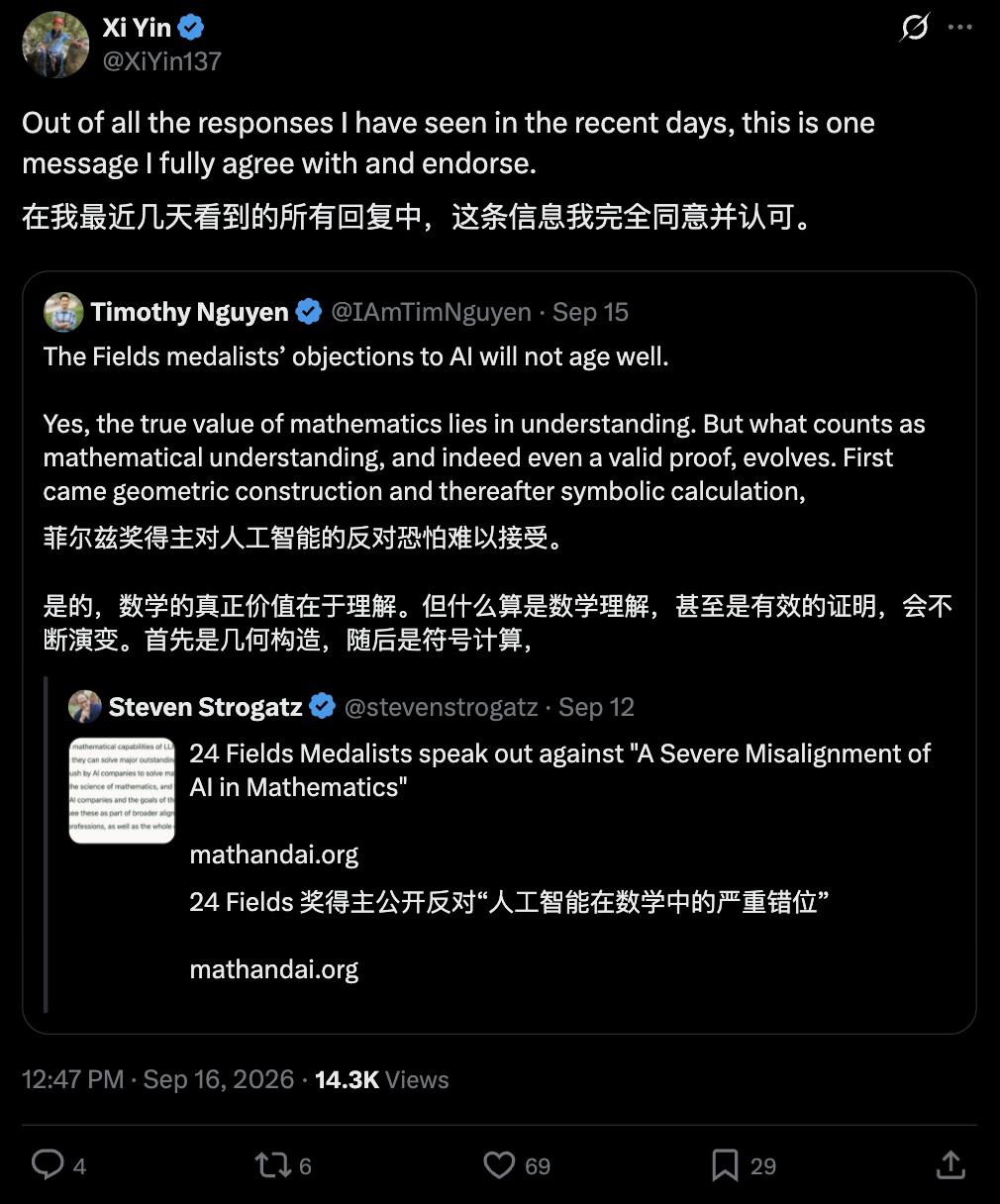
Nguyen opened his response directly by saying: The objections to AI from these Fields Medalists will not stand the test of time.
His core point is that the way people understand mathematics has been changing all along. From geometric construction, symbolic computation to computer-aided proof, mathematics has been constantly expanding its toolbox.
Verified machine proofs, even if they temporarily exceed the comprehension of a single individual, can also become the foundation for further research. If AI makes past difficult problems easy, humans can continue to explore further in uncharted territory.
From this perspective, even as a human physicist, Xi Yin is not obsessed with putting humans at the center of scientific discovery. As long as the answers are verifiable, he is happy to see AI get there first.
Fundamental Scientists Joining AI Model Companies
When Xi Yin previously joined OpenAI, a group of top experts in mathematics and physics had already gathered around him.
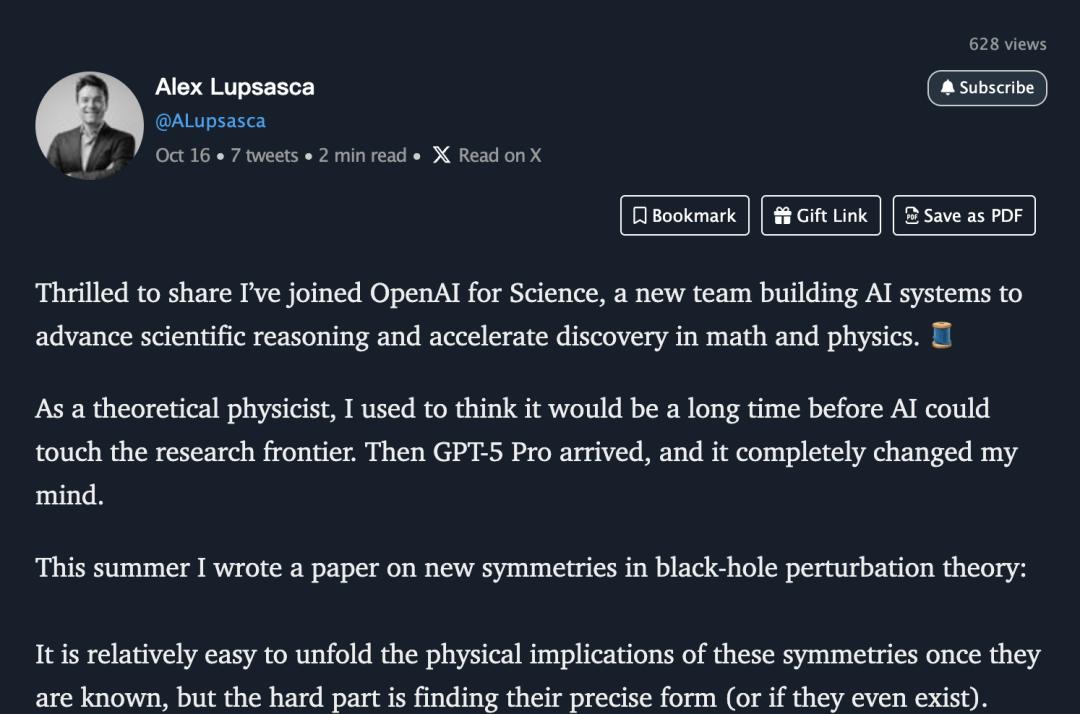
Alex Lupsasca, the black hole physicist whom Xi Yin specially thanked in his farewell post, announced that he would join OpenAI for Science as early as October 2025.
Lupsasca said at that time: This team aims to build AI systems that can advance scientific reasoning and accelerate mathematical and physical discoveries.
In addition, what attracted public attention around the same time as the news of Xi Yin's joining was Weijie Su, one of the "Golden Second Generation" figures from the School of Mathematical Sciences of Peking University.
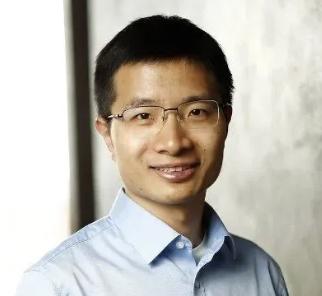
In May this year, Weijie Su announced that he would join OpenAI to participate in model training during his academic sabbatical at the Wharton School, and at the same time, he was officially promoted to full professor at the Wharton School.
Earlier, at the beginning of this year, Lijie Chen, an alumnus of the Yao Class at Tsinghua University and a theoretical computer scientist, also joined OpenAI, focusing on mathematical reasoning.
Scientists bring research problems and the professional ability to judge the quality of answers; AI model companies provide models, computing power and engineering environments.
The goal of the two parties coming together is very straightforward: to let AI truly participate in scientific discovery.
As for how Xi Yin views the relationship between AI and researchers, he already gave a very clear answer in the April interview: As long as AI can find the answer and there is a way to verify it, he will be very happy. Whether the answer is figured out by himself is secondary.
References
[1]https://x.com/XiYin137/status/2117405976462844370
This article is from the WeChat official account "QbitAI", author: henry, published with authorization from 36Kr.