The voice-only Personal Agent is here. Perhaps this is exactly the Siri that Steve Jobs had in his mind.
The Siri in Steve Jobs' mind might finally come true this time.
It looks like this ——
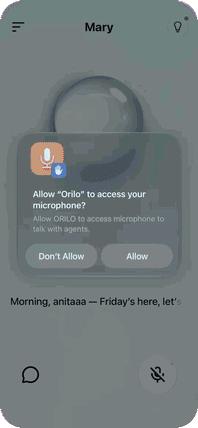
Leaving other things aside, we finally have an AI product with great aesthetic taste, and its UI is really comfortable to look at...
But the bigger highlight is yet to come.
This voice assistant is so magical.
It is just like having a personal secretary. You can drink coffee with bread while listening to it report the newsworthy events of the day.
The key point is that it is really human-like. Even if you interrupt it halfway and assign a task, such as "help me reply to an email", it will not fall into awkward silence.
It is literally the Samantha in the movie *Her*.
It is unbelievable. Five years ago, such scenes could only be seen in cinemas.
The AI industry has been developing for a long time. Every week, major manufacturers release new products regularly, and cutting-edge technologies emerge in endlessly, including Blender manipulation, dimension-reduced robots, and solving millennium-level problems...
But frankly speaking, I never thought these things were that exciting.
They are too far away from ordinary people. The real life of the vast majority of people will not change even a tiny bit in the short term due to these cutting-edge breakthroughs.
But after I used this product on and off for almost a week, all the romantic fantasies I once had about the AI era suddenly became tangible.
I even think ——
This is probably the AI assistant that is closest to sci-fi movies and meets all my romantic fantasies so far.
Its name is Orilo.
The Awkward Personal Agent
The concept of Personal Agent has really been hyped up recently.
The growth rate of Muse once surpassed that of GPT, and Agent has completely evolved from a productivity tool in the hands of geeks to the mass consumer market.
But to be honest, most of the experiences are not much better than the "Crayfish" at the beginning of this year...
I don't know about others, but I only felt fresh for the first few days after I got the invitation code, and I even granted it notification permission unprecedentedly.
Then, nothing else happened.

Typing is really a torture. What is more anti-human is its active push mechanism. Your pocket vibrates suddenly, you think it is an urgent WeChat notification, but you struggle to take out your phone on the subway only to find that Muse is reminding you of a to-do list that should have expired ages ago...
I was completely speechless at that moment.
So I always think that for the Personal Agent market, the solutions so far are still very immature.
The vast majority of Personal Agents are stuck in the same fatal dead end. I call it "one low and two highs":
Extremely low usage frequency.
Whether it is booking a flight ticket or unsubscribing from streaming media, it sounds really cool. But how many times can you encounter such complex tasks in a month?
For such low-frequency trivial matters, I still have to align with it for a long time. Why don't I just click it by myself conveniently?
Extremely high interaction friction.
When you are driving, washing dishes, cooking, or running, your hands and sight are completely occupied.
At this time, your pocket vibrates and asks you to stop to take out your phone and type to discuss logic with AI. Is that realistic?
Extremely high operating cost.
Every time the large model is called in the background, these scenarios above require very complex Tool Call, and every Loop costs real money.
With such a cost structure applied to consumer products, it is basically impossible to achieve large-scale popularization.
Technological fundamentalism has dominated this industry for too long. But to make products like personal companions, you can't win just by relying on large model parameters and high benchmark scores.
The next generation of Agents that can survive must be able to integrate into life quietly and frequently.
Voice Is the Real Entrance
This is also the part of Orilo that impresses me the most.
It has found a very intuitive new solution ——
Voice-first.
Why do I say voice is extremely important for C-end products?
It is the most natural way of human interaction.
Text was invented long after language appeared, and its main purpose is for knowledge transmission. It is not a necessity for daily communication.
Think about it, there are so many times in life when it is inconvenient to read text messages: driving, cooking, taking care of children...
More importantly, when people speak, they will unconsciously reveal more personal context (Conversational Context).
You won't just say "help me book a ticket", you may casually say "help me book a ticket to Shanghai next Wednesday, near the hotel I stayed at last time, by the way, the budget is a bit tight this time".
These "casual" pieces of information cannot be found in any connector, but they are the key to understanding a person.
But that's not enough.
Voice has a huge market to tap. For a new AI product, it must find a killer application.
This is also the second smart point of Orilo I think, they have found a tricky entry point ——
Morning.
This is the scenario with the most intensive information processing frequency in a day.
Just waking up, your mind is in chaos, and you urgently need to know what is happening outside the world and how to arrange today's tasks.
But at this very moment, you are holding a toothbrush or a coffee cup in your hand.
Orilo is mainly targeted at this pain point.
Your hands are completely freed, you can put the device aside, and you only need to receive information through voice.
During this period, if there is anything you need to instruct, you can directly output requirements to the AI through voice again.
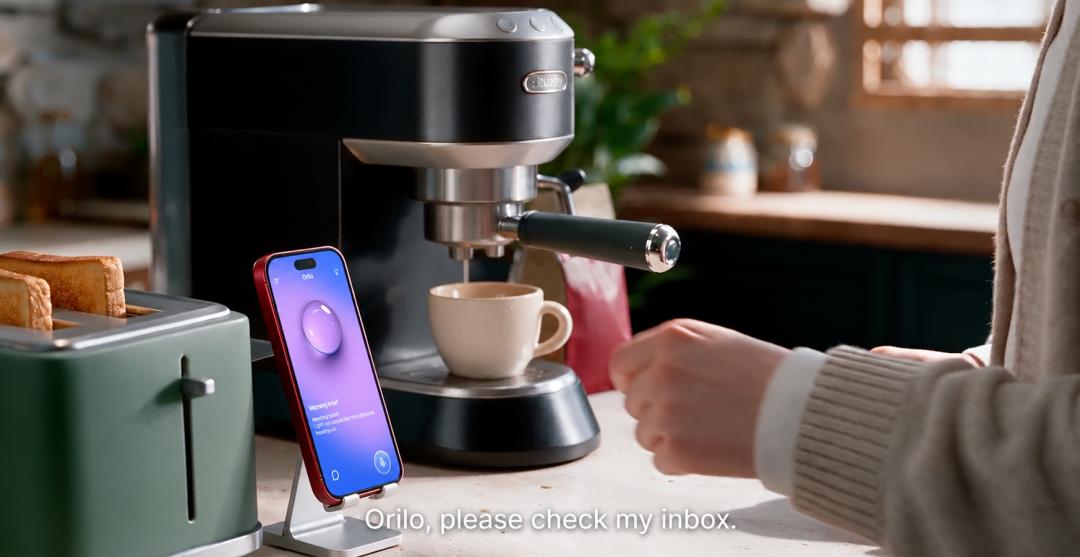
I'm so moved, finally there is a team that doesn't sit on an ergonomic chair with legs crossed and make up user pain points out of thin air.
And for the UI part, I think it is really far better than others.
Finally, it is no longer the stereotyped dialog box and full-screen toolbar...
Its shape is a water drop. It is connected with the physical gyroscope of the mobile phone. When you tilt the phone, it will slide slowly on the screen like a real water drop.
(ps: This is what a C-end product should look like, pay attention to the user experience, everyone! !)
Specifically for the actual scenarios, I will talk about the three points that attract me the most ——
Exclusive morning news briefing only for you
Simply put, it is a news express, and Muse also has this function.
But to be honest, I don't use it very often, after all, it basically pushes content hard based on interest tags, which is essentially a skinned information flow.
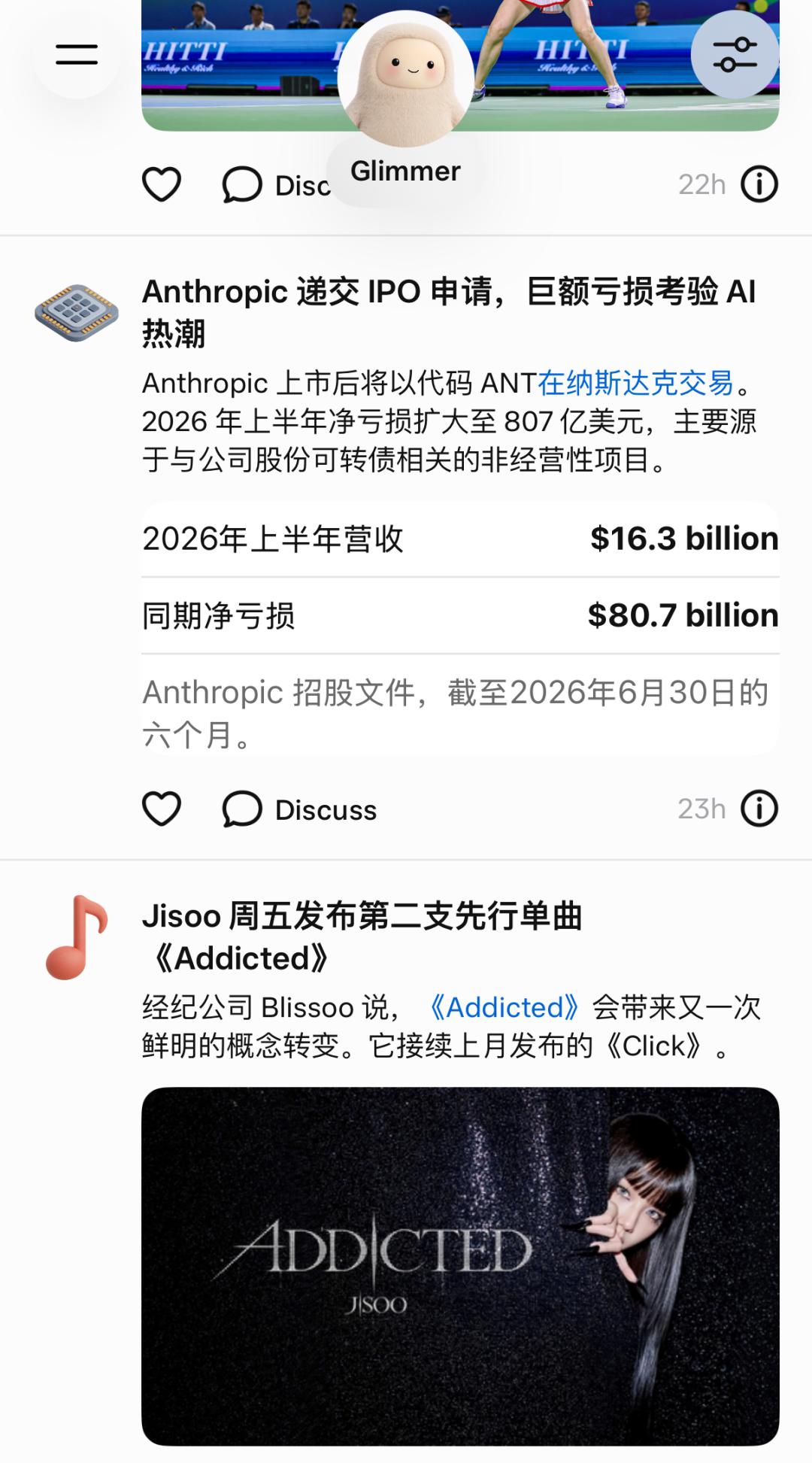
Orilo completely adopts a new logic.
It not only pays attention to what is happening, but also thinks about what this means to you.
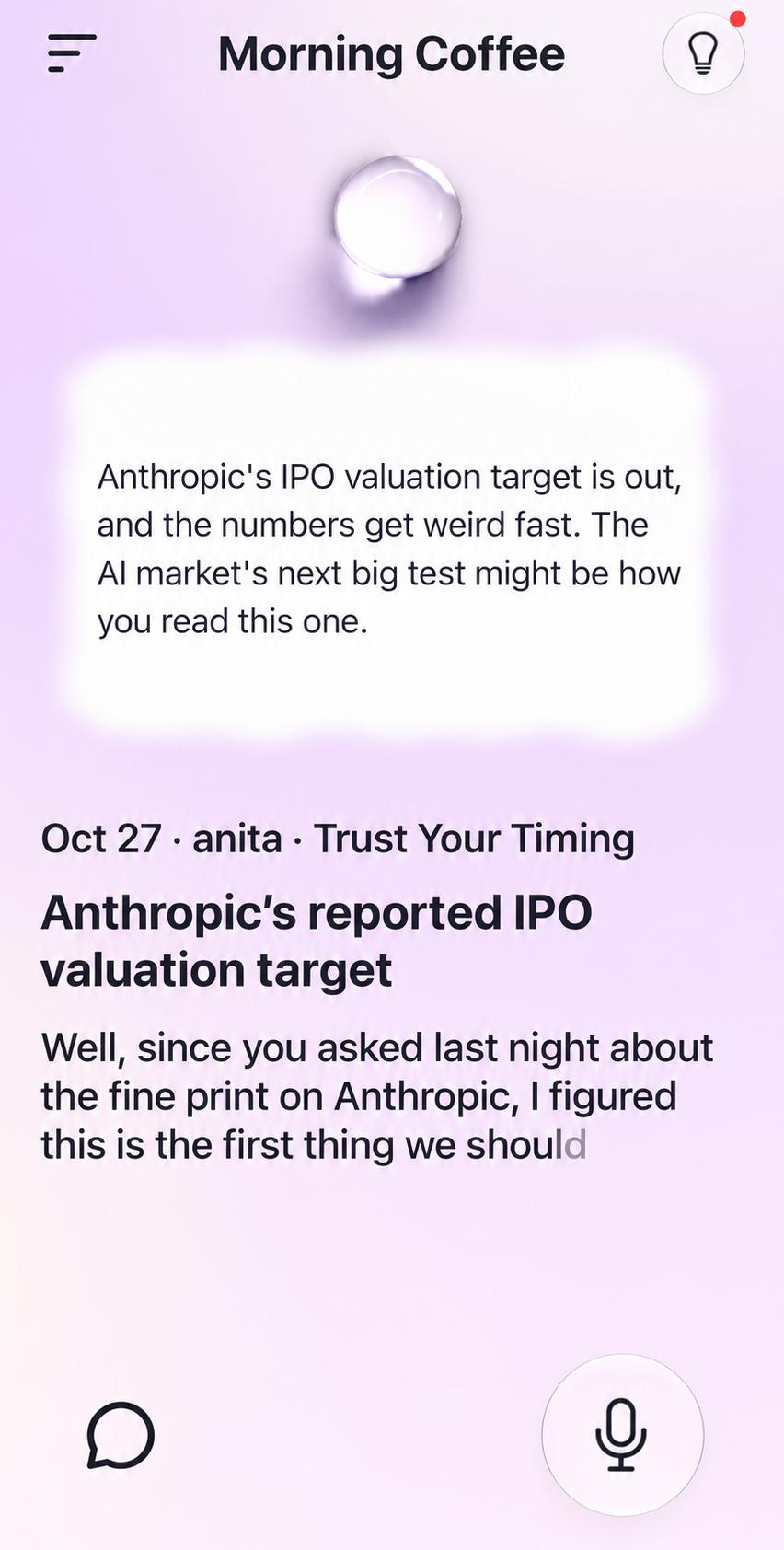
For example, you usually care about Anthropic very much. It knows from historical dialogues and long-term memory that compared with IPO, you actually care more about the value chain reshaping of the large model ecosystem.
So when it broadcasts the latest financing dynamics to you early in the morning, it will bring a set of customized interpretations from your work perspective.
It is just like a top industry analyst standing by your bed, chatting with you privately over a cup of coffee.
Keep a close eye on long-tail information for you
There are too many things we want to follow up every day: a niche startup, a Champions League group match, or a podcast that hasn't been updated for a long time.
But human attention is extremely limited. Who has time to manually refresh the search box every day?
Now you just need to give an instruction by voice.
It will stay on the information source for you 7x24 hours in the background, and take the initiative to report to you at the right time once there is any change.
One sentence closes the operation chain
Of course, more possibilities still lie in the ability to obtain context across APP subdomains.
Like other Personal Agents, Orilo also has a connector entrance, with some regular plugins built in.
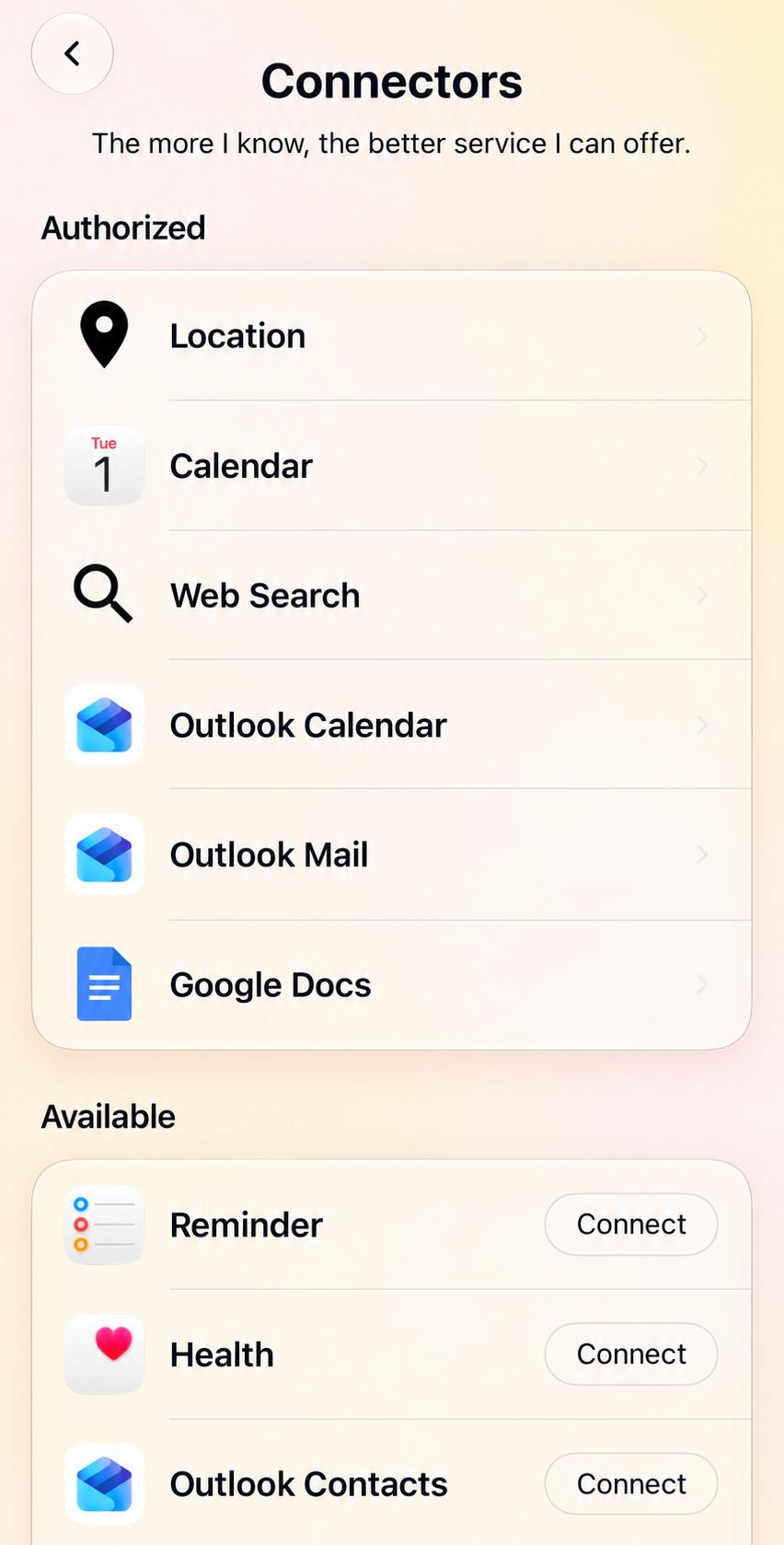
Take email as an example.
While listening to the morning news briefing, you suddenly remember that you haven't checked your work emails today.
"Help me check my email."
Orilo will naturally connect to Tool Call, extract important information in just two or three seconds:
Colleague A says that you need to update the PPT for the presentation next Tuesday.
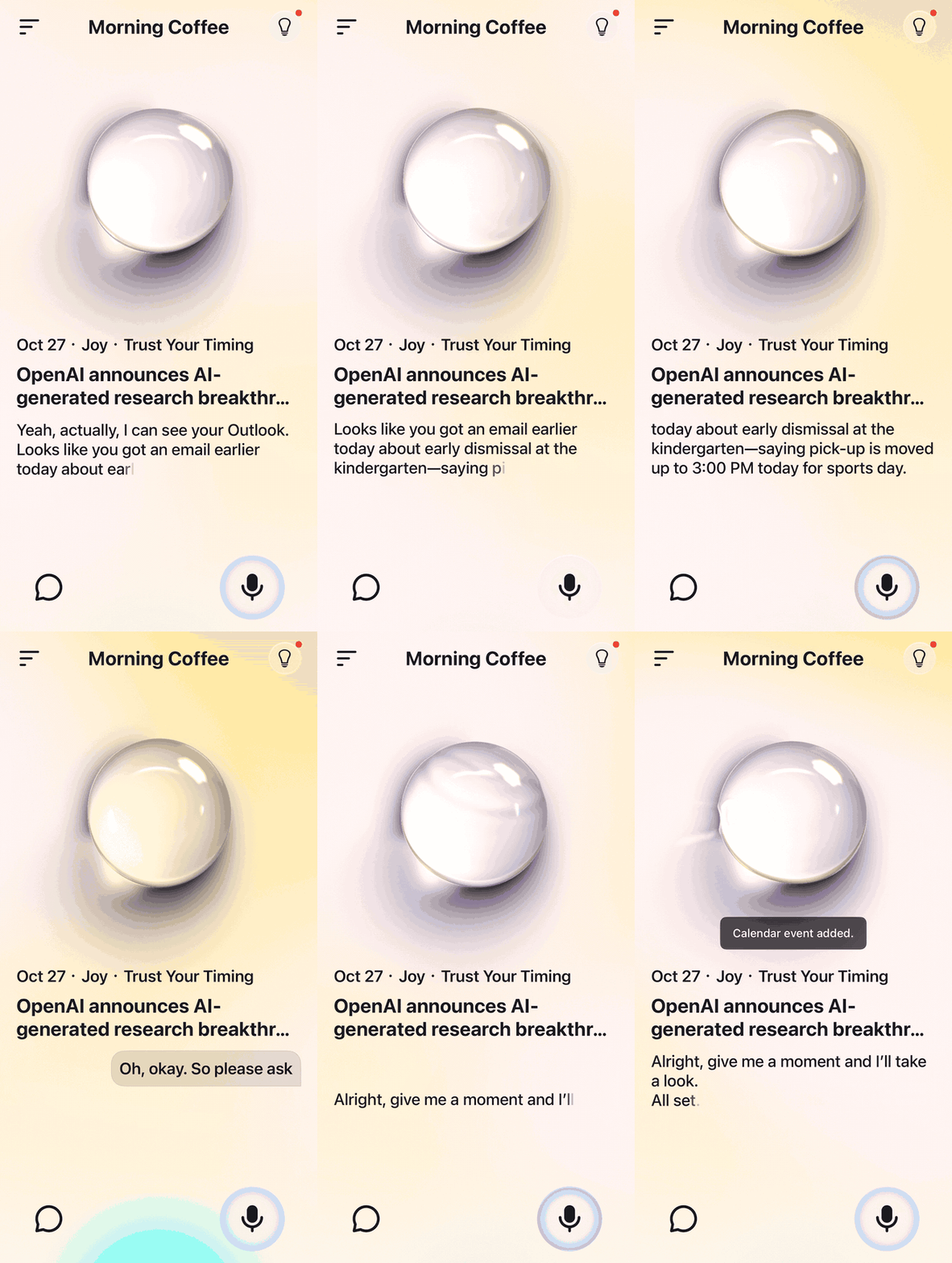
Of course, it also has the ability of active tracking.
For example, your child's school suddenly sends an email in the morning saying that school dismissal time is advanced to 3 p.m. After Orilo catches this email, it will casually insert a sentence in the middle of the voice morning briefing:
Your child's school ends school early today. Do you need me to add it to your calendar?
While squeezing the toothpaste, you mumble a reply:
Add it, and remind me half an hour in advance.
Done.
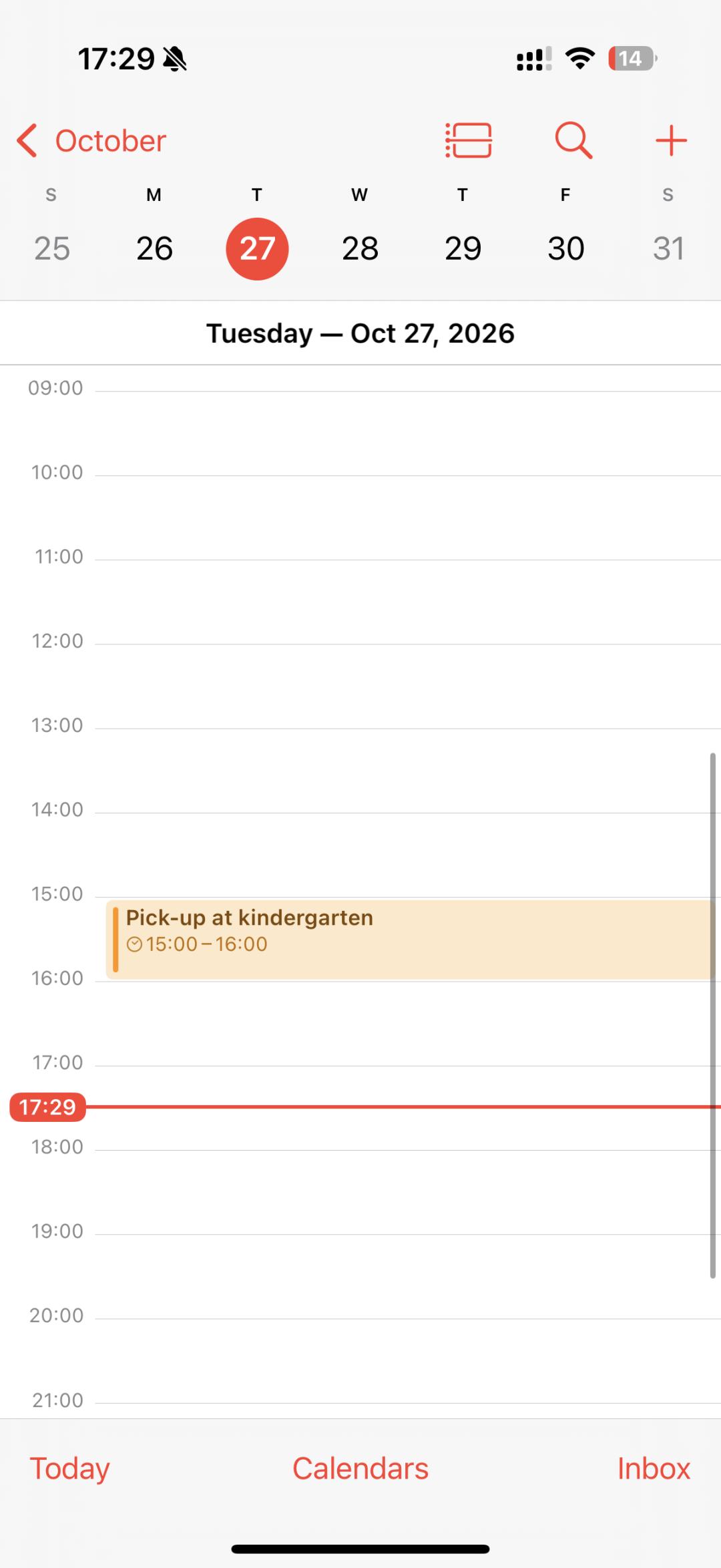
From "intercepting important information" to "cross-application task execution", the whole process is completed with two sentences seamlessly.
It may be more intuitive to compare with current competing products.
Ask Muse to check an email, it often gets stuck after you click like, and doesn't reply until more than 20 seconds later.
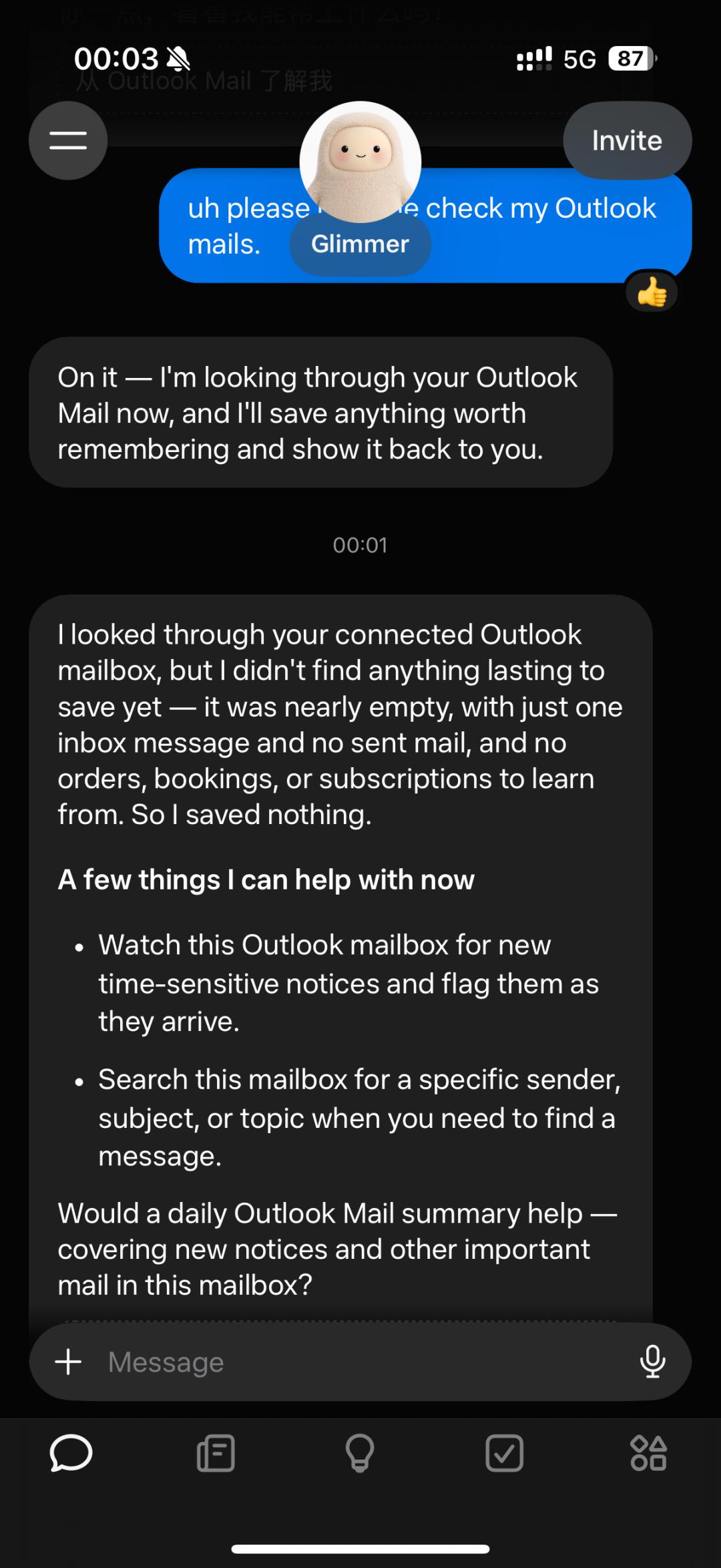
My reaction at that moment was ???
My blood pressure spiked immediately.
Of course, after all, it is the first-generation product, and there is one point I have to complain about.
Why does it only support English 😭!!!
For the first time, I feel the importance of learning English. Only when I really need to have a full English conversation, I realize:
I am just an ordinary person who has memorized thousands of postgraduate entrance examination English words.
If you can't choose your native language, it will really affect the efficiency of information exchange.
Of course, it may also be because the Chinese speech model is relatively less mature.
How to Make AI Take Action?
After talking about the experience, let's talk about the underlying logic.
Why can Orilo's real-time conversation run without any lag?
In fact, all teams working on voice Agents are tortured by the same physical dead end: deep reasoning and ultra-low latency are inherently incompatible.
There are two mainstream schools in the industry:
End-to-end native audio solution: Audio goes in directly, and audio comes out directly. It is very fast, and the emotion is extremely full and natural. But the fatal flaw is that the logical reasoning ability is too poor, and it will crash directly when encountering tasks with slightly complex logic.
Cascade architecture (ASR-LLM-TTS): Transcribe first, then let the large model think, and finally synthesize the voice to speak out. The intelligence is sufficient, but the latency starts at 1.5 to 2 seconds. This is not a conversation at all, it's like shouting through a walkie-talkie.
There is a cruel psychological red line in human-computer interaction: once the voice latency exceeds 1.5 seconds, as long as the other party does not respond, the sense of reality that you are "communicating with an intelligent life" will disappear instantly.
Orilo's breakthrough solution is to completely