The next round of competition in AI video
On October 26, Jimeng AI launched its short drama studio, adding a feature with strong traditional film and television production attributes: the 3D Director's Console.
Creators can adjust camera positions, design camera movements, and preview storyboards. At the same time, functions including fixed-point reshooting of single shots, audio reconstruction, and character and scene asset management are all integrated into the same workbench.
In the traditional film and television industry, these links are completed through the collaboration of professional positions such as directors, cinematographers, and editors. AI video tools once tried to compress these complex job functions into a one-time automated task with a single prompt, but now they are returning the core control back to creators.
Two days before the release of this feature, ByteDance had just completed a centralized consolidation of AI application resources internally.
According to 36Kr, "Little Skylark", the AI short drama creation platform under CapCut, has been officially merged into Jimeng. While retaining the independent product entry and keeping the team stable, all operational resources have been fully tilted towards Jimeng.
In March this year, when Little Skylark launched the short drama Agent, it was still focused on one-click finished video generation. More than half a year later, Jimeng began to emphasize storyboarding, modification and collaboration.
From eliminating human intervention by all possible means to re-emphasizing storyboards, camera positions and partial corrections, the evolution of ByteDance's product form constitutes a thought-provoking contrast in the AI video track.
This is not a step backward for AI video. For casual users who just want to try out new features, generating a short video with one prompt is more than enough; but for production teams that must make modifications as required and deliver on schedule, generation is only one link in the long workflow.
From Little Skylark to Jimeng, ByteDance has not only adjusted the product architecture, but also reflected a new proposition for the entire AI video track: when "generating visuals" has an extremely low threshold, who can organize scattered generation capabilities into a stable and deliverable production system?
The Boundary of One-Click Finished Video
In the early days of the AI video boom, "one-click finished video" was almost the ultimate paradigm pursued by all products.
Under this logic, scripts, characters, storyboards and videos can all be automatically completed by the model, and creators only need to put forward their demands. Little Skylark is a typical example of this.
Little Skylark can parse scripts of up to 100,000 words with one click, and automatically complete character setting, storyboard segmentation and image generation relying on the capabilities of models such as Seedance. Compared with the traditional mode of multi-model invocation plus manual collage, this solution greatly shortens the time to produce the first draft. In highly standardized scenarios such as marketing short videos and knowledge commentary that have low requirements for narrative continuity, "automatic generation" has indeed shown amazing capabilities in reducing costs and increasing efficiency.
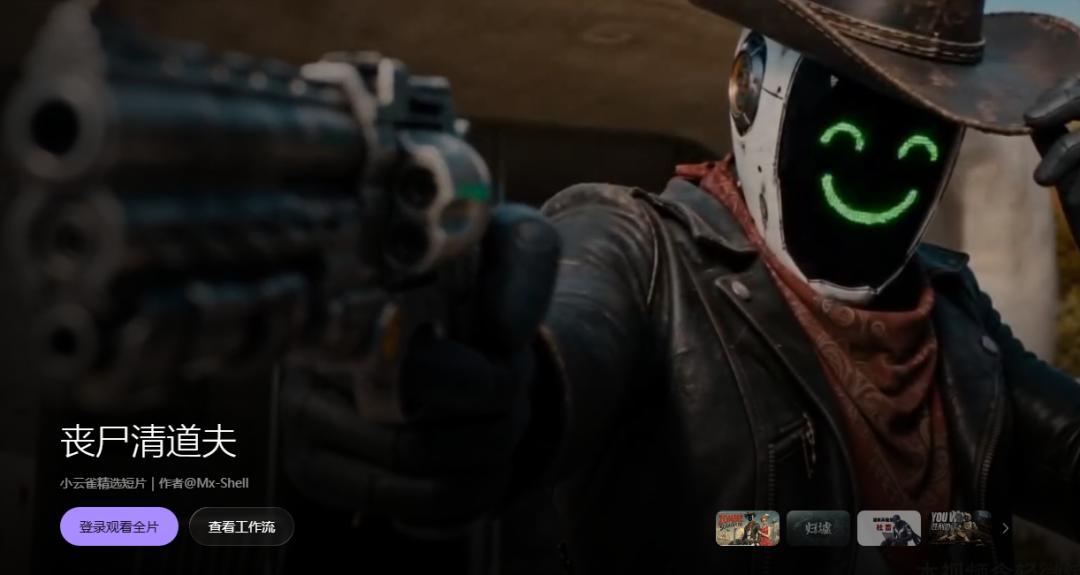
Selected short film "Zombie Cleaner" by Little Skylark
However, when application scenarios extend from single-point short videos to dramas with continuous narratives, the limitations of one-click finished video are quickly exposed. The core bottleneck does not lie in the clarity of a single shot, but in the logical and visual continuity when combining cross-scene shots.
For example, in a 15-second independent clip, the character's movements and lighting may be perfect; but when placed in a short drama with dozens of episodes, creators must ensure that the character's facial features, costumes and props, and spatial positions remain highly consistent in different scenes, and the shot transitions conform to audio-visual language.
In April this year, China National Radio of China Media Group visited the AI short drama production team of Shaanxi Baize Film and Television. At that time, the 20-person team was producing a semi-sci-fi short drama with 60 episodes and a total duration of more than 100 minutes. Zheng Jieyi, the production lead, revealed that even with the help of AI models, low-level errors such as "the character stands on the left side of the scene in one episode, but jumps to the right side for no reason in the next episode" still frequently occurred when different production staff worked on their respective parts.
To solve these "hallucinations" and out-of-control problems, the team had to spend a lot of energy unifying step lengths and positions in advance, and carry out extensive supplementary shooting and modification in the post-production stage.
These hidden costs brought by uncontrollability do not disappear automatically with the decline in unit computing power prices. In traditional film and television, costs are spent on actors, venues and shooting cycles; after introducing AI, the front-end shooting cost is greatly reduced, but repeated trial-and-error generation has become a brand new production cost.
The newly added fixed-point reshooting and 3D Director's Console in Jimeng are exactly trying to reduce this uncertainty. The former allows creators to modify partial shots, while the latter moves camera position planning to the front, reducing the waste caused by generating shots first and then finding they do not meet the requirements.
With the emergence of a large number of third-party AI video Agents on the market, the differentiation barrier established purely by "one-click generation" is extremely easy to replicate. When generation capability becomes an increasingly accessible service, completing a video with only one click is no longer enough to explain the long-term value of a tool.
Who Can Master the Production Workflow of AI Video?
When the underlying video generation capability gradually becomes the infrastructure of the industry, the competitive focus of AI video platforms has quietly shifted.
In the past, the core indicators for users to choose tools were image quality, duration and price. This competition based on single-point capabilities leads to extremely low user stickiness, and ByteDance's products have inevitably encountered the impact of previously launched products such as Minimax M3 and Kling.
But in the professional film and television production workflow, what creators need more is script decomposition, character resources, scene construction, prop sub-library, multi-track audio and video slicing, etc.
These links cannot be solved by a single independent API call. Whoever can connect and solidify these scattered nodes will become the "productivity workbench" that creators cannot live without.
ByteDance is accelerating its layout in line with this logic. In September, CapCut launched CapCut Hub, combining infinite canvas with multi-track editor. Creators can not only organize scripts and generate materials in the canvas, but also send the results to the familiar editing workflow. The generation capabilities provided by Jimeng and Little Skylark have become part of this workbench.
CapCut, which started with video editing, extends upstream to script and material generation, while Jimeng, which is good at generation, penetrates downstream to editing and asset management. The two meet in the middle of the production workflow.
This product evolution has also changed the competition scale between platforms.
Kuaishou's Kling chooses to start with model capabilities. Kling 3.0 enhances character consistency, multi-shot narrative and fine control, aiming to reduce post-production repairs caused by character changes and shot loss of control at the generation stage. When the model better understands the director's intention, some problems that previously relied on external workflow processing may be solved directly at the model layer.
Third-party aggregation platforms such as LibTV focus on creating differentiation through multi-model aggregation, infinite canvas and Skill system. By scheduling the most suitable model for different links (for example, using Model A for character setting, Model B for action, and Model C for dubbing), and precipitating mature production experience into reusable skills, they can still create cross-model added value.
When the control capability of native large models is getting stronger, and large manufacturers' products start to complete their workflows, is the simple "model aggregation + canvas interface" enough to build a sufficiently deep defensive moat?
The real ultimate battlefield will most likely lie in the productization of project digital assets and production experience.
For a team that has been producing AI short dramas for a long time, exclusive 3D character assets, specific art style models, verified storyboard presets and workflow specifications are assets that can be reused frequently in subsequent projects. Once these assets are deposited on a certain platform, the migration cost of the team will become extremely high.
At the same time, the storyboard splitting experience and action control skills of traditional film and television directors are being transformed into standardized templates and skills that can be called by Agents. The business model of tool platforms is also gradually changing from selling Token "value-added tax" to SaaS models based on team subscription, asset hosting and collaboration premium.
It is worth noting that in this battle for control, content production companies have not completely handed over their production lifeline to platforms. For example, Mango TV has launched its self-developed platform "Mango Lingchuang", which deeply integrates model scheduling, character asset library and collaborative production. For leading content producers, transforming their core film and television production know-how into an independent and controllable production system is far more secure than simply relying on external tools.
AI video manufacturers with different positioning have inevitably stepped into the same river, intervening in the entire life cycle of works from project initiation, production to final delivery.
After Professionalization, Will Low-Quality Supply Be Cleared Out?
The great leap forward of productivity is still ongoing, and production tools can be tested in the real market in longer and higher-spec film and television works.
At the end of August this year, the AIGC long drama "Post Journey to the West" was launched on Mango TV and Hunan TV. The first season of the drama has 30 episodes, each with a duration of about 40 minutes. All the visuals and character performances in the whole drama are completed with AI assistance. Facing the huge industrialized volume, Mango Lingchuang generated 109 deeply bound character assets and 143 scene assets for this drama, which greatly compressed the production cycle and production cost.
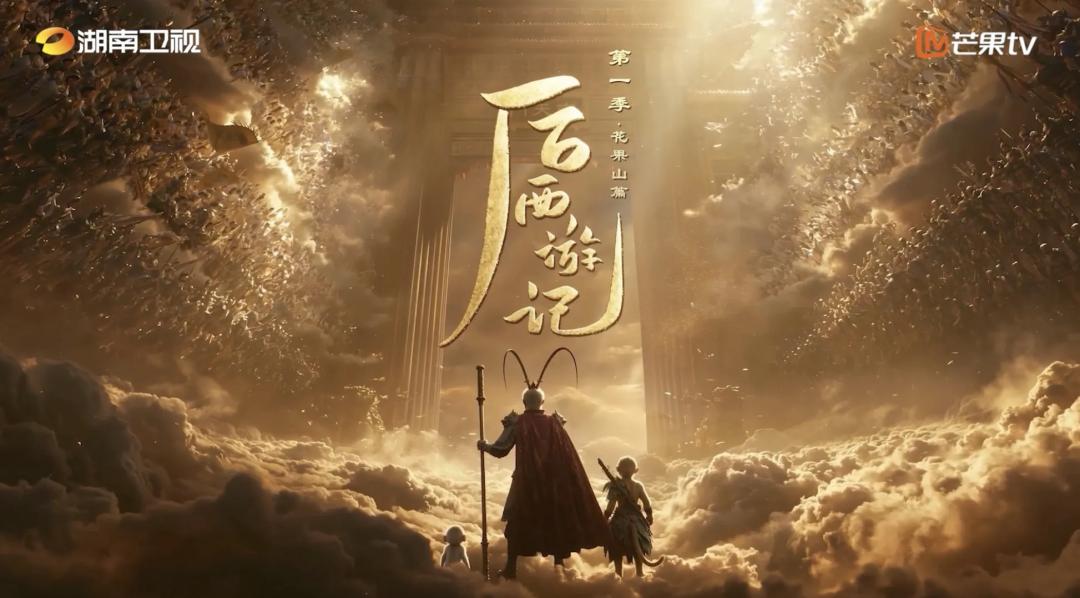
If long dramas verify AI's ability to undertake long-cycle production on the streaming media end, then theatrical films directly push AI to the examination room at the top of the audio-visual consumption pyramid.
On October 23, "Sanxingdui: Past and Future", China's first AI full-process theatrical film to obtain the public screening license, was officially released. This 100-minute film took more than two years to produce. The nearly 100-person team set up 17 professional functional positions referring to the traditional film industry, and iterated more than 1.2 million base images. With a production investment of tens of millions of yuan, AI has shown extremely amazing cost advantages in the production of audio-visual blockbusters.
However, the technological breakthrough has not seamlessly translated into a commercial miracle at the box office.
According to data from Maoyan Professional Edition, as of the evening of October 28, the total box office of the film in 6 days after its release was only about 1.37 million yuan (excluding preview screenings). There is a very noticeable gap between this result and the huge R&D and production investment in the early stage.
This phenomenon has sounded the alarm for the entire AI film and television boom. Technology can help creators bring their imagination within the scope of budget permission, and eliminate huge set construction and lighting scheduling, but it cannot write touching stories for creators, let alone automatically build emotional resonance with the audience.
From the ancient Greek dramas to today's AI-generated videos, the core of content production is the judgment of works at all times.
This contradiction is particularly acute in the oversupplied short drama market. Data from DataEye shows that in September 2026 alone, the number of new native AI dramas and manhua dramas on Douyin reached 51,800, hitting a record high. However, the top 1.46% of new head dramas took away 64.6% of the total playback increment across the network.
The supply explosion brought by the extremely low threshold has not led to an equal increase in audience attention. On the contrary, the content market has fallen into a more intense Matthew effect.
Professional tools may promote two trends at the same time. On the one hand, low-cost and standardized short dramas continue to compete for traffic through mass production and subject matter trial and error; on the other hand, AI is used to lower the threshold of special effects and industrialization, and the saved costs are invested in screenwriting, narrative and aesthetic expression, to try to enter high-premium markets such as films and long dramas.
These two routes are not mutually exclusive, but they put forward completely different requirements for tools. Automation pursues extreme efficiency, while quality delivery requires the support of a professional workflow.
In this differentiation, tool platforms also face a choice: to serve a larger scale of low-cost production, or to serve professional teams with fewer projects but more complex management requirements.
Looking back at ByteDance's move to integrate Little Skylark into Jimeng, its essence is not to deny the value of "one-click finished video", but to try to put the originally isolated "automatic generation capability" into a larger and more rigorous film and television industrial system.
Generation capability has torn down the wall of creation, but the real value of the work still needs to be re-proven in the market outside the wall.
This article is from WeChat Official Account "Bohu Finance", written by Qin Sanqian, and published with authorization from 36Kr.