With the reshuffle of provincial capital city rankings, is the "second largest city in central China" about to change?
The Q3 economic reports of cities across China have been released one after another, and Hefei, the dark horse, has once again taken the spotlight.
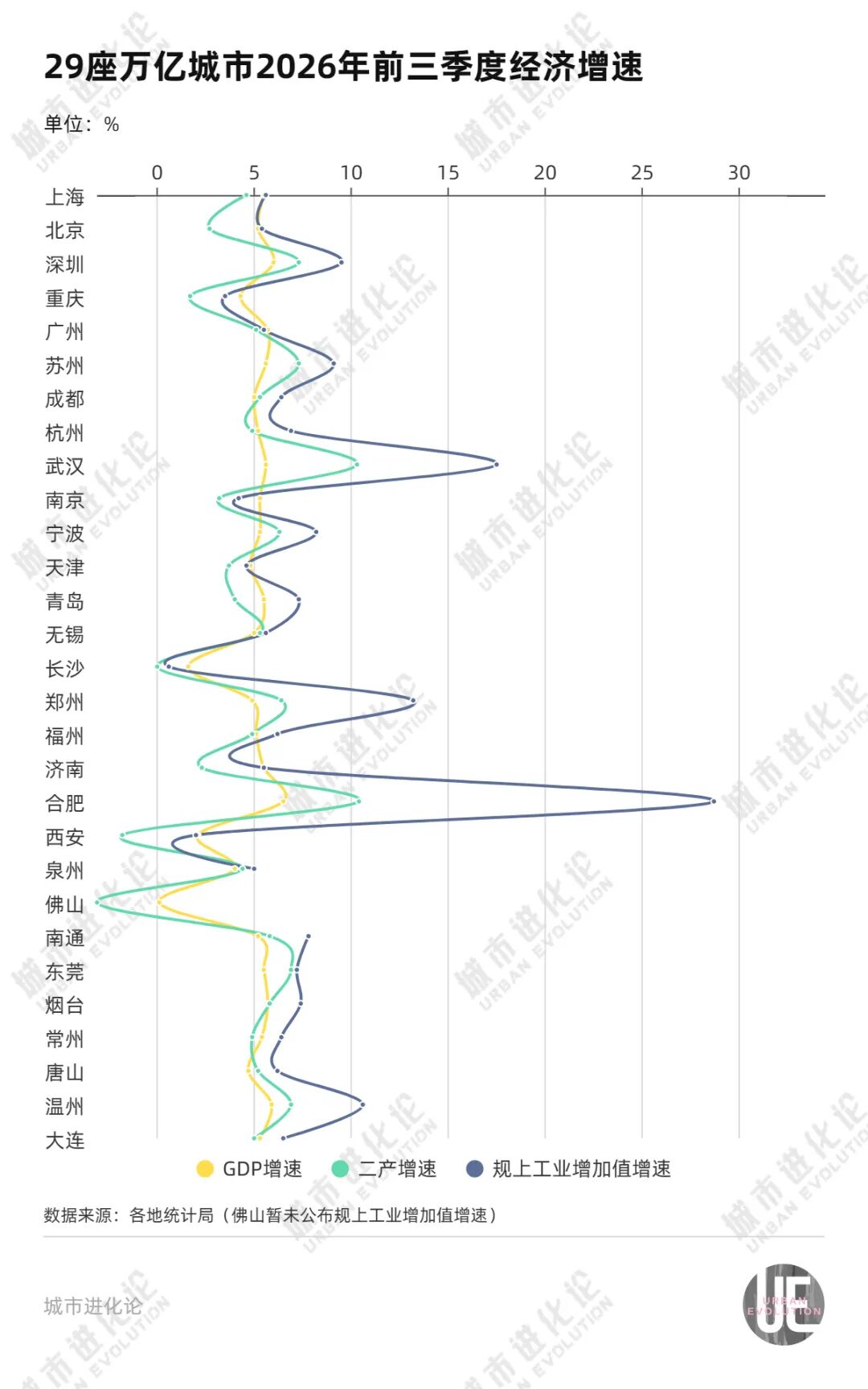
In the first three quarters of this year, Hefei's GDP reached 11.18 trillion yuan, up 6.5% year on year, and its growth rate led all 29 trillion-yuan cities across the country. Its added value of the secondary industry and the added value of industries above designated size surged by 10.4% and 28.7% year on year respectively, also ranking first among all trillion-yuan cities.
This fault-leading economic growth trend has brought rare changes to the "waist" camp of trillion-yuan cities that gather a large number of provincial capitals: Hefei's GDP has surpassed that of Jinan and Fuzhou in one go, moved up in the ranking competition of provincial capital cities, and accelerated to catch up with Zhengzhou and Changsha ahead of it. This also means that the "second largest city in Central China" has ushered in a new disrupter.
Previously, all three cities have set the goal of breaking through 2 trillion yuan in GDP during the 15th Five-Year Plan period. For Hefei, in addition to the "surge" of the industry, accelerating to make up for its "weaknesses" has become an urgent priority.
01
"Waist" Reshuffling
In the first three quarters of this year, 29 trillion-yuan cities across the country have delivered impressive results: the total GDP of the 29 cities exceeded 45 trillion yuan, accounting for more than 40% of the national economic aggregate.
In terms of growth momentum, the economic growth rate of 24 trillion-yuan cities outperformed the national average (4.6%). Among them, the economic growth rates of Hefei and Shenzhen reached 6.5% and 6% respectively, steadily ranking the top two; 19 cities including Wenzhou, Guangzhou and Yantai all achieved a growth rate of 5% or above; the growth rates of 5 cities including Chongqing, Quanzhou, Xi'an, Changsha and Foshan were lower than the national level.
With this rapid growth momentum, Hefei achieved an economic increment as high as 92.76 billion yuan over the same period last year, surpassing many cities with far larger economic volume than itself, such as Nanjing, Tianjin and Qingdao.
A greater variable occurred in the "waist" camp of trillion-yuan cities. Looking at the national urban GDP list, the 15th to 20th places gather 6 provincial capitals: Changsha, Zhengzhou, Fuzhou, Jinan, Hefei and Xi'an. The maximum GDP gap between any two of these 6 cities is no more than 90 billion yuan, making them the most competitive echelon of provincial capital cities across the country.
Just in the first three quarters of this year, Hefei's GDP of 11.18 trillion yuan surpassed Fuzhou (10.7235 trillion yuan) and Jinan (11.1005 trillion yuan). Compared with the whole year of last year, Hefei moved up two positions in the urban economic ranking, and the GDP ranking of provincial capital cities has also been reshuffled accordingly.
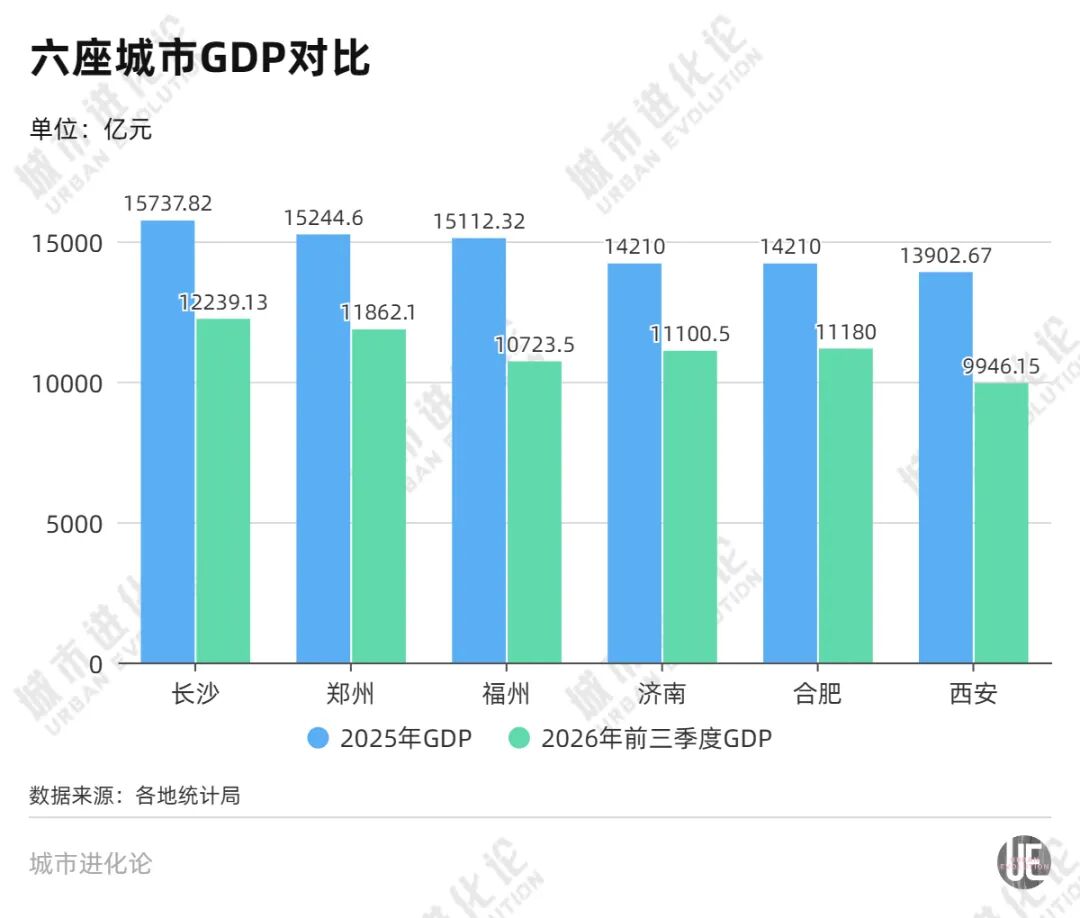
Looking back, this round of ranking change is no accident. In the first three quarters of 2025, Hefei's GDP once surpassed Fuzhou by more than 20 billion yuan, but failed to achieve the reversal for the whole year in the end; while in the whole year of 2025, Hefei had already caught up with Jinan, and the two cities tied for 18th place nationwide with a GDP of 1.421 trillion yuan, only one step away from overtaking.
After careful comparison, the performance of Fuzhou and Jinan is not bad. Their economic growth rates in the first three quarters were 5.1% and 5.5% respectively, 0.5 and 0.9 percentage points higher than the national level respectively.
It's just that the opponent is "too fierce". Judging only from this year, Hefei achieved an economic growth rate of 6.8% in both the first quarter and the first half of the year, and has led all trillion-yuan cities for three consecutive quarters. With the continuous acceleration, Hefei's economic increment in the first three quarters was 20.9 billion yuan and 26 billion yuan more than that of Fuzhou and Jinan respectively, which rewrote the ranking that was originally only a tiny gap.
There is no doubt that Hefei's biggest confidence in "moving up" comes from its industry. Data shows that in the first three quarters, the added value of Hefei's secondary industry increased by 10.4%, and the added value of industries above designated size surged by 28.7%. Both indicators ranked first among all trillion-yuan cities. Among them, the growth rate of the added value of industries above designated size was more than 10 percentage points higher than that of Wuhan (17.5%), which ranked second, showing a clear leading position.
On October 19, Mao Shengyong, spokesperson and Deputy Director of the National Bureau of Statistics, said at a press conference that the rapid growth of new driving forces is a prominent highlight of this year's economic development. "Preliminary calculations show that the contribution rate of new driving forces represented by high-end manufacturing, digital intelligence economy, modern services, etc. to economic growth in the first three quarters remained above 40%. The growth of high-tech manufacturing and digital product manufacturing has accelerated, and the "relay baton" of economic growth has been further passed to the new driving forces."
Hefei is a typical representative among them. Data shows that the added value of industries above designated size in Hefei has maintained double-digit growth for 35 consecutive months. Among them, the added value of the computer, communication and other electronic equipment manufacturing industry and the automobile manufacturing industry increased by 106.2% and 14.7% respectively in the first three quarters. Among the industrial products above designated size, the output of lithium-ion batteries, semiconductor discrete devices and liquid crystal displays increased by 86.5%, 18.8% and 16.4% respectively.
02
Pattern Loosening
Compared with overtaking Jinan and Fuzhou, Hefei's next impact target has attracted more external attention.
Focusing on Central China, Hefei, which crossed the threshold of trillion-yuan GDP in 2020, has long ranked fourth among the six provincial capitals, after Wuhan, Changsha and Zhengzhou, and this ranking has not changed in the past ten years.
However, in recent years, the signal of "loosening" of the original pattern has become more and more obvious.
Looking at the longer timeline, in 2015, Hefei's total economic volume was 566 billion yuan, equivalent to only 66% of Changsha's and 77% of Zhengzhou's. Ten years later, in 2025, Hefei's GDP jumped to 1.421 trillion yuan, exceeding 90% of that of Changsha and Zhengzhou.
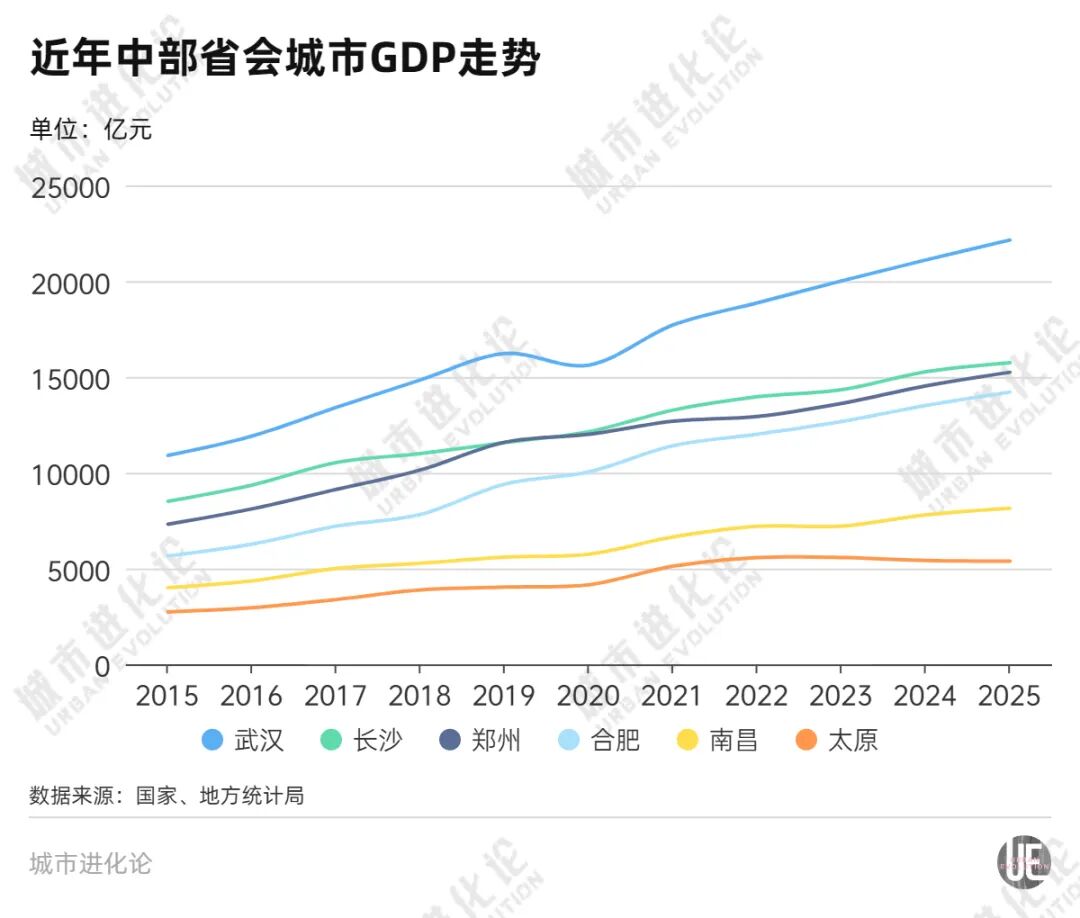
The comparison of economic increments is more intuitive. Over the above ten years, Hefei's GDP increment reached more than 850 billion yuan, while Changsha's economic increment in the same period was 722.7 billion yuan and Zhengzhou's was 793.3 billion yuan, both significantly lower than Hefei's.
According to the latest released data, Hefei is accelerating to approach Changsha and Zhengzhou.
In the first three quarters of this year, Hefei's economic increment of 92.76 billion yuan far exceeded that of Zhengzhou (67.23 billion yuan) and Changsha (27.923 billion yuan). As a result, the GDP gap between Hefei and Changsha has been greatly reduced from 170.7 billion yuan in the same period last year to 105.9 billion yuan, and the gap with Zhengzhou has been reduced to only 68.2 billion yuan from 93.7 billion yuan.
Such a catching-up momentum undoubtedly brings greater possibility for Hefei to impact the title of "second largest city in Central China".
In contrast, the latest "report cards" of Changsha and Zhengzhou are not satisfactory. In the first three quarters of this year, the economic growth rates of both cities did not outperform the provincial average. Among them, Changsha's GDP grew by only 1.6%, ranking the second last among trillion-yuan cities, only higher than Foshan (0.1%); Zhengzhou's GDP grew by 4.9%, 0.1 percentage points lower than the growth rate of Henan Province.
At the industrial level, Changsha is under greater pressure. In the first three quarters, the added value of Changsha's secondary industry achieved zero growth, and the added value of industries above designated size increased slightly by 0.6% year on year, with both growth rates ranking at the bottom of trillion-yuan cities.
Behind this, Changsha's traditional advantageous industries such as construction machinery have entered a deep adjustment cycle, which once became a drag on economic growth. At the same time, the scale of emerging industries is relatively small, and the contradiction of "new industries are not enough to make up for the decline of old ones, and growth is not enough to offset the reduction" is prominent.
The research report of Huatai Securities previously pointed out that in recent years, the K-shaped differentiation between cities has become more prominent: cities with rapid conversion of old and new driving forces benefit from the AI industry cycle and the development of the technology industry, showing stronger development resilience; some cities are dragged down by traditional industries and the real estate sector.
In this regard, the local government is not without a sense of crisis.
Public reports show that on the same day when the Q3 economic data was released, Changsha held an economic situation analysis meeting for the first three quarters, facing up to the current situation and existing problems, and clearly proposed to promote the economic recovery and improvement with "extraordinary intensity and measures".
From guiding advantageous industries such as construction machinery and advanced energy storage to increase production and expand capacity, to accelerating project construction and promoting consumption expansion, Changsha is working hard to find new growth points, "making every effort to fight the fourth quarter and sprint for the whole year".
03
"Second Entrepreneurship"
Further analyzing the sub-indicators, Hefei is not "without a single worry".
An intuitive contrast is that while its industry is surging, the performance of the tertiary industry, consumption and investment is slightly weak.
Specifically, in the first three quarters, the added value of Hefei's tertiary industry increased by 4.4%, and the total retail sales of consumer goods increased by only 0.4%, which not only ranked low among trillion-yuan cities, but also was significantly lower than the national average.
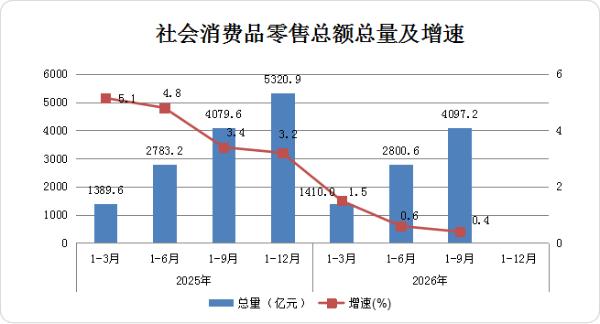
Changes in Hefei's total retail sales of consumer goods Source: Hefei Municipal Bureau of Statistics
As one of the "three carriages" driving economic growth, Hefei's fixed asset investment in the first three quarters decreased by 18.6% year on year, 11.4 percentage points lower than the national level (down 7.2% year on year).
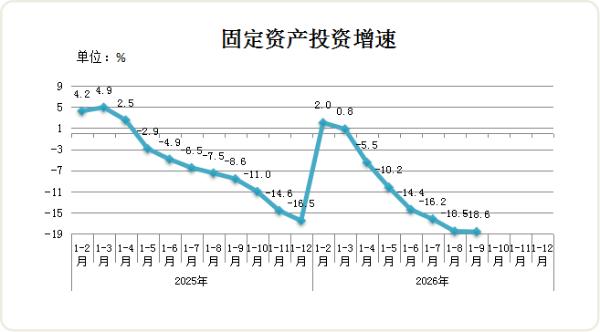
Changes in Hefei's fixed asset investment growth rate Source: Hefei Municipal Bureau of Statistics
Where is the problem?
It cannot be ignored that compared with brother cities such as Changsha and Zhengzhou with deeper industrial and population foundations, Hefei, which has risen rapidly in recent years, still has shortcomings that need to be "made up for".
For example, in the consumer sector, high-quality resources have long been siphoned by surrounding cities such as Nanjing and Hangzhou. "It can spend ten years 'investing' to nurture BOE and NIO, but cannot 'invest' to create a top-level commercial IP", which is regarded as a major local pain point.
More importantly, with the increasing importance of the service industry, its influence is no longer limited to the tertiary industry, but is deeply embedded in the texture of the real economy, becoming the core engine driving the upgrading of manufacturing industry and the reconstruction of the entire industrial chain.
Hefei is not without reflection on this.
Local media recently published an article stating bluntly that in the last round, Hefei seized the window period, attracted industries through investment, and achieved breakthroughs at single points, realizing the leap from scratch; now the space for driving growth by launching new projects and leading enterprises is narrowing, and it has reached a critical juncture of growing from strength to excellence.
Behind this, while the scale of the manufacturing industry is expanding, the shortcomings of local high value-added services are prominent. There is insufficient supply in fields such as industrial design, high-end testing, industrial software, and intellectual property operation, and many leading enterprises turn to Shanghai, Jiangsu and Zhejiang for their R&D and quality inspection needs.
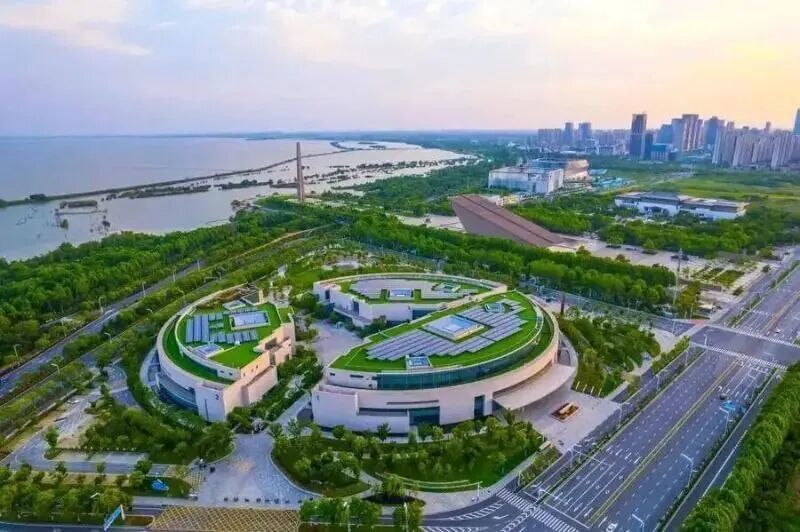
Image Source: Anhui Daily
Also on the day when the local bureau of statistics released the Q3 data (October 29), Hefei held a municipal conference on high-quality development of advanced manufacturing and service industries, clearly proposing to "promote the coordinated and efficient development of advanced manufacturing and service industries with greater efforts".
At this meeting, "Second Entrepreneurship" became the key word. This means that Hefei, which has already achieved an upward growth curve, will also step up efforts to achieve "further advancement".
The meeting mentioned that "we will do a good job in counter-cyclical, cross-cyclical and pro-cyclical regulation of industries", focus on promoting the intelligent, green and integrated development of the manufacturing industry, promote the high-quality and efficient development of the service industry, and build an industrial development pattern of "multi-point support and alternating leading"... The sense of urgency is self-evident.
The evolution of industries always has cyclical fluctuations. When the "chip, screen, automobile