A post-2000s girl with a valuation of 30 billion.
On the other side of the ocean, the AI craze is still going strong.
What looks like the most bustling coffee shop in the Bay Area is actually an AI insurance unicorn. Its main business is selling insurance powered by AI, while its side business is running a 24-hour coffee shop located downstairs of startup companies. The rise story of Corgi is quite astonishing.
Founded two years ago, Corgi's latest valuation disclosed by Forbes has reached 5 billion US dollars (equivalent to about 33 billion RMB).
What is more surprising are its two founders: one is a 26-year-old graduate of Columbia University; the other is a post-2000s Chinese female who dropped out of Stanford to start her business in her junior year and is only 23 years old this year. During their entrepreneurial journey, the two witnessed the chaos and complexity of commercial insurance, so they decided to found Corgi, focusing on insurance services for startups. Its coffee shop unexpectedly became its largest customer acquisition entry.
This entrepreneurial experience left a quite magical impression on the public: two post-2000s founders, an AI company selling coffee in Silicon Valley, with a valuation of 30 billion RMB. It makes people sigh again that the AI era always brings unexpected entrepreneurial stories.
Post-2000s Female Founders Team Up
Run a Coffee Shop and Sell Insurance with AI
Judging only from its style, it is hard to associate Corgi with an insurance company.
The whole company keeps a brown and white corgi that often runs around under people's feet; mattresses are tucked in the corners of the meeting rooms for employees to rest overnight. Downstairs there is a 24-hour cafe called Corgi Cafe operated by the company itself, which has become an all-night gathering place for many young entrepreneurs in Silicon Valley.
But if the company's leaders are from the post-2000s generation, everything becomes natural and reasonable.
CEO Nico Laqua, 26 years old, has learned programming since childhood and majored in neuroscience after being admitted to Columbia University. COO Emily Yuan once studied computer science at Stanford University, dropped out to start a business in her junior year, and is only 23 years old this year.
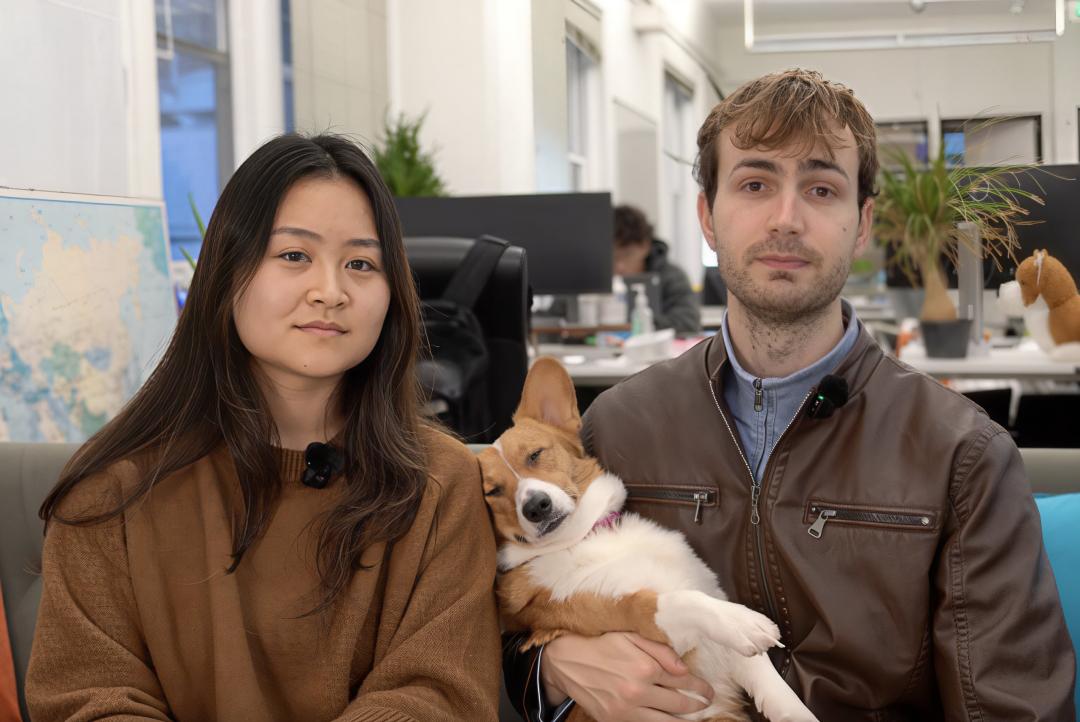
The two met in the startup circle. During their school days, Nico developed a social application. Emily thought it was good after using it, and they jointly participated in the development of the Picnic app, and finally built a game company named Basket Entertainment. With this achievement, they were selected into the Forbes 30 Under 30 list in 2024.
Unexpectedly, it was this experience that made the two of them have the idea of entering the insurance industry.
It is reported that during the operation of Basket Entertainment, once the insurance company delayed giving the premium quotation for a long time, almost missing an important contract; the copyright dispute claim that Nico thought he deserved was rejected by the insurance company.
"Insurance is one of the largest industries in the world, but its underlying infrastructure still dates back to 'several centuries ago'." Emily once shared in an interview. The two believed that the insurance service experience for startups was extremely poor, so they left Basket to found Corgi, whose name and logo were both taken from a corgi dog.

The product design is very simple: use AI to generate quotations for customers and evaluate workflows, and then price insurance products accordingly. In addition, processes originally undertaken by manual teams, such as claims settlement, insurance sales, and reinsurance, are all supported or taken over by AI.
The difference is that Corgi's service targets start from startups, and it sells commercial insurance such as Cyber Security Insurance, Directors & Officers Liability Insurance (D&O), Errors & Omissions Liability Insurance (E&O), AI Liability Insurance, and General Liability Insurance. These names sound unfamiliar, but they are rigid demands for startups.
In July 2025, the company officially obtained regulatory approval to start business, but U.S. Forbes disclosed that its annualized recurring revenue has exceeded 100 million US dollars, with thousands of startup clients, including well-known startups such as human resource service startup Deel, AI company Artisan, and enterprise-level AI company Eragon, carving out a space in the already red ocean insurance market.
Even the non-stop Corgi Cafe downstairs of the company has expanded to Atlanta and London. It is reported that Corgi Cafe sells not only coffee but also exposure, with brand-named drinks on the menu and corresponding logos printed on coffee cups, generating considerable profits.
Founded for Two Years, Valued at 30 Billion RMB
Yunfeng Capital Clarifies Rumors
Speaking of which, Corgi originated from Y Combinator's 2024 summer incubation camp, and has been closely related to Silicon Valley capital from the very beginning.
At first, Corgi entered the industry as an insurance broker and smoothly sold tens of thousands of dollars in premiums. But the team soon found that the operation of the underwriter itself was extremely traditional and inefficient. In order to truly control the product, the only way was to become an insurance underwriter itself.
That was a quite difficult period. Nico once recalled in a podcast that the company had to face a long transformation at that time, "We didn't do demo day, nor were we the popular company in the batch", and it was on the verge of closing down several times during that period.
It was not until investors came to the door. In January this year, the company's seed round and Series A financing totaled about 108 million US dollars, with investors including Y Combinator, Kindred Ventures, Contrary, Oliver Jung, Glade Brook Capital Partners, etc., with a valuation of 630 million US dollars.
In May, the financing accelerated sharply - at the beginning of the month, it announced the completion of 160 million US dollars in Series B financing led by TCV, with a valuation of 1.3 billion US dollars, making it a unicorn; only three weeks later, it raised another 106 million US dollars in Series B1 financing, which was only open to existing investors, and the valuation reached 2.6 billion US dollars.
The partner of Kindred Ventures attributed the surge in valuation to the rapid revenue growth, "Corgi brings rare tenacity and technical focus to one of the hardest challenges in financial services".
Corgi came into the sight of China's venture capital circle from a "gossip" - in August this year, the news that "Yunfeng Capital participated in the investment of Corgi" spread widely. But then Yunfeng Capital responded to the investment community that the news was not true, and the fund did not participate in the investment of this project.
At the same time, a regulatory document from the U.S. Securities and Exchange Commission (SEC) showed that Corgi raised 40.7 million US dollars from 11 investors through securities issuance, in the form of equity plus subscription rights for additional securities, with a valuation still at 2.6 billion US dollars.
The latest disclosure from U.S. Forbes shows that Corgi has completed a 64 million US dollars Series B extension financing, with a valuation of 5 billion US dollars.
All of this took only two short years.
The Post-2000s Era in Venture Capital Circle
Applause and Vigilance
The magic of the AI era is manifested here - a group of young people who have not yet got rid of their childishness have led companies that have completed round after round of financing.
The most typical example is the personal Agent product Instinct, whose leader is just 23 years old, and has not completed his studies at Northeastern University before devoting himself to AI entrepreneurial projects one after another. In just a few months, Instinct's valuation soared from 50 million US dollars to 10 billion US dollars.
There is no shortage of post-2000s entrepreneurs who get a head start and embark on the road to financial freedom. Earlier, SpaceX bought Cursor's parent company Anysphere for 60 billion US dollars, taking the world's most popular programming tool into its pocket. This also means that the four post-2000s co-founders, each holding about 4.5% of the company's equity, will have a net worth of about 2.7 billion US dollars (equivalent to about 18 billion RMB) per capita.
Looking back at China, "young prodigies" are popular in the domestic venture capital circle this year: in their twenties, graduated from top universities, still studying or just leaving campus, with a large number of competition achievements or project experiences, their entrepreneurial fields are concentrated in cutting-edge directions such as AI and robotics.
This is reasonable. Young people born around the millennium are growing up. The large model exploded around 2023, and they were almost pursuing master's and doctoral degrees at the same time, and their academic training is completely based on the new AI route. When the theoretical research matures, the entrepreneurial window comes, and the two are almost naturally synchronized.
The more we walk through uncertainties, the more precious young people's imagination is. At present, technology iterates by months or even weeks. The originally profound industrial accumulation may become a burden, while cutting-edge insight, flat decision-making and abundant vitality have instead built an image of a "young helmsman" that can ride out storms.
However, we also need to be alert to the "young prodigy" narrative.
In the past, 50 people had to work for 5 years before they dared to raise financing, but now 5 people can put together a demo and sit at the negotiation table. Some people joke that "with a top university title and the first author of a top conference paper, the valuation automatically starts at 100 million yuan".
But beyond the glamour, what awaits them is the long daily work of product polishing and customer delivery, and financing is just the very beginning.
Entrepreneurship has always been a high-risk journey where only a few can survive. The public is happy to see genius stories, but the industry still needs to maintain a sense of awe. Steady progress leads to a far journey.
This article is from the WeChat official account "Investment Community" (ID: pedaily2012), written by Yu Mengying, and published with authorization from 36Kr.