In the AI era, why do enterprises need to transcend their past successes?
Since generative AI achieved breakthrough progress, "AI+" has almost become the transformation proposition for all enterprises. However, in this process, more and more enterprises have found that simply adding the AI prefix to existing products, positions and processes can hardly achieve the expected results.
In August this year, Wang Puzhong, CEO of Meituan's core local commercial business, shared a not-so-smooth initial experience when reviewing the internal AI application: after promoting all employees to try AI at the beginning of the year, the token bill rose rapidly, and errors generated by the model also interfered with actual operations. Since then, the company has gradually shifted its focus to high-value scenarios and the collaboration between business, organization and technology.
The implication of this review is that Meituan is precisely an enterprise that has successfully grasped the last round of technological change. It grew up in the mobile Internet wave and reshaped local life services with the help of digital technology. But even so, in the face of the new round of AI wave, it also needs to go through trial and error to re-find the matching mode among technology investment, business goals and organizational collaboration.
New technologies have changed the conditions for business development, and the strategic judgments and execution methods that worked well in the past need to be re-verified accordingly. This is also why the more mature an enterprise is, the more difficult it may be to adapt to AI transformation, because past successful experience may form path dependence at this time and become a transformation obstacle that is more difficult to overcome.
The exploration of SUPCON transforming from an automation company to an industrial AI company may be another sample worthy of observation.
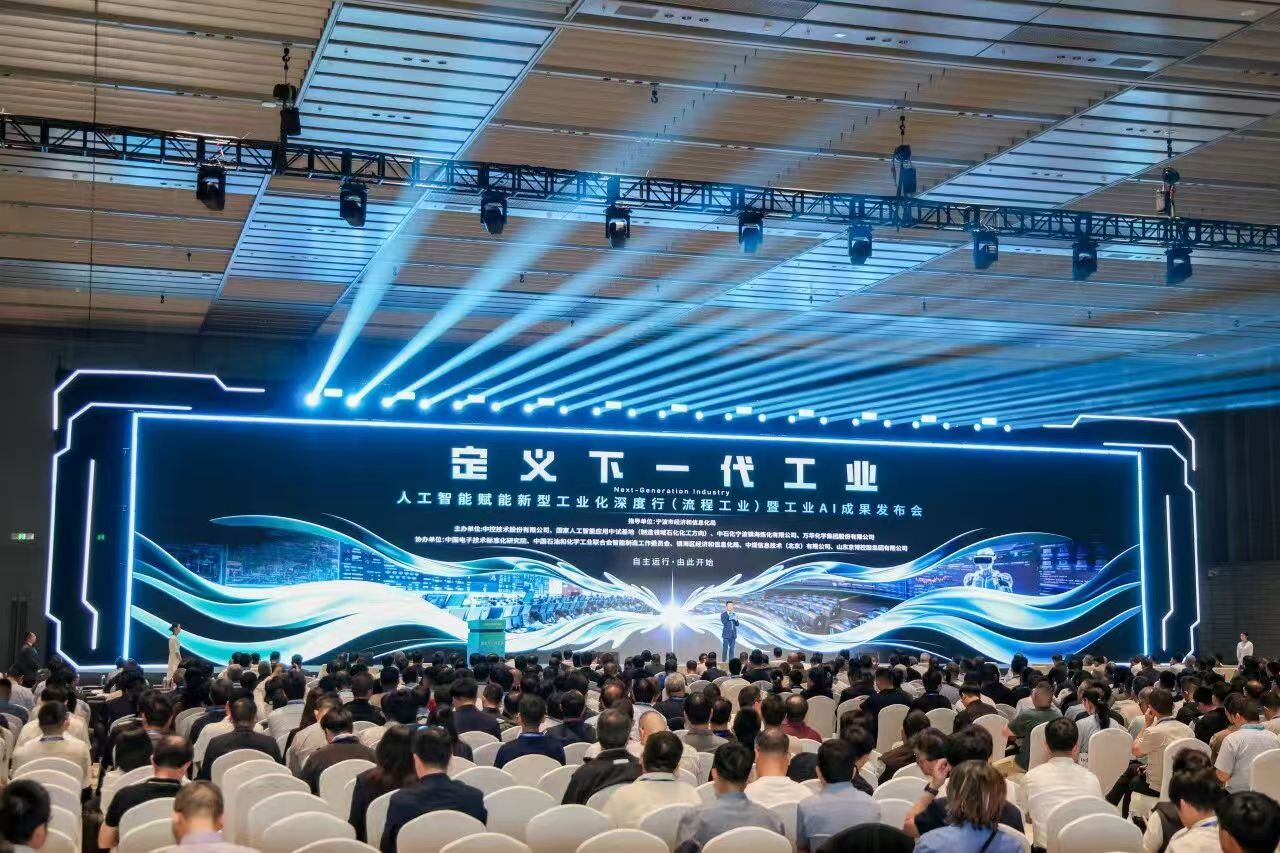
This industrial automation leader, founded in the 1990s and ranking first in China's domestic DCS (Distributed Control System) market share for 15 consecutive years, is trying to actively "revolutionize itself" at its peak and transform from an automation company to an industrial AI company. On October 16, the industrial AI achievement conference co-hosted by SUPCON, Zhenhai Refining & Chemical and Wanhua Chemical in Ningbo has attracted wide attention in the industry. Its display of mass industrial AI applications in the process industry is a concentrated presentation of phased achievements of innovative technologies.
As a company starting from industrial automation, SUPCON has established an absolute leading position in complex production sites such as oil refining and chemical industry by relying on control technology, industrial software and engineering delivery capabilities. Now, it is trying to further transform its long-term accumulated industry experience into large models, industrial intelligent agents and continuous service capabilities, and continue to expand its capability boundary in the AI era. This provides a window for observing how mature enterprises can go beyond past success in the AI era.
When past success becomes today's inertia
Compared with native enterprises that emerged in the new generation of technology wave, mature enterprises like SUPCON have undoubtedly accumulated stable and effective operation methods, but in the future-oriented transformation, these precipitations may become a burden for continued development. Because technology, products and customer relationships have been accumulated for many years, corresponding resource allocation and collaboration habits have also been formed behind them. Even if the new direction can form a set of logically closed-loop strategies, it will become difficult to implement due to inertia when it is actually implemented in daily operation.
Such a situation often occurred in past technological changes. In 2009, Nokia launched the N97, trying to respond to the competition brought by iPhone with this flagship product. Later, a senior executive admitted in a public review that the quality of this product actually failed to meet expectations.
At that time, the top management hoped to launch competitive products as soon as possible, while middle managers and engineers faced practical difficulties in development. Later organizational scholars found that middle managers' concerns about status and resources reduced their willingness to report negative information, which also made the top management form an overly optimistic judgment on the company's technical capabilities.
Nokia did not fail to see the competitive threat under technological change, but between seeing the trend change and making effective adjustments, there was a whole set of decision-making and execution methods that had been operating for many years. The past operation system once allowed Nokia to launch products on time, teams to achieve goals, and managers to get rewards. But when the competition focus shifted to software capabilities, the same pressure instead prompted it to prioritize solving immediate product problems.
The transformation of most mature enterprises has experienced similar tensions: on one side is the existing business with estimable cost, predictable sales and clear goals for teams to achieve; on the other side is the new direction that remains to be verified, requires repeated tests, and even needs to change products and business models first.
In fact, not only Meituan, large factories such as Tencent and Baidu are also facing external doubts about "insufficient staying power" in this round of AI wave. This shows that transformation affects not only technical capabilities themselves, but also strategic judgment, resource allocation, talent training and organizational collaboration. The more successful an enterprise is, the more closely these elements are often combined with the existing business. Any slight adjustment is more likely to affect the whole system, which makes it more difficult for the "elephant to turn around".
Chu Jian, the founder of SUPCON, has also publicly expressed his vigilance against this phenomenon before. He believes that the vitality of an enterprise depends on its judgment of the future, investment in technology R&D, and responsiveness and sensitivity to customer needs. He advocates that managers should leave space for attempts with controllable risks and be tolerant of failures.
For mature enterprises, the more convincing the past success is, the more space they need to leave for new judgments and practices. The difficulty of overcoming past success lies in that changes must be made when the old methods can still bring returns.
Overcoming success: What has SUPCON done?
In this context, observing SUPCON's transformation has a clearer clue. It already has the technology and customer base to enter industrial sites, and the next step is to judge what kind of future these accumulations can support in the AI era.
Strategic path: From DCS leader to industrial AI company
"All in AI" is a general direction judgment that is not difficult to make, but for mature enterprises, the really significant decisions take place in more specific scenarios. AI can be used to improve the efficiency of R&D and delivery, and can also be integrated into existing control systems and industrial software. The direction of resource investment ultimately determines the appearance of the enterprise after transformation.
SUPCON's choice is to take time series data and production processes as the key entry point for AI transformation.
This is closely related to SUPCON's business accumulation over the past 30 years. A refinery is unlikely to deeply bind its production process to a model just because the model can answer questions fluently. What industrial customers really care about is still whether the equipment can operate stably, how to adjust operations smoothly after raw material changes, and how to achieve a better balance among quality, energy consumption and output. SUPCON is no stranger to these problems. Most of the company's past control technologies, industrial software and engineering experience are focused on solving these problems. This gives SUPCON sufficient reasons to continue investing along the production process.
But being familiar with customers' problems does not mean that new technologies are naturally effective. How much value AI can add beyond existing technologies and whether it can reduce the application's dependence on expert experience need to be proved in actual production.
Technical route: TPT + UCS = AOP
In terms of specific technical transformation, SUPCON's choice is to combine the model's analytical and predictive capabilities with existing control technologies, so that AI can gradually participate in the judgment and adjustment in the production process.
Therefore, SUPCON did not follow the trend to choose large language models. Instead, based on the characteristics of process industry enterprises, it took a different path and embarked on the self-developed road of time-series pre-trained transformer TPT, a time series large model based on historical time series data as training basis. This model can also make accurate prediction or analysis on unseen new sequences. Different from traditional methods (such as ARIMA and LSTM), time series large models emphasize generalization, universality and scalability, and can handle multivariate, multi-task and cross-domain time series problems. The TPT developed by SUPCON processes industrial time series data that changes with time, such as temperature, pressure and flow. These data record the operation status of the equipment and are also an important basis for understanding the production process. TPT establishes basic capabilities through pre-training, and then adapts to the data and process characteristics of specific devices, supporting the evolution of devices to autonomous operation with core capabilities such as simulation, optimization and prediction.
Following this route, AI can enter the business scenarios that SUPCON is familiar with, but past experience cannot be directly transformed into model capabilities. The same temperature rise may mean different problems in different devices and different production stages; adjusting one parameter may also affect output, quality and equipment status at the same time. The model needs to understand these changes combined with process knowledge, and the suggestions given must also meet equipment capabilities, process requirements and safety constraints.
This is exactly the difficulty of transformation. The fact that engineers can handle an abnormality based on experience does not mean that the software can repeat the same judgment under different working conditions. Experience needs to be sorted out, data needs to be managed, and which methods can be reused and which situations still require expert intervention also need to be continuously verified. Industrial accumulation provides the basis for model application, but there is still a lot of work to do to transform it into stable product capabilities.
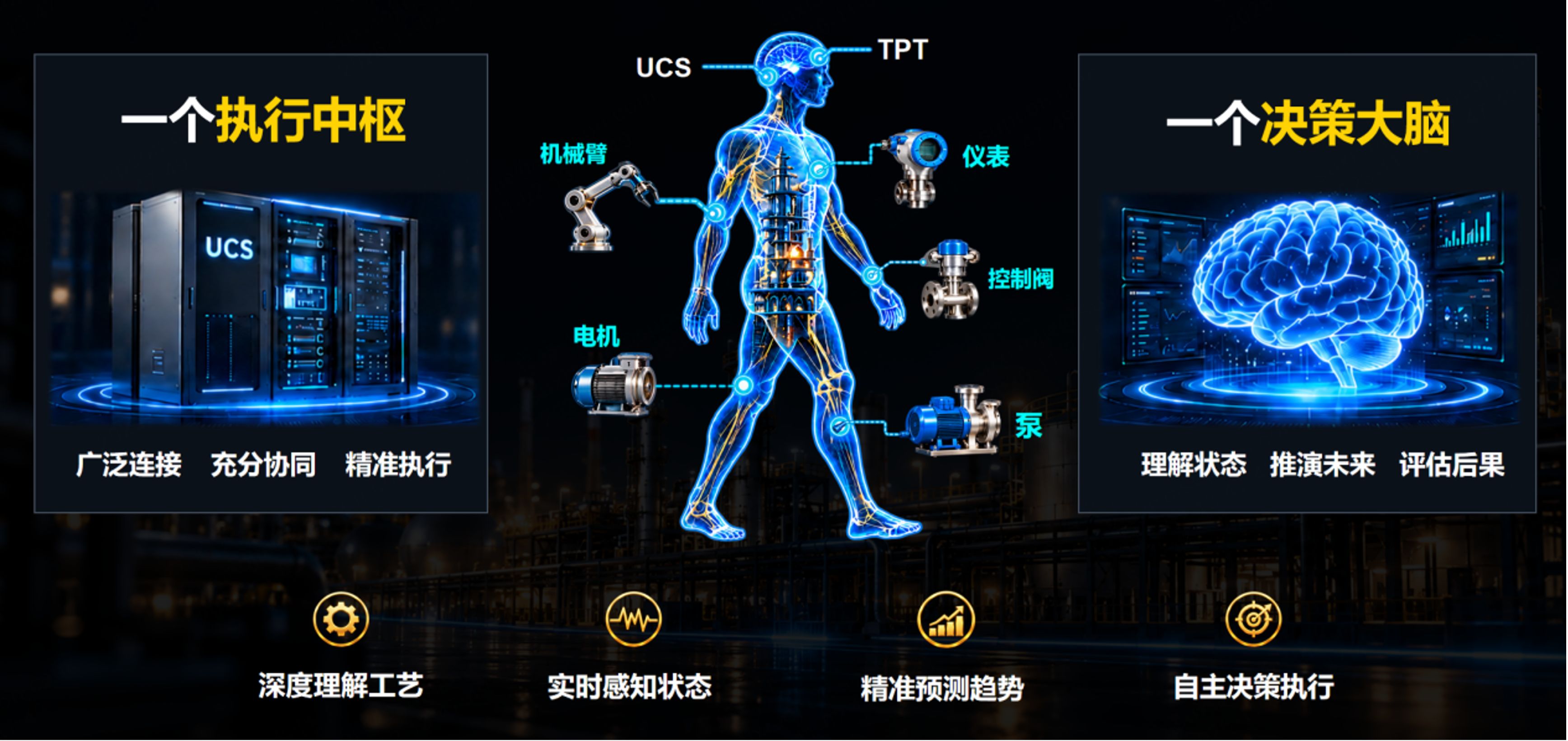
Analysis is followed by execution. Predicting the change of indicators will not automatically improve production, and relevant judgments need to be transformed into appropriate operations. SUPCON's Universal Control System (UCS) undertakes the work of connecting field equipment and executing production control, providing a basis for model capabilities to enter actual production.
Based on the integrated value of TPT and UCS, SUPCON proposed the Autonomous Operating Plant (AOP) system to connect these links: AOP can connect analysis and prediction with control execution, and then test the effect through actual operation results, so as to gradually improve the autonomous operation capability of the factory. Whether the model's suggestions can be used on site still requires corresponding professional judgment, verification and authorization. Past control technology and process experience are still important, but they need to be more closely combined with model capabilities to jointly support factory operation.
The more difficult step is to popularize this kind of cooperation. There are differences in equipment, processes and operating conditions in different factories. A set of methods that works in one project does not mean that it can be directly moved to another site. SUPCON needs to extract reusable model capabilities, knowledge and implementation methods from the project, while retaining the adaptation for specific devices.
Talent management: First of all, the transformation of people's concepts
This problem also changes the relationship between R&D and delivery. Problems found by the on-site team need to be fed back into the product; new capabilities formed by R&D also need to be tested in more scenarios. The adjustment of talents and organizations has thus become a practical problem to be solved in the process of technology promotion.
At the talent level, Chu Jian once summarized this layer as: "The AI transformation of enterprises is first the transformation of people's concepts." In the past, various departments operated like running "blind boxes". After AI is integrated into the process, the operating status is more transparent and the improvement space is easier to locate; but the premise is that managers first complete cognitive iteration, form an AI atmosphere within the organization, and then drive middle managers and employees. Talent transformation is not to add the AI prefix to old positions, but to enable all employees to have AI thinking and AI capabilities.
Organization adaptation: Re-matching knowledge, authority and responsibility
At the organizational level, SUPCON established the Industrial AI Business Group, reorganized the business process and technical talent structure, placed algorithm R&D, engineering implementation and industry experts in the same organizational unit, and formed a closed-loop chain of "demand - algorithm - launch - iteration". Cui Shan, Chairman and President of SUPCON, once said in an interview with the media that in order to adapt to the strategic transformation of industrial AI, the company has not only adjusted the technical route and product R&D, but also increased investment in organizational structure, talent reserve, capacity building, R&D investment and market expansion.
Whether these adjustments based on AI native needs and liquid management goals can work cannot be verified through the organization chart, and the implementation of the project is still the final touchstone: whether on-site problems can enter R&D in time, whether effective methods can be adopted by other teams, and whether sales, delivery and services form a common understanding of the effect after customer use.
This is also the interconnected part of SUPCON's transformation. Choosing to enter the production process means solving the problem of technical reliability; hoping to expand applications means improving product reusability; to continuously transform on-site experience into products, talents and collaboration methods must also keep up.
After overcoming success: Where has SUPCON reached?
From the current situation, SUPCON's transformation has been verified. The benchmark cases at this conference give specific answers.
At Wanhua Chemical's Ningbo Chlor-Alkali Base, based on the TPT large model as the intelligent hub, the total number of device alarms has been reduced by 50%, and the early warning accuracy rate exceeds 95%; independent operation has been realized in processes such as wastewater treatment, precise feeding, and electrolytic load allocation, creating an annual value of over 10 million yuan. These changes make the value of industrial AI fall into specific production links, and also make SUPCON's technology investment have measurable application results. Wanhua Chemical's industrial AI practice is being replicated and promoted from the single-point optimization of the Ningbo base to national production bases such as Yantai and Fujian, to implement the group-level "autonomous operating plant" - answering the question of "whether it can be replicated".
Jingbo Group is deeply integrating the TPT industrial AI base platform with process manufacturing, promoting the integration of pilot platform and industrial production data and business, and building a leading intelligent factory and a high-standard digital park; at present, the refining unit of Jingbo Petrochemical has realized early warning of process abnormalities 5-30 minutes in advance, reduced the number of alarms by 90%, and the annual comprehensive economic benefit of a single unit exceeds 5 million yuan. In the future, it will be expanded to full-link closed-loop optimization of more units and scenarios such as refining island, chemical island, new material island and public island - answering the question of "whether AI can enter core production from a single point and move towards multi-device collaboration".
Aiming at the pain point of high carbon emission pressure in the coal chemical industry, SUPCON joined hands with China Coal to explore the in-depth application of industrial AI in the core link of coal chemical production. Based on the TPT large model, the two sides built a decision-making chain of "coal quality prediction - risk early warning - production optimization" in China Coal Yuanxing, which increased the comprehensive economic benefit of a single furnace by more than 8 million yuan and reduced annual CO₂ emissions by about 7,000 tons - answering the question of "whether AI can form quantifiable economic and environmental value in the core link of high carbon emission in coal chemical industry".
In addition, SUPCON's AI applications have also gone deep into key links of refining and chemical production. The TPT large model has explored and built a full-value chain intelligent scenario around the core goals of petrochemical enterprises "safety, quality, low carbon and benefit" for Zhenhai Refining & Chemical, and formed the operation effect of coordinated promotion of "intelligent internal operation and unmanned external operation" - answering the question of "how a world-class green petrochemical base can use AI to achieve full-chain efficiency improvement".
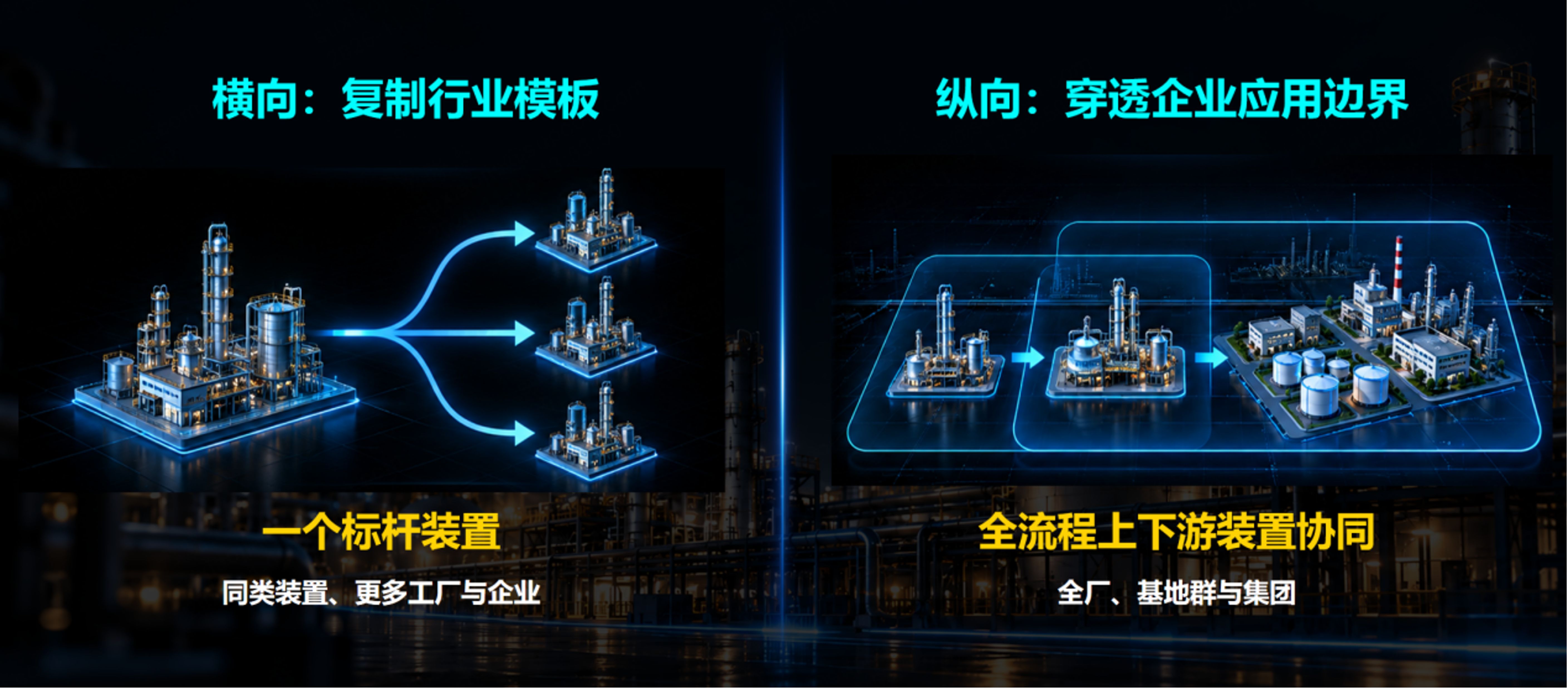
The four cases cover customers of different ownership systems such as private enterprises, state-owned enterprises and central enterprises, as well as process scenarios, verifying that SUPCON's capabilities can adapt to different customer types and process conditions. From a single device to more production scenarios, SUPCON is trying to transform on-site experience into product capabilities that can be popularized, and continue to promote the large-scale implementation of industrial AI along the two paths of horizontal replication and vertical expansion.
Cross-base promotion also provides more specific inspection standards for SU