The per capita income ranking of 31 provincial-level regions has been unveiled. Who is taking the lead?
With the release of the economic performance data for the first three quarters of this year, the data of per capita disposable income and per capita consumption expenditure of residents in the first three quarters, which reflect residents' living standards and consumption status, were also released simultaneously.
Data from the National Bureau of Statistics show that in the first three quarters of 2026, the per capita disposable income of Chinese residents reached 34,230 yuan, a nominal increase of 5.3% over the same period of the previous year, and an actual increase of 4.4% after deducting price factors; the per capita consumption expenditure of Chinese residents was 22,354 yuan, a nominal increase of 3.6% over the same period of the previous year, and an actual increase of 2.7%.
In terms of actual growth rate, the growth of residents' income is slightly lower than the GDP growth rate of 4.6%, while the growth rate of consumption expenditure has slowed down further, 1.7 percentage points lower than the growth rate of residents' income.
This indicates that although residents' income maintains growth, the growth of consumption expenditure lags relatively behind. How to promote the transformation of residents' income increase into consumption growth more effectively is still worthy of attention.
By region, 8 out of 31 provinces have figures higher than the national average. Among them, the per capita disposable income of residents in Shanghai and Beijing both exceeded 70,000 yuan, reaching 72,175 yuan and 70,405 yuan respectively.
While income is growing, the changes in residents' consumption expenditure are also worthy of attention.
In the first three quarters, the average propensity to consume of residents, measured by dividing per capita consumption expenditure by per capita disposable income, was only 65.3%, lower than the 66.4% calculated based on the published data in the same period of last year. The fact that income grows faster than consumption expenditure reflects that the current growth of residents' consumption is relatively slow.
12 Provinces Have Joined the "30,000 Yuan Club"
Residents' disposable income refers to the total sum of residents' income that can be used for final consumption expenditure and savings, that is, the income that residents can dispose of freely, including both cash income and income in kind. According to the source of income, disposable income includes four items: wage income, net operating income, net property income and net transfer income.
From the perspective of income sources, wage income is still the main source of residents' income.
In the first three quarters, the per capita wage income of Chinese residents was 19,653 yuan, a year-on-year increase of 5.3%; per capita net operating income was 5,542 yuan, up 6.6%; per capita net transfer income was 6,364 yuan, up 5.7%; per capita net property income was 2,671 yuan, up 1.6%.
It can be seen that the growth rates of wage income, net operating income and net transfer income of Chinese residents are relatively fast, while the growth rate of net property income is relatively slow, and there are differences in income growth from different sources.
By province, 8 provinces including Shanghai, Beijing, Zhejiang, Tianjin, Jiangsu, Guangdong, Fujian and Shandong have figures higher than the national average level of 34,230 yuan.
Taking 30,000 yuan as the threshold, a total of 12 provinces saw their per capita disposable income of residents exceed this level in the first three quarters.
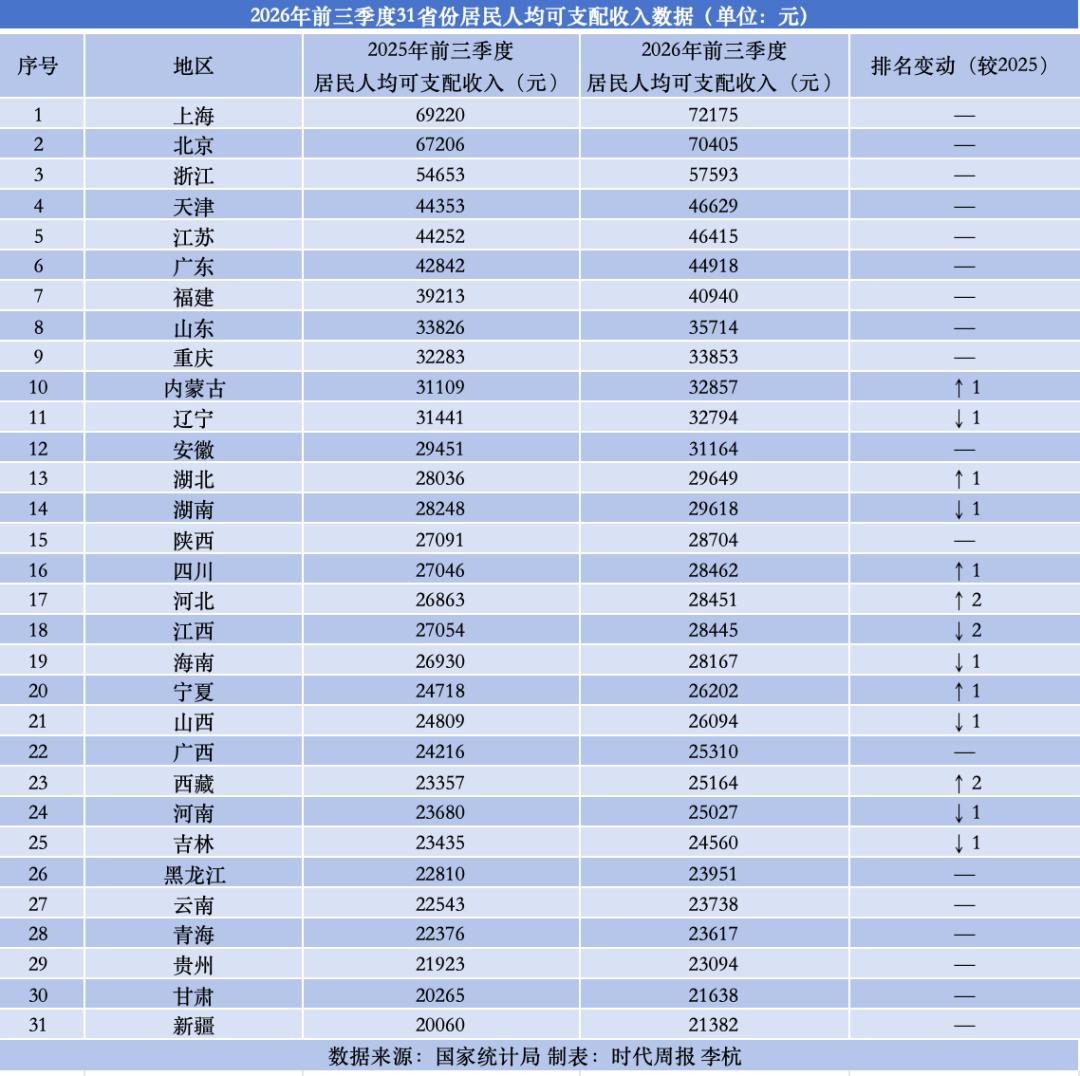
According to the data of the first three quarters, the per capita disposable income of residents in Inner Mongolia reached 32,857 yuan, an increase from 31,109 yuan in the same period of the previous year, ranking up one place to the 10th in the country, exceeding Liaoning's 32,794 yuan.
However, the ranking in the first three quarters does not represent the final ranking for the whole year. For the whole year of 2025, the per capita disposable income of residents in Inner Mongolia ranked 9th nationwide, higher than Chongqing. As the data for the fourth quarter are released one after another, it remains to be seen whether Inner Mongolia can further improve its annual ranking this year.
It is not only Inner Mongolia whose ranking has risen compared with the same period of last year.
In the first three quarters, the per capita disposable income of residents in Hubei was 29,649 yuan, a year-on-year increase of about 5.8%, ranking up to 13th; that of Sichuan was 28,462 yuan, a year-on-year increase of about 5.2%, ranking up to 16th; Hebei and Xizang ranked 17th and 23rd with 28,451 yuan and 25,164 yuan respectively, both rising two places compared with the same period of last year.
In terms of economic performance, in the first three quarters, the GDP of Inner Mongolia, Hubei and Sichuan grew by 4.8%, 4.7% and 4.9% respectively, all maintaining positive growth and outperforming the national average (4.6%). In terms of residents' income, the nominal growth rate of per capita disposable income in the three regions also exceeded 5%.
This shows that local economic growth and residents' income increase advance simultaneously, but the two do not have a simple one-to-one correspondence. Residents' income also depends on many factors such as employment, wage growth and business activities. The GDP growth rate alone is not sufficient to explain the change in ranking.
In contrast, the rankings of Liaoning, Hunan, Hainan, Shanxi, Henan, Jilin and other regions all dropped by one place, while Jiangxi dropped by two places. From the data, the income gap between some provinces is small, and the acceleration or slowdown of the growth rate in a single quarter may affect the ranking.
Residents' Consumption Growth Is Relatively Slow
Compared with the income growth rate, the growth rate of Chinese residents' consumption expenditure is relatively slow.
In the first three quarters of 2026, the per capita consumption expenditure of Chinese residents increased by 2.7% in real terms over the same period of the previous year, 1.7 percentage points lower than the growth rate of residents' disposable income.
Reporters from *Time Weekly* calculated based on the ratio of per capita consumption expenditure to per capita disposable income, the average propensity to consume of Chinese residents in the first three quarters was about 65.3%, lower than the 66.4% calculated based on the published data in the same period of last year, down by about 1.1 percentage points.
Income grows faster than consumption expenditure, which reflects that the current growth of residents' consumption is relatively slow.
Fu Yifu, a special researcher at Sochow Bank, said in an interview with a reporter from *Time Weekly* that the decline in residents' propensity to consume indicates that the transformation chain from income to consumption is blocked, which is not simply "unwilling to spend money".
Fu Yifu believes that unstable employment and income expectations, the pressure of housing loans, and the uncertainty of expenditure on pension, medical care and other items have prompted residents to increase savings. At the same time, the insufficient supply of services such as elderly care and childcare also limits the release of part of consumption demand.
In addition, he also pointed out that the middle and low-income groups have a high propensity to consume but a low proportion of total income, while the high-income groups have a low propensity to consume, which pulls down the overall conversion rate. The superposition of multiple factors makes it difficult for income growth to be transformed into consumption expansion synchronously.
From the perspective of China's residents' consumption structure in the first three quarters, service consumption performed relatively well.
In the first three quarters, the per capita service consumption expenditure of Chinese residents was 10,565 yuan, a year-on-year increase of 4.6%, 1 percentage point higher than the overall growth rate of per capita consumption expenditure of residents.
Specifically, service consumption expenditure accounted for 47.3% of per capita consumption expenditure, 0.5 percentage points higher than the same period of the previous year. In addition, the per capita expenditure on education, culture and entertainment of residents increased by 4.6%, and the expenditure on daily necessities and services increased by 4.7%, both faster than the overall growth rate of consumption expenditure. In contrast, the expenditure on housing increased by 1.9%, and the expenditure on medical care and health care increased by 2.3%, with relatively slow growth rates.
By province, in the first three quarters, a total of 7 provinces across the country exceeded the national average level of 22,354 yuan. Among them, Shanghai, Beijing and Zhejiang ranked the top three in terms of per capita consumption expenditure of residents, all exceeding 36,000 yuan. The other four provinces that outperformed the "national line" are Jiangsu, Tianjin, Guangdong and Fujian.
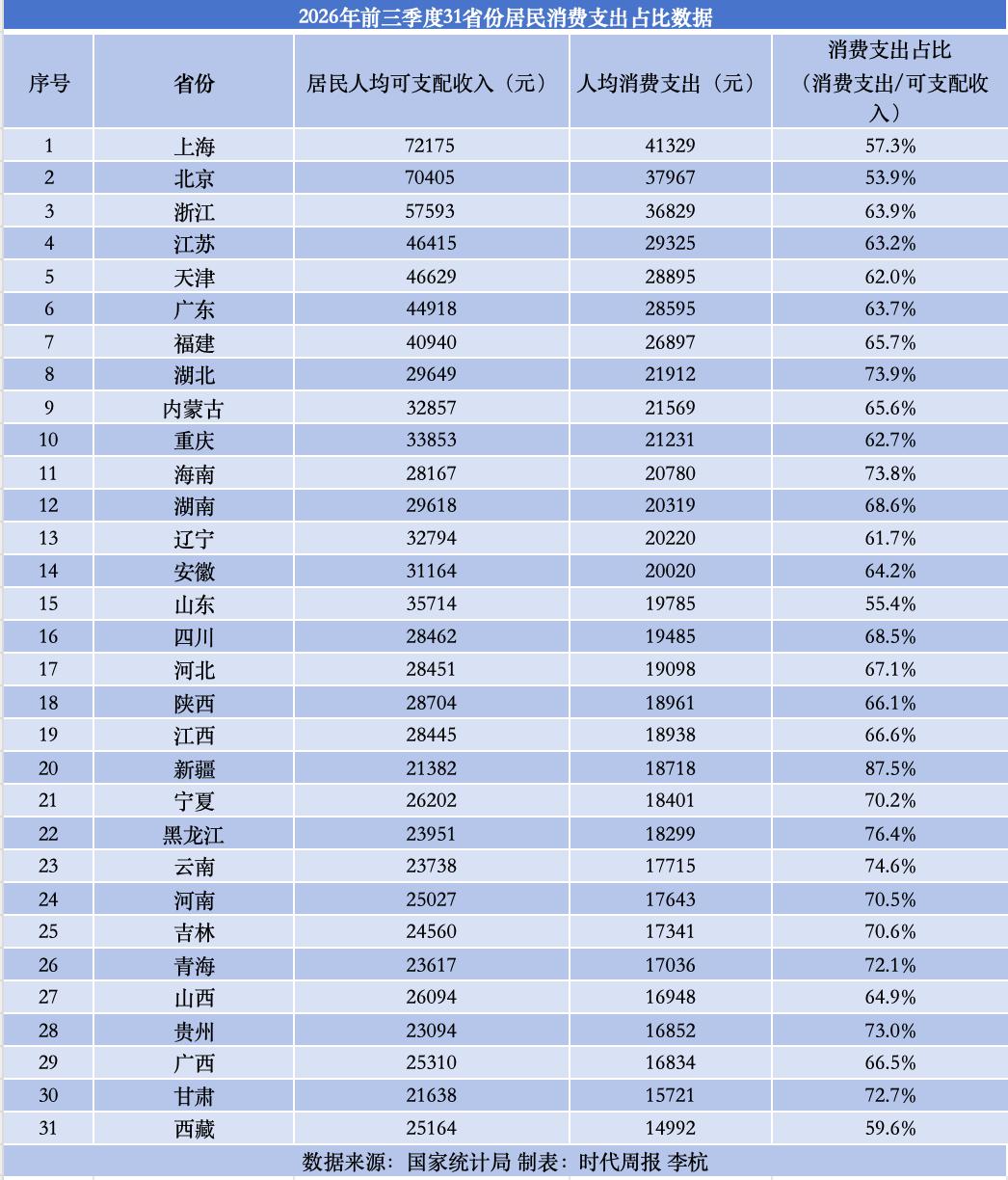
In contrast, the per capita consumption expenditure of residents in Xizang, Gansu and other places is less than 16,000 yuan, showing a large gap with the regions at the top of the ranking.
If we further observe the proportion of consumption expenditure in income, different regions show different characteristics.
In the first three quarters, the per capita consumption expenditure of residents in Xinjiang accounted for about 87.5% of their per capita disposable income, the highest among the regions listed in the table; Heilongjiang, Yunnan, Hubei and Hainan also exceeded 70%. This proportion in Beijing, Shandong and Shanghai is relatively low, at 53.9%, 55.4% and 57.3% respectively.
On the whole, the consumption level of residents in various regions is not only related to the income level, but also affected by factors such as consumption structure and household expenditure arrangement. How to further promote the steady growth of residents' income and improve consumption expectations is still an issue that needs attention to promote the continuous recovery of consumption.
Fu Yifu believes that to make income growth better transformed into consumption expenditure, the key is to open up the closed loop of "being able to consume - daring to consume - willing to consume".
"On the income side, priority should be given to stabilizing employment and promoting income increase, focusing on raising the income of middle and low-income groups, increasing the proportion of labor remuneration, so that incremental income can flow more to groups with high propensity to consume. On the security side, we should increase public investment in elderly care, childcare, medical care, education and other fields to reduce residents' defensive saving motivation for future uncertainty." Fu Yifu said that only when income growth, security support and supply optimization work in concert can the propensity to consume pick up systematically.
This article is from the WeChat official account "Du Cheng Ji Studio", written by Li Hang, and authorized for release by 36Kr.