AI for Science: The first stop for AI to step into the physical world
In the past few years, when talking about AI, we mostly discussed chatbots, coding, agents, and robots. But the greatest productivity opportunity of this round of AI may not lie in the screen, but in the physical world composed of atoms and molecules.
AI for Science (hereinafter referred to as AI4S), in simple terms, refers to using AI to assist scientific research and enhance scientific research capabilities. For example, let AI learn the knowledge and laws of physics, chemistry, and biology to calculate and design things at the atomic and molecular level, such as proteins, drugs, and new materials. It is the first stop for AI to enter the physical world.
In October 2024, the Nobel Prize in Chemistry was awarded to the developers of protein design and AlphaFold2, marking that AI4S has reached a turning point in the scientific research paradigm. Two years later, the changes are faster than most people expected: two years ago, AI drug development was often questioned for "failing to produce drugs"; today, XtalPi, Insilico Medicine, and Metis Therapeutics have successively listed on the Hong Kong Stock Exchange, drugs designed with AI participation have entered Phase III clinical trials, multinational pharmaceutical companies such as Eli Lilly, Pfizer, and GSK have begun to invest heavily in binding AI-native companies with exclusive model capabilities, and antibodies can even be directly calculated in a "zero-shot" manner.

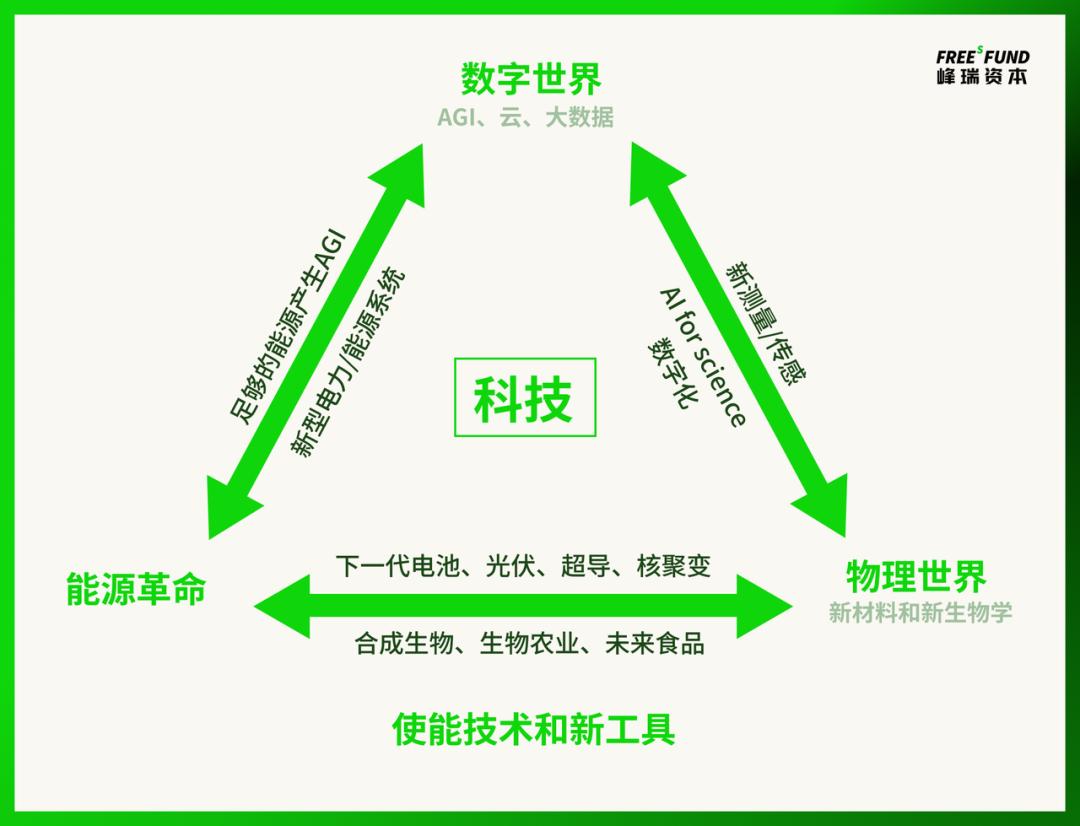
After large models slow down, the deciding factor for AI competition lies in the physical world
Sino-US AI competition: China has advantages in energy, the United States leads in chips, and the deciding factor lies in applications
When Jensen Huang introduces NVIDIA's strategy, he often mentions a full-stack layered diagram of the AI industry, or called the "five-layer AI cake": from bottom to top are energy, chips, infrastructure, models, and applications. Compare China and the United States with these five layers:
· Energy: China has the advantage. In 2025, China's power generation is about 2.3 times that of the United States, with an obvious total energy advantage.
· Chips: The United States leads, and China is catching up. There is a gap between China and the United States in advanced processes (below 7nm), but if we look at chip manufacturing capacity, China is catching up.
· Infrastructure: China has an overall advantage. Whether it is hard facilities such as power grids, energy storage, and transformers, or soft foundations such as the Internet and AI infrastructure, China has a solid industrial foundation.
· Models: The most cutting-edge models are still in the United States, but the gap is narrowing, and China leads in open-source models.
· Applications: This is the deciding factor in Sino-US AI competition. AI applications include agents, embodied intelligence, AI4S, and AI+ all walks of life. At present, the United States has taken the lead, and programming agents have achieved large-scale revenue: Anthropic's Claude Code reached an annualized revenue of 1 billion US dollars half a year after its launch; Cursor's annualized revenue also exceeded 1 billion US dollars in 2025. China is expected to overtake later. Giants such as Tencent, Alibaba, and ByteDance are injecting competitiveness into the application layer, and China's strong industrial chain also provides soil for AI implementation.
Technological breakthroughs do not equal productivity: the annual TFP growth rate in the United States has dropped from 2.1% to 0.17%
Historically, it often takes more than ten to decades for a technology from being invented to being widely applied and truly bringing productivity improvement. Electricity was invented in the late 19th century, but the real explosion of productivity came after 1900 and continued until the 1940s.
Looking at the total factor productivity (TFP, that is, the growth brought by technological progress beyond capital and labor input) in the United States makes it clearer. Eli Dourado from the Astera Institute pointed out that from 1947 to 1972, the average annual TFP growth in the United States was about 2.1%; since the mobile Internet era in 2005, it has only been about 0.17%. The core reason is that the innovations in the past 20 years were mainly limited to the digital world, while the last round of innovation took place in the physical world: the productivity improvement brought by electricity, trains, and cars is far greater than that brought by computers and the Internet.
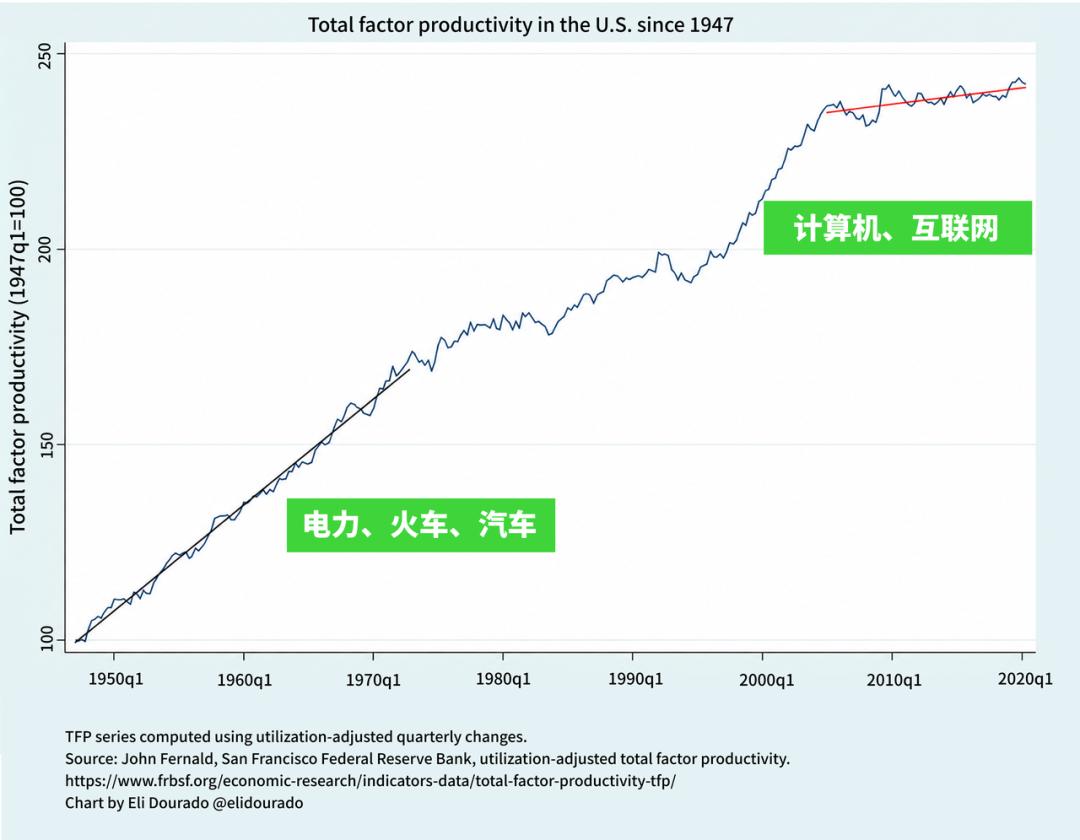
Development trend of total factor productivity (TFP) in the United States since 1947
But these two decades have accomplished one key thing: digitizing all kinds of human-related data, including human language, text, images, videos, and behaviors such as searches. This is exactly the data foundation of today's large models.
AI is undoubtedly the biggest technological breakthrough in this round of scientific and technological revolution, and it can even be compared with electricity. However, according to existing data, the comprehensive improvement of productivity has not yet arrived — large-scale application implementation is still in its early stage. The greatest productivity progress may not lie in the digital world, but in the intersection of AI, biology, materials, and energy, at the integration of the digital world and the physical world.
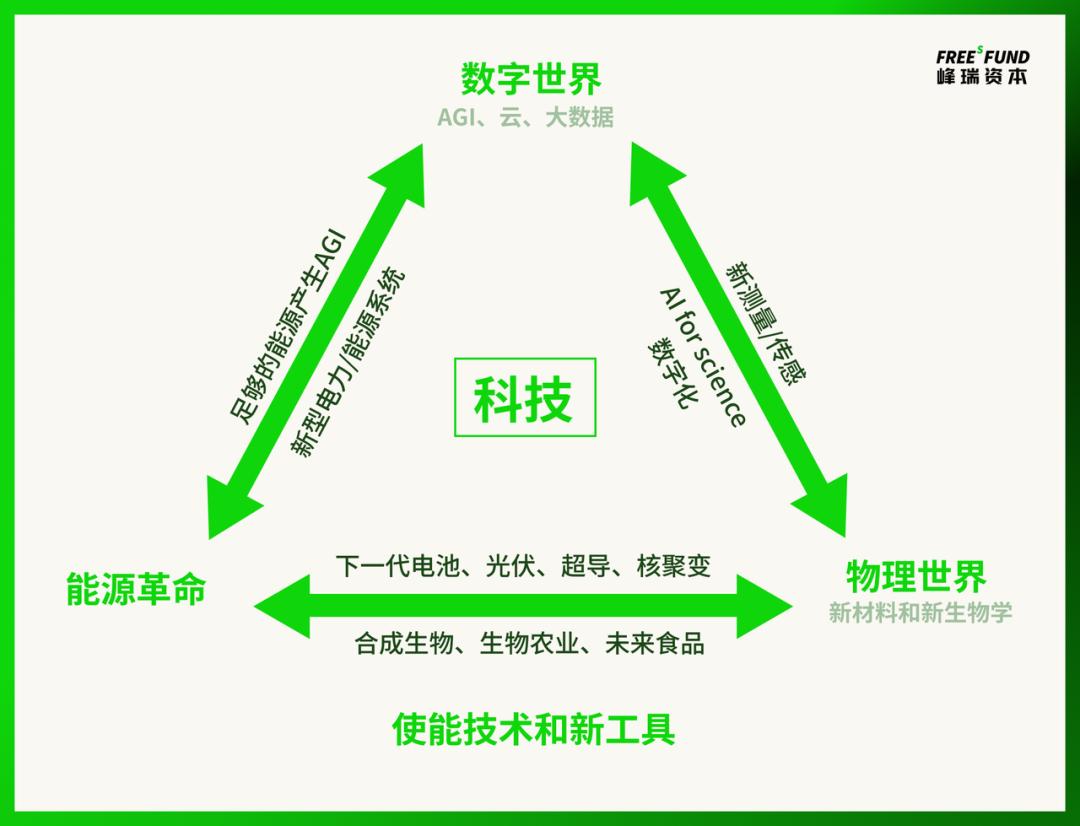
Large models have consumed almost all existing text data, and AI needs new models, new data, and new computing power
The development of AI depends on three elements: data, computing power, and algorithms (models). Today, large language models have almost consumed all available text data, and the iteration speed is slowing down. To move forward, it needs three new weapons:
· New models: In the aforementioned long article about the "five-layer cake", Jensen Huang also emphasized that models should not only understand language, but also understand biology, chemistry, physics, and the physical world itself; he believes that models have shown strong product-market fit (PMF) in fields such as programming, robotics, digital biology, and drug discovery. Physical AI is becoming more important than ever. Whether it is micro-level AI4S, 3D reconstruction models, or world models, they are all key to the next step. New models may require new architectures.
· New data: New data is the new fuel for further model iteration. We need data from the physical world, such as 3D Gaussian reconstruction, depth data, interaction data in 3D space, spatial intelligence, embodied operations, and interactions between molecules in biopharmaceuticals; we also need human-related data, which may be generated from new types of sensors and smart hardware; we also need brain science data. After all, many important breakthroughs in AI history originated from the inspiration of brain science. With the further advancement of brain-computer interfaces and brain science, a large amount of available high-quality data will be brought.
· New computing power: New models and new data put higher requirements on computing power. Behind NVIDIA's surpassing Intel is that GPU (graphics processing unit) has gradually replaced CPU (central processing unit) as the mainstream computing power architecture in the AI era by virtue of its parallel computing advantages. When Jensen Huang began to talk about the synergy between GPUs and QPUs (quantum processors), quantum computing is expected to become the next generation of computing power. In October 2025, NVIDIA released NVQLink, which enables direct connection between quantum processors and GPU supercomputers.
AI is becoming a "key variable" in the development of various disciplines
Many people think that AI only brings efficiency improvement and cannot become the core driving force of a discipline. But we do observe that AI's capabilities are accelerating to spill over into the field of basic science. ARK Invest called AI the "central engine" in "Big Ideas 2026", which drives innovation platforms such as robotics, energy storage, and multi-omics to accelerate together. In other words, AI is like a tornado that sweeps in surrounding innovations and industries. Here are four examples.
Protein structure prediction. Input a protein sequence, and AlphaFold2 can give its 3D structure, with accuracy comparable to experimental methods for the first time. Before that, it took humans about 60 years to experimentally resolve about 200,000 protein structures; while the AlphaFold database provided about 200 million predicted structures in 2022. This work won the 2024 Nobel Prize in Chemistry. In the field of protein structure prediction, AI is already the main driving force.
Battery materials. In the past 150 years, from lead-acid batteries to lithium-ion batteries, the energy density has only increased by about 5 times, with an annual progress of less than 1%, which is very slow. US battery material company Feon Energy used EDGE, a generative AI-based molecular design platform, to design electrolyte molecules from scratch in 2 weeks: with its electrolyte, the energy density of lithium metal batteries exceeds 400Wh/kg, which is about 50% higher than existing lithium-ion batteries; its other fast-charging lithium-ion electrolyte supports 6C fast charging. According to the Stanford University Office of Technology Licensing, Feon used battery formula and performance data to train AI prediction models, reducing the electrolyte R&D cycle from more than one year to 3 to 4 months. On the one hand, there is progress of less than 2% per year, and on the other hand, the R&D cycle is greatly shortened. AI is also becoming a key driving force in material design.
Biomanufacturing. Biomanufacturing is carried out at normal temperature and in a green condition, with the greatest advantages of environmental friendliness and high yield. In layman's terms, the yield refers to how much of the input raw materials are converted into the target product: after 20 steps of chemical reaction, the yield is often less than 1%; after 20 steps of biological route, the yield can reach 80% or even higher. But the difficulty of biomanufacturing lies in how to design routes and pathways. The ATLAS of Biochemistry database contains more than 130,000 theoretically feasible metabolic engineering reactions, but most of them were not reported in organisms at that time. In the future, using AI to design metabolic pathways will be the biggest variable in biomanufacturing.
Future healthcare. US company Tempus aggregates and aligns multi-modal data such as patient clinical data, molecular biology, and medical images, analyzes them with generative AI, and then outputs insights to pharmaceutical companies and diagnostic enterprises. In 2025, Tempus's annual revenue was about 1.3 billion US dollars, a year-on-year increase of about 83% (including the acquired genetic testing company Ambry). In the same year, it signed data cooperation agreements with more than 70 large and medium-sized pharmaceutical companies; in the first half of 2026, its revenue was 731 million US dollars, a year-on-year increase of about 28%, and the company raised its full-year revenue guidance to about 1.6 billion US dollars.
Cascading amplification: from 0 to 1, then from 1 to 100
Putting these examples together is our judgment on how AI brings productivity leaps: the bottom layer is the progress of AI and large models themselves; it spills over to mathematics, physics, chemistry, materials, and biology — this is AI4S; further up, it affects material design, protein design, superconducting materials, and new-generation chips; further up, it gives birth to future industries such as biomanufacturing, AI drug development, quantum computing, nuclear fusion, brain-computer interfaces, and embodied intelligence; finally, it is amplified to strategic emerging industries such as biomedicine, new energy, new materials, and aerospace.
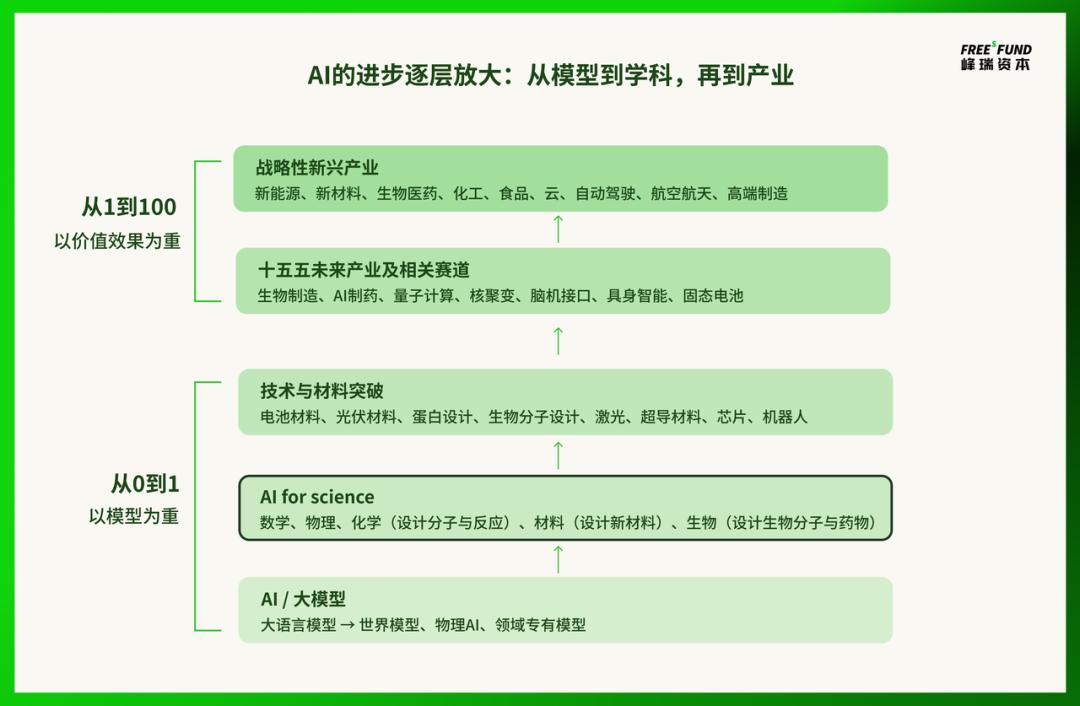
AI cascading amplification — five levels, two stages
AI4S is at the key position of this chain: it translates the progress of large models into underlying innovations in various disciplines, and then the industrial chain amplifies them layer by layer.
This process is divided into two steps. The first step, from 0 to 1, with the model as the core: AI spills over to other disciplines through AI4S, completing the 0-to-1 innovation of underlying technology, which is the focus of Sino-US competition. The second step, from 1 to 100, with value effect as the core: combine these underlying innovations with China's strong industrial chain to realize the integration of scientific and technological innovation and industrial innovation. This is the long-term opportunity for China's scientific and technological innovation.
What is AI4S doing? Achieve the accuracy of quantum mechanics at the speed of empirical force fields
AI4S studies microscopic particles such as atoms and molecules and their interactions. It is the most important bridge between the digital world and the physical world: in the past, we could only calculate and design in computers. With AI4S, the design results can be turned into real atoms and molecules in the physical world.
The reason why atoms and molecules are important is that they form the foundation of the physical world. Carbon atoms arranged in a planar hexagon are graphite in pencils; when arranged three-dimensionally, they become diamond. Carbon atoms plus hydrogen, oxygen, nitrogen, and phosphorus arranged in a double helix are DNA, the basis of life. Lithium, manganese, cobalt, nickel, and oxygen arranged at specific intervals form the cathode material of ternary lithium batteries in electric vehicles.
Selecting elements from the periodic table to form molecules, if we know the structure and dynamics of the molecule, we will know its function and role. What AI4S does is to calculate what a molecule can do along the chain of sequence (molecular composition) → structure → dynamics → function.
The difficulty lies in calculation. The traditional calculation method is molecular simulation, but it faces the "curse of dimensionality": when the number of atoms or molecules increases, the computational complexity rises exponentially. For example, the molecular dynamics simulation calculated completely from scratch (that is, based only on the basic equations of quantum mechanics without empirical parameters) has a computational volume that roughly increases with the cube of the number of atoms.
The idea of Deep Potential is to only perform accurate first-principles calculations on part of the system, and use AI to learn these accurate values; next time when calculating, there is no need to calculate all atoms or molecules from scratch, just call AI directly, and the computational volume is reduced to be proportional to the number of atoms. The result is both accurate and fast: achieving the accuracy of quantum mechanics at the speed of empirical force fields. This is the core principle of AI4S.
There is also a more popular understanding: AI is a "guessing machine" with strong output ability, but it often makes mistakes; the Science part is to filter out the garbage and leave the truly useful parts through scientific verification. It means generating with AI and verifying with science.
AI4S aims to use AI to empower basic scientific research. In the field of mathematics, it can strictly verify mathematical proofs; in the field of physics, it can build a bridge between quantum mechanics and classical coarse-grained models, connecting models of different scales — once the physical problem is solved, energy can be calculated accurately, which lays